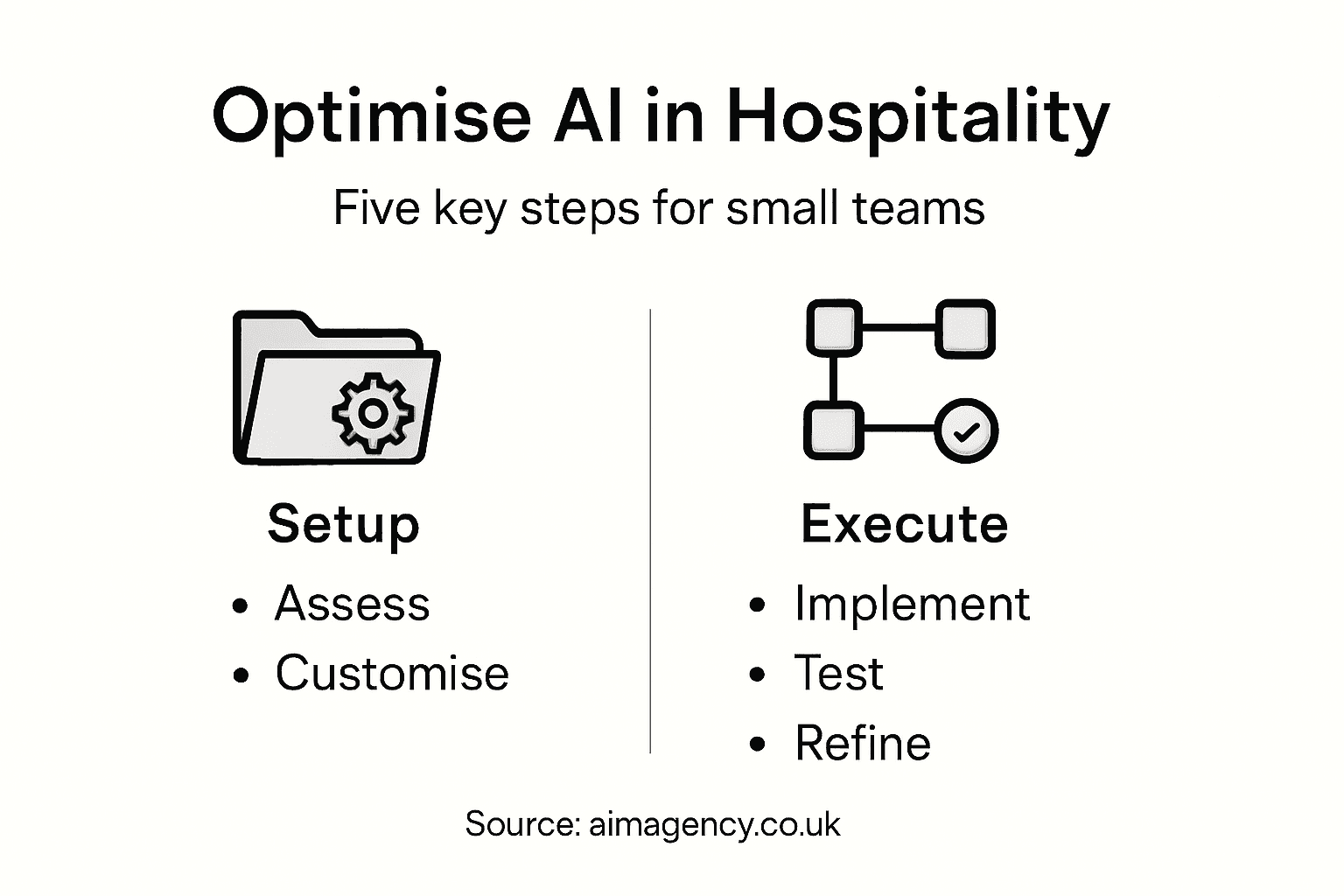
Managing guest interactions and operational tasks can feel overwhelming for small hospitality teams in the United Kingdom. As customer expectations evolve and efficiency becomes vital, optimising your AI tools is increasingly valuable. By focusing on areas like AI communication models and targeted scenario testing, you can boost staff comfort and create warmer guest experiences. This article guides you through practical steps designed for smaller hospitality businesses aiming to blend technological precision with genuine human touch.
Table of Contents
- Step 1: Assess Current AI Interaction Patterns
- Step 2: Customise AI Language For Natural Tone
- Step 3: Implement Context-Specific Response Flows
- Step 4: Test AI Responses With Real Scenarios
- Step 5: Monitor Outcomes And Refine Settings
Quick Summary
| Key Message | Explanation |
|---|---|
| 1. Assess AI Interaction Patterns | Evaluate existing AI tools to identify strengths and weaknesses for better optimisation. |
| 2. Customise AI Language | Develop warm, engaging communication for AIs to enhance customer interaction experiences. |
| 3. Implement Context-Specific Responses | Create dynamic response flows that tailor interactions to individual guest needs. |
| 4. Test AI Responses with Scenarios | Conduct realistic scenario testing to ensure AI reliability and adaptability in interactions. |
| 5. Monitor and Refine AI Performance | Continuously track AI performance and refine settings for ongoing quality improvement. |
Step 1: Assess Current AI Interaction Patterns
Understanding your hospitality team’s existing AI interaction landscape is crucial for targeted optimisation. This assessment involves systematically examining how your current AI tools engage with customers and staff, identifying strengths and potential improvement areas.
To conduct a comprehensive assessment, start by mapping out your existing AI touchpoints. These might include customer service chatbots, automated booking systems, or digital reception interfaces. AI engagement across hospitality service phases reveals critical insights into performance expectations and interaction dynamics.
Key assessment strategies include:
- Reviewing existing AI interaction logs
- Analysing response accuracy and resolution rates
- Surveying staff perceptions of current AI tools
- Measuring customer satisfaction metrics
- Identifying communication gaps between AI systems and human staff
Your goal is to create a baseline understanding of current AI performance. Look for patterns such as:
To better understand how AI is utilised in hospitality, here’s an overview comparing common AI touchpoints and their business impact:
| AI Touchpoint | Primary Function | Business Benefit |
|---|---|---|
| Customer service chatbot | Handles guest queries quickly | Improves response speed |
| Automated booking system | Manages reservations efficiently | Reduces manual workload |
| Digital reception | Streamlines check-in and check-out | Enhances guest convenience |
| Staff communication tool | Supports internal task coordination | Boosts workflow efficiency |
- Frequency of successful interactions
- Types of queries most effectively handled by AI
- Scenarios requiring human intervention
- Staff comfort levels with existing AI technologies
Effective AI integration requires understanding both technological capabilities and human workforce perspectives.
Top tip: Create a detailed spreadsheet tracking AI interaction metrics to help visualise performance trends and identify precise optimisation opportunities.
Step 2: Customise AI Language for Natural Tone
Creating a conversational and authentic AI communication style is essential for small hospitality teams seeking to enhance customer interactions. This step focuses on transforming your AI’s language from robotic responses to warm, personalised communication that feels genuinely human.
AI-employee interaction dynamics highlight the critical importance of developing language models that blend technological efficiency with emotional intelligence. To achieve this, start by analysing your existing AI communication patterns and identifying areas where language can be more natural and engaging.
Key strategies for customising AI language include:
- Developing a consistent brand voice template
- Incorporating regional dialect and local hospitality language
- Using conversational sentence structures
- Implementing contextual understanding algorithms
- Adding subtle humour and personality markers
Practical implementation steps:
Here’s a summary of language customisation strategies and the value they deliver:
| Language Customisation Strategy | Expected Outcome | Business Value |
|---|---|---|
| Brand voice template | Consistent messaging | Strengthens guest loyalty |
| Regional dialect integration | Relatable local experience | Builds customer rapport |
| Conversational structure | Natural interactions | Reduces guest frustration |
| Humour and personality | Engaging user experience | Increases positive feedback |
- Review current AI script templates
- Map out typical guest interaction scenarios
- Draft more conversational response alternatives
- Test and refine language models
- Gather staff and customer feedback
Successful AI language customisation bridges the gap between technological precision and human warmth.
Top tip: Create a comprehensive language style guide that outlines your desired tone, key phrases, and communication boundaries to ensure consistent and authentic AI interactions.
Step 3: Implement Context-Specific Response Flows
Designing intelligent response mechanisms that adapt to unique hospitality scenarios is crucial for creating seamless AI interactions. This step focuses on developing dynamic communication pathways that anticipate and address guests’ specific needs with precision and personalisation.
Adaptive AI response strategies demonstrate the potential for intelligent systems to transform guest experiences through context-aware communication models. By mapping detailed interaction scenarios, your AI can deliver nuanced, situation-specific responses that feel remarkably human.
Key components for building context-specific response flows include:
- Creating detailed scenario mapping templates
- Developing decision tree algorithms
- Identifying trigger points for contextual shifts
- Implementing multi-dimensional response options
- Integrating machine learning for continuous adaptation
Practical implementation steps:
- Document typical guest interaction scenarios
- Develop branching response pathways
- Define clear transition criteria between response modes
- Build in fallback communication strategies
- Establish continuous learning mechanisms
Effective context-specific AI requires understanding not just what guests say, but the underlying intent and emotional subtext.
Top tip: Regularly audit and refresh your AI’s response flows by collecting real-world interaction data to ensure ongoing relevance and accuracy.
Step 4: Test AI Responses with Real Scenarios
Validating your AI’s performance through comprehensive scenario testing is crucial for ensuring reliable and authentic customer interactions. This step involves creating targeted test environments that simulate genuine hospitality challenges and evaluate your AI’s responsiveness and adaptability.
Scenario-based AI evaluation methods reveal the importance of methodical response testing across diverse interaction scenarios. By systematically challenging your AI with realistic guest communication scenarios, you can identify potential limitations and refine its performance.
Key elements for effective scenario testing include:
- Creating comprehensive guest interaction scripts
- Developing diverse communication scenarios
- Establishing clear performance benchmarks
- Recruiting staff and sample guests for feedback
- Implementing multi-stage testing protocols
Practical testing approach steps:
- Design representative interaction scenarios
- Script complex guest request variations
- Conduct blind testing with hospitality staff
- Analyse response accuracy and naturalness
- Iterate and improve AI communication models
Rigorous scenario testing transforms AI from a theoretical tool to a practical hospitality asset.
Top tip: Create a structured testing matrix that covers emotional, transactional, and complex communication scenarios to thoroughly validate your AI’s adaptive capabilities.
Step 5: Monitor Outcomes and Refine Settings
Optimising AI performance requires continuous monitoring and strategic refinement of your system’s capabilities. This step focuses on developing a robust feedback mechanism that enables ongoing improvement of your AI’s interaction quality and operational effectiveness.
Continuous AI performance monitoring reveals the critical importance of systematic outcome evaluation across multiple performance dimensions. By implementing structured tracking methods, you can identify nuanced opportunities for enhancing your AI’s responsiveness and accuracy.
Key monitoring strategies include:
- Establishing quantitative performance metrics
- Creating comprehensive feedback collection systems
- Tracking customer satisfaction indicators
- Measuring response time and accuracy rates
- Identifying recurring communication patterns
Practical monitoring approach steps:
- Define clear performance benchmarks
- Set up automated analytics dashboards
- Collect qualitative and quantitative feedback
- Compare performance against initial expectations
- Develop targeted refinement strategies
Effective AI monitoring transforms raw data into actionable insights that drive continuous improvement.
Top tip: Implement a quarterly review process that combines statistical analysis with team and customer feedback to ensure holistic and dynamic AI performance refinement.
Elevate Your Hospitality AI with Expert Management Solutions
Small hospitality teams often struggle with creating AI responses that feel natural yet efficient, as highlighted in the article. The challenges of optimising AI language for a warm conversational tone, designing context-specific response flows, and continuously refining AI performance can feel overwhelming without expert support. Recognising these key pain points, including ensuring AI understands emotional cues and adapts dynamically to guest needs, is essential for transforming your AI from robotic to remarkable.
At AI Marketing – AI Management Agency, we specialise in crafting customised AI agents like natural-tone AI receptionists who work tirelessly 24/7 to handle calls, answer FAQs, and book qualified sales appointments. Our proven approach incorporates in-depth AI interaction assessments and scenario testing to fine-tune responses that genuinely connect with guests.
Take control of your hospitality AI today by visiting https://aimagency.co.uk and explore success stories in our case study – AI Management Agency section. Don’t wait to delight your customers with AI that understands their needs and speaks with a genuine human touch.
Frequently Asked Questions
How can I assess the current AI interaction patterns in my hospitality team?
To assess your current AI interaction patterns, begin by mapping existing AI touchpoints such as chatbots and booking systems. Review interaction logs and collect feedback from staff and customers to create a baseline understanding of performance within 30 days.
What are effective strategies for customising AI language to sound more natural?
Effective strategies include developing a brand voice template, incorporating local dialect, and using conversational sentence structures. Aim to create a comprehensive language style guide within 60 days, ensuring your AI’s communications feel more engaging and authentic.
How do I implement context-specific response flows for my AI in hospitality?
To implement context-specific response flows, document typical guest scenarios and develop branching response pathways. Establish clear criteria for transitions between different response modes and refine these flows over time by analysing real interaction data.
What steps should I take to test my AI’s responses with real scenarios?
Start by designing representative guest interaction scenarios and scripting variations of complex requests. Conduct blind testing with your hospitality staff to evaluate the accuracy and naturalness of AI responses over a two-week testing period.
How can I monitor outcomes and refine my AI system?
You can monitor outcomes by establishing performance metrics and creating feedback collection systems to track customer satisfaction. Set up automated analytics dashboards to review data quarterly and adjust your AI’s interactions for continuous improvement.