As someone who's worked with service businesses for years, I've seen the same frustrating pattern over and over: talented sales teams grinding through endless cold calls, follow-ups, and admin work, yet struggling to hit consistent conversion numbers. Traditional sales approaches that worked five years ago are now leaving money on the table.
That's where autonomous AI agents come into play as a complete game-changer for B2B service businesses.
Key Takeaways
• Hybrid AI-human models deliver up to 3.9x higher conversion rates compared to traditional sales teams alone
• Pure AI agents show 70% improvement in lead conversion rates with instant response capabilities
• Service businesses using AI sales automation achieve 83% revenue target success vs 66% without AI
• Speed advantage of AI agents reduces lead conversion time by 20% through instant engagement
• Cost efficiency scales without linear increases in personnel expenses
The Reality Check: Traditional Sales Teams Are Hitting a Wall
Traditional sales teams face mounting challenges that autonomous AI agents solve systematically. Manual lead qualification consumes 60-70% of a salesperson's time according to McKinsey research, leaving minimal bandwidth for actual relationship building and closing deals.
Service businesses particularly struggle with this because their sales cycles involve multiple touchpoints, technical explanations, and relationship nurturing that traditional teams handle inefficiently. The result? Inconsistent pipeline generation and conversion rates that plateau despite increased effort.

1. Conversion Rate Performance: The Numbers Don't Lie
The Hybrid Model Delivers Near-4x Results
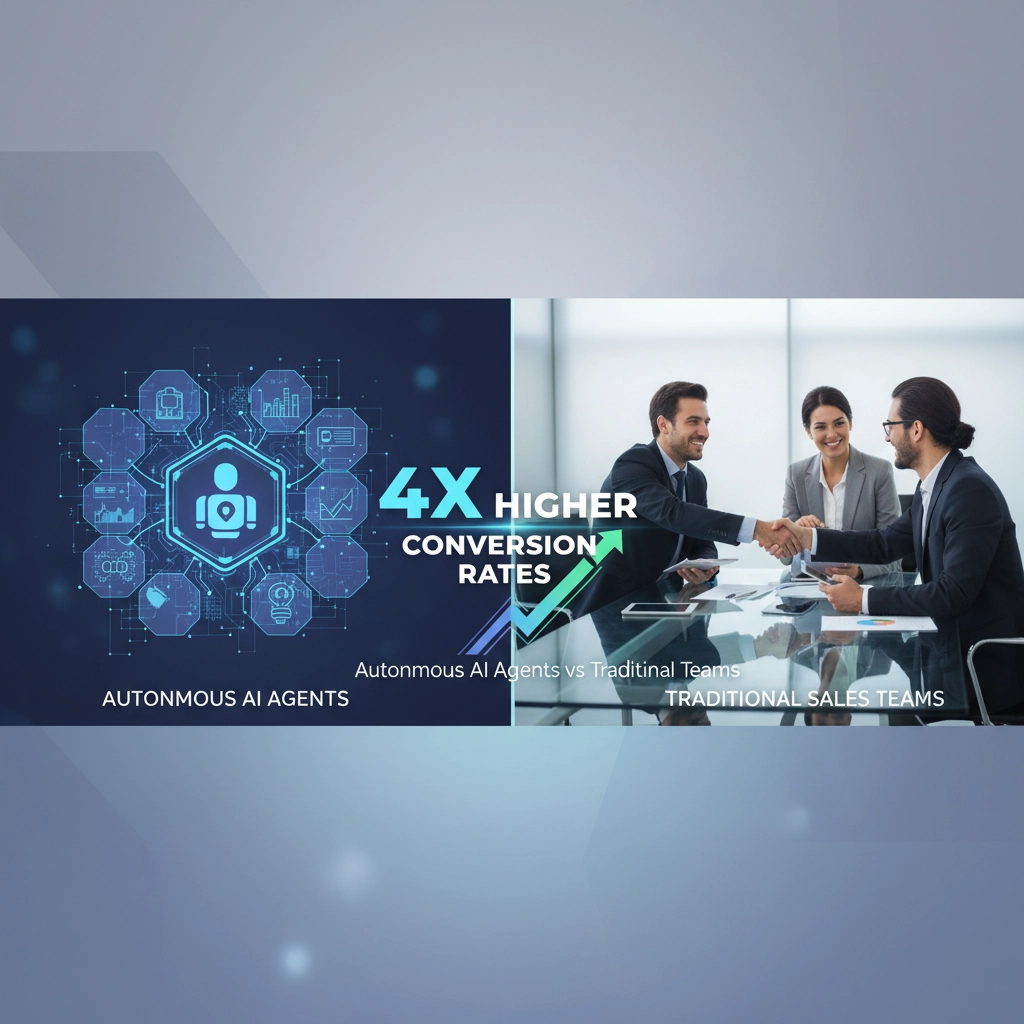
The closest performance to that coveted 4x conversion rate improvement comes from hybrid Human + AI models. Martal's research shows their Human + AI approach achieving 3.9x higher conversion rates and 6.6x more replies across various industries.
This isn't about replacing your sales team: it's about amplifying their effectiveness through AI marketing automation that handles routine tasks while humans focus on high-value activities like relationship building and complex negotiations.
Pure AI Agents Show Strong Independent Results
Organizations implementing standalone autonomous AI agents for B2B report impressive metrics:
- 70% improvement in lead conversion rates
- 32% higher conversion rates with real-time conversation agents
- 42% higher email open rates through AI-driven personalization
- 31% higher meeting booking rates
For service businesses specifically, AI lead generation for service businesses shows particularly strong results in SaaS (25% higher conversion rates) and telecom services (15% higher conversion rates).
2. Speed and Response Advantages That Traditional Teams Can't Match
Instant Engagement vs Hours of Delay
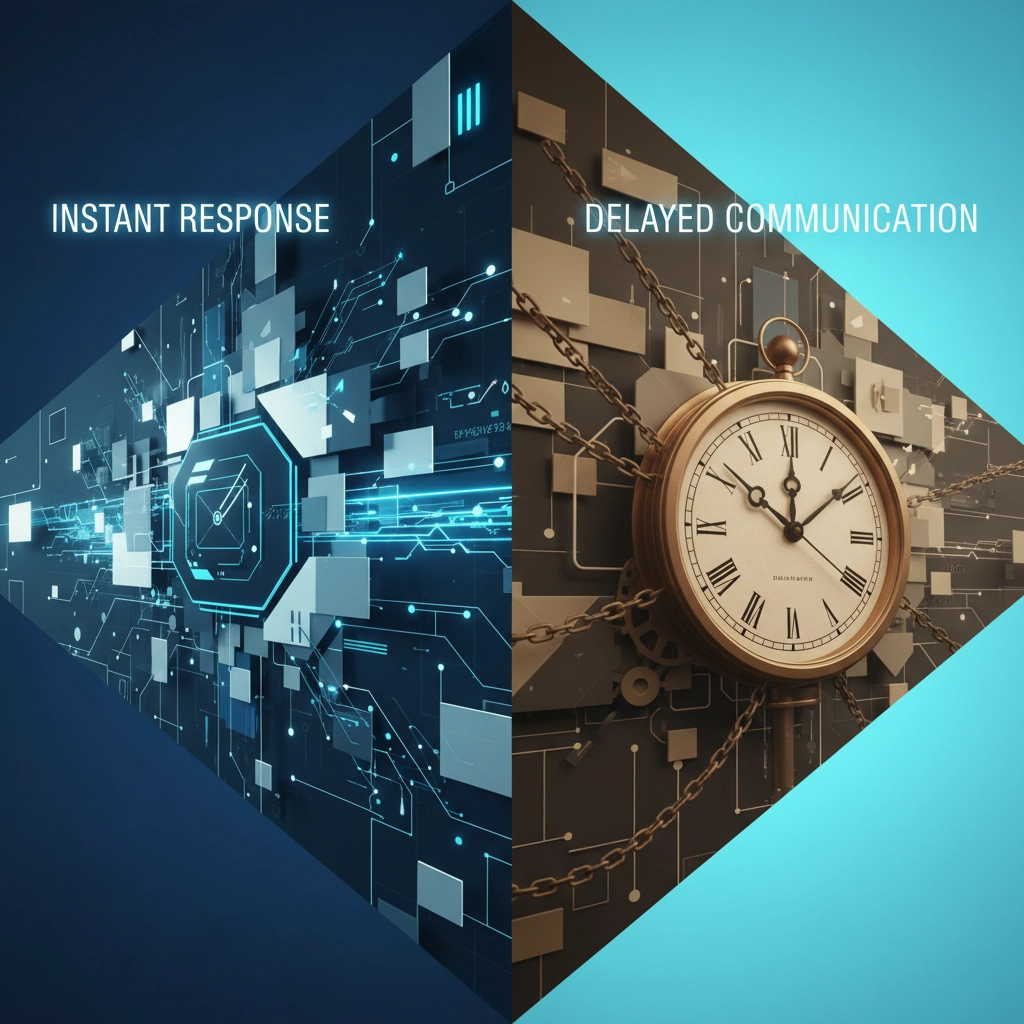
AI agents provide immediate responses when prospects fill out forms or engage with your content. Traditional sales teams average response times measured in hours or days, while AI agents respond in seconds.
This speed difference creates a 20% reduction in time to convert leads because prospects receive instant, relevant information while their interest is highest. One video tech company saw their free trial-to-paid customer conversion jump 43% in under six months simply by implementing timely, AI-powered follow-ups.
24/7 Availability Creates More Opportunities
Service businesses often deal with prospects across multiple time zones. Predictive sales intelligence powered by AI agents captures and nurtures these opportunities around the clock, while traditional teams miss weekend inquiries or after-hours interest spikes.
3. Quality and Personalization at Scale
Better Lead Qualification Through Data Analysis
AI agents analyze hundreds of data points instantly to qualify leads more accurately than manual processes. This results in 3x higher deal-win rates for businesses using AI compared to competitors relying solely on traditional qualification methods.
Hyper-Personalization Without Human Effort
AI sales automation enables personalized outreach at scale that would be impossible for human teams. AI agents customize messaging based on:
- Company size and industry
- Previous interaction history
- Behavioral signals from website visits
- Integration with CRM and marketing data
This level of personalization contributes to the 27% improvement in proposal acceptance rates seen across AI-adopting service businesses.
4. Cost Efficiency and Scalability Comparison
Linear vs Exponential Scaling
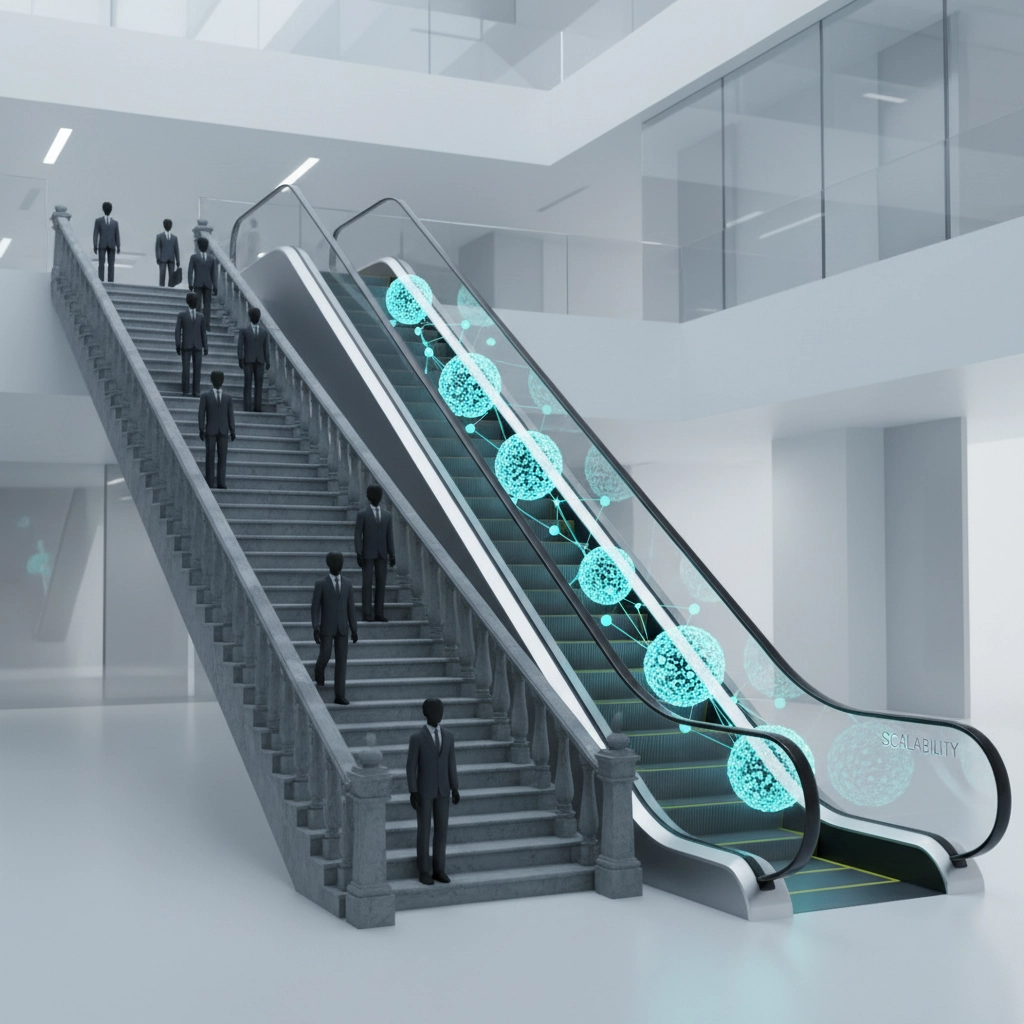
Traditional sales teams require linear cost increases for growth: more salespeople mean higher salaries, benefits, and training costs. Autonomous AI agents for B2B scale exponentially without proportional cost increases.
Consider a managed IT services firm that traditionally needed 5 SDRs to handle 1,000 leads monthly. With AI agents, they can process 3,000+ leads with the same overhead while improving conversion quality.
ROI Advantages
Sales teams using AI achieve their revenue growth targets at an 83% success rate compared to just 66% for teams without AI. This 17-percentage-point difference translates to significant revenue impact for service businesses operating on tight margins.
5. Industry-Specific Results for Service Businesses
SaaS and Tech Services
AI-native SaaS companies report 56% conversion rates compared to traditional companies' 32%. The combination of instant technical support, automated trial nurturing, and predictive analytics creates substantial competitive advantages.
Professional Services
Law firms, consulting agencies, and accounting practices using AI agents see improvements in:
- Initial consultation booking rates (up 31%)
- Proposal response times (down 40%)
- Client qualification accuracy (up 45%)
Managed Services Providers
MSPs particularly benefit from AI agents handling initial technical inquiries, service level discussions, and contract renewals: tasks that traditionally required senior staff time.
The Hybrid Approach: Best of Both Worlds
What the Data Really Shows
While the question asks about autonomous AI agents vs traditional sales teams, the research reveals a more nuanced truth: hybrid models consistently outperform either approach alone.
The 3.9x conversion rate improvement comes from AI handling routine tasks (lead scoring, initial outreach, follow-up sequences, CRM updates) while humans manage relationship building, complex problem-solving, and deal closing.
Implementation Strategy for Service Businesses
- Start with lead qualification: Let AI agents handle initial prospect screening
- Automate follow-up sequences: Use predictive intelligence for timing and messaging
- Human handoff for complexity: Transfer qualified prospects to human reps for relationship building
- Continuous optimization: Use AI analytics to refine human performance
Addressing Common Concerns
"Will AI Agents Replace My Sales Team?"
The data suggests augmentation rather than replacement. The most successful implementations use AI to eliminate administrative burden, allowing sales professionals to focus on relationship building and strategic selling activities.
"What About Relationship Building?"
AI agents excel at initial engagement and nurturing, but human relationship building remains crucial for complex B2B service sales. The hybrid model maximizes both capabilities.
"Is the Technology Ready?"
Current AI marketing automation platforms integrate seamlessly with existing CRM systems and provide immediate implementation value. The learning curve is measured in weeks, not months.
The Competitive Reality
Service businesses that delay AI adoption face an increasingly difficult competitive landscape. Organizations already using AI sales automation enjoy:
- Faster response times that capture more prospects
- Better lead qualification that improves deal quality
- Cost advantages that enable competitive pricing
- Scalability that supports rapid growth
This isn't about future possibilities: these advantages exist today and compound over time.
The question isn't whether autonomous AI agents or traditional sales teams perform better in isolation. The research clearly shows that strategic AI integration amplifies human sales performance to achieve conversion improvements approaching 4x traditional results.
For service businesses, this represents a fundamental shift from manual, time-intensive sales processes to predictive sales intelligence that identifies, nurtures, and converts prospects more effectively than either approach alone.
The companies implementing these hybrid models today are building sustainable competitive advantages that will be difficult for traditional competitors to overcome.