
Generic AI agents are costing UK hospitality businesses more than they realise. When a guest receives a response that feels scripted or impersonal, the opportunity to build loyalty disappears instantly. AI enhances efficiency and personalisation but risks eroding the human touch if implemented carelessly. The good news? With the right approach, your AI agent can feel as warm and attentive as your best member of staff. This guide walks you through exactly how to personalise an AI agent for your hospitality business, from laying the groundwork to measuring real results, with practical examples and expert tips throughout.
Table of Contents
- What you need to personalise your AI agent
- Step-by-step process to personalise an AI agent
- Common mistakes and how to avoid them
- How to measure and improve AI agent personalisation
- Why ‘one-off’ AI setups won’t cut it: A contrarian’s view
- Unlock next-level AI personalisation for your business
- Frequently asked questions
Key Takeaways
| Point | Details |
|---|---|
| Start with data | Effective AI personalisation relies on unified, quality guest data from all channels. |
| Iterative process | Personalising an AI agent is a continuous cycle of testing and improvement, not a one-off setup. |
| Balance automation and human touch | Smart personalisation avoids making guests feel surveilled or replaces all human warmth with robots. |
| Measure what matters | Key performance indicators and guest feedback should drive all iterations. |
What you need to personalise your AI agent
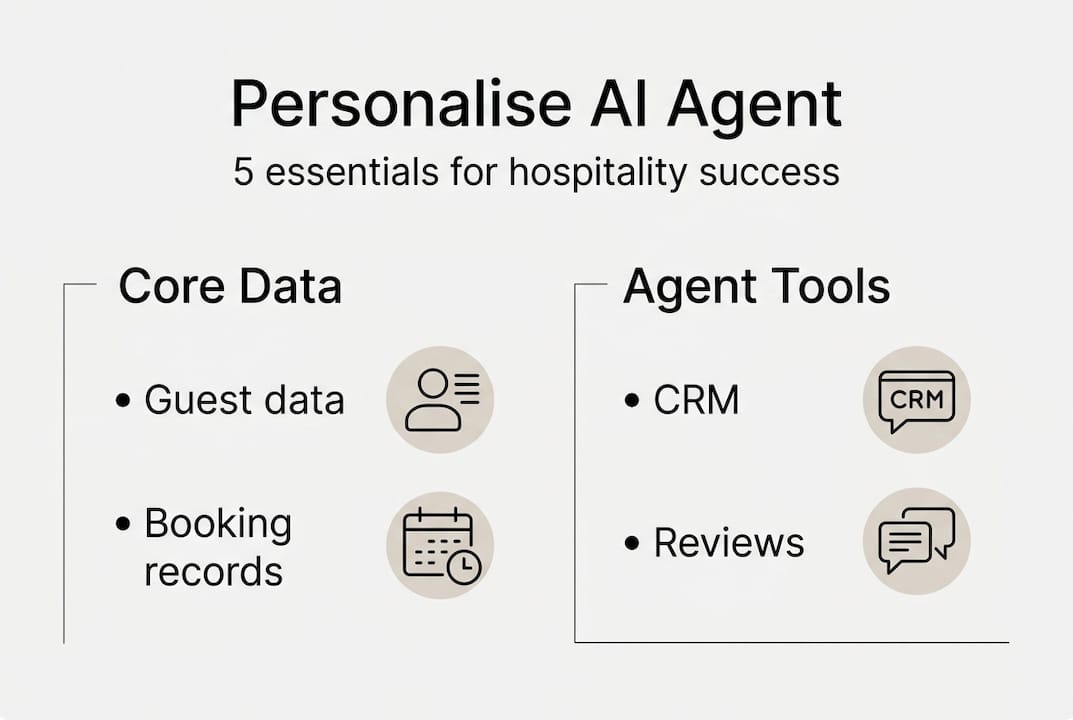
Now that you understand the stakes, let’s lay the groundwork needed for effective AI agent personalisation. Before you configure a single rule or write a single conversation flow, you need the right foundations in place. Skipping this stage is one of the most common reasons personalisation projects stall. As EHL research confirms, pilots often fail due to shallow integration and lack of ownership.
Here is what you need to get started:
- Guest data: CRM records, booking history, dietary preferences, past complaints, and loyalty status
- Behavioural signals: Website browsing patterns, email open rates, and social media interactions
- Integration readiness: Your AI agent must connect to your existing reservation system, CRM, and communication tools
- Staff buy-in: Your team needs to understand how the AI works and how to complement it, not compete with it
The table below gives you a quick-glance readiness checklist:
| Requirement | What it involves | Ready? |
|---|---|---|
| Guest data sources | CRM, booking records, reviews | ✓ / ✗ |
| System integrations | PMS, email, chat platforms | ✓ / ✗ |
| Data governance | GDPR compliance, consent management | ✓ / ✗ |
| Staff training plan | Onboarding, escalation protocols | ✓ / ✗ |
| Pilot segment defined | E.g. loyalty guests or repeat bookers | ✓ / ✗ |
For a broader view of how to manage AI tools effectively, the AI management essentials guide is worth exploring. You can also review AI solutions for founders to understand which tools align with your current setup.
Pro Tip: Don’t try to personalise for every guest segment at once. Start with your highest-value group, such as loyalty members or frequent weekend bookers, and refine your approach before scaling.
Step-by-step process to personalise an AI agent
With your groundwork in place, here’s exactly how to personalise your AI agent for maximum guest impact.
Step 1: Gather and unify your data
Pull together data from all guest touchpoints: reservations, CRM records, post-stay reviews, and direct feedback. The goal is a single, unified guest profile. Dynamic AI profiles using real-time behaviour and context consistently outperform static personas built on outdated assumptions.
Step 2: Configure your agentic stack
Your AI agent needs four core components: a brain (the language model), memory (guest history), hands (integrations with your systems), and a face (the tone and personality it presents). Understanding agentic AI structures will help you configure each layer correctly.
Step 3: Train with real scenarios
Feed your AI agent genuine guest conversations, FAQs, and edge cases. Set personalisation rules, such as addressing returning guests by name or referencing a previous stay.

Step 4: Pilot with a defined group
Launch with a small, defined segment. Collect structured feedback from both guests and staff. Hawksmoor, the restaurant group, achieved a 24% CRM visibility increase after implementing AI identity resolution and segmentation, proving that focused pilots deliver measurable gains.
Step 5: Review, iterate, and scale
Analyse your pilot results, adjust your personalisation rules, and then expand to additional guest segments. Explore AI agent development options to support this scaling phase.
| Step | Goal | Key tool | KPI |
|---|---|---|---|
| Unify data | Single guest view | CRM, PMS | Data completeness |
| Configure stack | AI ready to act | Agentic platform | Integration uptime |
| Train scenarios | Accurate responses | Conversation logs | Resolution rate |
| Pilot | Real-world testing | Feedback forms | NPS, CSAT |
| Scale | Broader impact | Analytics dashboard | Repeat visit rate |
Pro Tip: Record every guest interaction during your pilot phase. These transcripts become your most valuable training data for the next iteration.
Common mistakes and how to avoid them
Having seen how to implement personalisation, it’s vital to sidestep classic errors that can undermine all your hard work.
Even well-resourced hospitality businesses get this wrong. The mistakes below are more common than you’d expect, and each one is entirely avoidable.
- Over-personalisation: Referencing too much guest data in a single interaction can feel surveillance-like. Guests want to feel known, not monitored
- Ignoring data transparency: Failing to inform guests how their data is used erodes trust quickly. Clear opt-in language and a straightforward privacy notice are non-negotiable
- Neglecting staff training: If your team doesn’t understand how the AI agent works, they can’t support it or escalate gracefully when needed
- Treating deployment as the finish line: Personalisation is not a one-time setup. It requires ongoing refinement as guest expectations shift
“Guest loyalty is earned through ‘just enough’ personalisation. The moment guests feel their data is being used against them rather than for them, trust collapses.”
Over-automation can erode the human touch, and privacy concerns can actively moderate loyalty gains. The fix is balance: let your AI handle efficiency while your staff handle empathy.
Reviewing common AI agent mistakes in implementation will help you anticipate issues before they become problems.
Pro Tip: Introduce a simple guest-facing message such as “We use your preferences to personalise your experience” at the point of data collection. Transparency builds loyalty, not suspicion.
How to measure and improve AI agent personalisation
Mistakes are part of the process, but what matters most is tracking results and learning continuously.
Personalisation without measurement is guesswork. You need clear KPIs from day one so you can see what is working and what needs adjusting.
1. Set your core KPIs
Focus on metrics that directly reflect guest experience and business outcomes:
- CRM visibility rate (how complete and accurate your guest profiles are)
- Net Promoter Score (NPS) before and after AI implementation
- Average booking value per guest
- Repeat visit rate over a rolling 90-day window
2. Use guest feedback actively
Post-stay surveys, in-app ratings, and direct responses to AI conversations all provide signal. Feed this data back into your personalisation rules regularly.
3. Build a feedback loop
Schedule monthly reviews of AI performance. Compare KPIs against your baseline, identify patterns, and make targeted adjustments. Small, frequent changes outperform large, infrequent overhauls every time.
4. Track the bigger picture
By 2028, 68% of guest interactions in hospitality will be powered by AI. Businesses that build strong measurement habits now will be far better positioned to compete as that shift accelerates.
5. Scale what works
Once a personalisation rule consistently improves a KPI, roll it out to broader guest segments. Use AI automation solutions to handle the operational side, and refer back to the scaling with AI guide for strategic direction.
Pro Tip: Regular micro-adjustments, such as tweaking a greeting message or updating a preference rule, deliver far greater ROI over time than waiting for a full system overhaul.
Why ‘one-off’ AI setups won’t cut it: A contrarian’s view
Now, let’s step back from the process and address the key strategic mindset that separates industry leaders from laggards.
Most hospitality businesses approach AI personalisation as a project. They plan it, build it, launch it, and move on. That is precisely why most of them plateau within six months.
The businesses seeing genuine competitive advantage treat personalisation as a living strategy, not a finished product. Guest expectations evolve. Booking patterns shift. New communication channels emerge. An AI agent configured for 2024 guest behaviour will feel noticeably stale by late 2026 if nobody has touched it.
The real differentiator is not the technology itself. It is the human creativity and strategic intent behind it. Agentic vs automation thinking matters here: agentic AI adapts and responds dynamically, but only if someone is steering it with purpose.
The most successful operators we work with schedule quarterly strategy sessions specifically for their AI agent. They review guest feedback, reassess personalisation rules, and ask one simple question: does this still reflect who our guests are today? That habit alone separates the leaders from the rest.
Unlock next-level AI personalisation for your business
If you’re ready to move beyond generic AI and unlock true competitive advantage, there are tangible solutions right at your fingertips.
At AI Management Agency, we specialise in building personalised AI agents for UK hospitality businesses that actually deliver results. Whether you need an AI receptionist for your restaurant that greets guests by name, an agent that handles AI-powered hospitality bookings around the clock, or a fully managed AI call handling solution that never misses an enquiry, we have the tools and expertise to make it happen.
Book a free consultation today and see how a personalised AI agent can increase your bookings, improve guest loyalty, and free your team to focus on what they do best. The difference between a generic chatbot and a truly personalised AI agent is measurable, and we can show you exactly what that looks like for your business.
Frequently asked questions
What is an AI agent in hospitality?
An AI agent in hospitality is software that automates guest interactions, bookings, or support, using data to tailor each experience individually. With 68% of interactions set to be AI-powered by 2028, adoption is no longer optional for competitive businesses.
How can small businesses start personalising an AI agent?
Begin by unifying your guest data and running a focused pilot with clear goals, then expand personalisation based on feedback and measurable results. Pilots fail most often from shallow integration or insufficient team ownership, so invest in both from the start.
What are the risks of over-personalisation?
Too much personalisation can feel intrusive or robotic and actively damage guest trust, so balance is essential for effective automation. Over-automation erodes the human touch and can reduce the loyalty gains you set out to achieve.
How do I measure if my AI agent’s personalisation is working?
Track metrics including CRM visibility rate, guest feedback scores, and changes in booking or repeat visit rates over time. Hawksmoor saw a 24% CRM visibility lift after AI personalisation, demonstrating that the right metrics will show clear, quantifiable progress.
Recommended
- How to Optimise AI Responses for Small Hospitality Teams – AI Management Agency
- Role of AI agents explained: 30% more bookings UK 2026 – AI Management Agency
- AI Receptionist for Hotels: Improve Bookings & Guest Experience by AIM Agency
- 6 Essential AI Customer Interaction Tips for Boutique Hotels – AI Management Agency
- How to Maximize Guest Comfort in Corporate Housing – Guestly Homes