
Running a small hospitality business often means juggling endless guest questions and late-night enquiries whilst keeping costs under control. For British founders and directors, understanding the basics of artificial intelligence can make your operation more efficient without overwhelming complexity. This article introduces key AI concepts tailored to hospitality, helping you discover practical ways to improve customer service and free up valuable staff hours.
Table of Contents
- AI For Small Businesses: Essential Concepts
- Top AI Applications In Hospitality Sector
- Legal, Data And Privacy Challenges Explained
- Managing Costs, Risks And Getting Compliance Right
- Choosing And Implementing The Right AI Tools
Key Takeaways
| Point | Details |
|---|---|
| Understanding AI’s Role | AI can significantly streamline operations in hospitality by automating repetitive tasks, allowing staff to focus on building guest relationships. |
| Ethics and Compliance | Ensure compliance with GDPR by managing guest data responsibly and being transparent about the use of AI systems. |
| Cost Management | Small businesses can recover their investment in AI quickly by reducing operational inefficiencies and improving booking capture rates. |
| Strategic Implementation | Start with a targeted pilot project to evaluate the effectiveness of AI before scaling to avoid overextension and manage costs effectively. |
AI for Small Businesses: Essential Concepts
You don’t need a computer science degree to understand how AI can transform your hospitality business. The basics are straightforward, and grasping them will help you make smarter decisions about which AI solutions actually work for your operation.
What exactly is AI?
Artificial Intelligence refers to computer systems designed to perform tasks that normally require human intelligence. For your hospitality business, this means systems that can understand customer requests, recognise patterns in bookings, or respond to frequently asked questions without human intervention.
Machine learning is the subset you’ll hear about most often. It’s the technology that lets AI improve over time by learning from data. Your AI receptionist, for example, becomes better at answering guest questions the more interactions it handles.
Why should you care about AI right now?
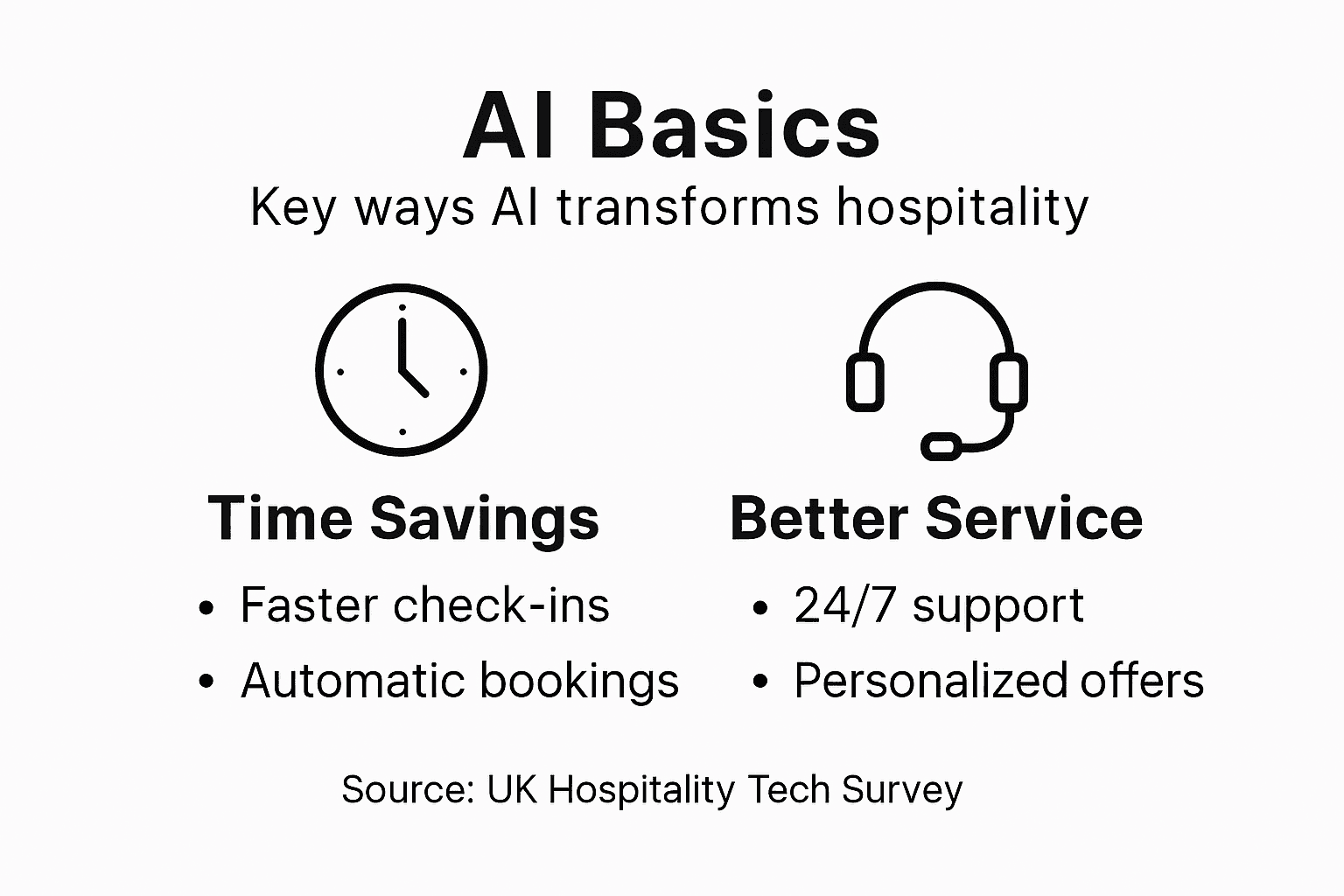
According to research on AI applications for small businesses, small firms can boost efficiency, improve decision-making, and deliver better customer service using AI tools. The key advantage is simple: you can automate repetitive tasks whilst your team focuses on guests who need genuine human interaction.
Consider the practical impact:
- 24/7 availability: Your business responds to booking enquiries and guest questions whilst you sleep
- Cost reduction: Fewer administrative hours spent answering the same questions repeatedly
- Consistency: Guests receive the same quality of information every time
- Better data: AI systems track what customers ask, helping you understand patterns
The real distinction: AI for hospitality
AI in customer service isn’t one-size-fits-all. Hospitality has unique needs. Your guests want natural conversation, not robotic responses. They expect answers about room availability, facilities, and local recommendations. Your team needs to handle edge cases and complaints with warmth.
This is why AI agents designed specifically for hospitality matter more than generic chatbots.
Common misconceptions
Many business owners think AI means replacing staff. It doesn’t. It means your receptionist stops fielding forty repetitive phone calls daily and instead focuses on building genuine relationships with guests who arrive at your door. Your chef isn’t replaced by an algorithm. Your cleaning team isn’t redundant. Your staff becomes more strategic.
Another myth: AI is too complicated for small teams. False. Quality AI solutions should feel invisible to your staff—they simply work in the background, handling volume.
Ethical use matters
As you explore AI, consider how it affects your guests. Data privacy, transparent communication about automated systems, and honest representation of your service are non-negotiable. Quality AI providers build these principles in from the start.
Understanding these essentials helps you evaluate whether AI genuinely fits your business, rather than adopting it simply because competitors mention it.
Pro tip: Start by identifying your most time-consuming, repetitive task—usually answering the same questions repeatedly. That’s your ideal AI pilot project, not a complete system overhaul.
Top AI Applications in Hospitality Sector
You’ve probably heard about AI chatbots, but the real opportunities in hospitality go far beyond simple customer replies. Your business can deploy AI across multiple areas to cut costs, boost guest satisfaction, and free up your team for what they do best.
AI Receptionists and Customer Service
This is the most visible application for small hospitality businesses. An AI receptionist that answers calls 24/7 handles booking enquiries, answers frequently asked questions, and qualifies guest requests before they reach your team. The system learns your specific operation—your room types, pricing, local attractions, house rules—and responds naturally, not like a robot.

Guests call at 11 PM on a Sunday. Your AI receptionist is there. They ask about availability, and the system checks your actual calendar instantly. They want restaurant recommendations, and they get informed suggestions. No more missed bookings because nobody answered the phone.
Demand Forecasting and Revenue Management
Research on machine learning applications in hospitality shows AI excels at predicting booking patterns and travel demand. Artificial neural networks analyse historical data—your past bookings, seasonal trends, local events, competitor pricing—to forecast what you’ll need next month.
This helps you:
- Optimise staffing: Know when busy periods arrive so you schedule appropriately
- Adjust pricing: Increase rates when demand spikes, offer deals during quiet times
- Manage inventory: Stock kitchens and supplies based on predicted occupancy
- Reduce overbooking: Understand capacity constraints before accepting reservations
Sentiment Analysis and Guest Feedback
Sentiment analysis through machine learning reads through guest reviews and feedback automatically, identifying patterns in satisfaction. One guest mentions “terrible wifi”. Another says “staff couldn’t help with restaurant bookings”. Your AI spots these issues across dozens of reviews instantly.
Instead of waiting until you stumble across a complaint, you see problems in real time. Your team acts before the issue becomes widespread.
Operational Efficiency
AI handles repetitive admin tasks that eat up your time. Booking confirmations, expense tracking, scheduling, invoice processing—these can all be automated. Your receptionist stops typing the same confirmation email fifty times daily.
Smaller hospitality operations see the biggest wins here. If you’re a three-person team, every hour saved on admin is an hour spent on guest relationships.
Below is a practical comparison of staff roles before and after AI adoption in hospitality:
| Role | Pre-AI Typical Tasks | Enhanced Role with AI |
|---|---|---|
| Receptionist | Answer repeat enquiries, booking | Handle special requests, guest welcome |
| Manager | Manual data entry, scheduling | Focus on staff management and planning |
| Chef/Cleaning | Purely operational duties | No change to core role |
| Team Overall | Routine admin dominates workload | More time for guest experience |
Personalisation at Scale
When guests return, AI remembers their preferences. They stayed in a room with a view last time. They requested extra pillows. They’re vegetarian. The system flags these details, so your team can delight them without asking twice.
Real AI applications in hospitality aren’t flashy. They’re practical systems that do unglamorous work consistently, freeing you to focus on genuine guest experiences.
Pro tip: Start with AI receptionist services that handle your call volume and FAQ questions. This single application typically recovers its costs through booked reservations that would otherwise be missed, then everything else becomes profit.
Here’s a summary of major AI applications in hospitality and how they benefit small businesses:
| Application Area | Example Functionality | Main Benefit |
|---|---|---|
| AI Receptionists | 24/7 call response, FAQs, bookings | Capture bookings day and night |
| Demand Forecasting | Predict occupancy, adjust pricing | Optimise resources, raise revenue |
| Sentiment Analysis | Scan reviews, flag issues | Respond faster to guest concerns |
| Admin Automation | Bookings, invoicing, scheduling | Reduce repetitive admin tasks |
| Personalisation | Remember guest preferences | Enhance guest loyalty |
Legal, Data and Privacy Challenges Explained
AI isn’t completely unregulated in the UK, but the rules are still evolving. As a small business owner deploying AI, you need to understand your responsibilities around data, guest privacy, and how your system operates. Ignoring these now could create problems later.
Data Protection Under GDPR
Your AI receptionist collects guest data. Names, phone numbers, email addresses, booking preferences, even dietary requirements. This data is covered by the General Data Protection Regulation (GDPR). You must store it securely, tell guests you’re collecting it, and delete it when they request.
Many small business owners assume their AI provider handles this. Wrong. You remain responsible. You must verify that any AI system you deploy meets GDPR requirements before switching it on.
Transparency and Disclosure
Guests deserve to know they’re talking to AI, not a human. UK AI governance frameworks emphasise transparency as a fundamental safeguard. When your AI receptionist answers a call or responds to a message, it should identify itself clearly.
This isn’t about deception. It’s about building trust. Guests who know they’re speaking to an AI receptionist often feel more comfortable than when they’re misled.
Algorithmic Bias and Fairness
AI systems learn from data. If your historical booking data shows you’ve unconsciously favoured certain types of guests, your AI will repeat that pattern. Algorithmic bias and fairness remain critical governance challenges in UK AI regulation.
Watch for unintended patterns:
- Does your AI offer premium rooms to some callers but basic rooms to others?
- Are certain accents or speech patterns treated differently?
- Does the system deny bookings to guests with accessibility requirements?
Accountability and Liability
When your AI makes a mistake, who’s responsible? You are. If your system refuses a legitimate booking or provides incorrect information, you can’t hide behind the AI. The guest has a claim against your business, not the software provider.
This means you need clear processes for reviewing AI decisions, especially high-stakes ones. If your system consistently denies bookings to a particular demographic, you’ll face legal exposure.
Data Retention and Guest Rights
Guests have the right to request their data, correct it, or have it deleted. Your AI system must support these requests. You can’t tell a guest “the AI has it, we can’t access it.” You must be able to extract their information, review it, and act on their requests within 30 days.
This requires your AI provider to give you access to the data it collects. Verify this before implementation.
Legal compliance with AI isn’t bureaucratic theatre. It’s how you protect your guests, your reputation, and your business from avoidable problems.
Pro tip: Before deploying any AI system, ask your provider for their GDPR compliance documentation, data deletion procedures, and transparency policies in writing. If they can’t provide these, find a different provider.
Managing Costs, Risks and Getting Compliance Right
Deploying AI sounds expensive. It doesn’t have to be. Small hospitality businesses often recover their investment within months by eliminating inefficiencies and capturing bookings they’d otherwise lose. The key is understanding what actually drives costs and which risks matter most.
Where Your AI Investment Goes
AI receptionist services typically charge per minute of call handling, per message processed, or as a monthly subscription. Initial setup involves training the system on your specific operation—your room types, pricing, booking process, local information. This usually takes days, not weeks.
Many small operators worry about hidden costs. There shouldn’t be any. Clear pricing from the outset means you know exactly what you’ll spend. Compare this to hiring a full-time receptionist at £25,000 annually, plus employment taxes, holiday pay, and sick leave.
Labour Cost Reduction Through Automation
AI adoption in UK hospitality cuts costs and improves efficiency through automation and smart workforce planning. Your receptionist no longer spends four hours daily answering the same questions. They spend time on complex guest requests, special arrangements, and relationship building.
This doesn’t mean layoffs. It means your existing team becomes more productive. A three-person operation handling 300 monthly bookings manually might process 500 with AI handling initial enquiries, freeing your staff for higher-value work.
Operational Waste and System Integration
Disconnected systems cause significant operational cost drain in hospitality businesses. Your booking system doesn’t talk to your accounting software. Your guest feedback isn’t connected to your maintenance requests. You manually input the same information repeatedly.
Quality AI integrates across these systems, reducing duplicate work:
- Guest calls your AI receptionist
- Booking is automatically logged in your system
- Payment confirmation is sent
- Housekeeping receives notification
- Post-stay survey is scheduled
No manual data entry. No bottlenecks.
Risk Mitigation Through Audit Trails
When every interaction is recorded, you have complete visibility. A guest claims they were overcharged? Check the conversation log. A booking was incorrectly cancelled? Trace exactly what happened. This transparency protects you from disputes and gives you data for continuous improvement.
Document everything your AI system does, especially decisions affecting revenue or compliance.
Phased Implementation Approach
Don’t deploy AI across your entire operation on day one. Start with one application—typically call handling and basic FAQ responses. Let it run for 30 days. Measure results. Then expand to other areas.
This approach:
- Reduces upfront investment
- Lets your team adjust gradually
- Provides clear ROI measurement
- Identifies problems before they scale
- Builds confidence in the technology
Vendor Due Diligence
Not all AI providers are equal. Before signing anything, verify they can answer these questions directly:
- Where is data stored and backed up?
- What happens if they go out of business?
- How frequently do they update their systems?
- What compliance certifications do they hold?
- Can they provide references from similar-sized businesses?
Smart AI adoption isn’t about cutting costs recklessly. It’s about investing strategically in systems that reduce waste, improve guest experiences, and protect your business.
Pro tip: Start your AI journey with a 30-day trial on call handling alone. Track the number of bookings captured, time freed for your team, and guest satisfaction. Use these metrics to justify expansion to other areas, making budget approval easier.
Choosing and Implementing the Right AI Tools
You don’t need to overhaul your entire operation to implement AI effectively. Success comes from choosing the right tool for your specific problem, testing it properly, and scaling gradually. This methodical approach reduces risk and proves value to your team.
Start with a Readiness Assessment
Before you buy anything, understand where you actually stand. Do you have clean, organised data? Can your team adopt new systems? What’s your biggest operational bottleneck? Planning and preparing for AI implementation requires assessing data readiness, user needs, and ethical considerations upfront.
Ask yourself these questions honestly:
- Which repetitive task costs you the most time?
- What information do guests ask about most frequently?
- Where do you lose bookings or revenue?
- Is your team ready to work differently?
- What data can you actually access and use?
Define Clear Business Objectives
Don’t deploy AI just because it exists. Define what success looks like. “Improve customer service” is vague. “Capture 95% of booking enquiries within 30 seconds, reducing missed reservations by 40%” is measurable.
Your objective should answer: What problem does this solve? How will you measure improvement? What timeline makes sense?
Write these down. Share them with your team. Use them to evaluate whether AI actually helped.
Pilot Before Full Deployment
Start small. Choose one area where AI can genuinely help—typically your highest-volume, most repetitive task. Run it in parallel with your current process for 30 days. This means your AI receptionist answers calls whilst you still answer some manually.
During this pilot phase:
- Track metrics: calls handled, bookings captured, customer satisfaction
- Document what works and what doesn’t
- Gather feedback from your team
- Identify gaps or improvements needed
- Calculate actual return on investment
Staff Training and Change Management
Your team needs to understand what AI does and doesn’t do. They’re not being replaced—their role is changing. They’ll shift from handling routine enquiries to managing complex situations, building relationships, and handling complaints.
Give them access to the AI system. Let them test it. Answer their concerns directly. Involve them in optimising responses and identifying problems.
Data Governance and Integration
Your AI system will generate and collect data. You need clear policies: What data does it collect? How long is it stored? Who can access it? How do you maintain data security?
Integration matters too. Your AI should connect to your booking system, accounting software, and communication platforms. Manual data entry defeats the purpose.
Scaling Up Strategically
Once your pilot succeeds, expand carefully. Add another application—perhaps automated guest feedback collection. Measure again. Then scale further. This staged approach prevents overextension and keeps costs predictable.
The best AI implementation isn’t the most advanced technology. It’s the right tool, properly configured, with staff prepared to use it, solving a real problem your business faces.
Pro tip: Before purchasing any AI tool, ask the vendor for a two-week trial with genuine sample data. During the trial, measure exactly what it captures and how much staff time it saves. Use these real numbers to justify investment to decision-makers.
Unlock the True Potential of AI for Your Hospitality Business
If repetitive booking enquiries and administrative tasks are draining your team’s energy, it is time to explore tailored AI solutions that change the game. This article highlights the need for AI systems designed specifically for the hospitality sector — natural, reliable, and able to handle 24/7 call responses with the warm professionalism your guests expect. By automating routine tasks with sophisticated AI receptionists, you can free your staff to focus on creating exceptional guest experiences while boosting bookings and reducing operational costs.
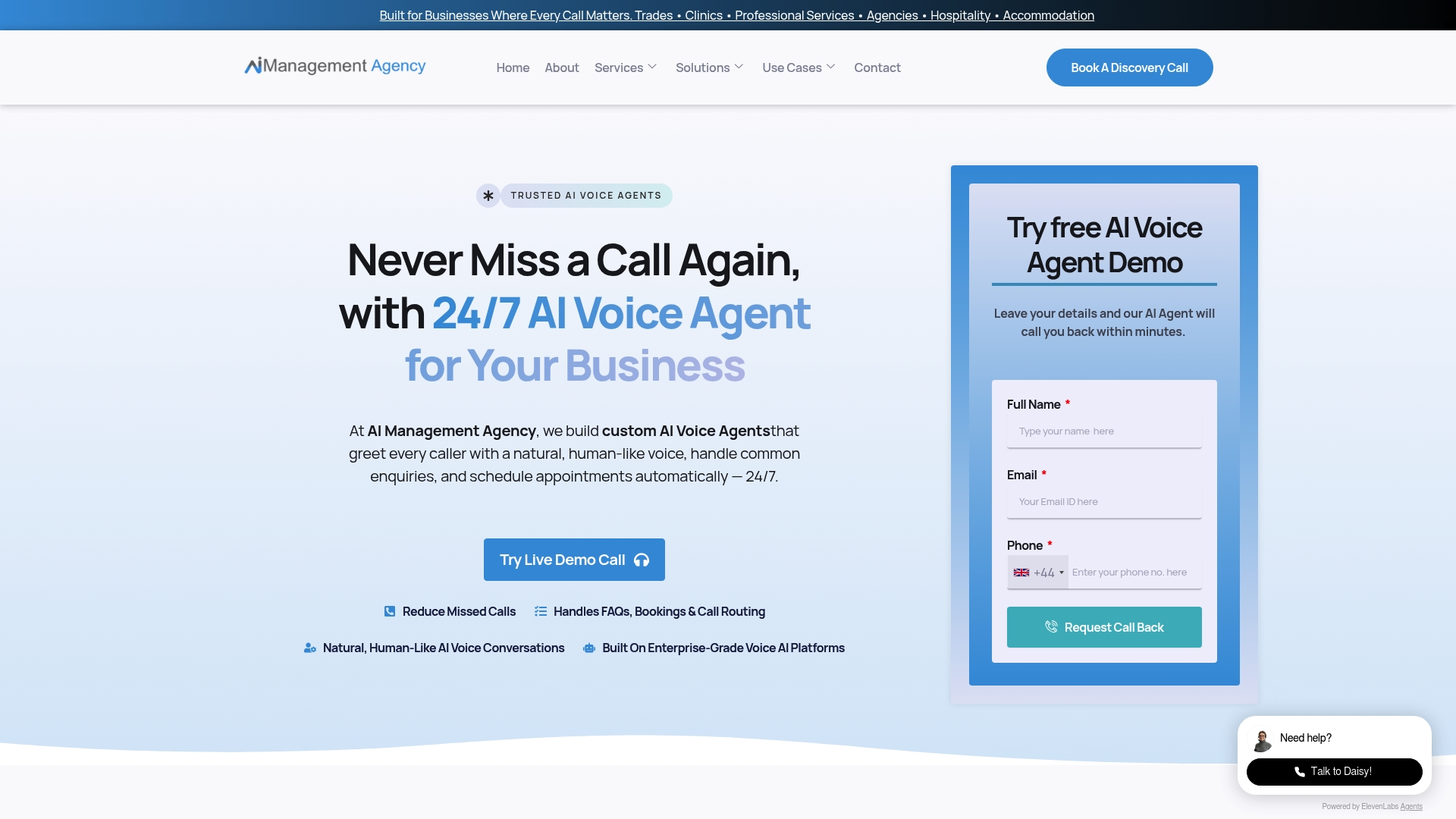
Discover how our experts at AI Management Agency craft bespoke AI agents that speak naturally, answer FAQs efficiently, and manage qualified sales appointments round the clock. Start your journey with a strategic approach from our Ai Marketing – AI Management Agency solutions and see real-world impact in our detailed case study – AI Management Agency. Embrace smart AI today and transform your hospitality business into a 24/7 powerhouse. Visit us now at https://aimagency.co.uk to take the first step.
Frequently Asked Questions
What is AI and how can it benefit my hospitality business?
Artificial Intelligence refers to computer systems that perform tasks requiring human-like intelligence. In hospitality, AI can improve efficiency, enhance customer service, and automate repetitive tasks, allowing staff to focus on guest interactions.
How does an AI receptionist work in the hospitality sector?
An AI receptionist operates 24/7, handling booking inquiries, answering frequently asked questions, and qualifying guest requests, thus providing immediate responses without human intervention. It learns specific details about your operation, improving its responses over time.
What are the common misconceptions about AI in small businesses?
Many believe AI will replace staff, but it actually complements them by automating mundane tasks. This allows employees to focus on more strategic and meaningful interactions with guests, enhancing overall service and operational efficiency.
What legal considerations should I be aware of when implementing AI in my hospitality business?
You must comply with data protection regulations, ensure transparency with guests about AI usage, and monitor for algorithmic bias. It’s essential to have clear data governance policies to protect guest information and ensure compliance with regulations.
Recommended
- Role of AI in Small Business Customer Service – AI Management Agency
- How to Optimise AI Responses for Small Hospitality Teams – AI Management Agency
- AIM Agency: Boutique Hotel Cuts Admin by 60% with AI in 2026
- 6 Essential AI Customer Interaction Tips for Boutique Hotels – AI Management Agency
- Business Travel Accommodation: Comparing Key Features | Jigsaw Conferences