TL;DR:
- Hotel AI integration connects hotel systems to automate tasks, personalize guest services, and improve revenue management. Its success depends on clear problem definition, clean data, and starting with high-volume, repetitive tasks to measure results effectively.
Hotel AI integration is the process of embedding artificial intelligence technologies into hotel systems to automate operations, personalise guest services, and improve revenue management. For UK hotel managers, explaining hotel AI integration means understanding how AI connects your property management system (PMS), customer relationship management (CRM), booking engine, and guest communication tools into a single, intelligent workflow. The industry term for this connected approach is “AI-driven hospitality automation.” 57% of consumers say technology has improved their hospitality experience. That figure signals a clear shift in guest expectations that UK hotels cannot afford to ignore.
What operational benefits can AI integration bring to hotels?
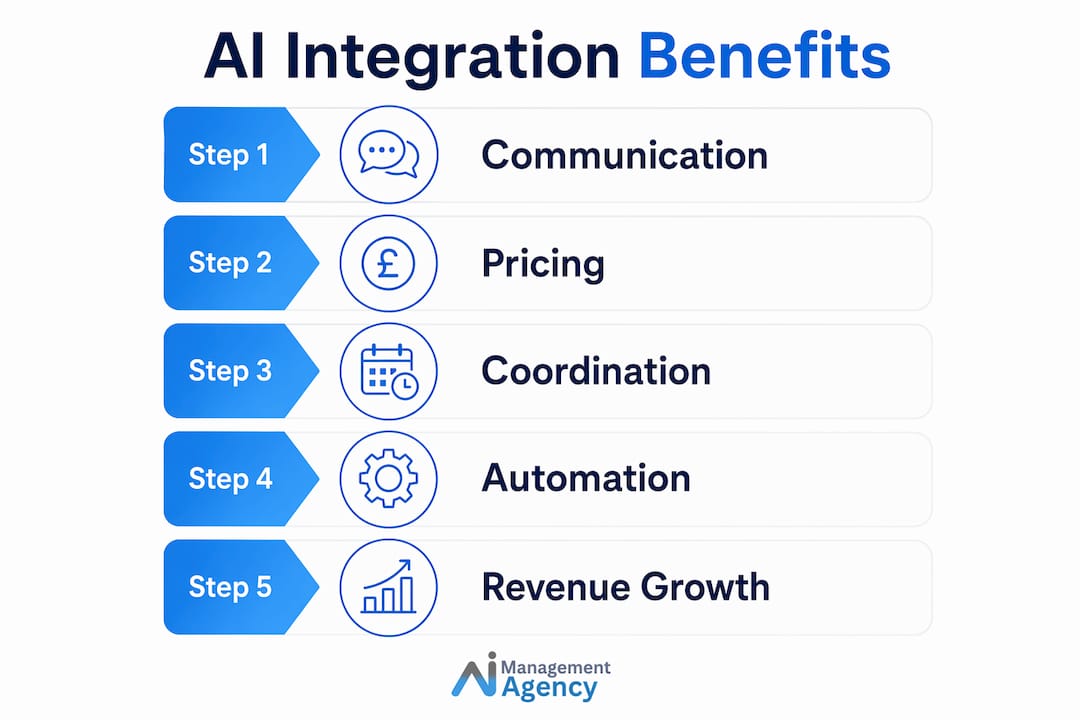
AI integration produces measurable gains across every department, not just the front desk. Hotels using AI tools connected to their PMS report 30–50% faster task completion. That speed translates directly into lower labour costs and higher guest satisfaction scores.
Front desk and guest communication
An AI Voice Agent handles inbound calls, answers frequently asked questions, and books reservations around the clock without a human operator. Guests receive instant, accurate responses at 2am just as readily as at midday. This removes the bottleneck that causes missed calls and lost bookings, particularly for independent hotels with lean reception teams. Aimagency’s AI receptionist for hotels operates exactly this way, speaking in a natural tone and qualifying enquiries before passing them to your team.
Revenue management and dynamic pricing
AI analyses occupancy data, competitor rates, local events, and historical booking patterns to adjust room prices in real time. A revenue manager who previously spent hours building rate reports can now act on AI-generated recommendations within minutes. The result is tighter yield management without adding headcount.
Cross-departmental coordination
Integrating AI across rooms, F&B, events, and spa creates a unified data view that improves pricing alignment and resource allocation. When your spa system and your rooms system share data, AI can identify upsell opportunities at check-in based on a guest’s booking history. That kind of joined-up intelligence was previously only available to large hotel groups with enterprise budgets.
Key operational benefits at a glance:
- Automated check-in and check-out workflows reduce front desk queues
- AI-driven upselling increases average spend per guest
- Predictive maintenance alerts cut reactive repair costs
- Automated guest messaging improves review scores by resolving issues before checkout
- Real-time reporting replaces manual end-of-day reconciliation
Pro Tip: Start with one high-volume, repetitive task such as answering phone enquiries. Automate that single process first, measure the time saved, then use that data to justify your next AI investment.
How is AI integrated technically into existing hotel systems?
Technical integration begins with an audit of your current systems. Most UK hotels run a PMS, a channel manager, a booking engine, and some form of CRM. AI cannot function well if these systems hold data in silos or use incompatible formats.

RAG architecture and brand compliance
The most reliable technical framework for hotel AI integration is Retrieval-Augmented Generation, known as RAG. RAG architecture connects AI directly to your property, guest, and pricing databases so that every AI output is grounded in your actual data rather than generic training data. This matters for brand compliance. An AI that answers guest queries about room rates must pull live pricing, not an outdated figure from its training set. HSMAI Region Europe identifies RAG as the recommended approach for hotels that want accurate, on-brand AI responses at scale.
Legacy systems and API challenges
Older PMS platforms often lack modern APIs, which makes direct AI integration difficult. Integration intermediaries, sometimes called middleware or iPaaS platforms, sit between your legacy system and the AI layer to translate data formats. This adds a step but removes the need to replace your entire PMS. Independent hotels can deploy cost-effective AI stacks that combine natural language querying tools with data reading software, bypassing expensive enterprise contracts entirely.
| Integration approach | Best suited for | Key consideration |
|---|---|---|
| Direct API connection | Modern PMS with open APIs | Fastest to deploy, lowest ongoing cost |
| Middleware layer | Legacy PMS without native APIs | Adds flexibility without full system replacement |
| RAG-based AI layer | Hotels needing brand-accurate AI responses | Requires clean, structured data feeds |
| Entry-level AI stack | Independent and small UK hotels | Lower upfront cost, scalable over time |
Pro Tip: Before selecting any AI tool, map every data source your hotel uses and identify where guest data lives. Clean, centralised data is the foundation that determines whether your AI performs well or poorly.
What challenges do UK hotels face implementing AI, and how can they overcome them?
The most common reason hotel AI projects fail is not technical. Hotels fail in AI adoption by prioritising tool choice over defining the operational problem they are trying to solve. Buying a sophisticated AI platform without first clarifying what it should fix leads to poor adoption and wasted budget.
Defining the problem before choosing the tool
Successful AI integration requires you to state the specific problem, name who owns the solution, and set measurable success criteria before you evaluate any technology. A hotel that defines its problem as “we miss 40 inbound calls per week during peak hours” can select an AI Voice Agent with confidence. A hotel that simply wants to “use AI” has no way to measure whether it worked.
Employee resistance and training
Staff often fear that AI will replace their roles. The reality is that AI handles repetitive, low-value tasks so your team can focus on guest relationships and complex problem-solving. Addressing this directly through structured training reduces resistance. Aimagency’s guide on training AI for hotel staff covers practical approaches to building staff confidence alongside new AI tools.
Common implementation challenges and how to address them:
- Data hygiene: Audit guest records and rate data before connecting any AI system. Dirty data produces unreliable AI outputs.
- Governance gaps: Assign a named owner for each AI workflow. Accountability prevents tools from drifting out of alignment with your brand standards.
- Scope creep: Pilot one use case at a time. Trying to automate everything simultaneously creates confusion and delays measurable results.
- Compliance concerns: UK hotels must align AI data practices with UK GDPR. Confirm that any AI vendor stores and processes guest data in accordance with ICO guidelines.
Pro Tip: Build backward from the output your team will actually read. If your revenue manager needs a daily rate recommendation report, design the AI workflow to produce exactly that, then choose the tool that delivers it most reliably.
How can UK hotels prepare for the future of AI in hospitality?
The next phase of hotel AI technology moves well beyond chatbots and automated emails. Agentic AI goes beyond chatbots by autonomously perceiving, deciding, executing, and verifying guest engagement tasks such as win-back campaigns without human oversight. That capability represents a fundamental shift in how hotels can operate.
Here is how to position your hotel for what is coming:
- Audit your data infrastructure now. Maintaining data hygiene and structured data feeds is the prerequisite for AI-driven booking workflows and guest engagement. Hotels with clean, connected data will adopt Agentic AI far faster than those without it.
- Shift from reactive to predictive operations. AI systems that monitor guest behaviour patterns can flag dissatisfied guests before they leave a negative review. Build this capability into your guest communication workflows now.
- Invest in staff interpretability. Your team needs to understand what the AI is recommending and why. AI outputs that staff cannot interpret get ignored. Train your team to read and act on AI-generated reports, not just receive them.
- Build an adaptable AI ecosystem. Avoid locking your hotel into a single vendor’s closed platform. Modular AI stacks that connect via open APIs give you the flexibility to swap components as the technology evolves.
- Monitor continuously. AI systems degrade when the data they rely on changes. Schedule quarterly reviews of AI performance against the success metrics you defined at the outset.
The future of AI in hospitality points toward fully autonomous booking workflows where an AI agent handles the entire guest journey from initial enquiry to post-stay follow-up without a single human touchpoint.
What are the best practice strategies for successful hotel AI integration?
The hotels that get the most from AI share one characteristic: they focus on measurable operational outcomes rather than the technology itself. The tool is secondary. The outcome is primary.
Best practice strategies for UK hotel managers:
- Define success metrics upfront. Set specific targets such as reducing missed calls by 50% or cutting check-in time by three minutes. Vague goals produce vague results.
- Run phased pilots. Deploy AI in one department, measure results over 60–90 days, then scale to the next area. This approach limits risk and builds internal confidence.
- Maintain the human touch. AI handles volume and speed. Your staff handle empathy and complexity. Design workflows that escalate to a human when a guest situation requires judgement.
- Keep content profiles current. Robust content profiles on major travel aggregators directly improve AI-driven visibility and booking conversion. Outdated listings undermine AI performance at the point of sale.
- Review and retrain regularly. AI models trained on last year’s data may not reflect current guest expectations. Schedule regular reviews and update training data as your property and market evolve.
For practical examples of AI working across guest communication, Aimagency’s resource on AI guest communication shows how UK hotels are applying these principles right now.
Pro Tip: Treat your first AI pilot as a learning exercise, not a final deployment. The insights you gain from a 90-day pilot are worth more than any vendor’s sales presentation.
Key takeaways
Hotel AI integration succeeds when you define the operational problem first, connect clean data systems using RAG architecture, and measure outcomes against specific targets before scaling.
| Point | Details |
|---|---|
| Define the problem first | Clarify the specific operational issue and success metrics before selecting any AI tool. |
| Use RAG architecture | Connect AI directly to your PMS and guest data to keep outputs brand-accurate and factually reliable. |
| Start with one use case | Pilot a single high-volume task, measure results over 60–90 days, then scale with confidence. |
| Address staff concerns early | Train your team to interpret and act on AI outputs to drive adoption and avoid wasted investment. |
| Maintain clean data | Structured, up-to-date data feeds are the foundation of every effective AI workflow in hospitality. |
Why most hotel AI projects miss the mark
I have seen a consistent pattern across hotels that struggle with AI adoption. They start with the tool, not the problem. A manager reads about an AI chatbot, signs a contract, and then tries to retrofit it onto existing workflows that were never designed with AI in mind. Six months later, the tool is barely used and the budget is gone.
The hotels that get it right do the opposite. They spend time mapping where their operation loses money or time, whether that is missed calls, slow check-in, or inconsistent upselling. Then they find the AI solution that addresses that specific gap. That sequence sounds obvious, but the pressure to “do something with AI” pushes most teams to skip it entirely.
The other thing I would stress is the human element. AI in hospitality is not about removing people from the guest experience. It is about removing people from the tasks that do not require human judgement, so they are fully present for the moments that do. A guest dealing with a billing dispute needs a person. A guest asking what time breakfast starts does not. Getting that distinction right is what separates hotels that thrive with AI from those that frustrate their guests with it.
The UK hospitality sector has the data, the guest volume, and the operational complexity to benefit enormously from AI integration. The barrier is rarely technical. It is almost always a question of clarity, planning, and the willingness to measure honestly.
— Geoff
How Aimagency helps UK hotels with AI integration
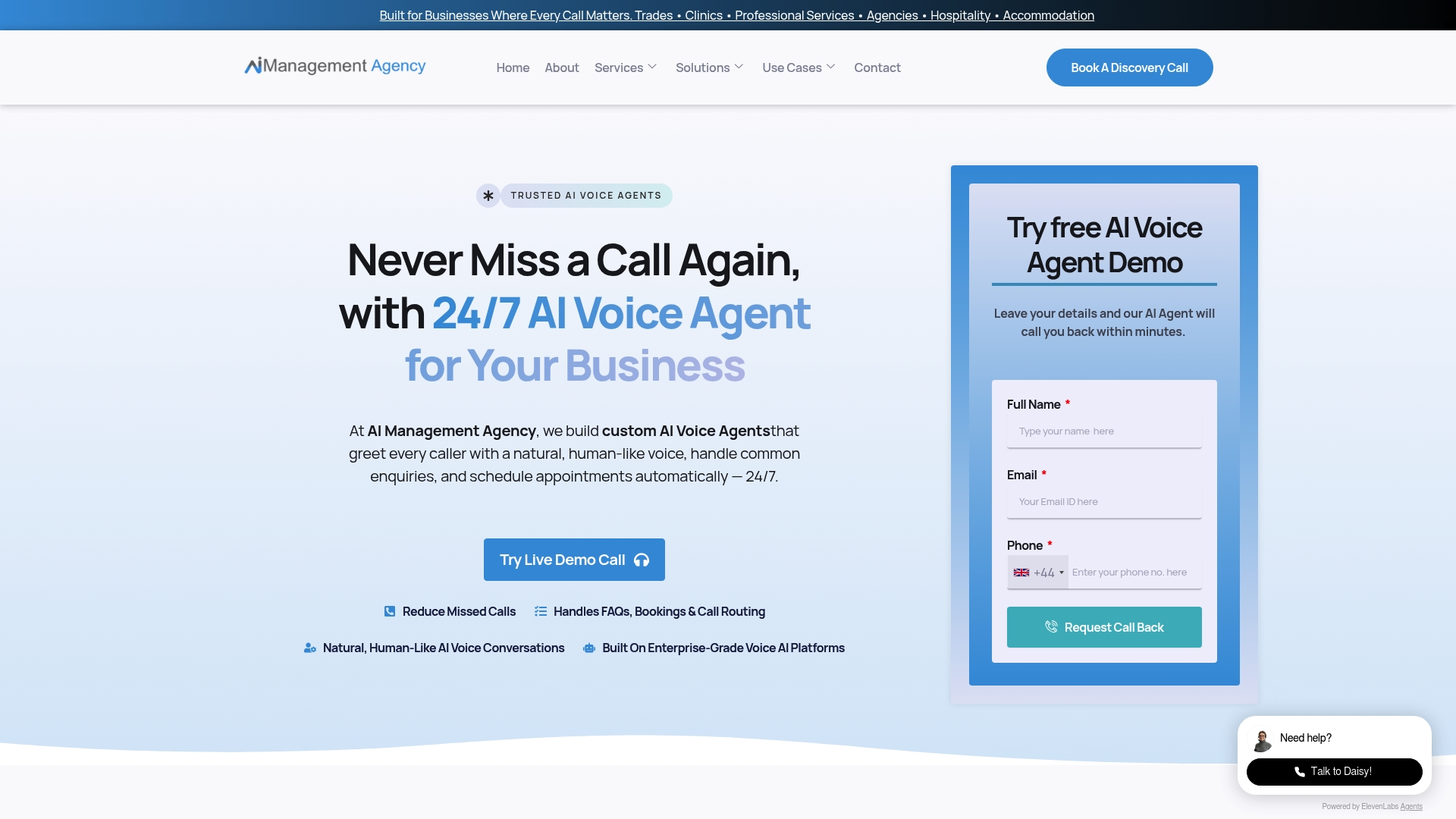
Aimagency specialises in building AI agents that handle the high-volume, time-sensitive tasks that drain your team’s capacity every day. The flagship AI Voice Agent answers calls 24 hours a day, responds to guest FAQs in a natural tone, and books qualified appointments directly into your calendar.
For UK hotel managers ready to move from curiosity to action, Aimagency’s AI agents in hospitality guide sets out exactly how the onboarding process works and what results you can realistically expect. Independent hotels benefit particularly from Aimagency’s approach, which is built around the advantages AI agents offer smaller businesses without the cost or complexity of enterprise platforms. If you want a practical starting point, speak to the Aimagency team about a tailored pilot for your property.
FAQ
What is hotel AI integration?
Hotel AI integration is the process of connecting artificial intelligence tools to a hotel’s existing systems, such as the PMS, CRM, and booking engine, to automate operations and personalise guest services.
How does AI improve hotel revenue management?
AI analyses occupancy data, competitor rates, and booking patterns in real time to recommend dynamic pricing adjustments, enabling hotels to maximise yield without manual rate-building.
What is RAG architecture in hotel AI?
RAG, or Retrieval-Augmented Generation, connects an AI system directly to a hotel’s live property and pricing databases so that every AI response is accurate and brand-compliant rather than based on outdated training data.
How can small UK hotels afford AI integration?
Independent hotels can deploy cost-effective AI stacks combining natural language querying and data reading tools, which bypass expensive enterprise contracts and scale as the business grows.
What is Agentic AI and why does it matter for hotels?
Agentic AI autonomously perceives, decides, and executes tasks such as guest win-back campaigns without human oversight, representing the next stage beyond basic chatbots in hospitality automation.