
TL;DR:
- Virtual agents recover up to 16.8 hours of executive time each week by automating routine tasks. They cut staffing costs by 67 to 80 percent and handle complex multi-step workflows autonomously. Proper onboarding, clear documentation, and continuous tuning lead to maximum performance and operational benefits.
Virtual agents are autonomous AI systems that handle routine business tasks, from answering calls to booking appointments, without human intervention. The advantages of virtual agents are most visible in three areas: time recovery for leaders, reduced staffing costs, and improved customer service quality. A 2025 survey of 400 executives found that leaders regain 13 to 16.8 hours per week through virtual assistance. That figure alone represents up to 42% of a standard working week returned to strategic work. For small and medium enterprises, where every hour of leadership time carries disproportionate weight, this is a material operational shift.

1. How do virtual agents save time and increase productivity?
Executives who systematically offload scheduling, inbox management, and research workflows to virtual agents achieve the highest time savings. The median recovery is 13 hours per week, with an average of 16.8 hours. That time does not disappear into administration. It moves to client relationships, product decisions, and growth activity.
Virtual agents handle the workflows that consume the most time without adding value proportional to their volume. Scheduling alone can consume several hours per week across a leadership team. Answering the same ten customer questions repeatedly is another common drain. Agents absorb both without fatigue or error accumulation.
Productivity gains extend beyond the leadership level. When agents handle first-line customer queries, front-of-house staff focus on higher-value interactions. When agents manage appointment booking, sales teams spend more time closing. The efficiency benefit compounds across the organisation, not just at the top.
Key workflows virtual agents handle to recover productive time:
- Inbound call answering and FAQ responses
- Appointment scheduling and calendar management
- Lead qualification and initial sales conversations
- Inbox triage and routine email responses
- Customer follow-up sequences and reminders
- Data entry and CRM updates after interactions
Pro Tip: Document your ten most common customer questions and your standard booking process before deploying a virtual agent. Agents trained on clear Standard Operating Procedures reach full delegation efficiency faster and with fewer errors.
2. How virtual agents reduce operational costs
Businesses save between 67% and 80% on annual staffing costs by replacing in-house executive assistants with virtual agents. That saving accounts for salary, payroll taxes, benefits, paid leave, onboarding, and office overhead. For an SME carrying two or three administrative roles, the annual saving is substantial.
The cost reduction is not limited to headcount. MIT Sloan research highlights that AI agents reduce transaction costs by processing large volumes of information at near-zero marginal cost. A human agent handling 50 calls per day has a ceiling. A virtual agent does not. Volume increases without a corresponding increase in cost.
| Cost category | Human staff | Virtual agent |
|---|---|---|
| Annual salary | £25,000–£35,000 | Not applicable |
| Employer NI and pension | £3,000–£5,000 | Not applicable |
| Paid leave and sick cover | £2,000–£4,000 | Not applicable |
| Office space and equipment | £2,000–£5,000 | Not applicable |
| Monthly service cost | Not applicable | Typically £200–£800 |
| Scalability | Hire additional staff | Handles volume increases automatically |
The financial case is clearest when you factor in scalability. A virtual agent handling 200 calls per month costs the same as one handling 20. Human staffing does not work that way. For growing SMEs, this cost structure is a genuine operational advantage.
Pro Tip: When budgeting for your first virtual agent deployment, allocate three months of service cost before measuring ROI. The onboarding and tuning period runs 30 to 90 days, and performance metrics taken before that window closes will understate the agent’s true value.
3. What virtual agent capabilities enhance customer interactions?
Modern virtual agents are not chatbots. Google Cloud’s 2026 AI perspective defines AI agents as systems with the autonomy to converse, reason, learn, and use tools. That distinction matters. A traditional chatbot follows a script. An AI agent reads context, adjusts its response, and completes multi-step tasks without human prompting.
Agentic AI can complete multi-step plans and interact with digital environments with minimal human supervision. In practice, this means an agent can answer a caller’s question, check diary availability, book an appointment, and send a confirmation message in a single interaction. No human handoff required.
The customer experience benefit is direct. Callers reach a natural-sounding voice agent at any hour, receive accurate answers, and complete their intended action without waiting for office hours. For sectors like property, finance, and trades, where enquiries arrive outside business hours, this availability converts leads that would otherwise be lost.
Advanced virtual agent capabilities that improve service quality:
- Natural language reasoning for context-aware responses
- 24/7 availability across phone, web, and messaging channels
- Integration with CRM, calendar, and booking systems
- Self-improvement through interaction data and feedback loops
- Multi-step task completion without human intervention
- Consistent tone and accuracy across every interaction
The transition from simple chatbots to agentic AI brings a qualitative shift in what automation can achieve. SMEs that deploy agentic systems rather than basic bots see meaningfully better outcomes in customer satisfaction and lead conversion.
4. What implementation considerations affect the benefits?
Virtual agents do not reach peak performance on day one. A learning curve of 30 to 90 days is required after initial deployment for an agent to tune and fully align with specific business processes. Leaders who measure ROI in week two will draw the wrong conclusions.
The quality of onboarding documentation directly determines how quickly an agent reaches full capability. Businesses with clearly documented SOPs see significantly higher delegation efficiency and faster integration success. An agent trained on vague instructions produces vague outputs. An agent trained on precise process documentation produces precise results.
| Onboarding stage | Typical timeframe | Expected delegation efficiency |
|---|---|---|
| Initial deployment | Days 1–14 | 40–60% |
| Active tuning | Days 15–60 | 65–80% |
| Optimised performance | Days 61–90 | 84% average |
| With SOP documentation | Post day 90 | Up to 91% |
Delegation efficiency reaches 84% after 90 days on average, rising to 91% when SOP documentation is in place. That 7-percentage-point difference is the direct return on the time invested in process documentation before deployment. It is not a marginal gain. It is the difference between an agent that handles most tasks correctly and one that handles nearly all of them.
Iterative tuning matters beyond the initial period. Achieving optimum performance requires ongoing process refinement, not a one-time setup. The businesses that extract the most value from virtual agents treat them as a managed system, not a set-and-forget tool. Regular review of call transcripts, booking accuracy, and customer feedback drives continuous improvement.
Pro Tip: Assign one person internally to review agent performance weekly during the first 90 days. Their observations feed directly into tuning decisions and accelerate the path to peak efficiency.
Key takeaways
Virtual agents deliver their greatest value when deployed with clear process documentation, realistic onboarding timelines, and a commitment to iterative improvement.
| Point | Details |
|---|---|
| Time recovery is measurable | Executives regain up to 16.8 hours per week by delegating routine workflows to virtual agents. |
| Cost savings are substantial | Businesses save 67–80% on staffing costs compared to equivalent in-house roles. |
| Agentic AI outperforms basic bots | Modern agents reason, learn, and complete multi-step tasks without human intervention. |
| Onboarding takes 30–90 days | Measuring ROI before the tuning period ends will understate an agent’s true performance. |
| SOPs accelerate efficiency | Agents trained on documented processes reach 91% delegation efficiency versus 84% without them. |
Why virtual agents are more than a cost-cutting exercise
I have worked with enough SME leaders to know that the conversation about virtual agents almost always starts with cost. That is a reasonable place to start. The staffing savings are real and the numbers are compelling. But the businesses that get the most from virtual agents are the ones that reframe the question early.
The more interesting question is not “how much does this save?” It is “what does my leadership team do with 16 hours back per week?” The answer to that question determines whether virtual agent adoption becomes a genuine growth lever or just a line item on a cost reduction report.
The cultural dimension is also underestimated. Deploying an AI voice agent that handles customer calls requires trust from your team and your customers. That trust is built through consistency and quality, not through novelty. Agents that sound natural, answer accurately, and complete tasks reliably earn that trust quickly. Agents that are deployed without proper tuning erode it just as fast.
My honest observation is that executive involvement in the first 90 days is the single biggest predictor of success. Leaders who stay close to the onboarding process, review early transcripts, and provide feedback on tone and accuracy get dramatically better outcomes than those who hand it off entirely and check back in at month three.
The future direction is clear. Agentic AI will handle increasingly complex workflows, integrate with more business systems, and require less human oversight over time. The SMEs that build internal capability now, including the habit of documenting processes and reviewing agent performance, will be better positioned to benefit from every capability improvement that follows.
— Geoff
How Aimagency helps UK SMEs deploy virtual agents effectively
Aimagency specialises in building high-quality AI agents for small and medium UK businesses, including AI voice agents that answer calls in a natural tone, respond to FAQs, and book qualified sales appointments around the clock.
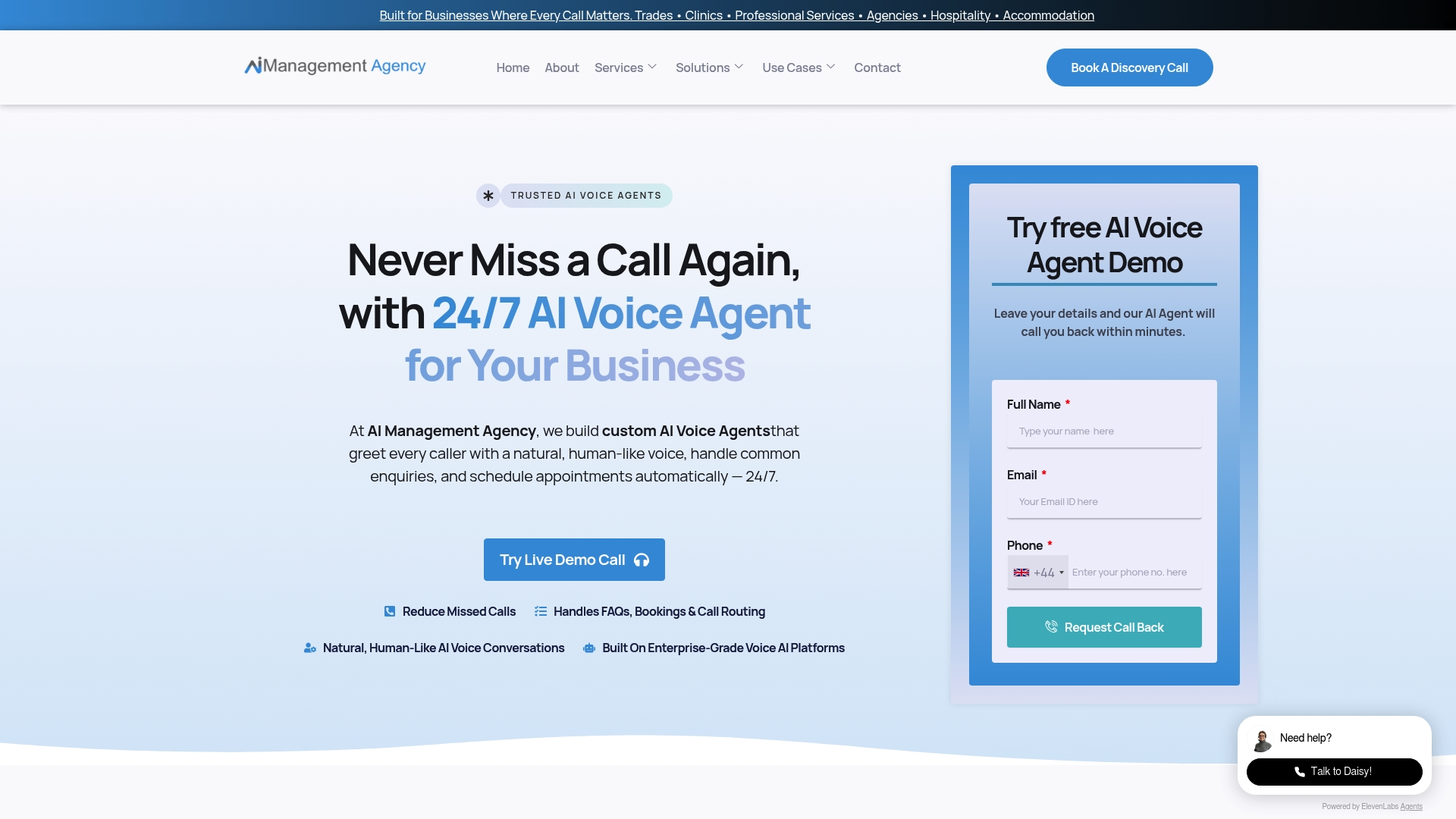
The AI agent advantages for UK SMEs that Aimagency delivers go beyond basic automation. Every deployment includes strategic onboarding, SOP development, and ongoing tuning to ensure agents reach and maintain peak performance. Whether you are in property, finance, trades, or hospitality, Aimagency builds agents that fit your specific workflows and customer expectations. If you are ready to see what a well-deployed virtual agent can do for your business, the team at Aimagency is the right starting point.
FAQ
What are the main advantages of virtual agents for SMEs?
Virtual agents reduce staffing costs by 67–80%, recover up to 16.8 hours of executive time per week, and provide 24/7 customer service without additional headcount.
How long does it take for a virtual agent to reach full performance?
Most virtual agents require a 30 to 90-day tuning period after deployment. Businesses with documented SOPs reach up to 91% delegation efficiency after that period.
Are virtual agents better than traditional chatbots?
Yes. Modern AI agents can reason, learn, and complete multi-step tasks autonomously. Traditional chatbots follow fixed scripts and cannot adapt to context or complete complex workflows.
What tasks can a virtual agent handle for a small business?
Virtual agents handle inbound calls, FAQ responses, appointment booking, lead qualification, CRM updates, and customer follow-up sequences without human involvement.
How do virtual agents improve customer service quality?
Virtual agents provide consistent, accurate responses at any hour, integrate with booking and CRM systems, and complete customer interactions end-to-end without requiring a human handoff.
Recommended
- AI agent advantages for small UK businesses – AI Management Agency
- Uses of AI in SMEs: boost efficiency with smart tools 2026 – AI Management Agency
- What is a virtual agent? A guide for UK businesses – AI Management Agency
- Real benefits of 24/7 AI agents for small UK businesses – AI Management Agency