
TL;DR:
- Effective AI agent onboarding involves a structured process with clear preparation, human supervision, and continuous context updates. It is essential to assign a dedicated supervisor, maintain up-to-date knowledge bases, and regularly review and correct agent outputs to ensure sustained value. Neglecting these practices can lead to performance degradation, error accumulation, and reduced operational efficiency.
The AI agent onboarding process is a structured framework that prepares and integrates AI agents into business operations so they perform reliably from day one. Done well, it is the difference between an agent that compounds value over time and one that stalls after the first week. AI agents save staff 30–45 minutes per day and can lift productivity by up to 40% over a week. That figure only holds when the agent has been properly briefed, given the right context, and assigned a human supervisor who keeps it on track. This guide covers every stage of the process, from prerequisites to continuous optimisation, grounded in 2026 best practices.
What does the AI agent onboarding process actually involve?
The AI agent onboarding process is the industry term for what some call automated agent training or virtual agent integration. It covers everything from the initial briefing session to the governance structures that keep an agent accurate over months of use. The primary impediment in AI adoption is managing work, not technology. That insight from Harvard Business Review reframes the whole exercise. You are not just configuring software. You are defining a working relationship with a new team member that has no prior context about your business.
The process breaks into three phases: preparation, execution, and continuous improvement. Each phase has distinct responsibilities, tools, and success criteria. Skipping any one of them is the most common reason AI agents underperform. The best practices for AI agents in 2026 treat onboarding as an ongoing discipline, not a one-time setup task.
What prerequisites and tools are essential for effective AI agent onboarding?
Before you run a single onboarding session, three foundations must be in place: a shared knowledge base, a governance structure, and the right tooling. Without these, even a well-designed onboarding interview produces an agent that drifts within weeks.

The core tooling landscape
| Tool or resource | Role in onboarding |
|---|---|
| Onboarding interview framework | Structures the initial briefing to produce an agent brief and first-week plan |
| CLAUDE.md or equivalent context file | Stores role instructions, team norms, and process knowledge the agent references |
| Viktor AI coworker | Manages multi-step onboarding plans via Slack with built-in human approval gates |
| Organisational knowledge base | Centralises FAQs, SOPs, and trust signals that new agents inherit |
| Human supervisor role | Provides governance, plan approval, and accountability for agent outputs |
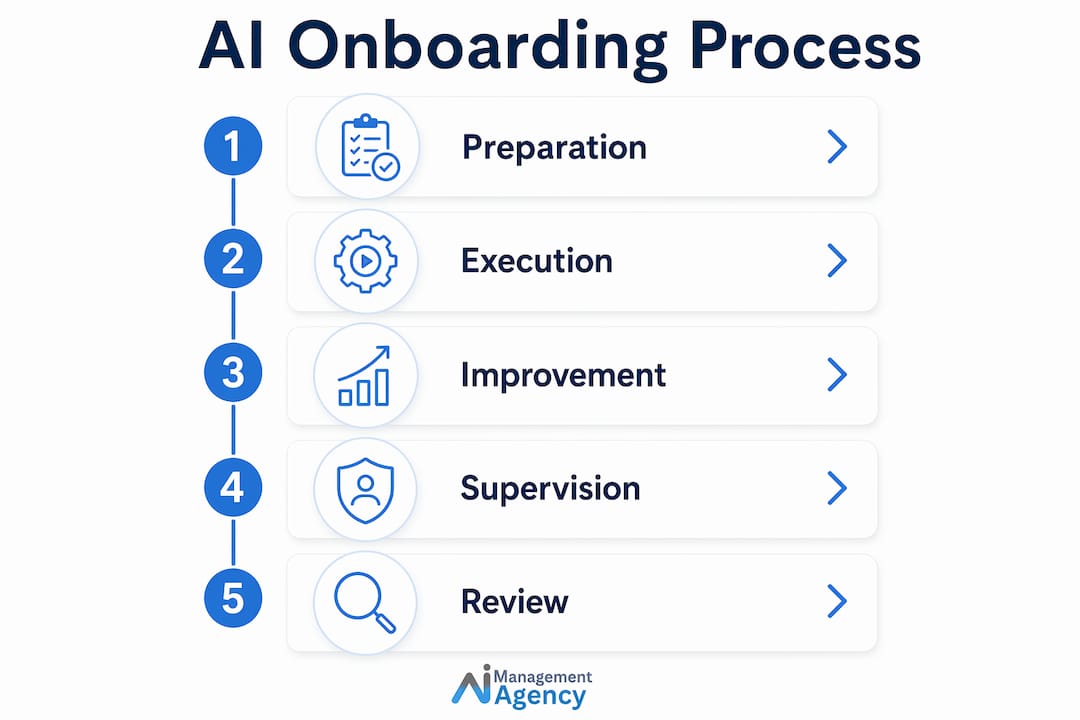
Successful teams assign a named human supervisor for every AI agent they deploy. This person approves plans before execution, reviews outputs, and feeds corrections back into the system. Without this role, errors accumulate silently.
The knowledge base is equally non-negotiable. An agent that cannot access your pricing, your escalation rules, or your tone of voice guidelines will invent answers. That is not a technology failure. It is a preparation failure.
Pro Tip: Before onboarding any agent, audit your existing documentation. If a human new starter could not do the job using only those documents, your AI agent cannot either.
Shared infrastructure also carries trust signals. When a new agent inherits a well-maintained context file, it starts with the accumulated learning of every agent that came before it. That compounding effect is one of the strongest arguments for treating agent onboarding as repeatable rather than ad hoc.
What are the step-by-step AI onboarding steps to deploy a new agent?
The execution phase follows a clear sequence. Each step builds on the last, and skipping steps creates gaps that surface later as errors or misaligned outputs.
-
Run the onboarding interview. A structured 15–30 minute session produces the two foundational documents every agent needs: an agent brief and a first-week plan. Onboarding in 15 minutes is achievable when you use a pre-built interview framework rather than starting from scratch. The interview covers role scope, success criteria, escalation paths, and communication style.
-
Create or update the agent brief. This document, often called CLAUDE.md in Claude-based deployments, contains the agent’s role instructions, the team context it operates within, and the processes it must follow. Write it in plain language. Avoid internal jargon unless you define it explicitly within the document.
-
Assign a human reviewer. Before the agent executes any plan, a named supervisor must approve it. This is not bureaucracy. It is the governance step that prevents a well-intentioned agent from taking actions that conflict with your business rules or client commitments.
-
Add role-specific instructions and team context. Generic instructions produce generic outputs. Include your brand voice guidelines, your preferred response formats, and any sector-specific rules that apply to your business. An AI receptionist for an estate agent, for example, needs different escalation rules than one deployed in a restaurant.
-
Automate provisioning and permissioning. Tools like Viktor AI coworker can manage a 22-step onboarding plan through Slack, routing each approval to the right person before the next step executes. This removes manual bottlenecks without removing human oversight.
-
Run a supervised test period. For the first two weeks, have the human supervisor review a sample of agent outputs daily. Log every correction. These corrections become the raw material for the next context update.
Onboarding steps and responsible parties
| Step | Owner | Output |
|---|---|---|
| Onboarding interview | Manager or AI operator | Agent brief and first-week plan |
| Context file creation | Manager with agent assistance | CLAUDE.md or equivalent |
| Plan approval | Named human supervisor | Signed-off execution plan |
| Role-specific configuration | Manager | Updated context file with sector rules |
| Provisioning automation | AI tool (e.g. Viktor) | Access rights and workflow connections |
| Supervised test period | Human supervisor | Correction log for context updates |
Pro Tip: Use the correction log from the test period as the agenda for your first context review. Every repeated error is a gap in the agent brief, not a flaw in the agent.
How to maintain and optimise AI agents post-onboarding
Onboarding is not a project with an end date. The agents that deliver sustained value are the ones whose context files are treated as living documents, updated as your business changes.
Key maintenance practices include:
- Schedule context reviews every 1–2 months. Onboarding documents updated regularly outperform static ones. Set a calendar reminder. Review the agent brief against any process changes, new team members, or updated pricing.
- Feed corrections into the central context layer. Failure to feed corrections back into the organisational context causes repeated errors. Each correction logged and incorporated means the next agent you deploy starts smarter than the last.
- Monitor operational costs actively. Zero-cost monitoring techniques can reduce running costs to as little as $0.08 per 24-hour cycle by activating large language model calls only when necessary. For businesses running multiple agents, this discipline compounds into significant savings.
- Avoid the blank-slate mistake. Deploying a new agent without inheriting the context and corrections from previous agents wastes every lesson your team has learned. Institutional memory is the compounding asset in AI operations.
The goal of post-onboarding maintenance is cumulative learning. Each update to the context file makes the agent more accurate, more aligned with your business, and less dependent on human correction. That trajectory is what separates businesses that get lasting value from AI from those that cycle through failed deployments.
Pro Tip: Assign the context review to the same person who owns the human supervisor role. They have the most direct knowledge of where the agent is drifting and why.
What common challenges occur during AI agent onboarding and how to troubleshoot them?
Most onboarding failures trace back to a small set of predictable mistakes. Recognising them early saves significant time and prevents the erosion of team trust in AI tools.
- Treating onboarding as a one-off event. The most damaging mistake is completing the initial setup and then leaving the agent unchanged. Processes evolve, teams change, and pricing updates. An agent briefed in January with no updates by March is already operating on stale information.
- Skipping the human supervisor role. Without a named reviewer, errors go uncorrected and uncaptured. The agent does not improve. The team loses confidence. Refer to guidance on hiring an AI agent operator to understand what this role requires in practice.
- Inaccurate role templates blocking provisioning. If the agent brief contains incorrect permissions or outdated process steps, automated provisioning tools will either fail or grant the wrong access. Audit the template before running provisioning automation.
- Neglecting feedback loops. Teams that correct agent errors verbally but never update the context file are solving the same problem repeatedly. Every correction that does not make it into the agent brief is a correction you will need to make again.
“Agent onboarding must be repeatable, with every new agent inheriting institutional knowledge.” — AI agent onboarding: The missing discipline
Managing user churn during onboarding is also a real concern. Staff who interact with a poorly briefed agent and receive wrong answers will stop using it. The fix is not better technology. It is a better brief, a faster correction cycle, and visible human oversight that signals the agent is being actively managed. For a broader view of where AI deployments go wrong, the guide on common AI implementation mistakes covers the patterns that appear most frequently across B2B deployments.
Key takeaways
A well-executed AI agent onboarding process requires structured preparation, named human governance, and continuous context updates to deliver compounding operational value.
| Point | Details |
|---|---|
| Onboarding takes 15–30 minutes | Use a structured interview framework to produce an agent brief and first-week plan quickly. |
| Human supervision is non-negotiable | Assign a named supervisor to approve plans and log corrections before and after deployment. |
| Context files must stay current | Review and update CLAUDE.md or equivalent every 1–2 months to prevent knowledge drift. |
| Corrections must be captured centrally | Feed every error correction into the organisational context layer to prevent repeated mistakes. |
| Onboarding is a continuous discipline | Treat each new agent as inheriting institutional knowledge, not starting from a blank slate. |
Why I think most businesses are still getting AI onboarding wrong
After working with businesses across the UK on AI agent deployment, the pattern I see most often is this: a business invests in a capable AI agent, runs a basic setup, and then wonders why performance plateaus after six weeks. The agent is not broken. The onboarding process was incomplete.
The businesses that get the most from their agents are the ones that treat the context file like a staff handbook. They update it when processes change. They assign someone who owns it. They review it on a schedule. That discipline sounds ordinary because it is. The technology is sophisticated, but the management practice required to sustain it is the same practice that makes any team member effective.
What surprises me most is how few businesses assign a named human supervisor from day one. The governance and accountability question is not a nice-to-have. It is the single variable that most reliably predicts whether an AI agent delivers sustained value or quietly degrades. I have seen well-configured agents underperform because no one owned the correction loop, and I have seen modest agents outperform expectations because someone was actively managing them.
The compounding value of institutional memory is real. Every correction captured, every context update made, every new agent that inherits a richer brief than the last one. That is the return on investment that does not show up in a product demo but absolutely shows up in operational results twelve months in.
— Geoff
How Aimagency helps UK businesses onboard AI agents effectively
Aimagency specialises in building and managing high-quality AI agents for UK businesses, from AI receptionists that answer calls 24/7 to agents that book qualified sales appointments and handle FAQs in a natural tone.
If you are exploring the advantages of AI agents for your business, Aimagency provides the full onboarding framework, human governance support, and ongoing context management that turns a capable agent into a reliable operational asset. Whether you run a single site or manage multiple workflows, the team at Aimagency builds agents that are properly briefed, actively supervised, and continuously improved. Get in touch to find out how a structured onboarding approach can reduce your team’s workload from week one.
FAQ
How long does AI agent onboarding take?
A structured onboarding interview takes 15–30 minutes and produces an agent brief and first-week plan. The supervised test period that follows typically runs for two weeks.
What is a CLAUDE.md file and why does it matter?
CLAUDE.md is a context file used in Claude-based AI deployments that stores role instructions, team norms, and process knowledge. It should be reviewed and updated every 1–2 months to prevent performance drift.
Do I need a human supervisor for every AI agent?
Yes. Successful teams assign a named human supervisor to approve plans, review outputs, and capture corrections. Without this role, errors accumulate and agent performance degrades over time.
What happens if I skip the onboarding process?
Agents deployed without a structured brief lack the context to perform accurately. They replicate errors, produce misaligned outputs, and erode team trust. Treating onboarding as a one-off event produces the same result.
How do I reduce the running costs of AI agents?
Zero-cost monitoring techniques that activate large language model calls only when necessary can reduce operational costs to as little as $0.08 per 24-hour cycle. Reviewing agent activity logs regularly also identifies unnecessary calls that can be removed.