As an AI Agent Consultant, I’ve seen hundreds of B2B service businesses hit a "glass ceiling" right around the £1M to £1.5M revenue mark. Usually, the culprit isn't a lack of talent or a poor product; it’s a pipeline that has become too complex for manual management but remains too nuanced for basic automation.
For years, we relied on "if-this-then-that" logic to bridge the gap. We called it AI automation, but in reality, it was just a digital conveyor belt. If a lead did X, we sent email Y. It worked, until it didn't. In 2026, the market has shifted. Buyers are more sophisticated, buying committees are larger, and the sheer volume of data required to close a high-ticket B2B deal has exploded.
The problem? Traditional automation is brittle. If a prospect deviates even slightly from the expected path, the system breaks or, worse, sends an embarrassing, out-of-context message that kills the deal.
That’s where Agentic AI changes the game. Unlike its predecessor, Agentic AI doesn't just follow a script; it follows a goal. It reasons, adapts, and executes with a level of autonomy that was science fiction only 24 months ago. If you are looking to scale your pipeline from £1M to £5M, understanding the difference between these two isn't just an academic exercise, it’s a survival requirement.
Key Takeaways
- Traditional AI Automation is rule-based and static, making it prone to breaking as you scale.
- Agentic AI uses goal-oriented reasoning and live context to handle complex B2B sales cycles autonomously.
- Businesses using Agentic AI are seeing 15–35% conversion rate increases through individual-level personalisation.
- The Revenue Precision Engine is our proprietary framework for non-disruptively integrating these agents into your existing CRM.
- Agentic systems deliver ROI significantly faster (often within 30–90 days) compared to the 6–18 months required for traditional workflow maturity.
1. The Brittle Wall: Why Traditional Automation Fails the £5M Test
Traditional automation (think Zapier-style triggers or basic CRM workflows) is essentially a series of rigid tracks. It’s fantastic for simple, repetitive tasks like moving a contact from a form-fill to a mailing list. However, B2B service businesses operating at scale face "non-linear" problems.
When you’re aiming for a £5M pipeline, you aren't just dealing with one lead; you’re dealing with a buying committee. You have the CFO looking at ROI, the CTO looking at security, and the end-user looking at features. Traditional automation cannot distinguish between these personas in a live conversation. It treats every "trigger" the same.
In my experience, this leads to "automation fatigue." Your prospects can smell a canned response from a mile away. When the system fails to recognise the nuance of a prospect’s question, perhaps they’ve mentioned a specific competitor or a unique budgetary constraint, the "automation" becomes a liability. It creates friction, and in high-ticket B2B sales, friction is the enemy of the close.
2. Enter Agentic AI: The Autonomous Paradigm
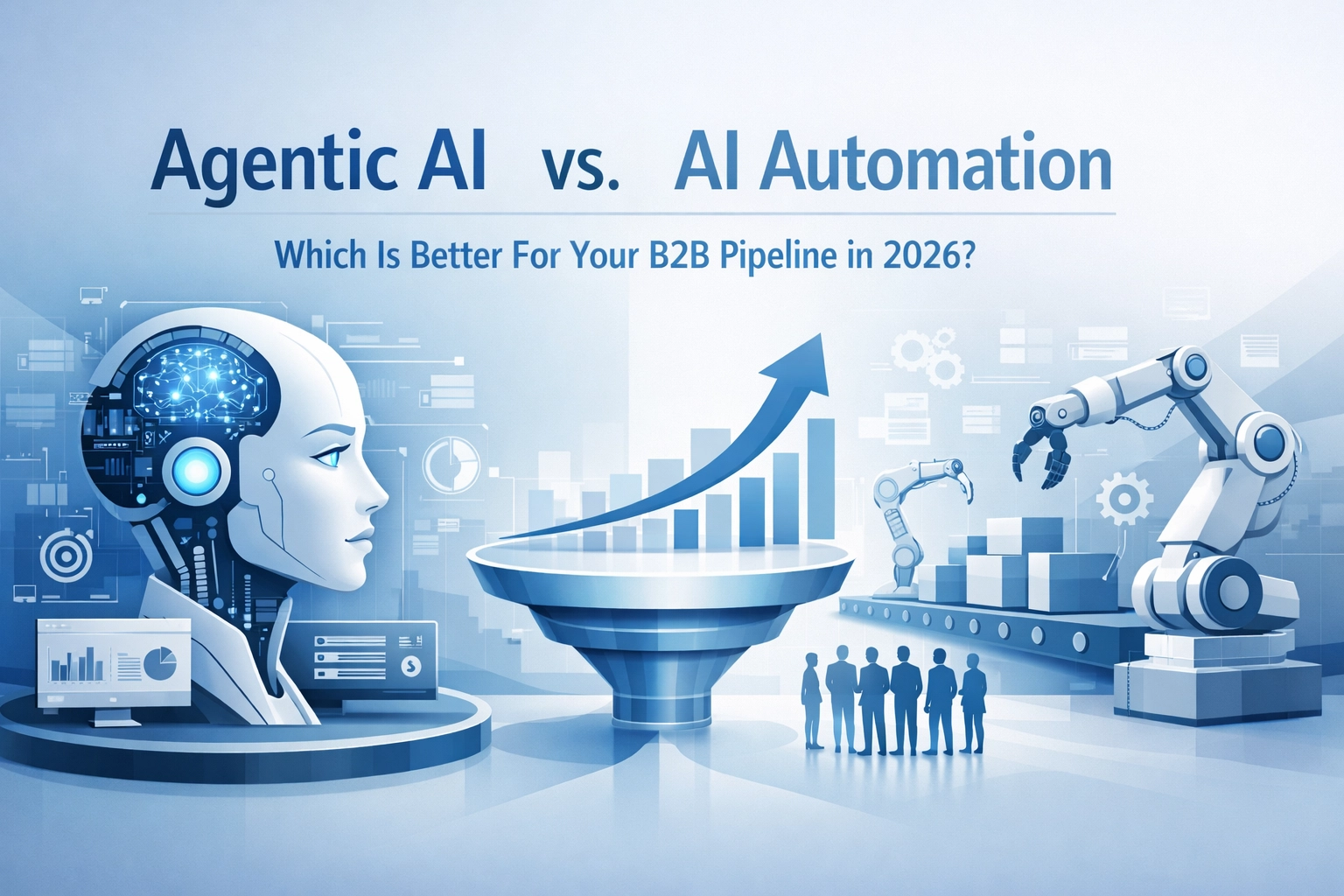
Agentic AI represents a fundamental shift from "doing" to "thinking." Instead of a human programmer defining every single step, we define the outcome.
For example, instead of telling a bot to "send email sequence A," we give an AI agent a goal: "Research this lead’s recent LinkedIn activity, cross-reference it with our internal case studies, and initiate a conversation that positions our AI sales solution as the answer to their specific growth bottleneck."
The agent then uses its reasoning layer to decide the best course of action. It can browse the web, check your CRM for past interactions, and even "self-correct" if the prospect's behaviour changes. This is the difference between a player piano that only plays one song and a live jazz musician who can riff based on the mood of the room.

3. The "Revenue Precision Engine": Our Strategic Framework
At AI Management Agency, we don't just "plug in" AI and hope for the best. We utilise what we call the Revenue Precision Engine. This is a strategic architecture designed specifically for B2B service firms looking to scale.
The Engine works by creating a single, governed layer of truth. It connects signals across your CRM, marketing platforms, and even sales call transcripts (which we analyse for deep insights).
By treating AI as a decision engine rather than just an analytical tool, the Revenue Precision Engine allows for non-disruptive integration. We don't ask you to bin your current CRM or change your entire sales team’s workflow. Instead, the agents sit on top of your existing stack, acting as an "Autonomous SDR" squad that works 24/7.
4. Head-to-Head: Agentic AI vs. Traditional Automation
| Feature | Traditional AI Automation | Agentic AI (2026 Standard) |
|---|---|---|
| Logic Basis | Fixed "If-This-Then-That" rules | Goal-oriented reasoning & logic |
| Personalisation | Segment-level (tags & fields) | Individual-level (context & memory) |
| Adaptability | Brittle; requires manual updates | Self-optimising; learns from data |
| Scaling | Linear (requires more human management) | Exponential (agents run in parallel) |
| Data Usage | Structured triggers only | Multi-source (CRM, Web, Intent data) |
| Implementation | 6–18 months for full maturity | 30–90 days for positive ROI |
5. Why Agentic AI Is Essential for B2B Service Scaling
If you’re moving from £1M to £5M, your biggest challenge is bandwidth. You cannot hire enough talented SDRs and Account Executives fast enough to handle the required lead volume without compromising on quality.
Agentic AI solves this by providing 24/7 coverage. These agents can handle the "heavy lifting" of lead generation and initial nurturing. They can answer complex FAQs, handle objections based on your company’s specific methodology, and only hand off to a human when the prospect is "sales-ready."
This doesn't just save time; it improves the prospect experience. In 2026, waiting four hours for a reply is four hours too long. An AI agent can provide a tailored, strategic response in four seconds. This speed-to-lead, combined with deep personalisation, is how you win in a crowded market.

6. Non-Disruptive Integration: How to Start
One of the biggest fears I hear from founders is: "Will this break what’s already working?" It’s a valid concern. You’ve spent years building your current processes.
The beauty of the current wave of agentic technology is its modularity. We recommend a phased approach:
- Identify the Bottleneck: Is it lead qualification? Is it following up with "cold" leads in your CRM?
- Pilot an Agent: Deploy a single autonomous agent to handle that specific task.
- Governance Layer: Ensure there are "human-in-the-loop" checkpoints to monitor quality and brand voice.
- Scale: Once the agent proves ROI, expand its remit across the pipeline.
By focusing on a non-disruptive integration, you maintain your current revenue stream while building the engine for your future growth.
7. Future-Proofing for 2026 and Beyond
The gap between those who use basic automation and those who leverage Agentic AI is widening. Research shows that 75% of companies are expected to invest in agentic systems by the end of this year. If you are still relying on static workflows, you aren't just falling behind; you’re becoming invisible to your market.
The goal isn't to replace your sales team. The goal is to give your team "superpowers." It’s about allowing your human experts to focus on building high-level relationships and closing the complex deals that require empathy and creativity, while the Revenue Precision Engine handles the relentless optimisation of the pipeline.
Frequently Asked Questions (FAQ)
Q: Is Agentic AI more expensive than traditional automation?
A: Initially, the setup may require more strategic input, but the ROI is significantly higher. Because it scales exponentially and requires less manual maintenance, the cost per lead and cost per acquisition usually drop by 15–20% within the first year.
Q: Does this replace my CRM?
A: Not at all. We believe in non-disruptive integration. Agentic AI acts as the "brain" that sits on top of your CRM (HubSpot, Salesforce, etc.), making your existing data more actionable.
Q: How do I know the AI won't say something "wrong" to a prospect?
A: We implement strict governance frameworks and "guardrails." Think of it as a training period. The agent is fed your brand guidelines, past successful emails, and "no-go" topics to ensure it stays perfectly on-brand.
Q: Can it handle multi-channel outreach?
A: Yes. Agentic AI can coordinate across LinkedIn, email, and even AI-powered call handling to ensure a consistent message regardless of where the prospect engages.
Conclusion: The Strategic Path Forward
The transition from £1M to £5M in pipeline is the "valley of death" for many B2B service firms. You’re too big to do everything manually, but you’re too small to survive the inefficiencies of traditional automation.
Agentic AI provides the bridge. By moving away from rigid rules and towards autonomous, goal-oriented systems, you can create a Revenue Precision Engine that scales with your ambition. The technology is no longer a luxury: it is the standard for 2026.
Ready to see how Agentic AI can transform your pipeline? Contact us today to discuss a strategic audit of your current sales and marketing stack. Let’s build the engine that takes you to £5M and beyond.