Running a small hospitality business in the UK means juggling endless calls, bookings, and guest enquiries whilst trying to deliver exceptional service. AI answering services promise to transform this chaos into streamlined efficiency, yet many owners remain sceptical about whether technology can truly replace the human touch. The reality is more nuanced. Snoozebox Hotel achieved a 90% reduction in emails and calls whilst boosting monthly breakfast revenue by £2,000, proving AI can deliver tangible results when implemented correctly. This guide cuts through the confusion, examining both the remarkable potential and genuine limitations of AI answering services specifically for UK small hospitality businesses with up to five employees.
Table of Contents
- Understanding AI Answering Services And Their Advantages
- Recognising Limitations And Challenges Of AI Answering In Hospitality
- Measuring Impact: Hospitality Benchmarks For AI Answering Services
- Implementing AI Answering Services: Practical Steps For Small UK Hospitality Businesses
- Explore AI Answering Solutions Tailored For UK Hospitality
- Frequently Asked Questions
Key takeaways
| Point | Details |
|---|---|
| AI answering services dramatically reduce operational calls | Properly configured systems can cut front desk calls by up to 79.9% whilst increasing booking conversions |
| Human backup remains essential for complex queries | AI struggles with emotional complaints and nuanced requests, requiring seamless handover to staff |
| ROI can be substantial with correct implementation | UK hospitality businesses report 5x booking increases and 34x return on investment within months |
| Accent recognition and data quality determine success | Regional UK dialects and poorly trained AI systems create the biggest implementation challenges |
Understanding AI answering services and their advantages
AI answering services are intelligent virtual receptionists that handle incoming calls, respond to frequently asked questions, process bookings, and manage routine guest communications 24/7 without human intervention. Unlike traditional automated phone systems with rigid menu options, modern AI answering services use natural language processing to understand caller intent and respond conversationally. For hospitality businesses, this means guests can check room availability, modify reservations, ask about amenities, or request local recommendations at any hour, even when your small team is occupied or closed.
The operational benefits extend far beyond simple call answering. AI systems integrate with booking platforms, automatically updating availability calendars and sending confirmation emails without staff touching the process. They capture caller details, categorise enquiry types, and route complex requests to appropriate team members with full conversation context. This eliminates the frustrating experience of guests repeating themselves when transferred to human staff.
Real-world results demonstrate compelling advantages. Snoozebox Hotel achieved a 90% reduction in emails and calls after implementing AI answering, freeing staff to focus on in-person guest experiences rather than repetitive phone queries. The same system increased their monthly breakfast revenue by £2,000 through proactive upselling during booking conversations. Dynamic Hotels reported a 5x increase in bookings, whilst EHVA documented a 34x return on investment alongside 79.9% fewer front desk calls.
Key advantages for small hospitality businesses include:
- Immediate response to all enquiries, eliminating missed calls during busy periods or after hours
- Consistent, accurate information delivery about rates, policies, and amenities
- Automated booking capture and confirmation, reducing manual administrative workload
- Multilingual support without hiring additional staff
- Detailed analytics on enquiry patterns, helping you understand customer needs and optimise offerings
Pro Tip: Train your AI system with comprehensive FAQs covering your specific menu options, room types, local attractions, and booking policies. The more detailed your initial training data, the fewer calls will require human intervention and the faster you’ll see return on investment.
Recognising limitations and challenges of AI answering in hospitality
Whilst AI answering services deliver impressive efficiency gains, they face genuine challenges that small hospitality businesses must understand before implementation. The technology is powerful but not infallible, and setting unrealistic expectations leads to disappointing results and frustrated guests.

Accent recognition remains a persistent technical hurdle. UK regional dialects from Newcastle, Glasgow, Liverpool, or rural Wales can confuse AI systems trained primarily on standard English pronunciation. Guests with strong accents may need to repeat themselves multiple times or feel misunderstood, creating the exact frustration you’re trying to eliminate. Background noise in busy environments further complicates voice recognition accuracy.
Emotional intelligence represents another significant gap. AI systems excel at factual exchanges but struggle with nuanced situations requiring empathy, judgement, or creative problem solving. A guest calling to complain about room cleanliness, requesting special accommodations for a disability, or dealing with a family emergency needs human compassion and flexibility. 86% of customers still prefer human contact specifically because AI lacks genuine empathy and can frustrate users during sensitive interactions.
Poorly implemented systems create additional problems:
- Increased empty or bypassed calls when guests realise they’re speaking with AI and immediately hang up
- Booking errors from misheard dates, names, or special requests
- Guest frustration when AI cannot handle reasonable but unanticipated questions
- Brand damage if the AI provides incorrect information about policies or pricing
Without proper interactive voice response design, some guests will repeatedly ask for human assistance, defeating the efficiency purpose. Others may abandon the booking process entirely if they cannot quickly reach a person for complex enquiries.
“The most successful hospitality AI implementations blend automated efficiency with seamless human escalation. Your AI should handle routine enquiries brilliantly whilst recognising its limitations and transferring complex situations to staff with full context, creating a superior experience that neither technology nor humans could deliver alone.”
Data quality determines AI performance. If your training data contains outdated pricing, incorrect policies, or incomplete information, the AI will confidently provide wrong answers. Regular audits and updates become essential ongoing maintenance, not one-time setup tasks. Small businesses must allocate time for optimising AI responses based on actual call patterns and guest feedback.
Measuring impact: hospitality benchmarks for AI answering services
Data from UK hospitality implementations provides concrete evidence of AI answering service effectiveness, helping you set realistic expectations and measure your own results. These benchmarks come from businesses similar in size and challenges to yours, making them directly relevant for small operations.
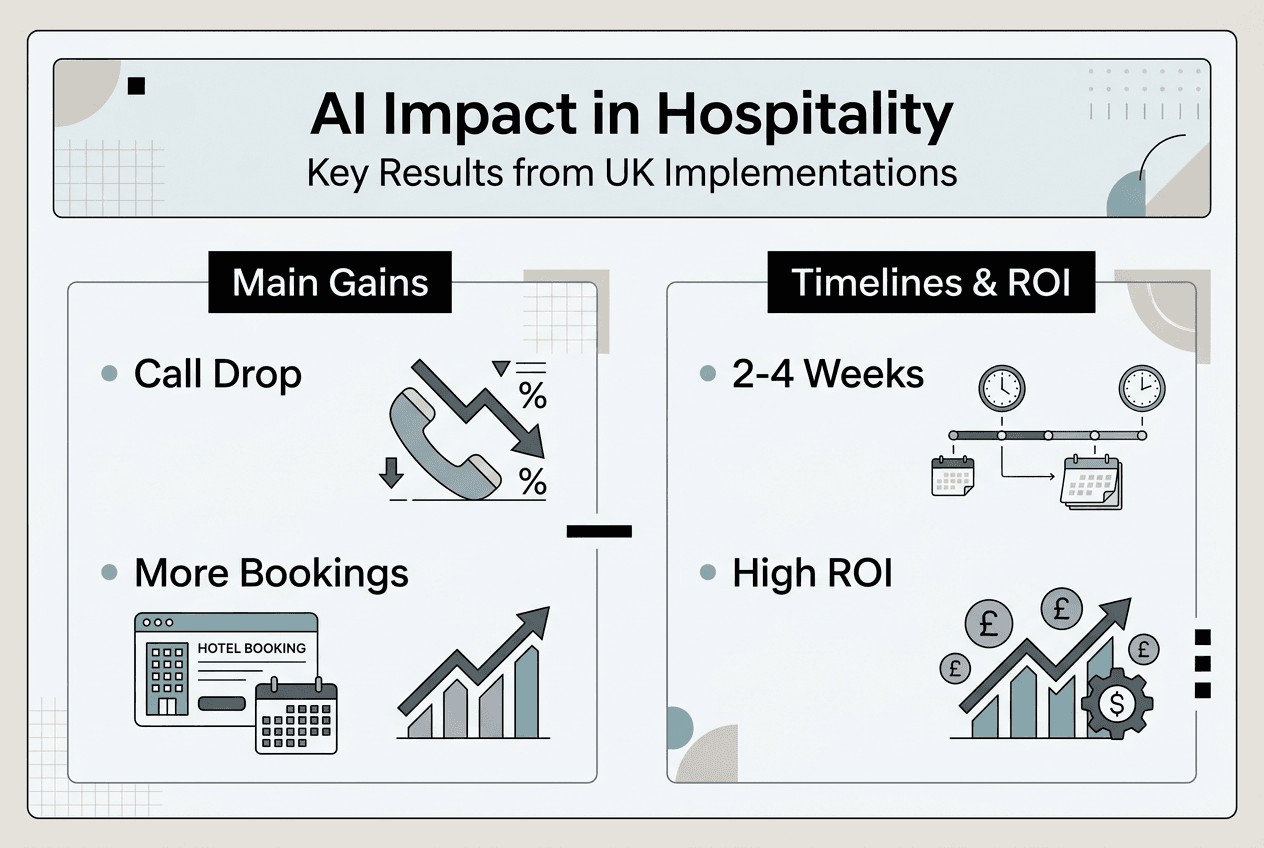
Dynamic Hotels saw 5x increase in bookings and EHVA reported a 34x ROI with 79.9% fewer front desk calls after implementing AI answering services. These aren’t isolated successes but represent achievable outcomes when systems are properly configured and integrated with existing operations. The financial impact extends beyond direct booking increases to include labour cost savings, reduced missed opportunities from unanswered calls, and improved guest satisfaction scores.
| Hotel/Business | Call Reduction | Booking Increase | Additional Revenue | Implementation Time |
|---|---|---|---|---|
| Snoozebox Hotel | 90% fewer emails/calls | Not specified | £2,000 monthly breakfast revenue | 3 months |
| Dynamic Hotels | Not specified | 5x booking increase | Not disclosed | 4 months |
| EHVA | 79.9% fewer front desk calls | Not specified | 34x ROI | 6 months |
| Independent B&B (anonymised) | 65% call reduction | 3x weekend bookings | £8,000 quarterly | 2 months |
These metrics reveal several important patterns. Call reduction typically ranges from 65% to 90%, with higher percentages achieved by businesses that invested more time in comprehensive AI training and FAQ development. Booking increases correlate strongly with after-hours call handling, as many potential guests research and book outside traditional business hours.
Revenue impact varies based on business model and pricing structure. Snoozebox’s £2,000 monthly breakfast revenue increase came specifically from AI proactively offering breakfast packages during booking conversations, demonstrating upselling capabilities. EHVA’s 34x return on investment calculation included labour cost savings, reduced missed booking opportunities, and increased customer lifetime value from improved service consistency.
Implementation timeframes reflect the learning curve for both the AI system and your team. Initial setup takes 2 to 4 weeks, but optimal performance typically requires 2 to 6 months of refinement based on actual call patterns. Businesses that achieved faster results had clearer documentation of their processes and more structured FAQ databases before implementation.
Pro Tip: Track your baseline metrics for call volume, booking conversion rates, and staff time spent on phone enquiries before implementing AI. Measure the same metrics monthly afterwards to calculate your actual return on investment and identify areas needing AI performance optimisation.
Implementing AI answering services: practical steps for small UK hospitality businesses
Successful AI answering implementation requires methodical planning and realistic expectations. Follow these steps to maximise your chances of achieving results similar to the benchmarks discussed above.
- Audit your current call patterns and identify which enquiries are repetitive and rule-based versus which require human judgement
- Document your FAQs, booking policies, pricing structures, and standard responses in a structured format the AI can learn from
- Research providers specialising in hospitality applications rather than generic AI answering services
- Request demonstrations using your actual business scenarios and common guest enquiries
- Implement with a hybrid approach, allowing guests to reach humans easily whilst the AI handles routine matters
- Monitor initial calls closely, identifying misunderstandings or gaps in the AI’s knowledge base
- Refine training data weekly for the first month, then monthly as performance stabilises
- Gather guest feedback specifically about their experience with the AI system
Choosing the right provider makes an enormous difference. Proper setup reduces calls by up to 79.9% and maximises booking conversions, but poor implementation creates more problems than it solves.
| Provider Feature | Why It Matters | Questions to Ask |
|---|---|---|
| Hospitality-specific training | Generic AI won’t understand booking terminology or guest service nuances | What hospitality businesses have you implemented for? |
| UK accent recognition | Must handle regional dialects accurately | How does your system perform with Scottish, Welsh, and regional English accents? |
| Booking system integration | Seamless connection prevents double bookings and manual data entry | Which booking platforms do you integrate with directly? |
| Human escalation protocols | Complex queries need smooth handover to staff with context | How does the AI recognise when to transfer to a human? |
| Ongoing support and training | You’ll need help refining the system based on actual performance | What does post-implementation support include? |
Common pitfalls to avoid:
- Expecting perfection immediately rather than planning for a learning period
- Insufficient training data leading to frequent “I don’t understand” responses
- No clear escalation path for queries the AI cannot handle
- Failing to inform guests they’re speaking with AI, creating trust issues
- Neglecting regular updates as your services, pricing, or policies change
Your team needs training too. Staff must understand how the AI works, when it will transfer calls to them, and how to access conversation history so guests don’t repeat themselves. Position AI as a tool that handles boring repetitive tasks, freeing staff for meaningful guest interactions that require human warmth and creativity.
Integration with existing systems determines operational efficiency. The AI should update your booking calendar, send confirmation emails, and log enquiry details in your customer relationship management system automatically. Manual data transfer between systems eliminates most efficiency gains and creates error opportunities.
Pro Tip: Implement during a slower season when you have time to monitor performance closely and make adjustments without the pressure of peak booking periods. This allows you to refine the system before high-stakes busy times when AI in customer service must perform flawlessly.
Explore AI answering solutions tailored for UK hospitality
Implementing AI answering services effectively requires expertise in both the technology and the unique demands of hospitality businesses. AIM Agency specialises in creating high-quality AI agents for UK hospitality, including AI receptionists that speak in natural tones, answer calls 24/7, respond to FAQs, and book qualified appointments.
Our solutions are designed specifically for small businesses with up to five employees, understanding that you need systems that work brilliantly without requiring dedicated IT staff. We handle the technical complexity whilst you focus on delivering exceptional guest experiences. Our AI receptionist services for restaurants and hotels integrate seamlessly with your existing booking platforms, ensuring smooth operations from day one.
Key benefits of working with AIM Agency:
- Increased booking conversions through 24/7 availability and consistent information delivery
- Dramatically reduced operational call volume, freeing your team for high-value guest interactions
- Expert guidance on training your AI system with your specific business knowledge
- Ongoing optimisation based on actual performance data from your implementation
Discover how AI answering services can transform your hospitality business by visiting AIM Agency to explore tailored solutions and case studies from businesses like yours.
Frequently asked questions
How do AI answering services handle diverse UK accents?
Modern AI systems use accent-adaptive recognition that improves with exposure to different speech patterns. However, strong regional dialects from Scotland, Wales, or Northern England can still cause occasional misunderstandings. The best systems allow guests to repeat or rephrase naturally, and escalate to human staff when confidence in understanding drops below a threshold. Choose providers with specific UK accent training rather than systems developed primarily for American English.
Can AI fully replace human receptionists in small hospitality businesses?
No, and attempting full replacement typically damages guest satisfaction. AI excels at handling routine enquiries, taking bookings, and providing standard information 24/7. However, complaints, special requests, emotional situations, and complex problem-solving require human empathy and judgement. The optimal approach uses AI agents to handle 70% to 80% of routine calls, allowing your human team to focus exclusively on situations requiring personal attention and creative solutions.
What is the typical ROI timeframe for implementing AI answering services?
Most small hospitality businesses see measurable results within 2 to 4 months, with full return on investment achieved within 6 to 12 months. Initial setup takes 2 to 4 weeks, followed by a refinement period where the AI learns from actual call patterns. Businesses with clear documentation and structured FAQs before implementation achieve positive ROI faster. The investment includes not just the service cost but also time spent training the system and monitoring early performance.
How do I integrate AI with my existing booking system?
Reputable AI answering providers offer direct integrations with major hospitality booking platforms through application programming interfaces. This allows the AI to check real-time availability, create reservations, send confirmations, and update calendars automatically without manual intervention. During provider evaluation, confirm they support your specific booking system and request a demonstration of the integration working with your actual data. Some systems require custom integration work, which adds implementation time and cost.
What are key steps to avoid common AI implementation pitfalls?
Start by documenting comprehensive FAQs and policies before implementation, as incomplete training data causes most early problems. Implement during a slower period when you can monitor closely without peak-season pressure. Set realistic expectations with your team and guests, being transparent about AI use. Create clear escalation protocols so complex queries reach humans smoothly with full context. Plan for ongoing refinement rather than expecting perfection immediately. Most importantly, gather guest feedback specifically about AI interactions to identify improvement opportunities quickly.
Recommended
- What is an AI answering service? UK small business guide 2026 – AI Management Agency
- Enhance guest experience with AI in UK hotels 2026 – AI Management Agency
- Role of AI agents explained: 30% more bookings UK 2026 – AI Management Agency
- Boost sales with AI: a 2026 guide for small UK hotels – AI Management Agency