TL;DR:
- Most UK hotels mistakenly believe their AI needs are met by simple chatbots, but true AI agents autonomously complete tasks within live systems. These agents require robust API integrations, proper governance, and careful scaling to deliver operational and revenue benefits. Early adoption should focus on low-risk, repetitive tasks and ensure compliance with evolving regulations for maximum effectiveness.
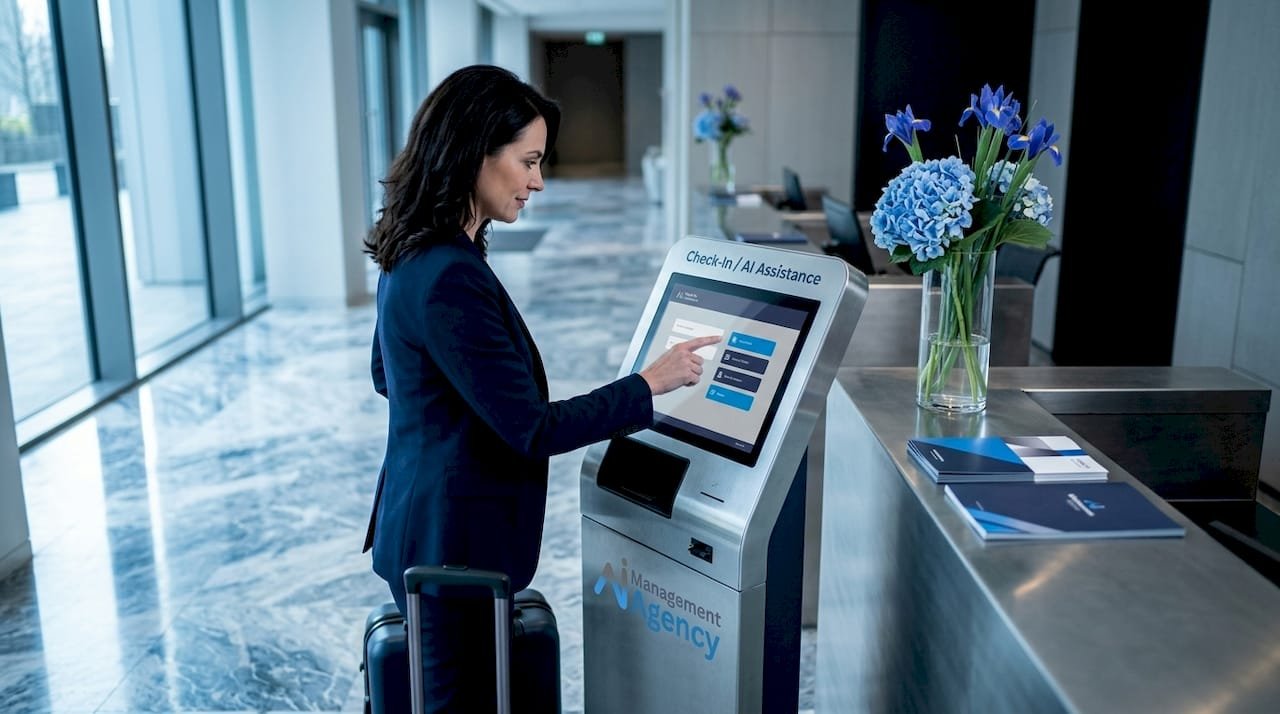
Most UK hotel managers assume they already have AI covered because they installed a chatbot two years ago. They don’t. AI agents in hospitality are a fundamentally different technology, and the distinction matters more than most people realise. Where a chatbot reads from a script, an AI agent reasons, acts, and completes tasks inside your live systems autonomously. This guide explains exactly how that works, what it means for your operations and revenue, and what you need to get right before deploying one in your property.
Table of Contents
- Key takeaways
- How AI agents actually work in hotels
- The operational benefits for UK hotels
- Challenges and how to avoid them
- Real use cases worth considering
- My honest view on AI agents in hospitality
- How Aimagency helps UK hotels deploy AI agents
- FAQ
Key takeaways
| Point | Details |
|---|---|
| AI agents go beyond chatbots | They reason and act within live systems, not just respond to pre-set questions from a script. |
| System integration is non-negotiable | Agents need API access to your PMS, booking engine, and payment systems to deliver real operational value. |
| Adoption is accelerating fast | 82% of hospitality professionals plan to expand AI use in 2026, making early movers a significant competitive advantage. |
| Governance protects your business | Human-in-the-loop safeguards and data traceability are not optional extras. They are structural requirements. |
| Start small, then scale | Automate repetitive low-value queries first, prove the value, and expand to booking and upselling workflows. |
How AI agents actually work in hotels
The phrase “AI agent” gets used loosely, so let’s be precise. An AI agent is a goal-directed, task-completing system that interacts with live data and external tools. A chatbot, by contrast, matches guest questions to pre-written answers. The difference in practical terms is enormous.
When a guest messages your hotel at 11pm asking to book a spa treatment for tomorrow morning, a chatbot tells them to call reception in the morning. An AI agent checks the spa calendar in real time, confirms availability, books the slot, charges the guest’s card, and sends a confirmation. No staff member involved. No friction. No lost revenue.
This capability depends on how the agent connects to your systems. A well-built agent integrates via APIs with your:
- Property Management System (PMS) to access room availability and guest profiles
- Booking engine to confirm and modify reservations
- Payment gateway to process charges and refunds
- CRM or guest data platform to retrieve preferences and history
That integration stack is what separates a genuine AI agent from a sophisticated FAQ tool. Platforms like OwlTing’s OwlPay, launching mid-2026, are already building dedicated infrastructure to support AI-initiated bookings, payment acceptance, and cross-border settlement for over 2,800 hotel clients. The direction of travel is clear: end-to-end agentic transactions are becoming the standard.
Pro Tip: When evaluating an AI agent platform, ask vendors specifically which APIs they support natively. A system that requires manual data exports is not a true AI agent. It’s expensive automation with a chatbot front end.
Beyond reactive tasks, agents can also be proactive. Using live occupancy data and guest preference history, an agent can identify that a returning guest who always books a sea-view room is arriving on a low-occupancy weekend and send a personalised upgrade offer at exactly the right moment. That kind of proactive guest engagement is where revenue gains become material.
The operational benefits for UK hotels
The numbers behind AI adoption in hospitality are significant, and they align with what operators are experiencing on the ground. In 2026, 85% of hospitality professionals plan to allocate at least 5% of their IT budgets to AI tools, with 71% describing AI’s impact as significant or transformational.
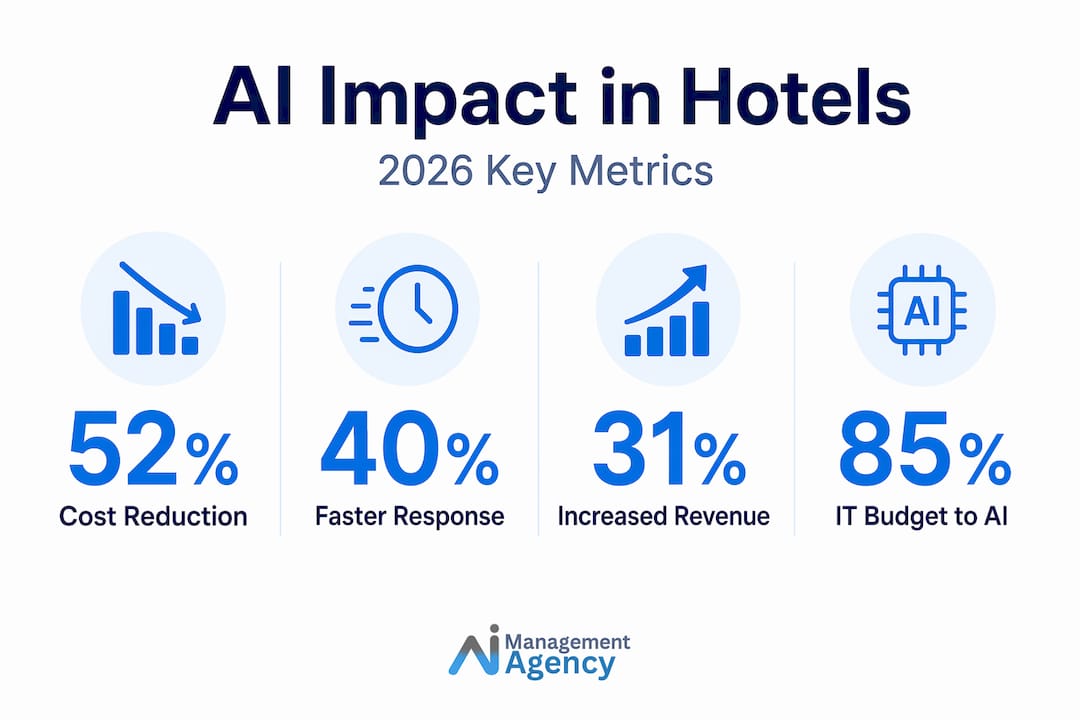
The table below outlines the core operational areas where AI agents deliver measurable impact.
| Operational area | What the agent does | Typical benefit |
|---|---|---|
| Guest enquiries | Handles FAQs, room queries, local info 24/7 | Up to 45% productivity lift in guest-facing roles |
| Upselling | Sends personalised upgrade offers based on live occupancy | Increased ancillary revenue without additional headcount |
| Booking management | Modifies, confirms, and cancels reservations autonomously | Fewer calls to front desk; faster resolution times |
| Direct booking conversion | Engages website visitors and moves them to booking completion | Reduced OTA dependency and commission costs |
For many UK hotels, the most immediate win is front-desk call volume. Staff at busy properties spend a disproportionate amount of their time answering the same twenty questions repeatedly: car park instructions, check-in times, late checkout policies, restaurant hours. An AI agent handles all of that automatically, freeing your team to focus on interactions that actually require a human presence and emotional intelligence.
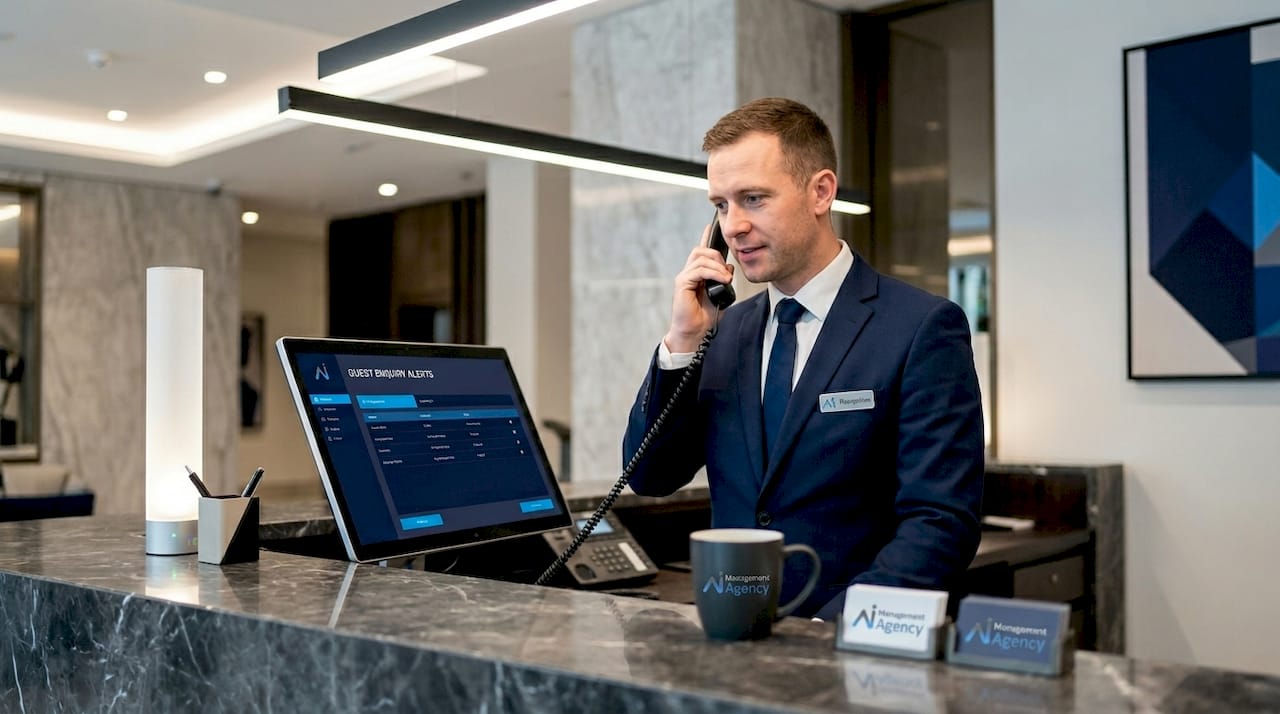
The revenue side is equally compelling. A well-configured agent doesn’t wait for a guest to ask about an upgrade. It identifies the right moment, based on availability, guest profile, and booking history, and makes a targeted offer. That 24/7 upselling capability operates without fatigue or inconsistency.
Pro Tip: Don’t remove human agents from sensitive touchpoints like complaints, bereavement accommodations, or complex group bookings. Design your AI agent to escalate those conversations immediately. The best deployments treat the agent as your most reliable junior staff member, not a replacement for your most experienced one.
Challenges and how to avoid them
Most AI agent pilots in hospitality fail for one of two reasons: poor system integration or poor governance. Understanding both before you start will save you considerable time and money.
The integration problem is straightforward. Most failed AI agent pilots lack connection to operational authority layers such as booking confirmation and payment authorisation. An agent that can only hold a conversation but cannot actually complete a transaction has limited commercial value. Ensure your deployment separates conversational intent capture from execution authority, with each layer handling its specific function reliably.
The governance challenge is less obvious but equally critical. When AI agents make decisions autonomously, those decisions need to be traceable, persistent, and recoverable. Systems like OpenClaw’s AI execution layer demonstrate how to build this correctly: escalating unresolved issues to humans, maintaining full audit logs of agent actions, and structuring data so that every decision can be reviewed after the fact.
Here are the non-negotiable governance requirements for any UK hotel deploying AI agents:
- Traceability. Every agent decision must be logged with a timestamp, the data inputs used, and the outcome. This is not optional if you want audit compliance.
- Human escalation paths. Define exactly which task categories require human approval before the agent acts. Financial refunds above a threshold, HR-sensitive queries, and complaint escalations are typical examples.
- Data recoverability. If the agent makes an error, your team needs to be able to identify what happened, reverse it if necessary, and update the agent’s behaviour.
UK hotel operators with EU-facing guest operations also need to account for the regulatory environment. The EU AI Act full requirements apply from 2 August 2026, including transparency requirements for guest-facing AI systems and high-risk classifications for tools that use facial recognition or influence staff scheduling decisions. Automated decisions that affect guests also trigger GDPR considerations. Discuss these obligations with your legal counsel before deployment, not after.
Real use cases worth considering
The most useful way to think about where to start is to ask: which tasks in my hotel are repetitive, predictable, and time-consuming for staff? Those are your highest-return deployment targets.
Here is how AI agents compare to legacy chatbots across common hotel workflows:
| Scenario | Legacy chatbot | AI agent |
|---|---|---|
| Guest asks about room availability | Shows static FAQ response | Checks live PMS, confirms availability, offers booking |
| Returning guest contacts hotel | No memory of past interactions | Recognises guest, references preferences, personalises response |
| Guest wants restaurant reservation | Provides phone number for restaurant | Checks availability, books table, sends confirmation |
| Upsell opportunity identified | Cannot initiate contact | Sends proactive offer based on occupancy and guest profile |
Beyond these individual tasks, the personalised travel experiences that guests increasingly expect require data-driven communication at every touchpoint. An agent that knows a guest prefers a quiet room, arrived by train last time, and typically orders room service on the first evening can tailor the entire pre-arrival communication sequence accordingly.
For direct booking conversion, the impact can be equally significant. Agents integrated with your booking engine can engage hesitant website visitors, answer questions about specific room types, and move them from browsing to confirmed reservation without the guest ever speaking to a human. For properties paying 15 to 18% OTA commissions, recovering even a portion of those bookings through direct channels adds up quickly. You can see how this plays out in practice across UK hotel deployments.
The key factors for a successful deployment include:
- Connecting agents to your revenue management system so they can make dynamic upgrade offers based on real-time room availability
- Ensuring guest data from your CRM feeds into the agent so every interaction feels personal, not generic
- Building pre-arrival messaging workflows that gather preferences, share arrival information, and introduce relevant services before the guest even arrives
My honest view on AI agents in hospitality
I’ve spent considerable time working with hospitality businesses on AI adoption, and I want to share something that doesn’t always make it into the conversation: most hotels are not yet ready to deploy a sophisticated AI agent, and that’s fine. Readiness is buildable.
What I’ve seen consistently is that hotels with clean, integrated data and clearly defined operational workflows get strong results from AI agents. Hotels with siloed systems, outdated PMS setups, and no clear ownership of guest data struggle regardless of how good the agent itself is. The technology isn’t the variable. The data infrastructure is.
My advice is to start with automated call handling and FAQ resolution. These are low-risk, high-volume tasks where the agent proves its value quickly and without significant governance complexity. Once your team trusts the system and you’ve seen it handle the predictable 80% of guest queries reliably, you scale into booking modifications, upselling, and proactive guest engagement.
I’d also caution against treating compliance as an afterthought. With EU AI Act requirements now in force, the cost of retrofitting governance into a deployed system is substantially higher than building it correctly from the start. Work with vendors who can demonstrate audit logging and human escalation design before you sign anything.
The opportunity here is real and the timing is right. But the hotels that benefit most will be the ones that approach this with clarity about their systems, their workflows, and their governance requirements. Not the ones that move fastest.
— Geoff
How Aimagency helps UK hotels deploy AI agents
Aimagency specialises in building high-quality AI agents designed specifically for UK hospitality businesses. From an AI receptionist for hotels that answers calls 24/7 in a natural tone, handles FAQs, and books qualified appointments, to fully integrated agents that connect with your PMS and booking engine, the solutions are built around your operational reality. Aimagency works with hotel owners and managers to identify the right starting point, design human escalation paths that protect your business, and scale deployments as confidence grows. If you want to understand the advantages AI agents offer your specific property, and get a clear roadmap for implementation, get in touch with the team today.
FAQ
What is the difference between a chatbot and an AI agent in hotels?
A chatbot follows a fixed script and matches questions to pre-written answers. An AI agent reasons and acts within live systems, completing tasks such as bookings, payments, and personalised offers autonomously.
Are AI agents in hospitality compliant with UK and EU regulations?
UK operators with EU-facing operations must meet EU AI Act requirements from August 2026, including transparency for guest-facing AI and GDPR compliance for automated decisions. Legal review before deployment is strongly recommended.
How much should a UK hotel budget for AI agents?
Industry data shows 85% of hospitality businesses plan to allocate at least 5% of their IT budgets to AI in 2026. This is a reasonable baseline for hotels entering the market competitively.
Which hotel tasks should AI agents handle first?
Start with repetitive, high-volume queries such as check-in times, parking information, and room availability. These tasks deliver immediate staff time savings and allow you to build confidence in the system before scaling to bookings and upselling.
Do AI agents replace hotel reception staff?
No. The most effective deployments use a human-in-the-loop model where the agent handles routine tasks and escalates sensitive or complex interactions to your team. This protects service quality and manages operational risk.