TL;DR:
- AI guest query systems, including chatbots and virtual concierges, provide real-time responses and personalized service. Small UK hotels benefit from increased bookings, operational efficiency, and better guest reviews by integrating AI with property systems and balancing human interaction. Implementing AI requires proper training, legal compliance, and a clear escalation process to ensure trust and optimal performance.
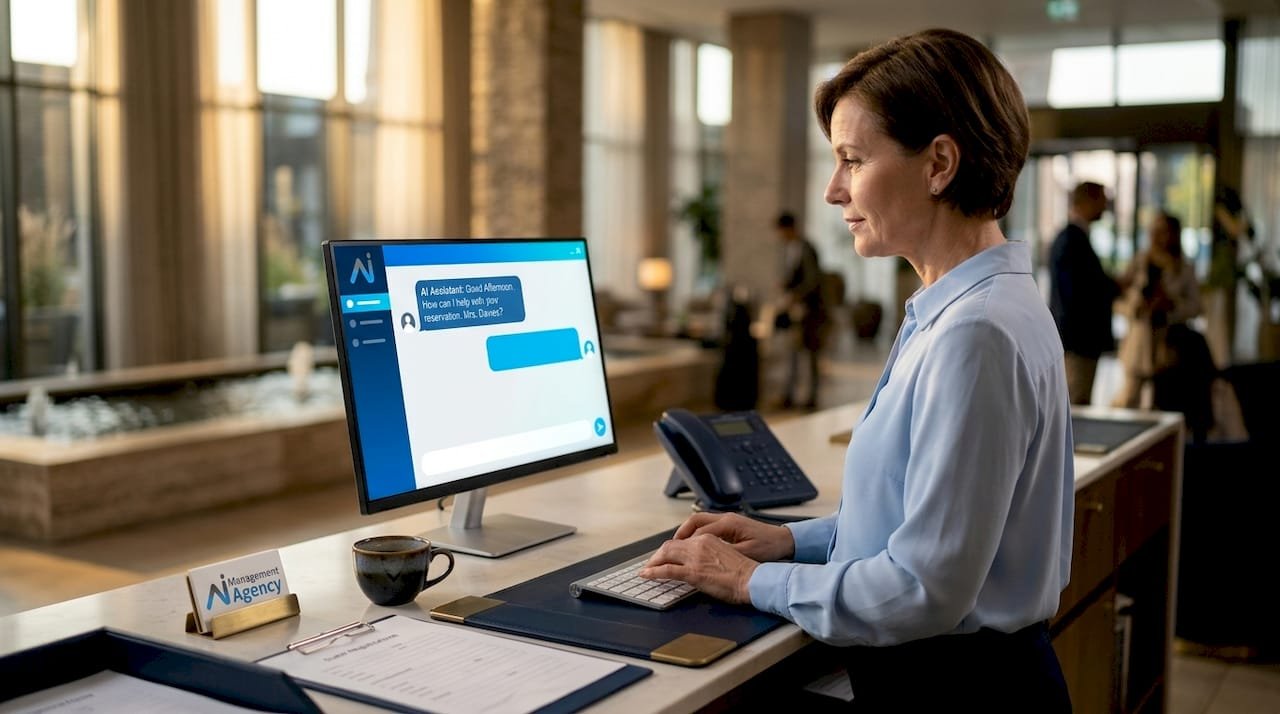
AI guest query handling is defined as the use of automated systems, including chatbots, virtual concierges, and AI Voice Agents, to respond to guest questions in real time, around the clock, without requiring a human agent. For small UK hotel owners, the question of why use AI for guest queries has a direct commercial answer: faster responses increase bookings, reduce staff workload, and lift guest satisfaction scores simultaneously. With 92% of hotels now using AI-powered messaging and average response times dropping to three seconds, the gap between early adopters and those still relying on phone calls and email is widening fast.
Why use AI for guest queries instead of traditional methods
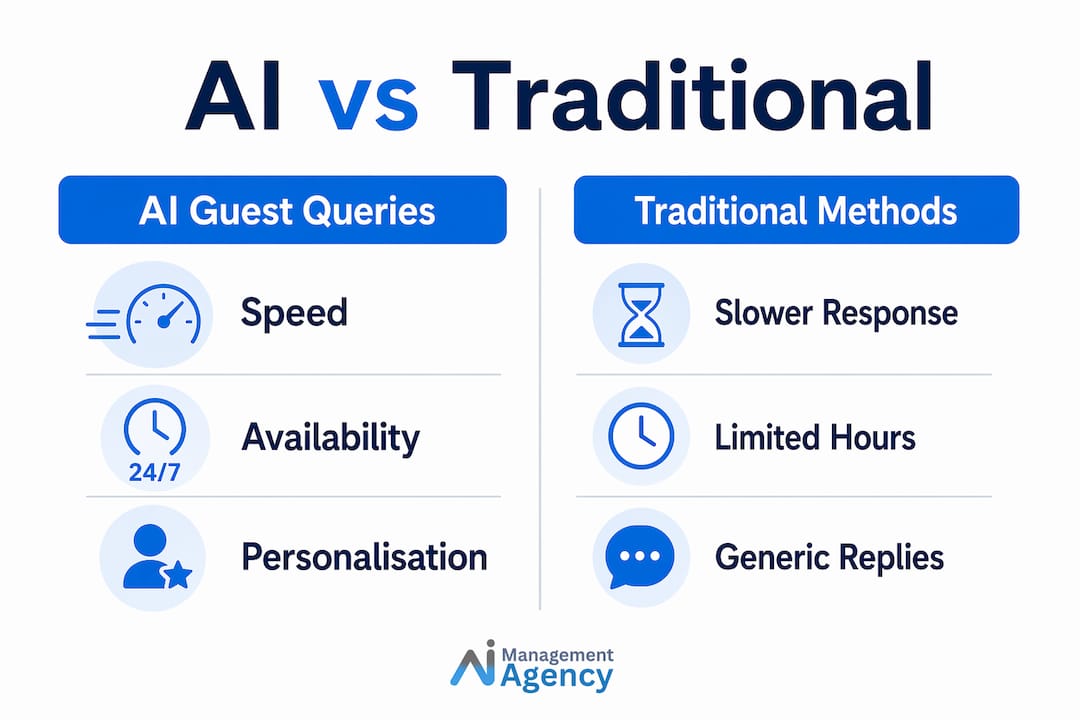
The most visible difference between AI and traditional guest communication is speed. A guest browsing your website at 11pm asking about parking, breakfast times, or late checkout does not want to wait until morning. AI reduces average query response time from several minutes to under three seconds, which directly affects whether that guest completes a booking or moves on to a competitor.
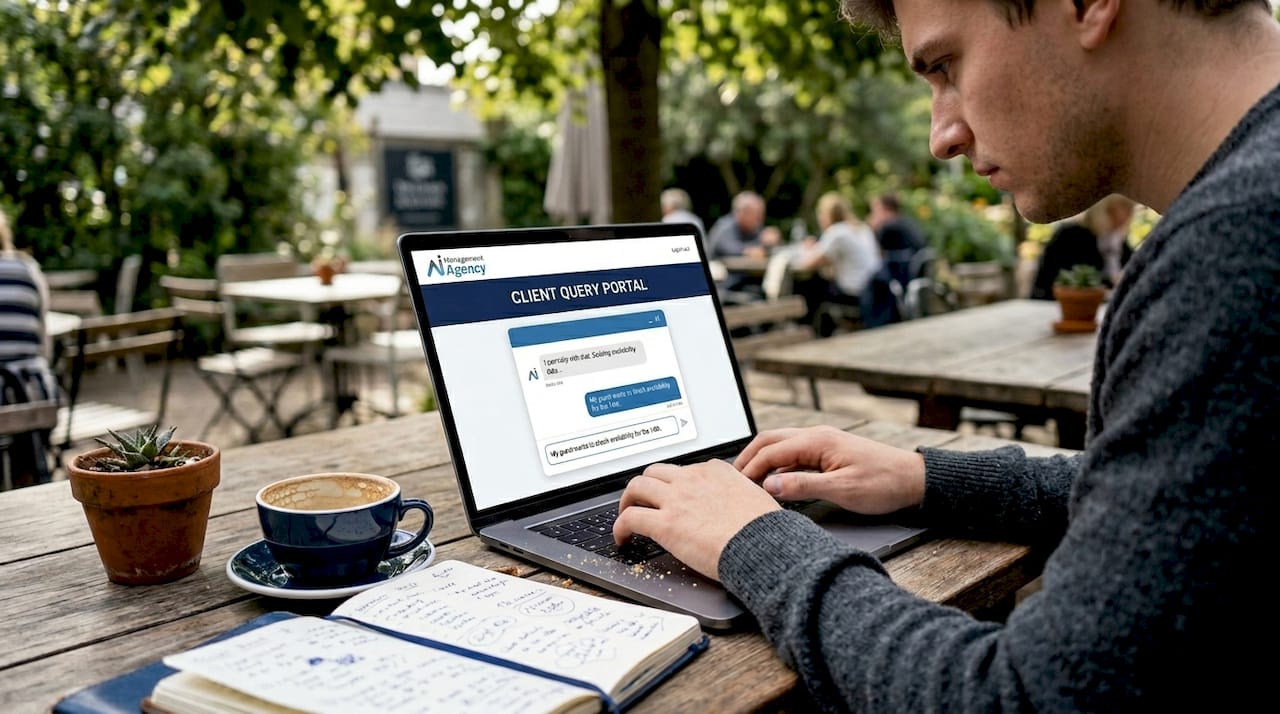
The scale advantage is equally significant. AI chatbots handle 70 to 80% of routine guest queries without any human involvement. That means your front desk team spends less time answering the same ten questions repeatedly and more time on the interactions that genuinely require their attention.
Personalisation is where AI moves beyond simple FAQ automation. When connected to your property management system (PMS) or CRM, an AI agent can reference a returning guest’s previous stay preferences, address them by name, and offer relevant upgrades. This is the difference between a generic auto-reply and a response that feels considered. For examples of AI in guest communication tailored to UK hotels, the contrast with static FAQ pages is stark.
Compare the three approaches side by side:
| Method | Response time | Availability | Personalisation |
|---|---|---|---|
| Human agent | 5 to 30 minutes | Business hours only | High, but inconsistent |
| Static FAQ page | Instant | 24/7 | None |
| AI guest query system | Under 3 seconds | 24/7 | High, data-driven |
Key business benefits of AI for small UK hotels
The revenue case for AI in hospitality is well established and growing. Hotels using AI-driven upselling see acceptance rates of 18 to 25% on room upgrades, roughly double the rate achieved by human agents. That uplift comes from timing: AI delivers upgrade offers at the precise moment a guest is engaged, such as during pre-arrival messaging, rather than at a busy check-in desk.
The four core business benefits for small hotels are:
- Direct booking growth. Integrating AI with your PMS, RMS, and CRM gives the system access to real-time inventory and pricing. AI chatbot integration with PMS boosts direct bookings by 15 to 22%, reducing commission paid to OTAs.
- Operational efficiency. Staff freed from repetitive query handling can focus on in-person guest experience, maintenance coordination, and revenue-generating tasks.
- Improved review scores. Post-stay AI messaging increases review submission rates by 40% compared to standard email campaigns. Conversational AI feels less transactional, and it can route negative feedback to a manager before it reaches TripAdvisor or Google.
- Data-driven improvement. Every AI interaction generates structured data on what guests ask, when they ask it, and where conversations break down. This intelligence informs staffing decisions, FAQ updates, and service improvements.
Pro Tip: Connect your AI system to your CRM from day one. Guest preference data captured during AI interactions becomes a permanent record that improves every future stay, not just the current one.
How to balance AI automation with human interaction
The most common mistake small hotels make is treating AI as a full replacement for human contact. 59% of hoteliers believe front desk and check-in moments should remain human-led, even as AI handles the majority of pre-arrival and routine queries. That instinct is commercially sound. Trust is built in person, and no AI system should be positioned between a guest and a warm welcome.
The practical model that delivers the highest return is AI-first with human-in-the-loop escalation. Routine and transactional queries go to the AI. Complex complaints, sensitive requests, and high-value guests get transferred to a human agent with full context already shared.
The handoff quality matters enormously. Sharing guest identifiers, query history, and AI confidence levels on transfer means the guest never has to repeat themselves. That single detail separates a frustrating experience from a smooth one.
Key principles for a well-balanced AI and human model:
- Use AI for check-in information, directions, amenity questions, booking amendments, and upsell offers.
- Reserve human agents for complaints, accessibility requirements, VIP guests, and emotionally sensitive situations.
- Set clear escalation triggers: if the AI cannot resolve a query within two exchanges, transfer automatically.
- Train your team to pick up AI-transferred conversations without asking the guest to start over.
Pro Tip: Review your escalation logs weekly for the first three months. The queries your AI fails to resolve are a direct map of the knowledge gaps you need to fill.
What UK hoteliers need to know about AI compliance
Deploying an AI chatbot or virtual concierge in the UK carries legal obligations that many small hotel owners overlook. The EU AI Act classifies guest-facing chatbots as limited-risk AI applications under Article 50, which requires you to inform guests clearly that they are interacting with an AI system. This is not optional. Failing to disclose AI use exposes your business to regulatory risk and, more practically, erodes guest trust when they discover it independently.
GDPR adds a further layer of obligation. If your AI system profiles guests or makes automated decisions that affect their stay, Article 22 of GDPR applies. Guests have the right to request human review of automated decisions, and your privacy policy must reflect how AI processes their data.
Practical compliance steps for UK hotel operators:
- Display a clear disclosure at the start of every AI conversation: “You are chatting with an AI assistant.”
- Update your privacy policy to include AI data processing, profiling, and guest rights.
- Ensure your AI provider signs a Data Processing Agreement (DPA) under UK GDPR.
- Document your AI governance policy. Hotels with formal AI governance report 92% trust in their AI tools versus 49% without one.
- Review your AI system’s data retention settings to align with your existing guest data policies.
For a detailed overview of the legal and compliance aspects relevant to AI guest service in UK hotels, including GDPR and AI Act obligations, the regulatory picture is more manageable than it first appears when you approach it methodically.
How to implement AI guest query solutions in a small hotel
Successful implementation follows a clear sequence. Rushing to deploy without proper integration or training is the single biggest cause of poor AI performance and guest frustration.
- Choose a solution with PMS, RMS, and CRM integration. An AI agent without access to live booking data, room availability, and guest history cannot personalise responses or handle booking amendments. Integration is not a nice-to-have; it is the foundation.
- Train the AI on your property. Load your AI with specific knowledge: room types, policies, local attractions, parking details, breakfast hours, and your cancellation terms. Generic AI performs generically. Property-specific AI performs well.
- Set escalation protocols before you go live. Define exactly which query types trigger a human handoff, and test those triggers before guests encounter them. The AI-first plus human escalation approach only works when the handoff is smooth and context is transferred automatically.
- Monitor resolution rates continuously. Only 24% of AI interactions fully resolve without human involvement at initial deployment. That figure improves significantly with ongoing tuning, but only if you are actively measuring it.
- Maintain a consistent brand voice. Your AI should sound like your hotel, not a generic customer service bot. Adjust tone, vocabulary, and response style to match your brand. Guests notice the difference.
Pro Tip: Start with a limited deployment covering your ten most frequently asked questions. Measure resolution rates for four weeks, refine the knowledge base, then expand. This approach reduces risk and builds confidence in the system before it handles complex queries.
For practical guidance on training AI for hotel staff, the process is more straightforward than most hotel owners expect once the right framework is in place.
Key takeaways
AI guest query systems deliver the highest return when they combine real-time data integration, property-specific training, and a clear human escalation protocol.
| Point | Details |
|---|---|
| Speed and availability | AI responds in under 3 seconds, 24/7, capturing bookings that would otherwise be lost overnight. |
| Revenue impact | AI-driven upselling achieves 18 to 25% acceptance rates and direct bookings rise by 15 to 22% with PMS integration. |
| Human balance | 59% of hoteliers keep check-in human-led; AI handles routine queries while humans manage complex or sensitive moments. |
| Compliance obligations | UK GDPR and EU AI Act Article 50 require transparent AI disclosure and a formal governance policy. |
| Implementation priority | Train AI on property-specific data first; monitor resolution rates and refine before expanding scope. |
The honest case for AI in small hotel guest service
I have worked with enough small hotel operators to know that the hesitation around AI is rarely about cost. It is about trust. Owners worry the system will say something wrong, frustrate a guest, or make the property feel impersonal. Those concerns are legitimate, but they point to implementation quality, not to AI itself.
The hotels that get the most from AI are not the ones that automate everything. They are the ones that are deliberate about what they automate. They use AI to handle the transactional load, and they protect the human moments that genuinely matter to guests. That distinction is what separates a well-run AI deployment from a poor one.
What I find most telling is the governance data. Hotels with a formal AI policy trust their tools at nearly double the rate of those without one. That gap is not about the technology. It is about whether the business has taken ownership of how the AI behaves. When you train it properly, set clear rules, and review its performance regularly, it performs reliably. When you deploy it and forget it, it drifts.
The other point worth making directly: AI is not a cost-cutting exercise. The hotels seeing the strongest returns are using it as a revenue lever, capturing upsell revenue, driving direct bookings, and improving review scores. If your only goal is to reduce headcount, you will underinvest in the system and underperform. Treat it as a strategic asset and it will behave like one.
— Geoff
AI guest query solutions for small UK hotels
Aimagency builds AI agents specifically designed for small UK businesses in hospitality. The AI receptionist handles inbound calls 24/7, responds to guest FAQs in a natural conversational tone, and books qualified appointments directly into your calendar.
For small hotel owners ready to reduce missed enquiries and increase direct revenue, the AI agent advantages for small UK businesses page outlines exactly what is possible with the right system in place. If you want to understand how AI agents differ from basic chatbots before committing, the AI agents vs chatbots guide for UK small businesses is a practical starting point. Book a consultation with Aimagency to see the system working on your specific property.
FAQ
What is an AI guest query system?
An AI guest query system is an automated tool, such as a chatbot, virtual concierge, or AI Voice Agent, that responds to guest questions in real time without human involvement. It connects to hotel systems like PMS and CRM to deliver personalised, accurate answers around the clock.
How quickly can AI respond to guest queries?
AI reduces average response time to under three seconds, compared to several minutes for human agents. This speed is particularly valuable for out-of-hours enquiries that would otherwise go unanswered until the next morning.
Do I need to tell guests they are talking to an AI?
Yes. Under EU AI Act Article 50, hospitality businesses must disclose to guests that they are interacting with an AI system. This applies to chatbots and virtual concierges deployed in guest-facing roles.
Will AI replace my front desk staff?
No. AI handles routine and transactional queries, but 59% of hoteliers maintain that check-in and welcome moments should remain human-led. The most effective model uses AI for volume and humans for trust-building interactions.
How do I measure whether my AI is performing well?
Track resolution rates, escalation frequency, and guest satisfaction scores tied to AI interactions. An initial resolution rate of around 24% is typical at launch; with proper tuning and property-specific training, this figure improves substantially over time.
Recommended
- Examples of AI in guest communication for UK hotels 2026 – AI Management Agency
- AI-driven guest support: boost hotel efficiency in 2026 – AI Management Agency
- Enhance guest experience with AI in UK hotels 2026 – AI Management Agency
- AI in hotels: boost service and cut calls by 90% – AI Management Agency