
TL;DR:
- AI-driven booking involves autonomous AI agents managing the entire reservation process without human involvement. It relies on high-quality, real-time data feeds and structured policy information to function effectively. Proper data infrastructure and trust are essential for successful implementation and improved booking performance in hospitality.
AI-driven booking is defined as an autonomous system where AI agents independently manage the full reservation workflow, from searching availability to confirming payment, without human intervention. Platforms like Booking.com and Trip.com are already deploying this technology at scale. AI-assisted order volume in travel grew 400% year-on-year as of march 2026, with nearly 60% of AI travel interactions tied directly to booking transactions. For hospitality managers, this is not a future trend. It is the operating reality of 2026.
What is AI-driven booking and how does it differ from a chatbot?
AI-driven booking, also referred to in the industry as agentic AI reservation management, is the use of autonomous AI agents to complete multi-step booking workflows without a human in the loop. This is a fundamental departure from the traditional chatbot model that most hospitality businesses are familiar with.
A standard chatbot reacts. A guest types a question, the chatbot returns a scripted answer, and the guest still has to click through to a booking engine to complete the transaction. AI agents are autonomous, meaning they initiate and complete contextual decisions independently. They can check live availability, compare room rates, apply a loyalty discount, and confirm a reservation in a single uninterrupted workflow.
The practical difference matters enormously for your operations. Consider a guest who asks an AI agent to find a sea-view double room for two adults in August, under £200 per night, with free cancellation. A chatbot surfaces options. An AI agent books the best match, sends the confirmation, and updates your property management system automatically.
Key capabilities that distinguish true AI agents from branded chatbots:
- Autonomous decision-making: The agent selects the best option based on live data, not a pre-written script.
- Multi-step workflow completion: Searching, comparing, pricing, and confirming happen in sequence without human prompts.
- Rebooking and modification: Agents can handle cancellations and rebooking autonomously when policies allow.
- Price optimisation: Agents apply dynamic pricing rules in real time to maximise yield per booking.
Pro Tip: If a vendor calls their product an “AI booking agent” but it cannot complete a transaction without redirecting the guest to a separate booking page, it is a chatbot with a rebrand. Ask specifically whether the system can confirm and pay in a single session.
What data infrastructure does AI-driven booking require?
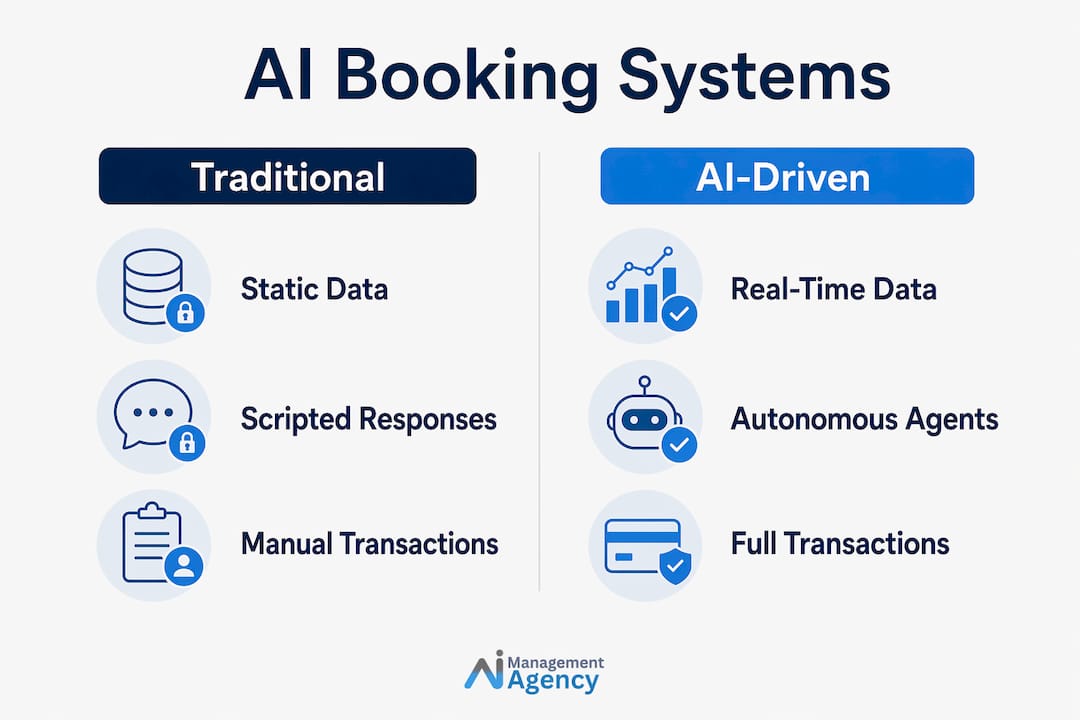
The single most overlooked requirement for AI-driven reservation systems is data quality. Your website copy, brand story, and photography are irrelevant to an AI agent. AI booking agents ignore traditional website marketing content entirely and instead prioritise structured, machine-readable, real-time data to make booking decisions.

Hospitality businesses need to provide live, structured, and interoperable data feeds including real-time pricing, availability, and policy clarity to be bookable by AI agents at all. If your property management system (PMS) serves cached or delayed inventory data, AI agents will either skip your property or generate booking errors.
The table below compares what AI-driven booking systems require versus what traditional online booking systems rely on.
| Data feature | Traditional booking system | AI-driven booking system |
|---|---|---|
| Pricing data | Static rates updated manually | Live API feed with dynamic pricing |
| Availability | Cached, updated periodically | Real-time inventory via structured API |
| Cancellation policy | Text on a webpage | Machine-readable schema markup |
| Pet and accessibility policies | FAQ page content | Structured data fields, queryable by agents |
| Review consistency | Displayed on listing page | Parsed and weighted by AI for recommendations |
| Geographic accuracy | Address field | Verified coordinates and location schema |
AI travel agents evaluate structured property data, real-time pricing, cancellation and pet policies, review consistency, and geographic accuracy when making booking recommendations. A property missing even one of these fields risks being excluded from the AI booking flow entirely.
Pro Tip: Treat your booking platform as data infrastructure, not a marketing channel. Audit your API feeds, schema markup, and policy fields before investing in any AI booking technology. Clean data is the foundation everything else depends on.
What are the main advantages of AI-driven booking for hospitality businesses?
The commercial case for automated booking systems is now well evidenced. AI booking systems increase booking volumes by an estimated 30% in the UK hospitality sector and improve customer satisfaction by personalising guest experiences. That figure reflects a structural shift in how guests discover and confirm reservations, not simply a technology upgrade.
Priceline’s multi-agent AI assistant demonstrates the efficiency gains available at the operational level. Multi-agent AI assistants save nearly 10 minutes per trip compared to traditional search methods and reduce customer care contact volumes by handling queries autonomously. For a property receiving hundreds of enquiries per week, that reduction in contact volume translates directly into staff time and cost savings.
The advantages of AI booking technology extend across both revenue and operations:
- Higher booking conversion: Guests complete reservations faster when an AI agent removes friction from the process.
- 24/7 availability: Automated booking systems handle enquiries around the clock, capturing bookings that would otherwise be lost outside office hours.
- Personalised guest experiences: AI agents use preference data and booking history to tailor recommendations, increasing satisfaction and repeat visits.
- Reduced customer service load: Autonomous handling of FAQs, modifications, and cancellations frees your team for higher-value guest interactions.
- Dynamic revenue optimisation: Real-time pricing adjustments maximise yield without manual rate management.
The benefits of AI in travel are not limited to large hotel chains. Independent hotels, boutique properties, and serviced apartments all stand to gain from the same efficiency and revenue improvements, provided their data infrastructure meets the requirements outlined above.
What challenges and trust issues come with AI-driven booking?
The primary barrier to AI-driven booking adoption is not technology. It is trust. Trust and reliable payment handling are critical for consumers to adopt autonomous booking systems, because travel transactions carry significant financial and emotional weight. A guest allowing an AI agent to charge their card for a non-refundable hotel stay is making a high-stakes decision. Any friction, error, or ambiguity in that process destroys confidence immediately.
Data inconsistency is the second major risk. In an agentic AI booking environment, inconsistent or ambiguous data leads directly to booking failures. If your cancellation policy is worded differently across your website, your OTA listing, and your API feed, an AI agent may either decline to book or generate an error at the point of payment. Both outcomes damage your reputation with the agent platform and the guest.
“The true competitive advantage in AI booking lies in trust. Users must feel confident that autonomous AI can handle payments and non-refundable bookings reliably.” — Booking.com on AI trust
The counterintuitive insight here is that less visible AI performs better. Invisible backend AI that quietly manages booking flows and customer support builds compounding trust over time, compared to flashy, overt AI interfaces that draw attention to the technology itself. Booking.com’s approach is instructive: their most effective AI operates entirely in the background, reducing errors and improving reliability without ever announcing itself to the guest.
Pro Tip: Do not market your AI booking capability as a feature. Let it perform reliably and let guest satisfaction scores tell the story. Trust is built through consistent, error-free experiences, not through branding.
How can hospitality businesses implement AI-driven booking systems?
Practical adoption of smart booking solutions requires a structured approach. Rushing to deploy AI booking technology without the correct foundations produces the exact trust failures described above.
Follow these steps to implement AI-driven booking effectively:
- Audit your data infrastructure first. Review your PMS API feeds, schema markup, and policy documentation. Identify gaps in real-time pricing, availability, and structured policy fields before evaluating any AI platform.
- Assess API readiness. Confirm your PMS and channel manager can expose live inventory via a standards-compliant API. Systems that rely on screen-scraping or manual exports are not compatible with AI booking agents.
- Standardise your policy language. Align cancellation, pet, accessibility, and payment policies across every channel: your website, OTA listings, and API data feeds. Inconsistency causes booking failures.
- Select an AI booking platform aligned with your property type. Evaluate platforms on their ability to complete end-to-end transactions, not just surface recommendations. Ask for evidence of live booking completion rates.
- Integrate with your existing PMS and CRM. AI-driven reservation systems deliver the most value when they write confirmed bookings directly into your property management system and trigger your guest communication workflows automatically.
- Define your success metrics before launch. Measure booking conversion rate, customer service contact volume, average booking value, and guest satisfaction scores. Establish a baseline before go-live so you can quantify the impact accurately.
- Review and refine data quality continuously. AI booking performance degrades when data drifts out of alignment. Assign ownership of data governance to a specific team member and schedule quarterly audits.
For a detailed walkthrough of AI hotel appointment scheduling and how it integrates with existing hospitality workflows, the Aimagency resource library covers the practical steps in depth.
Key takeaways
AI-driven booking delivers measurable commercial results only when autonomous AI agents operate on clean, real-time, structured data that your property management systems expose via live API feeds.
| Point | Details |
|---|---|
| AI agents vs chatbots | AI agents complete full booking workflows autonomously; chatbots only respond to prompts. |
| Data quality is the foundation | Real-time API feeds, schema markup, and consistent policy data determine whether AI agents can book your property. |
| Trust drives adoption | Invisible, reliable AI builds guest confidence faster than overt AI branding or flashy interfaces. |
| Commercial impact is proven | UK hospitality businesses using AI booking systems report up to 30% more bookings and measurably higher guest satisfaction. |
| Implementation requires sequencing | Audit data infrastructure and API readiness before selecting or deploying any AI booking platform. |
Why I think most hospitality businesses are approaching this backwards
Most hotel managers I speak with are asking “which AI booking platform should we buy?” before they have answered the more important question: “is our data good enough for AI agents to use?” That sequencing error is costly.
The properties seeing the strongest results from AI-driven booking in 2026 are not the ones with the most sophisticated AI interfaces. They are the ones that spent six months cleaning their inventory data, standardising their policy language, and ensuring their PMS exposes live availability via a reliable API. The AI technology itself is almost secondary.
The second thing I would push back on is the instinct to market AI as a feature. Guests do not want to interact with AI. They want a fast, accurate, and reliable booking experience. The moment you put “Powered by AI” on your booking flow, you introduce doubt. The moment your AI makes a single error on a non-refundable booking, you lose that guest permanently. Booking.com understands this. Their most effective AI is entirely invisible.
My honest view is that the hospitality businesses that will win in the next three years are those treating their booking platform as data infrastructure rather than a marketing channel. That mental shift is harder than any technology deployment. But it is the one that actually produces results.
— Geoff
How Aimagency helps hospitality businesses get AI-driven booking right
If you are a hospitality manager ready to move beyond theory and into practical deployment, Aimagency builds AI agents specifically designed for the demands of the hospitality sector.
From AI receptionists that answer calls 24/7 and book qualified appointments in a natural tone, to fully integrated reservation agents that write directly into your PMS, Aimagency’s solutions are built for reliability and trust. The focus is always on performance you can measure: more bookings, fewer missed enquiries, and a guest experience that feels effortless. Explore the 2026 hospitality AI guide to see how AI agents are being deployed across UK properties right now, or review the AI agent best practices resource to plan your implementation with confidence.
FAQ
What is AI-driven booking in simple terms?
AI-driven booking is where an autonomous AI agent handles the full reservation process, from searching availability to confirming payment, without any human involvement. It differs from a chatbot because it completes transactions independently rather than simply answering questions.
How does AI-driven booking differ from an automated booking system?
A traditional automated booking system follows fixed rules and scripts. An AI-driven booking system uses machine learning to make contextual decisions, adapt to guest preferences, and complete complex multi-step workflows in real time.
What data does my property need for AI booking agents to work?
AI booking agents require live API feeds with real-time pricing and availability, machine-readable cancellation and policy data, consistent schema markup, and verified geographic information. Properties with static or cached data are frequently excluded from AI booking flows.
Is AI-driven booking suitable for independent hotels and smaller properties?
Yes. AI booking systems deliver measurable booking volume increases for properties of all sizes in the UK hospitality sector. The key requirement is data infrastructure readiness, not property scale.
How long does it take to implement an AI-driven booking system?
Implementation timelines vary, but most properties require four to twelve weeks to audit data infrastructure, align API feeds, and integrate AI booking agents with their existing PMS and CRM systems before going live.