
TL;DR:
- AI call quality improvement uses machine learning and real-time audio processing to enhance voice interactions. It offers faster feedback, independent scoring, and network diagnostics, leading to measurable performance gains within months. AI assistants also provide more natural, efficient caller experiences compared to traditional IVR systems.
AI-assisted call quality improvement is defined as the use of machine learning, real-time audio processing, and automated evaluation to raise the standard of voice interactions between businesses and their customers. For business owners and managers, understanding how AI improves call quality is no longer optional. AI-driven quality evaluation agents can raise call quality scores by 15% across contact centres, with return on investment achieved within 30–90 days. The tools driving this shift include real-time transcription software, phoneme-level accent harmonisers, and AI voice agents that handle calls 24 hours a day.
How AI improves call quality: the core technologies
Three AI technologies sit at the centre of modern call quality improvement: real-time transcription, accent harmonisation, and automated quality scoring. Each one addresses a different failure point in the traditional call management process.

Real-time transcription and summarisation convert spoken conversations into accurate text records as the call happens. This removes the need for agents to take manual notes, which reduces errors and frees attention for the customer. Transcription also creates a searchable audit trail that quality assurance teams can review in minutes rather than hours.
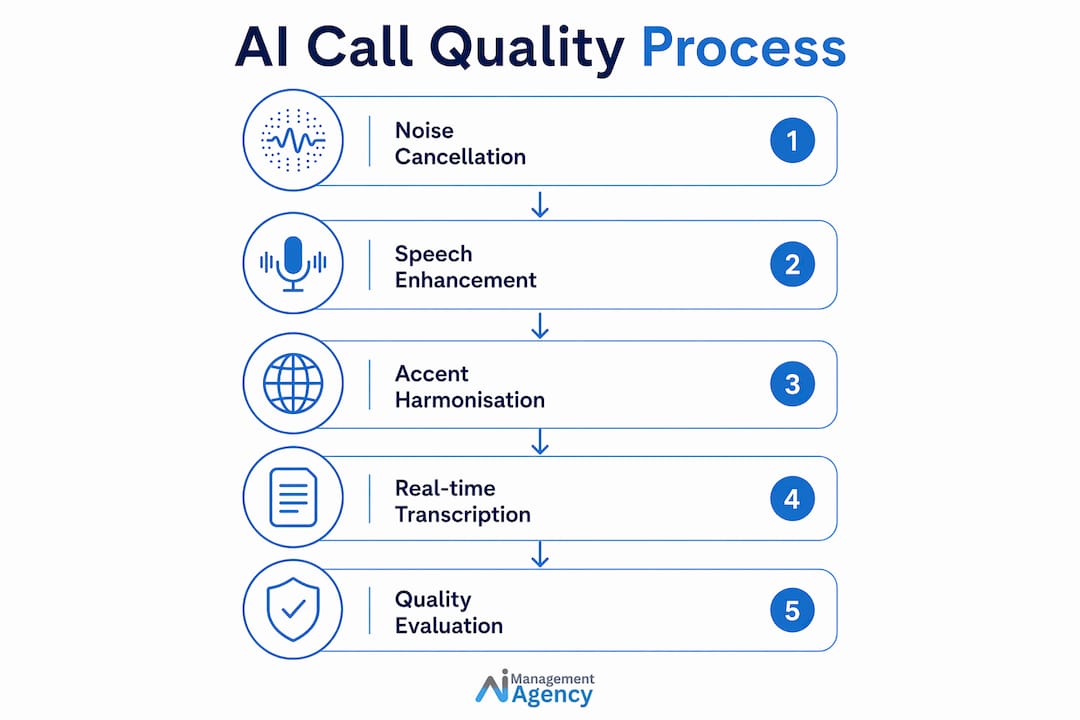
Phoneme-level accent harmonisation is the most technically specific of the three. Accent harmonisation software adjusts spoken phonemes in under 200ms latency, improving intelligibility without altering an agent’s tone or emotional delivery. It operates as a third processing layer behind noise cancellation and speech enhancement. The result is clearer audio for the caller without stripping the agent’s natural voice.
AI quality evaluation engines score individual call criteria independently rather than assigning a single overall score. Scoring calls independently improves accuracy and consistency, avoiding the bias that comes from rating a call as a whole. When a confidence score falls below 80%, the system flags the call for human review, which reduces false positives caused by noise or sarcasm.
Pro Tip: When selecting an AI call quality tool, check whether it scores criteria independently. A tool that gives one overall score per call will mask weak areas and produce misleading coaching data.
These technologies work together as a layered system. Noise cancellation clears the audio. Speech enhancement sharpens it. Accent harmonisation adjusts it for the listener. Transcription records it. And quality scoring evaluates it. Each layer depends on the one before it.
How does AI manage call quality operations in practice?
The operational benefits of AI in call quality management are measurable and fast. The shift from weekly manual reviews to same-day AI-generated feedback changes how quickly agents improve.
- Real-time compliance alerts. Automated escalation alerts notify floor managers within 60 seconds of a compliance violation. This prevents issues from compounding across a shift.
- Severity-based routing. Alerts are prioritised by severity, so managers deal with critical issues first. Lower-severity coaching points are batched for review, which reduces alert fatigue significantly.
- Same-day coaching. AI generates call summaries and specific examples from the day’s calls. Agents receive feedback on actual conversations rather than hypothetical scenarios, which makes coaching more relevant.
- Performance trend dashboards. Quality scores are tracked over time, giving managers a clear view of individual and team progress. Patterns become visible within days rather than weeks.
| Metric | Traditional QA | AI-Augmented QA |
|---|---|---|
| Review time per call | 15–20 minutes | Under 2 minutes |
| Feedback cycle | Weekly or fortnightly | Same day |
| Quality score improvement | Marginal over months | Up to 15% within 30–90 days |
| Compliance alert speed | End of shift review | Within 60 seconds |
The table above shows why businesses that adopt AI quality management see results quickly. The feedback loop is tighter, the data is richer, and the coaching is more specific. Evaluating call quality metrics independently also ensures balanced feedback, avoiding bias toward the most obvious issues and improving coaching precision across the board.
What network factors does AI help diagnose for call clarity?
Audio quality is not only a software problem. Network conditions cause a large proportion of call quality failures, and AI diagnostic tools are built to identify them.
The two most critical network metrics for voice calls are jitter and packet loss. Calls with jitter above 30ms or packet loss above 1% produce choppy or robotic audio that callers notice immediately. Standard broadband speed tests do not measure these metrics, which means many businesses are unaware their network is degrading call quality.
AI diagnostic tools break down call impairments by packet loss, delay, and codec compression. They identify whether a problem is network-side or software-side, which saves significant troubleshooting time. When the issue is network-related, Quality of Service settings on routers can often resolve bufferbloat and jitter problems in an afternoon. Ethernet connections consistently outperform Wi-Fi for reducing jitter and packet loss in office environments.
- AI tools capture packet-level data to pinpoint the exact source of audio artefacts
- Codec routing policies can be adjusted automatically when AI detects compression-related distortion
- Regional call routing reduces latency for geographically distributed teams
- Real-time monitoring flags degradation before callers report it
Pro Tip: Run a dedicated VoIP quality test, not a standard speed test, before deploying any AI call tool. Tools like PingPlotter or your VoIP provider’s own diagnostics will surface jitter and packet loss that a speed test misses entirely.
Effective call quality improvement integrates network diagnostics with AI to pinpoint technical faults, applying codec policies and regional routing to reduce audio artefacts at the source.
AI voice assistants vs. traditional IVR: what is the real difference?
Traditional interactive voice response systems force callers through rigid menu trees. AI phone assistants replace that experience with natural conversation, and the difference in caller satisfaction is substantial.
| Feature | Traditional IVR | AI Phone Assistant |
|---|---|---|
| Input method | Keypad or fixed voice commands | Natural speech, multi-turn dialogue |
| Routing logic | Menu-based, static | Intent-based, context-aware |
| Frustration handling | None | Detects frustration, escalates automatically |
| Handoff to agent | Caller repeats information | Full context summary passed to agent |
| Workflow changes | Requires developer involvement | No-code platforms allow real-time edits |
AI phone assistants using natural language understanding improve call routing, reduce average handle time, and increase customer satisfaction through intelligent handoffs. They handle multi-turn conversations, detect caller frustration, and pass a full summary to the live agent when escalation is needed. The caller does not repeat themselves. The agent starts informed.
Operations teams can modify AI response workflows in real time using no-code platforms, unlike static IVR systems that require developer changes. This means a business can update its AI assistant’s responses to reflect a new promotion, a policy change, or a seasonal offer within minutes. For businesses managing AI for business calls, this flexibility is a practical advantage over legacy systems.
Practical steps to implement AI for call quality improvement
Getting AI working for your call quality does not require a full infrastructure overhaul. The process follows a clear sequence.
- Audit your current call quality. Identify your biggest failure points before selecting any tool. Are calls dropping? Are agents receiving feedback too slowly? Is compliance monitoring manual? The answer shapes your tool selection.
- Define your quality criteria. Decide which call behaviours matter most: compliance language, empathy markers, resolution rate, or audio clarity. AI evaluation engines need these criteria defined to score calls accurately.
- Select tools with independent scoring. Avoid platforms that assign a single overall score per call. Independent criterion scoring produces more useful coaching data.
- Integrate with your existing infrastructure. Check that any AI tool connects with your current telephony system, CRM, and reporting dashboards. Poor integration creates data silos that undermine the whole process.
- Train and tune continuously. AI models improve with feedback. Build a process for your QA team to flag incorrect evaluations so the model learns from edge cases.
Pro Tip: Start with one AI tool that solves your most pressing problem, whether that is quality scoring, transcription, or network diagnostics. Deploying three tools simultaneously makes it difficult to measure which one is driving improvement.
Focusing on agent empowerment with AI tools increases customer satisfaction by reducing the administrative burden on agents, letting them concentrate on empathy and resolution. The technology handles the data. The agent handles the human connection. That division of labour is what makes AI-augmented call centres more effective than either approach alone. For a practical overview of AI call handling strategies, Aimagency’s resource library covers deployment approaches suited to UK businesses of all sizes.
Key takeaways
AI improves call quality by combining real-time audio processing, independent quality scoring, and same-day coaching to produce measurable gains in agent performance and customer satisfaction within 30–90 days.
| Point | Details |
|---|---|
| Independent quality scoring | Score each call criterion separately to avoid bias and produce precise coaching data. |
| Same-day feedback cycles | AI-generated summaries cut feedback from weekly to daily, accelerating agent improvement. |
| Network diagnostics matter | Jitter above 30ms and packet loss above 1% degrade audio; AI tools identify these before callers notice. |
| AI assistants outperform IVR | Natural language understanding and context handoffs reduce handle time and caller frustration. |
| Continuous model tuning | Flag incorrect AI evaluations regularly so the model improves on edge cases over time. |
Where I stand on AI and call quality
The shift is real, but the pitfalls are avoidable
Having worked closely with businesses deploying AI across their customer communications, I can say with confidence that the shift from manual quality assurance to AI-augmented evaluation is one of the most practical improvements available to a contact centre right now. The speed of the feedback loop alone changes agent behaviour faster than any training programme I have seen.
That said, I have watched businesses make the same mistake repeatedly. They deploy an AI quality tool, trust its scores without question, and stop involving their QA team in the evaluation process. That is where things go wrong. AI confidence scores below 80% exist precisely because the model knows its own limits. When businesses ignore the human review step, they end up coaching agents on incorrect assessments.
The other pitfall is treating AI as a replacement for empathy rather than a support for it. The best outcomes I have seen come from businesses that use AI to handle the data and free their agents to focus entirely on the caller. That combination, AI precision with human warmth, is what actually moves customer satisfaction scores.
My honest view is that businesses which adopt AI call quality tools in 2026 and invest in continuous model tuning will have a measurable advantage within a year. Those that wait for the technology to become standard will spend that year catching up.
— Geoff
How Aimagency supports UK businesses with AI call quality
Aimagency specialises in building AI agents that handle real business calls with a natural tone, 24 hours a day. Whether you need an AI receptionist that answers calls, responds to frequently asked questions, or books qualified sales appointments, the right AI agent can raise your call quality from the first interaction.
For UK small businesses weighing up where to start, the AI agent advantages page sets out the practical case clearly. If you are ready to move from evaluation to deployment, the AI agent onboarding guide walks through the full process step by step. Aimagency works with businesses across sectors to match the right AI voice solution to the right operational challenge.
FAQ
What is AI call quality improvement?
AI call quality improvement is the use of machine learning and real-time audio processing to evaluate, score, and enhance voice interactions automatically. It replaces or supplements manual quality assurance with faster, more consistent results.
How quickly does AI improve call quality scores?
AI-driven quality evaluation can raise call quality scores by 15% across contact centres, with return on investment typically achieved within 30–90 days through same-day coaching cycles.
What is accent harmonisation in AI call tools?
Accent harmonisation software adjusts spoken phonemes in under 200ms to improve caller intelligibility without changing an agent’s natural tone or emotional delivery. It operates as an audio processing layer behind noise cancellation.
How does AI detect network problems affecting call clarity?
AI diagnostic tools measure jitter, packet loss, and codec performance in real time. Calls with jitter above 30ms or packet loss above 1% are flagged automatically, allowing technical teams to apply fixes before callers report issues.
Can AI phone assistants replace traditional IVR systems?
AI phone assistants handle multi-turn natural conversations, detect caller frustration, and pass full context summaries to live agents. They outperform traditional IVR on routing accuracy, first-contact resolution, and caller satisfaction.