TL;DR:
- Many small businesses believe AI call management is only for large companies, but it rapidly benefits micro-enterprises. AI handles routine inquiries, improves efficiency, and enhances customer satisfaction by providing instant responses and accurate call routing. A hybrid approach combining AI automation with human involvement is most effective for fostering trust and maintaining quality customer relationships.
Many small business owners assume AI-powered call management is something reserved for large corporations with deep pockets and dedicated IT teams. That assumption is costing them real business. 31% of UK SMEs are already using AI in some form, and the pace of adoption is accelerating fast. If you run a micro-enterprise with a handful of staff and a phone that rings at all hours, this guide explains exactly how AI can transform your call handling, what to watch out for, and how to make it work practically for your business.
Table of Contents
- What is AI-powered business call management?
- The impact of AI on efficiency and customer service
- Best practices: setting up and optimising AI for your business calls
- Overcoming challenges: skills, data, and regulation
- Why the hybrid model is the real winner for micro-businesses
- How AIM Agency supports your AI business call journey
- Frequently asked questions
Key Takeaways
| Point | Details |
|---|---|
| AI grows efficiency | Automating routine business calls saves time and boosts responsiveness for micro-enterprises. |
| Hybrid model works best | Combining AI with human input offers both productivity and trusted customer experiences. |
| Train, monitor, review | Customising your AI with real business data and regular quality checks is essential for success. |
| Address challenges early | Prepare for skills, data, and compliance issues to ensure smooth adoption of AI for calls. |
What is AI-powered business call management?
AI-powered call management uses artificial intelligence to handle incoming and outgoing business calls without requiring a human to be present at every moment. It is not a simple answerphone. Think of it as a highly capable AI Voice Agent that speaks naturally, understands context, and responds intelligently to your callers in real time.
For a micro-enterprise, this technology typically delivers several core capabilities:
- Intelligent call routing: Directs callers to the right person or department based on their spoken request, eliminating the frustrating “press 1 for sales” experience.
- Appointment scheduling: Books qualified calls or client meetings directly into your calendar, integrating with tools like Calendly or Google Calendar.
- FAQ answering: Handles common questions about your opening hours, pricing, services, or location without any human input needed.
- Call transcription: Automatically converts conversations into text, creating records you can review for quality, compliance, or training purposes.
- Lead qualification: Gathers key information from prospects before passing them to you, so you are only dealing with genuinely interested enquiries.
The main benefit for small businesses is straightforward. You stop missing calls. You stop losing leads to competitors who pick up faster. And your team stops wasting time on repetitive questions that an AI can answer in seconds.
That said, AI excels with routine, high-volume queries but does lack the emotional sensitivity needed for complex or distressing conversations. A caller dealing with a complaint, a bereavement, or a serious concern will still benefit from speaking with a real person. Knowing when to hand over to a human is not a weakness in your system. It is a sign of intelligent design.
Learn more about how AI call screening works and why it is changing the way small businesses manage inbound enquiries.
Pro Tip: When setting up your AI call system, map out the ten most common questions your team fields every week. These are your AI’s starting scripts and will immediately reduce interruptions for your staff.
The impact of AI on efficiency and customer service
Having covered the basics, let us look at the measurable impact AI can make in everyday business operations and customer interactions.
The efficiency gains are real and quantifiable. When an AI Voice Agent handles routine calls, your team is free to focus on the work that actually grows the business. Consider a trades business with two staff members. Previously, both had to interrupt jobs to answer calls about availability or pricing. With AI handling those enquiries, they can complete more jobs per day without a single missed opportunity.

Here is a snapshot of where AI typically delivers the biggest gains for micro-enterprises:
| Area | Before AI | After AI |
|---|---|---|
| Missed calls | High, especially outside office hours | Near zero with 24/7 availability |
| Routine query handling | Manual, time-consuming | Automated, instant |
| Appointment booking | Staff dependent | Self-serve via AI agent |
| Lead qualification | Inconsistent | Standardised and reliable |
| Customer wait times | Variable | Immediate response |
Customer satisfaction improves noticeably too. Callers get instant, accurate answers rather than voicemails that go unreturned for hours. That responsiveness builds trust rapidly, particularly for new customers who are still deciding whether to choose you or a competitor.
A practical example: a small accountancy practice using an AI receptionist can handle inbound calls about tax deadlines, appointment availability, and document submission processes. The AI answers consistently and correctly every time, at 11pm on a Friday if needed. The human team then focuses entirely on advisory work where their expertise adds genuine value.
The key steps for realising these efficiency gains include:
- Identify your highest-volume call types. Track your calls for two weeks to understand the patterns.
- Configure the AI for those specific scenarios. Precision matters more than breadth at the start.
- Integrate with your existing booking tools. Seamless connectivity with your calendar removes friction for callers.
- Monitor outcomes weekly. Check how many calls the AI resolved versus escalated.
- Refine scripts based on real call data. Small adjustments produce large improvements quickly.
Notably, UK SME adoption of AI remains cautious especially around creative and sensitive tasks, which reinforces why you should start with process-driven calls rather than complex service conversations. Explore AI solutions built for founders and see how AI in business communication is reshaping the customer experience for small UK firms.
Best practices: setting up and optimising AI for your business calls
Now that efficiency gains are clear, here is how to set up AI for calls the right way, ensuring it fits your unique business needs rather than creating new problems.
The single most important factor in a successful AI call system is the quality of the data and scripts you feed into it. An AI that is trained on accurate, business-specific information will perform dramatically better than one configured with generic templates.
Training your AI on your own data
Start with your existing resources: your website FAQs, previous call recordings (where you have consent), email threads with common client questions, and your CRM records. The richer and more specific this information is, the more naturally your AI will handle real conversations. Hybrid AI and human approaches consistently outperform fully automated systems because human review continuously improves the AI’s training data.
Comparing implementation approaches
| Approach | Best for | Key benefit | Watch out for |
|---|---|---|---|
| AI only | High-volume, routine calls | Maximum automation | Mishandled sensitive calls |
| Human only | Complex, advisory calls | Full empathy | Scalability limits |
| Hybrid AI + human | Most micro-enterprises | Efficiency with flexibility | Needs clear handover rules |
The hybrid model wins for most micro-businesses. Use your AI automation solutions for volume, and keep humans available for the calls that genuinely require judgement.
Practical steps to optimise your setup
- Integrate with your CRM from day one. Connecting your AI to your CRM means every call creates a contact record, reducing manual data entry significantly. See how AI agent and CRM integration works in practice.
- Set clear escalation triggers. Define exactly which keywords or caller emotions should immediately route to a human.
- Review call transcripts regularly. Weekly reviews catch errors, identify new FAQ patterns, and ensure your AI stays accurate as your business evolves.
- Test the system as a caller. Ring your own number and experience the journey firsthand. Small friction points become obvious very quickly.
- Avoid over-configuring at launch. Start narrow and expand. Ten well-handled call types are more valuable than fifty poorly handled ones.
Pro Tip: Record a short voice introduction that sounds warm and natural. Callers respond far better to a conversational tone than a robotic greeting, and it sets the right expectation from the very first second.
Overcoming challenges: skills, data, and regulation
Even with the best technology, small firms can face obstacles. Here is how to tackle them head-on rather than letting them stall your progress.
Bridging the skills gap
Many micro-enterprise owners worry that AI is too technical to manage without specialist IT knowledge. In reality, modern AI call platforms are designed for non-technical users. The key is choosing a solution with strong onboarding support and clear documentation. UK SMEs frequently cite skills gaps as a barrier to AI adoption, but this is typically resolved through structured training rather than technical expertise.
Invest one afternoon in understanding how your AI platform works. Walk your team through it. Use written scripts so everyone knows how the AI should respond and when humans take over. Confidence grows quickly with hands-on familiarity.
Cleaning your data
Poor-quality data is the hidden enemy of AI performance. Before you connect your CRM or FAQ library to an AI system, audit it. Remove duplicate contacts, correct outdated information, and standardise your formats. Feeding messy data into an AI produces messy outputs, which erodes caller trust faster than having no AI at all.
A useful approach is to create a single, clean “source of truth” document containing your business information: services, pricing, opening hours, staff names, booking process, and key policies. This document becomes the foundation for your AI’s knowledge base and is easy to update as things change.
Navigating UK regulation
This is an area where micro-enterprises genuinely need to pay attention. Two regulations matter most:
- GDPR (General Data Protection Regulation): Any call recordings or transcripts that store personal data must comply with UK GDPR. Ensure you have clear privacy notices and a lawful basis for processing call data.
- Call recording consent: Under UK law, you must inform callers if their call is being recorded. Your AI should include a clear, upfront disclosure at the start of every call.
“Choosing a reputable AI call vendor with UK-specific data protection credentials is not optional. It is a fundamental part of responsible deployment for any small business handling customer data.”
Explore practical AI efficiency tips for SMEs and understand why AI accelerates SME growth when implemented thoughtfully and in compliance with regulation.
Keep your expectations grounded too. AI is a powerful operational tool, not a magic solution. Human input, ongoing review, and clear processes remain essential to long-term success.
Why the hybrid model is the real winner for micro-businesses
Here is an opinion that cuts against the hype: fully autonomous AI call handling sounds appealing in a product demonstration, but it consistently underperforms in real-world micro-business settings when callers bring anything unexpected to the conversation.
The businesses that get the most from AI are not the ones that hand everything over to automation. They are the ones that use AI intelligently for what it does best, volume and consistency, whilst keeping their people involved in the moments that build genuine customer relationships.
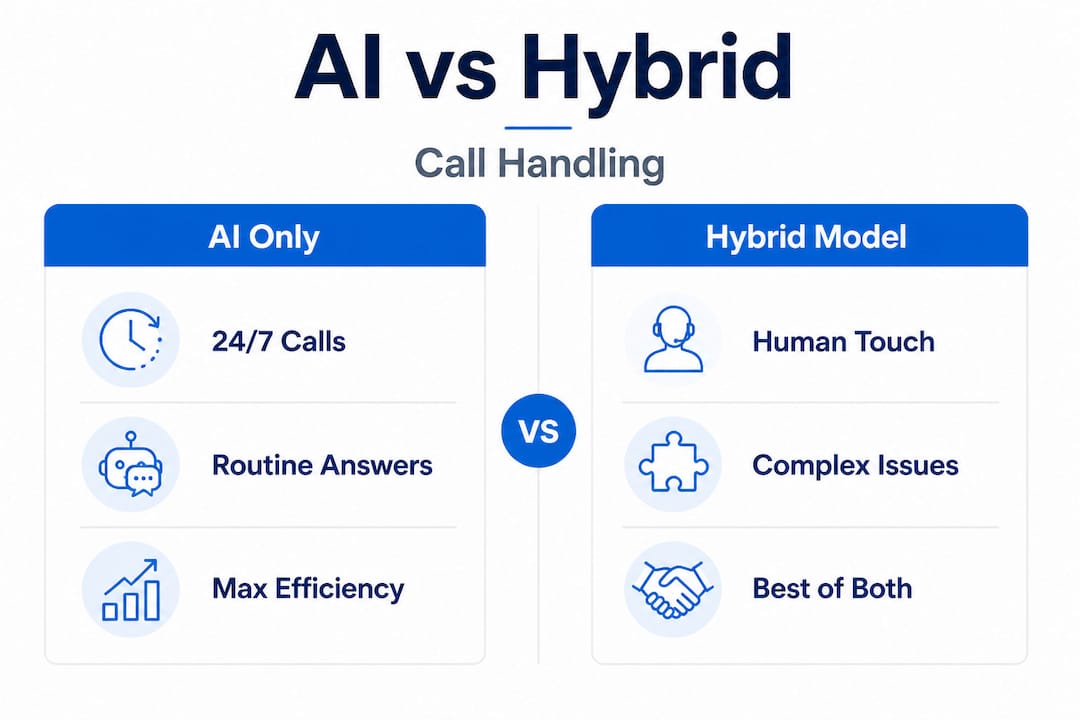
Think about a caller who rings with a sensitive situation, perhaps a complaint about a missed appointment or a question about a quote that went wrong. An AI can detect frustration and escalate the call, but it cannot truly empathise or make a creative exception to your usual process. That requires a human. And that moment, handled well by a real person, is often what turns a dissatisfied customer into a loyal one.
A hybrid approach to AI also protects your team’s skills. When staff remain actively involved in call handling for complex cases, they retain the communication skills and product knowledge that make your business distinctive. The risk with a “set and forget” mentality is that over time, your people lose the fluency that made your customer service excellent in the first place.
The practical takeaway is simple. Use AI as a capable, tireless first point of contact that filters, qualifies, and handles the routine. Then let your people deliver the human moments that no algorithm can replicate. That combination is where micro-enterprises find their real competitive edge.
Explore how business communication with AI can be designed to support rather than replace your team’s strengths.
How AIM Agency supports your AI business call journey
Ready to bring the best of AI and human support to your business calls? AIM Agency can help you every step of the way.
AIM Agency specialises in building high-quality AI agents specifically designed for micro-enterprises and small UK businesses. Our AI receptionist speaks in a natural, professional tone, answers calls around the clock, responds accurately to your FAQs, and books qualified sales appointments directly into your calendar. We tailor every solution to your specific industry, whether you work in hospitality, financial services, trades, or professional consulting. You are not getting a generic template. You are getting an AI agent built around how your business actually works. Visit AIM Agency to explore our services, read client case studies, and book a demo to see your AI receptionist in action.
Frequently asked questions
Is AI call handling secure and GDPR-compliant in the UK?
AI call management solutions can be GDPR-compliant when you ensure clear consent for call recording at the start of every call and select vendors with strong UK data protection credentials and transparent data processing agreements.
Can AI handle every type of business call?
AI manages routine and high-volume calls effectively, but complex, emotional, or sensitive calls still require a human, particularly within small businesses where personal relationships drive customer loyalty.
How do I get started with AI for my business calls?
Begin by identifying your most time-consuming and repetitive call tasks, then explore AI platforms that integrate with CRM and booking tools you already use, keeping the initial scope narrow for faster results.
Will staff lose jobs if we bring in AI for call handling?
AI reduces repetitive administrative work, but the best practice is a hybrid model that frees staff for higher-value tasks. Avoiding over-reliance on AI actively preserves your team’s skills and ensures they continue contributing meaningfully to your customer relationships.