
TL;DR:
- AI in hospitality is transforming hotel operations through autonomous systems and dynamic guest engagement. Most hotels use AI, but few integrate it deeply due to fragmented data and technical challenges. Successful AI adoption requires clear processes, trusted data pipelines, and balancing automation with human interaction.
Artificial intelligence in hospitality is defined as the integration of machine learning, natural language processing, and autonomous AI systems into hotel operations and guest services. The global AI in travel and hospitality market is valued at $8.7 billion in 2026, projected to reach $62.98 billion by 2035 at a 24.6% compound annual growth rate. For UK hotel professionals, these figures are not abstract. They represent a direct shift in how rooms are priced, how guests are served, and how operations are managed. The ai hospitality market trends shaping 2026 are not coming. They are already here, and the gap between hotels that act and those that watch is widening fast.
What are the most impactful AI innovations shaping hospitality operations?
The most consequential shift in artificial intelligence in hospitality right now is the move from traditional chatbots to agentic AI systems. Traditional chatbots follow scripts. Agentic AI performs autonomous, goal-oriented tasks, handling complex real-time booking changes and anticipating guest needs without constant human input. That distinction matters enormously for operational efficiency.

AI-driven dynamic pricing and revenue management sit at the top of the value chain. Hotels adopting AI-driven revenue management report 3–7% revenue increases per room, with investment typically recovering within a year. A 300-room hotel generating £12 million annually can realistically add over £600,000 in revenue from a 5% lift alone. That is not a marginal improvement. It is a structural advantage.
Natural language processing powers guest communication automation at scale. AI-driven guest communication platforms now automate up to 97% of messages, cutting manual workload dramatically while maintaining consistent response quality. Guest communication is ranked the top AI investment priority by 58% of hoteliers in 2026. That consensus reflects where the clearest return on investment sits.
Operational AI applications extend well beyond guest-facing tools:
- Predictive maintenance: AI flags equipment failures before they occur, reducing costly downtime.
- Labour forecasting: AI analyses booking patterns to schedule staff more accurately, cutting unnecessary wage spend.
- Inventory management: AI monitors stock levels and supplier lead times, reducing waste in food and beverage operations.
- Fraud detection: AI flags anomalous booking behaviour in real time, protecting revenue.
Pro Tip: Before investing in any AI application, map your current manual workflows and identify the three tasks consuming the most staff time. The best AI investment is the one that removes your biggest operational bottleneck first, not the one with the most impressive demo.
How is AI adoption evolving across the UK hospitality landscape?
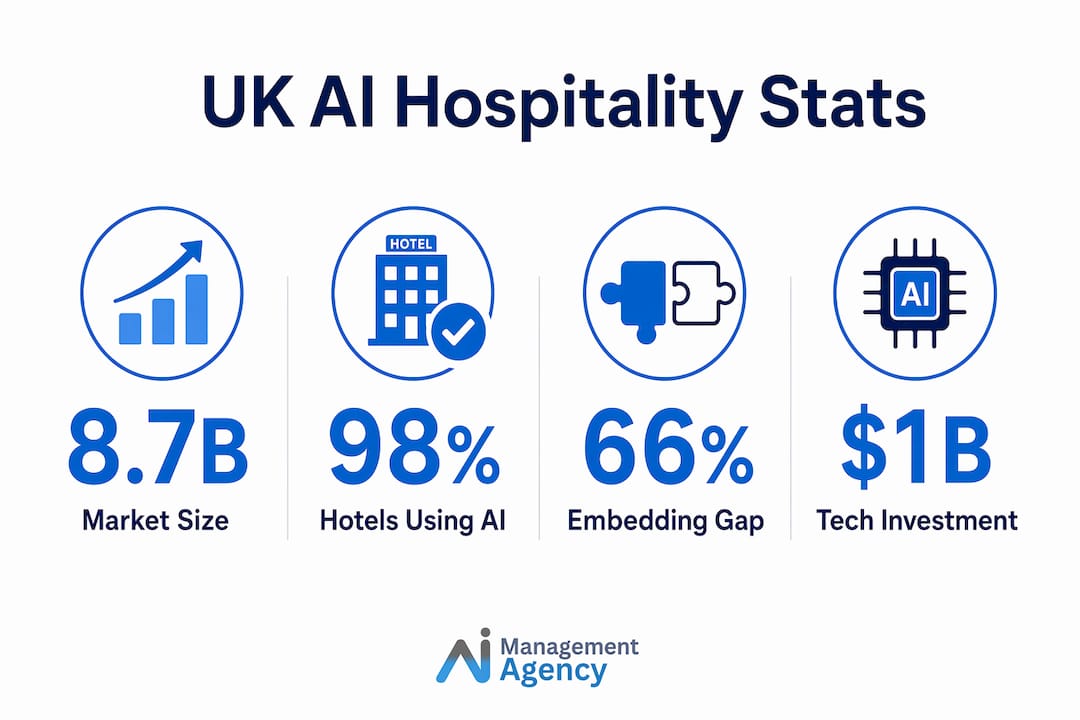
The adoption numbers in 2026 tell a story of widespread use but shallow embedding. 98% of hotel owners use AI in some form. Yet only 32% have it embedded across most operations, and just 25% have reached the scaling stage where measurable returns are consistent. That gap between use and genuine integration is the defining challenge of this moment.
The market investment flowing into hospitality technology confirms the sector’s direction of travel. Over $1 billion in venture capital has been invested in hospitality AI since 2025. That level of funding accelerates product development and drives down the cost of enterprise-grade tools for independent and mid-market UK hotels.
The table below summarises the key market and adoption figures for 2026.
| Metric | Figure |
|---|---|
| Global AI hospitality market size (2026) | $8.7 billion |
| Projected market size (2035) | $62.98 billion |
| Annual market growth rate (CAGR) | 24.6% |
| Hotel owners using AI in some form | 98% |
| Hotels with AI embedded across most operations | 32% |
| Hotels at AI-scaling stage with consistent returns | 25% |
| Hoteliers prioritising guest communication AI | 58% |
| VC invested in hospitality AI since 2025 | $1 billion+ |
The 66-percentage-point gap between hotels using AI and those with it embedded across operations is the most telling figure in that table. It shows that adoption is not the hard part. Execution is.
What challenges must UK hotels consider when implementing AI?
The most common barrier to successful AI implementation is not technology. It is data. Fragmented data systems and lack of cross-departmental alignment are the primary causes of the adoption-to-execution gap. When your property management system, booking engine, and CRM do not share clean, consistent data, AI cannot generate reliable outputs.
Property management system integration remains a persistent technical hurdle. Many UK hotels run legacy PMS platforms that were not built with API connectivity in mind. Connecting AI pricing engines or communication tools to these systems requires either middleware solutions or full platform migration, both of which carry cost and disruption.
Regulatory compliance adds another layer of complexity. The EU AI Act introduces transparency and auditability requirements for automated decision-making systems. Hotels implementing AI in pricing or booking are segregating AI pricing engines into explainable modules to meet audit requirements. This is not optional for properties operating across European markets.
Guest trust is a factor that operators underestimate at their peril. Operators who ignore the human element risk diminished guest experience and long-term loyalty damage. Guests accept AI-assisted service when it feels attentive and accurate. They reject it when it feels impersonal or evasive.
Key implementation challenges to address before deployment:
- Data quality: Audit your data sources for consistency before connecting any AI tool.
- PMS compatibility: Confirm API availability with your current PMS vendor before committing to an AI platform.
- Staff training: AI tools fail when staff do not understand or trust them. Training is not optional.
- EU AI Act readiness: Identify which AI applications fall under high-risk categories and build audit trails accordingly.
- Guest communication tone: Automated messages must match your brand voice. Generic responses erode trust faster than slow responses.
Pro Tip: Preserve authenticity by setting clear escalation rules. Define exactly which guest interactions AI handles autonomously and which ones route immediately to a human. Guests do not mind AI handling routine requests. They do mind when a sensitive complaint gets an automated reply.
How can UK hospitality professionals strategically harness AI?
Closing the adoption-to-execution gap requires a deliberate sequence, not a technology sprint. The hotels achieving consistent AI returns share one characteristic: they built clean, integrated data pipelines before deploying AI tools. Without that foundation, AI-driven signals cannot translate into meaningful operational decisions.
The following steps provide a practical framework for embedding AI effectively across your property.
- Audit your data infrastructure. Map every system that holds guest, booking, or operational data. Identify where data is duplicated, inconsistent, or siloed. Fix the pipeline before connecting AI.
- Secure cross-departmental buy-in. AI implementations that live only in the IT department fail. Revenue management, front office, food and beverage, and housekeeping all need to understand how AI affects their workflows.
- Prioritise guest communication first. With 58% of hoteliers already investing here, the tools are mature and the ROI is proven. An AI voice agent for hotels that answers calls 24/7, handles FAQs, and books appointments removes a significant manual burden from front desk staff.
- Layer in revenue management AI second. Once communication is automated, dynamic pricing delivers the next highest return. The 3–7% revenue uplift per room compounds quickly across a full year.
- Measure before scaling. Define your success metrics before deployment. Cost per resolved query, average response time, and revenue per available room are the three most useful starting benchmarks.
- Maintain a human escalation path. Every AI workflow needs a clear handoff point. Document it, train staff on it, and review it quarterly.
- Review regulatory exposure annually. The EU AI Act is evolving. Assign ownership of compliance monitoring to a named individual, not a committee.
The hotels that will lead on AI in 2026 and beyond are not the ones with the most tools. They are the ones with the clearest processes for turning AI outputs into staff actions and guest outcomes. You can explore practical AI use cases for hotels to identify where your property has the most to gain.
What future AI hospitality market trends should UK hotels prepare for?
The next phase of hospitality technology trends moves from AI assistance to AI autonomy. Agentic AI systems are already handling complex, multi-step tasks without human prompting. The trajectory points toward AI that manages entire operational workflows, from demand forecasting through to staffing adjustments and guest communication, within a single connected system.
The table below contrasts current AI capabilities with emerging ones.
| Capability area | Current AI (2026) | Emerging AI (2027 onwards) |
|---|---|---|
| Guest communication | Automates up to 97% of messages | Proactive outreach based on predicted guest needs |
| Revenue management | Dynamic pricing with historical data | Real-time market segmentation and autonomous rate setting |
| Operational management | Predictive maintenance alerts | Fully autonomous scheduling and resource allocation |
| Booking management | AI-assisted changes and confirmations | Autonomous rebooking and itinerary management |
| Compliance | Explainable AI modules for audit | Self-documenting AI decisions with regulatory mapping |
Economic bifurcation is an underappreciated trend. Budget and luxury segments will adopt AI differently. Budget properties will prioritise cost reduction through automation. Luxury properties will use AI to deliver hyper-personalised service, where AI anticipates preferences before guests articulate them. A one-size-fits-all AI strategy will not serve both segments equally.
AI-enabled discovery is also reshaping how guests find hotels. Search behaviour is shifting toward conversational AI queries, which means hotels need to think about how their content and data appear in AI-generated responses, not just traditional search rankings. Properties that structure their data clearly will gain visibility in this new discovery layer.
Regulatory development will continue. The EU AI Act’s implementation timeline means that hotels deploying automated pricing or booking systems in 2026 need compliance frameworks in place now, not when enforcement begins. The future of AI in hospitality will reward those who treat compliance as infrastructure rather than an afterthought.
Key takeaways
AI in hospitality delivers measurable returns only when clean data infrastructure, cross-departmental alignment, and clear human escalation paths underpin every deployment.
| Point | Details |
|---|---|
| Market growth is substantial | The global AI hospitality market grows from $8.7B in 2026 to a projected $62.98B by 2035. |
| Adoption outpaces embedding | 98% of hotels use AI, but only 32% have it embedded across most operations. |
| Guest communication leads ROI | 58% of hoteliers prioritise guest communication AI, where tools automate up to 97% of messages. |
| Data pipelines are the foundation | Fragmented data systems are the primary cause of the adoption-to-execution gap. |
| Agentic AI is the next frontier | Autonomous AI systems will manage multi-step workflows without human prompting by 2027 and beyond. |
Where most hotels are getting AI wrong
The pattern I see repeatedly is hotels investing in visible, guest-facing AI while neglecting the operational foundations that make it work. A polished AI chatbot on your website means nothing if it is pulling data from three inconsistent systems and giving guests wrong availability information.
The 73% of hoteliers who feel overwhelmed about AI implementation are not overwhelmed by the technology itself. They are overwhelmed because they skipped the infrastructure step. They bought the tool before they built the pipeline. That is the real adoption problem in UK hospitality right now.
What actually works is starting small and going deep. Pick one workflow, automate it properly, measure it rigorously, and then expand. The hotels I have seen achieve consistent AI returns did not deploy ten tools at once. They deployed one well, proved the value, and built from there.
Agentic AI is genuinely exciting, and the shift from scripted chatbots to autonomous agents is a real step change in what is possible. But the hotels that will benefit most are the ones that have already sorted their data, trained their staff, and built trust with their guests through consistent, accurate automated communication. The technology rewards preparation. It does not substitute for it.
The balance between AI and human connection is not a philosophical question. It is a practical one. Guests will tell you when automation has gone too far. The smart move is to define your boundaries before they do.
— Geoff
AI agent solutions built for UK hospitality
UK hotels are under real pressure to do more with leaner teams, and the right AI agent removes that pressure without sacrificing the guest experience your reputation depends on.
Aimagency builds high-quality AI agents designed specifically for hospitality operations. From an AI receptionist for your hotel that answers calls 24/7 in a natural tone, handles FAQs, and books qualified appointments, to fully integrated communication workflows, Aimagency handles the operational detail so your team can focus on guests. Whether you are an independent property or a growing group, you can explore the advantages of AI agents for small UK businesses and see exactly where the return on investment sits for your operation.
FAQ
What are the top hotel AI trends in 2026?
The top hotel AI trends in 2026 are agentic AI for autonomous operations, AI-driven dynamic pricing, and guest communication automation. Guest communication is the top investment priority for 58% of hoteliers, with platforms automating up to 97% of messages.
How big is the AI hospitality market?
The global AI in travel and hospitality market is valued at $8.7 billion in 2026 and is projected to reach $62.98 billion by 2035, growing at a 24.6% compound annual growth rate.
Why do so many hotels struggle to get value from AI?
Fewer than 10% of hospitality firms have AI materially impacting profit and loss. The primary cause is the adoption-to-execution gap, driven by fragmented data systems and lack of cross-departmental alignment rather than technology limitations.
How does the EU AI Act affect UK hotels using AI pricing tools?
Hotels using automated pricing systems are required to ensure those systems are transparent and auditable. The practical response is to segregate AI pricing engines into explainable modules that can demonstrate how automated decisions were reached.
How is AI changing the guest experience in hotels?
AI changes the guest experience by enabling faster, more consistent communication, personalised service recommendations, and proactive responses to guest needs. The critical condition is that AI complements human service rather than replacing the genuine human interaction guests value most.