Choosing the right AI applications for your hotel can feel overwhelming. With dozens of vendors promising transformative results, how do you identify solutions that genuinely improve guest satisfaction and operational performance? The difference between effective AI adoption and wasted investment lies in understanding proven use cases tailored to hospitality challenges. This article reveals the top AI applications already delivering measurable results in UK hotels, supported by real case studies and expert insights. You’ll discover practical criteria for evaluating AI opportunities, learn which technologies address your most pressing operational needs, and gain a framework for implementing AI solutions that drive both service excellence and revenue growth.
Table of Contents
- Key takeaways
- How to select and evaluate AI use cases for your hotel
- Top AI use cases in UK hotels to enhance customer service
- AI applications for operational efficiency and revenue growth
- Addressing challenges and future-proofing your AI strategy
- Ready to start your hotel AI transformation?
- Frequently asked questions
Key Takeaways
| Point | Details |
|---|---|
| Structured AI criteria | Choose AI opportunities using four criteria: integration with existing systems, measurable service impact, clear ROI, and manageable risk. |
| Concrete metrics matter | Define precise metrics before deployment to verify benefits and avoid vendor hype. |
| Pilot projects first | Launch small sandbox pilots to isolate risk and prove value before wider rollout. |
| Data and staff readiness | Invest in data consolidation and staff training before deploying sophisticated AI tools. |
How to select and evaluate AI use cases for your hotel
Selecting AI solutions requires a structured approach focused on four critical criteria: integration complexity, measurable service impact, clear ROI pathways, and manageable risk profiles. The best AI investments solve specific operational pain points whilst fitting seamlessly into your existing technology stack. Evaluate whether a proposed solution connects easily with your property management system, channel manager, and guest data platforms. Solutions requiring extensive custom development or complete system overhauls typically fail to deliver promised returns.
Measurable impact separates genuine opportunities from vendor hype. Define precise metrics before implementation: Will this AI reduce average response time to guest enquiries? Can it demonstrably increase direct booking conversion rates? Does it cut labour hours in specific departments? Vague promises of efficiency gains rarely materialise without concrete measurement frameworks. Understanding AI automation helps you identify which processes offer the greatest potential for meaningful improvement.
Many UK hotels struggle with foundational challenges that undermine AI success. Hospitality leaders plan wider adoption despite financial pressures, yet 72% face skills gaps and fragmented data that complicate implementation. Address these barriers by investing in staff training and data consolidation before deploying sophisticated AI tools. Your team needs both technical literacy and change management support to maximise AI value.
Pro Tip: Launch AI initiatives through small sandbox projects that isolate risk whilst proving value. Test a chatbot on your website for 90 days before rolling out voice agents across all channels. This approach builds internal expertise, reveals integration challenges early, and generates compelling ROI data to justify broader investment. Pilot projects also give staff time to adapt without overwhelming daily operations.
Top AI use cases in UK hotels to enhance customer service
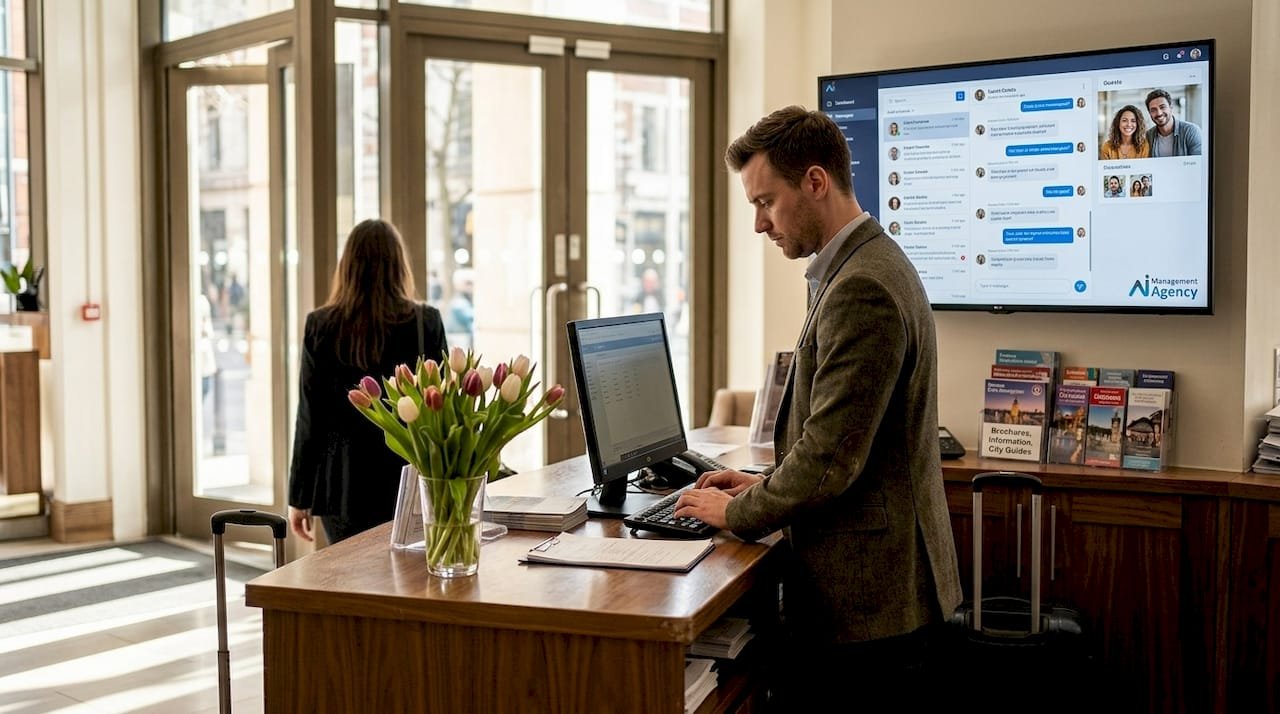
AI-powered guest communication tools represent the fastest-growing category of hotel technology adoption. These applications transform how properties handle enquiries, bookings, and service requests across multiple channels simultaneously. The most effective implementations combine chatbots for instant messaging platforms with voice agents that handle phone calls naturally.
Park Hall Hotel in Lancashire deployed an AI concierge automating interactions across languages 24/7, becoming the first UK property to implement this comprehensive approach. Their system handles routine questions about amenities, local attractions, and booking modifications without human intervention. This frees reception staff to focus on complex guest needs whilst ensuring no enquiry goes unanswered, regardless of time or language barriers.
Modern AI communication tools deliver three core functions that directly impact guest satisfaction:
- Instant response to common questions about facilities, policies, and local information, eliminating wait times that frustrate guests and reduce conversion rates
- Seamless booking assistance that captures reservation intent immediately, converting browsing visitors into confirmed guests before they explore competitor options
- Proactive service delivery through personalised recommendations and timely reminders, creating memorable experiences that drive positive reviews and repeat bookings
Review analysis automation offers another powerful customer service application. AI tools scan feedback across booking platforms, social media, and direct channels to identify sentiment patterns and recurring issues. Instead of manually reading hundreds of reviews monthly, you receive prioritised insights about specific service gaps or emerging guest preferences. This intelligence enables rapid response to problems before they damage your reputation.
“AI guest communication doesn’t replace human hospitality, it amplifies it. By handling routine interactions instantly, AI gives your team more time for the personalised service that truly differentiates your property.”
Examples of AI guest communication demonstrate how leading properties integrate these tools without sacrificing the personal touch that defines exceptional hospitality. The key lies in designing AI interactions that feel helpful rather than robotic, using natural language and seamless handoffs to human staff when complexity requires it. AI receptionists for hotels now handle initial contact with such sophistication that guests often don’t realise they’re engaging with automated systems until the conversation requires human judgement.
AI applications for operational efficiency and revenue growth
Whilst guest-facing AI captures attention, backend operational applications often deliver faster and larger financial returns. Demand forecasting systems analyse historical booking patterns, local events, weather data, and market trends to predict occupancy with remarkable accuracy. This intelligence transforms labour scheduling from guesswork into precision planning.

Distinctive Inns achieved 2.8% labour cost reduction and 7.7% sales increase by implementing AI forecasting and scheduling tools across their portfolio. The system predicts busy periods days in advance, enabling managers to optimise staffing levels without over-scheduling during quiet times or under-staffing during peaks. This dual benefit of cost control and service quality improvement demonstrates why operational AI generates such compelling ROI.
Dynamic pricing represents another high-impact operational use case. AI pricing engines adjust room rates continuously based on real-time demand signals, competitor pricing, booking pace, and dozens of other variables. Unlike static seasonal pricing or simple occupancy-based rules, machine learning models identify subtle patterns that maximise revenue per available room.
| AI operational tool | Primary benefit | Implementation complexity | Typical ROI timeline |
|---|---|---|---|
| Demand forecasting | Labour cost reduction through accurate scheduling | Medium – requires historical data integration | 3-6 months |
| Dynamic pricing | Revenue optimisation via real-time rate adjustments | Low – often cloud-based with simple PMS connection | 1-3 months |
| Energy management | Utility cost savings through predictive climate control | High – needs building system integration | 6-12 months |
| Inventory optimisation | Food and beverage waste reduction | Medium – requires purchasing system access | 4-8 months |
Implementing operational AI successfully requires a methodical approach:
- Audit your current data quality and accessibility across all relevant systems, identifying gaps that would prevent AI from functioning effectively
- Select one high-impact use case (typically dynamic pricing or labour forecasting) as your initial focus rather than attempting multiple deployments simultaneously
- Establish baseline metrics for the targeted process before AI implementation, ensuring you can measure actual improvement accurately
- Run the AI system in shadow mode initially, comparing its recommendations against human decisions to build confidence and refine parameters
- Deploy fully whilst monitoring performance weekly, adjusting algorithms based on actual results and seasonal variations
- Document lessons learnt and share wins across your organisation to build momentum for expanding AI to additional operational areas
Pro Tip: Prioritise dynamic pricing and labour optimisation as your first operational AI investments. These applications require minimal integration complexity whilst delivering measurable results within weeks. Success in these areas builds organisational confidence and generates budget for more ambitious AI projects. Boosting sales with AI becomes significantly easier once you’ve proven the technology’s value through quick wins. Using AI for bookings extends these operational benefits directly to revenue generation.
Addressing challenges and future-proofing your AI strategy
Successful AI adoption requires confronting three critical challenges that derail many hotel implementations: skills shortages, data security concerns, and the absence of formal AI strategies. Hotels face significant adoption barriers with 62% reporting skills gaps, 47% worried about data protection, and 92% lacking formal AI roadmaps. These statistics reveal why enthusiasm for AI often fails to translate into effective deployment.
The probabilistic nature of AI introduces risks in core hotel operations. Unlike traditional software that follows explicit rules, AI systems make predictions based on patterns in training data. This means they occasionally produce unexpected or incorrect outputs. Deploy AI cautiously in revenue-critical or guest-facing scenarios, always maintaining human oversight for high-stakes decisions. A chatbot providing incorrect restaurant recommendations creates minor inconvenience; AI miscalculating room inventory during peak season causes serious revenue loss.
Data privacy and ethical AI use demand particular attention in hospitality. Guest information carries legal protection under UK data regulations, and AI systems processing this data must comply fully with privacy requirements. Ensure any AI vendor provides clear documentation of data handling practices, storage locations, and security measures. Transparency about AI use also matters for guest trust. Many properties now disclose when guests interact with AI systems, maintaining authenticity whilst leveraging automation benefits.
Practical steps to overcome AI adoption challenges and secure strong returns:
- Invest in structured AI literacy training for management and front-line staff, focusing on practical capabilities rather than technical details
- Develop a formal AI strategy document that identifies priority use cases, budget allocation, success metrics, and governance processes
- Start with vendor-managed cloud solutions rather than building custom AI, reducing technical complexity and ongoing maintenance requirements
- Establish clear escalation protocols so AI systems hand off gracefully to human staff when encountering situations beyond their training
- Monitor AI performance continuously through defined metrics, adjusting or discontinuing implementations that fail to deliver promised value
- Join industry forums and peer networks to learn from other hotels’ AI experiences, avoiding common pitfalls and identifying proven solutions
Future-proofing your AI investments means selecting flexible platforms that evolve with advancing technology. Avoid proprietary systems that lock you into single vendors or require expensive custom development for updates. Cloud-based AI services typically receive continuous improvements automatically, ensuring your capabilities advance without constant reinvestment. Understanding AI agents helps you evaluate which technologies offer genuine long-term value versus temporary competitive advantage.
Ready to start your hotel AI transformation?
Navigating AI opportunities requires expertise that combines hospitality knowledge with technical understanding. Professional guidance helps you identify which AI applications address your specific operational challenges whilst avoiding costly implementation mistakes. AI Management Agency specialises in creating high-quality AI agents tailored for hospitality environments, including AI receptionists that handle calls 24/7 in natural conversational tones.
Our team supports you through the complete AI adoption journey, from initial use case assessment through deployment and performance optimisation. We help you measure and maximise ROI from AI agents, ensuring your investment delivers measurable improvements in guest satisfaction and operational efficiency. Explore our comprehensive guide to AI agents for UK small businesses to understand how these technologies work. Learn about the role of AI agents in UK hospitality and discover our specialised AI receptionist for hotels that books qualified appointments whilst answering guest questions around the clock.
Frequently asked questions
What are the most common AI use cases currently adopted by UK hotels?
Guest communication chatbots and voice agents lead UK hotel AI adoption, handling enquiries and bookings across multiple channels simultaneously. Dynamic pricing systems and demand forecasting tools follow closely, optimising revenue and labour costs through predictive analytics. Review analysis automation and energy management systems represent emerging applications gaining traction amongst forward-thinking properties.
How quickly can hotels expect ROI from AI implementations?
Dynamic pricing and guest communication tools typically deliver measurable returns within one to three months of deployment. Labour forecasting systems require three to six months as they learn seasonal patterns and refine predictions. More complex applications like energy management or inventory optimisation may need six to twelve months before generating significant savings. Starting with quick-win use cases builds momentum and funds longer-term AI investments.
What risks should hotel managers consider before deploying AI?
Data security and privacy compliance represent primary concerns, particularly when AI systems process guest information. Skills gaps within your team can undermine implementation success if staff lack training to use AI tools effectively. The probabilistic nature of AI means occasional errors, requiring human oversight for critical decisions. Vendor lock-in poses long-term risk if proprietary systems prevent switching to better solutions as technology evolves.
Do small independent hotels benefit from AI as much as large chains?
Small hotels often gain proportionally greater benefits from AI because they operate with tighter margins and smaller teams. A single AI receptionist handling after-hours calls provides enormous value when you lack 24/7 staffing. Cloud-based AI solutions now offer affordable subscription pricing that makes sophisticated technology accessible to independent properties. The key lies in selecting focused applications that address your specific constraints rather than attempting comprehensive deployments suited to large chains.
How can hotels measure AI performance effectively?
Define specific metrics before implementation that directly tie to business outcomes. For guest communication AI, track response time reduction, conversion rate improvement, and staff time savings. Dynamic pricing success shows in RevPAR increases and occupancy optimisation. Labour forecasting effectiveness appears in cost per occupied room and service quality scores. Compare these metrics against pre-AI baselines monthly, adjusting algorithms and processes based on actual performance data rather than vendor promises.
Recommended
- Enhance guest experience with AI in UK hotels 2026 – AI Management Agency
- AI Management Agency: Discover AI Success with Our Case Studies & Results
- 6 Ways to Use AI in Customer Service List for Hotels – AI Management Agency
- AI Voice Technology: Transforming Small Hotel Service – AI Management Agency