TL;DR:
- AI appointment setting enables UK hospitality businesses to respond to enquiries instantly, qualify prospects, and automate bookings 24/7, improving efficiency and guest experience. It uses natural language processing to hold natural conversations, check availability in real time, and send automated reminders, reducing no-shows and increasing confirmed bookings. Implementing a hybrid approach that combines AI with human judgment optimizes relationship building while streamlining routine tasks.
Every day, small hospitality businesses across the UK lose bookings not because their service is poor, but because enquiries arrive at the wrong moment. A call comes in during a busy Friday evening service. An email sits unread until Monday morning. A potential corporate client books elsewhere because nobody replied within the hour. AI appointment setting changes this picture entirely, giving your business the ability to capture, qualify, and convert enquiries around the clock without adding headcount or complexity.
Table of Contents
- What is AI sales appointment setting?
- Key benefits for UK hospitality and small business
- How AI appointment setting actually works: step by step
- Common misconceptions and expert answers
- How to get started with AI appointment setting in your business
- Why the future is hybrid: what most guides miss about AI appointment setting
- Discover the right AI appointment solution for your business
- Frequently asked questions
Key Takeaways
| Point | Details |
|---|---|
| AI boosts efficiency | Using AI for appointment setting delivers more bookings with less admin effort. |
| Hybrid models work best | The most effective setup combines AI’s speed with skilled human staff for complex needs. |
| Personalisation is possible | Modern AI can offer tailored service, not just generic responses. |
| Start small, scale up | Small businesses can easily trial AI on routine bookings, then expand as confidence grows. |
What is AI sales appointment setting?
AI sales appointment setting is the use of artificial intelligence to manage the process of receiving enquiries, qualifying prospects, and scheduling confirmed sales meetings or bookings without requiring manual intervention at every step.
Unlike a basic online booking form, AI appointment setting uses natural language processing (NLP) to hold genuine two-way conversations. It can answer questions, handle objections, collect relevant information, and place a confirmed appointment directly into your calendar. Unlike traditional automation such as autoresponders or rule-based chatbots, modern AI adapts its responses based on context, tone, and the specific needs of each enquirer.
The typical process looks like this:
- A prospect contacts your business via phone, website chat, or messaging platform
- The AI engages in a natural conversation, answering questions and gathering qualifying information
- The system checks availability in real time and proposes suitable appointment slots
- The prospect confirms, and the booking is locked into your calendar automatically
- Follow-up reminders are sent without any manual input
For UK hospitality businesses, this matters enormously. Speed and reliability are everything. A restaurant fielding private dining enquiries or a hotel handling corporate event bookings cannot afford slow responses. As AI appointment setting strategies demonstrate, AI excels at scale, consistency, and speed, and while it was once criticised for lacking personalisation, advanced NLP has largely put that concern to rest.
You can learn more about AI booking basics to understand how these systems work in practical terms for UK small businesses.
Pro Tip: Start by mapping your current enquiry-to-booking journey. Identify where leads go cold or get delayed. This is precisely where AI delivers the fastest return.
Key benefits for UK hospitality and small business
The reason AI appointment setting is gaining real traction in UK hospitality is straightforward: it solves several problems at once. Speed, consistency, and 24/7 availability are the headline benefits, but the detail underneath is what makes this genuinely compelling.
Here is how AI transforms the journey from enquiry to confirmed booking:
- Enquiry arrives via phone, web chat, social media, or email at any hour
- AI responds instantly, presenting a natural, on-brand conversation within seconds
- Qualification happens automatically, with the AI gathering guest numbers, dates, dietary needs, and budget information
- Availability is checked in real time against your live calendar or booking system
- Appointment is confirmed, with the prospect receiving immediate written confirmation
- Reminders are sent automatically, reducing no-shows significantly
Consider a boutique hotel in the Cotswolds that was missing out-of-hours enquiries for weddings and private events. By deploying an AI Voice Agent to handle inbound calls and web chat after hours, the hotel saw a measurable increase in confirmed bookings simply by responding to enquiries that would previously have waited until the next working day. The step-by-step AI automation approach used by hotels like this follows a structured deployment that any small venue can replicate.
Comparing AI versus manual appointment setting:
| Factor | Manual process | AI-powered process |
|---|---|---|
| Response time | Minutes to hours | Under 30 seconds |
| Availability | Business hours only | 24 hours, 7 days a week |
| Consistency | Variable, staff dependent | Uniform every time |
| Admin errors | Relatively common | Significantly reduced |
| Appointments handled per hour | 4 to 6 | Up to 4x more |
| Follow-up reliability | Manual, often forgotten | Automated and dependable |
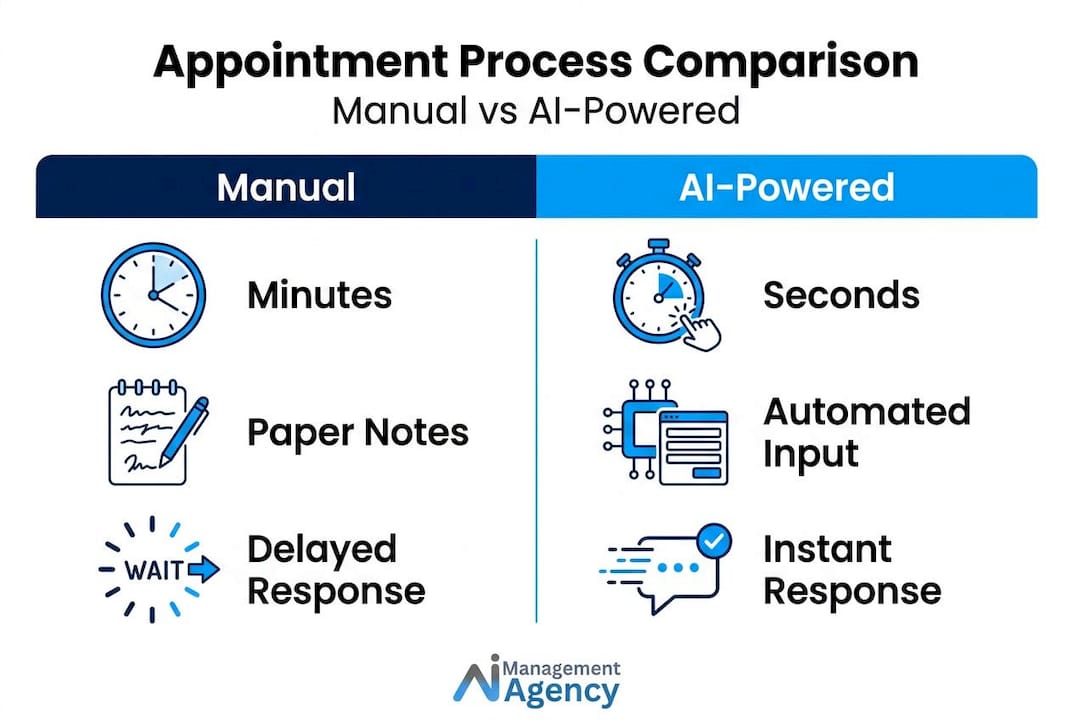
The appointment scheduling efficiency gains are not just about volume. They translate directly into revenue, staff wellbeing, and guest experience.
According to hybrid AI strategies, the best results come from a hybrid model where AI qualifies enquiries and humans close complex or high-value bookings. This balance keeps your team focused on where they add most value.
Pro Tip: Use AI for initial qualification and routine bookings. Reserve your most experienced team members for complex group bookings, VIP requests, and high-value corporate negotiations where personal rapport genuinely closes the deal.
How AI appointment setting actually works: step by step
Now, let us break down what actually happens behind the scenes in an AI-powered appointment setting system. Understanding the mechanics helps you deploy it confidently and set it up correctly from the start.
- Enquiry is received through your chosen channel, whether that is a phone call handled by an AI Voice Agent, a website chat widget, or a WhatsApp message
- Natural language processing interprets the intent, identifying whether the enquiry is a booking request, a general question, or a complaint requiring human attention
- The AI gathers qualifying information through conversational questions, checking party size, preferred dates, budget range, and specific requirements such as accessibility needs or dietary restrictions
- Real-time integration with your calendar or booking engine allows the AI to check and offer genuine availability rather than promising slots that no longer exist
- Confirmation and handoff occur seamlessly, with the AI either completing the booking autonomously or escalating to a human sales agent if the enquiry requires a more consultative approach
- Post-booking automation sends confirmation emails, calendar invites, and timed reminders to reduce cancellations
The sales qualification with AI stage is particularly important. Not every enquiry is equal. An AI system trained with the right guardrails will identify high-value leads and pass them to your team at exactly the right moment.
“The best appointment journeys start with tech, but end with trust.”
This is worth taking seriously. As AI sales strategies for 2025 and beyond confirm, agentic AI can operate autonomously but needs clear guardrails to avoid errors in complex or ambiguous sales situations. Your AI system should know its limits, and when it reaches them, it should hand off to a human calmly and professionally rather than guessing.
Pro Tip: Define your escalation triggers before you go live. These are the specific scenarios where the AI must pass control to a human, such as complaints, bespoke pricing requests, or guests with complex accessibility requirements. Build these triggers into your setup from day one.
Common misconceptions and expert answers
Despite clear benefits, some owners remain hesitant, so let us set the record straight on common doubts.
The biggest concern we hear from hospitality business owners is that AI feels impersonal. It is a reasonable instinct, but it is not supported by the evidence. Modern AI uses sophisticated NLP to tailor every conversation in real time, adapting tone, language, and detail to the individual.
Myth versus reality:
| Myth | Reality |
|---|---|
| AI lacks a personal touch | Advanced NLP creates genuinely tailored, natural conversations |
| AI will make embarrassing errors | Well-configured AI with guardrails is highly reliable and consistent |
| AI replaces your people | AI handles routine tasks; skilled staff focus on high-value interactions |
| It is too complicated to set up | Modern platforms are designed for non-technical business owners |
| Only large businesses benefit | AI scales to any size; small venues see proportionally large gains |
As AI personalisation research shows, criticisms about a lack of personalisation have been largely debunked by advanced NLP capabilities. The key is choosing a well-built solution rather than a basic chatbot.
Understanding the difference between approaches is also important. The comparison between agentic AI vs automation explains why not all AI tools are created equal, and why agentic systems offer far greater flexibility for complex hospitality environments.
You should consider a hybrid approach if your business experiences any of the following:
- High volumes of bespoke enquiries that require judgement or negotiation
- Regular VIP or returning guests who expect a personal relationship with your team
- Bookings involving complex logistics such as weddings, conferences, or large group events
- Staff who currently spend significant time on routine, repetitive booking admin
The AI versus traditional sales teams comparison makes a compelling case for why hybrid beats either extreme, delivering conversion rates that neither pure automation nor a fully manual team can match alone.
How to get started with AI appointment setting in your business
By now, you are likely convinced of AI’s role, so here is how to begin implementing these tools with confidence. The practical steps are straightforward, particularly if you approach this as a pilot project rather than a wholesale transformation overnight.
Step-by-step implementation plan:
- Audit your current process by mapping every touchpoint where enquiries arrive and identifying where leads are lost, delayed, or mishandled
- Choose the right platform based on your channels, booking volume, and the level of personalisation your guests expect; look for solutions built specifically for hospitality rather than generic sales tools
- Run a pilot project on one channel first, such as inbound phone calls after hours, before rolling out across all enquiry channels
- Train your staff on how the AI system works, how to review transcripts, and when and how to step in during a human handoff scenario
- Monitor and optimise by reviewing booking conversion rates, call transcripts, and customer feedback weekly during the first month
Hospitality-specific considerations to keep in mind:
- Ensure your AI integrates with your existing booking engine, whether that is ResDiary, OpenTable, or a property management system
- Configure the system to capture dietary requirements, accessibility needs, and special occasion details during the qualification stage
- Comply fully with UK GDPR regulations by ensuring the AI discloses its nature when required and that all data captured is stored and processed lawfully
- Test the AI’s responses to edge cases such as complaints, requests for discounts, and group bookings before going live
- Build in a regular review cycle to update the AI’s knowledge base as your menu, pricing, or services change
For further guidance on generating warm leads before they even reach the booking stage, the AI-driven lead generation resource provides practical frameworks. And if you want to save time at the outreach stage, these AI outreach automation tips offer seven immediately actionable ideas.
As AI appointment strategies consistently confirm, the most effective deployments treat AI as the qualifier and humans as the closers. Getting this balance right from the outset saves significant time, money, and frustration.
Why the future is hybrid: what most guides miss about AI appointment setting
Most guides on this subject focus on the technology. They walk you through features, integrations, and automation workflows, and then leave you to figure out the harder question: what actually makes guests feel well looked after?
In hospitality, the answer has always been trust. Guests return to venues where they felt understood and valued, not just efficiently processed. This is where many businesses make their first mistake with AI. They deploy it expecting it to replicate the warmth of their best front-of-house team member, and when it does not quite hit that note for a long-standing regular, they conclude that AI does not work.
The reality is more nuanced. Consultative selling requirements are real, and AI is not a full replacement for the kind of relationship-based selling that characterises the best hospitality businesses. But that is not what AI is for. It is for the 80% of interactions that are routine, repeatable, and entirely suitable for automation. Freeing your team from these interactions is what gives them the time and headspace to deliver genuine human warmth where it counts most.
The businesses we see thriving with AI sales qualification in hospitality are those that have been deliberate about this boundary. They have mapped their customer journeys carefully, identified the moments that require human empathy, and built their AI systems to escalate smoothly when those moments arrive.
Over-reliance on AI in hospitality carries a real risk. If a loyal guest calls to rearrange their anniversary dinner and is handled entirely by an automated system without any personal acknowledgement of the occasion, that guest notices. The solution is not to avoid AI. It is to deploy it thoughtfully, with clear human handoff triggers and regular quality reviews.
The best results come to businesses that view AI and their team as partners, not alternatives. Tech handles the scale and speed. People deliver the trust and judgement. That combination is genuinely hard to beat.
Discover the right AI appointment solution for your business
If this guide has given you a clearer picture of what AI appointment setting can do, the next step is finding a solution built for businesses like yours.
At AI Management Agency, we build AI agents specifically for UK hospitality and small business environments. Our AI Receptionist for restaurants handles inbound calls 24/7, responds to FAQs in a natural tone, and books qualified sales appointments without your team lifting a finger. Whether you run a single-site restaurant or a growing hotel group, we design solutions that fit your workflows, integrate with your existing systems, and support your team rather than replacing them. Explore how to book AI sales appointments effectively and see what the right AI solution looks like for your venue.
Frequently asked questions
Will AI appointment setting tools replace my staff?
No. As consultative selling evidence confirms, AI is not a full replacement for skilled people. It handles routine bookings so your team can focus on complex, high-value interactions where their expertise and personal touch make the biggest difference.
Is AI appointment setting too complicated or expensive for small hospitality firms?
Modern solutions are designed to be accessible and scalable, meaning even a small independent venue can deploy AI without significant upfront cost or technical expertise. As AI scalability research demonstrates, the benefits of speed and consistency apply equally to small businesses, not just large operators.
Can AI handle special requests and personalisation?
Yes. Modern AI uses advanced NLP to tailor conversations and capture individual guest needs such as dietary requirements, accessibility requests, and special occasions. The personalisation concerns that once surrounded AI have been firmly addressed by the latest generation of language models.
How quickly can a business see results after implementing AI?
Most businesses notice measurable improvements within the first few weeks, including fewer missed enquiries, reduced admin errors, and improved booking conversion rates. The speed of results depends on how well the system is configured and how quickly staff adapt to the new hybrid workflow.
Recommended
- How to book sales appointments with AI: UK small business – AI Management Agency
- AI sales appointment automation for hotels: a step-by-step guide – AI Management Agency
- AI hotel appointment scheduling: boost efficiency 40%+ – AI Management Agency
- AI appointment examples to streamline your UK hotel – AI Management Agency
- AI recruitment: faster, smarter hiring for HR leaders | Testask Blog | testask