TL;DR:
- AI for guest FAQs automates routine guest inquiries, providing instant, accurate responses and freeing staff for personal interactions. Implementing FAQ schema enhances AI visibility and citation rates, with self-contained answers of 134-167 words being most effective. Proper content preparation and balancing automation with human touch are crucial for delivering genuine hospitality and maintaining guest trust.
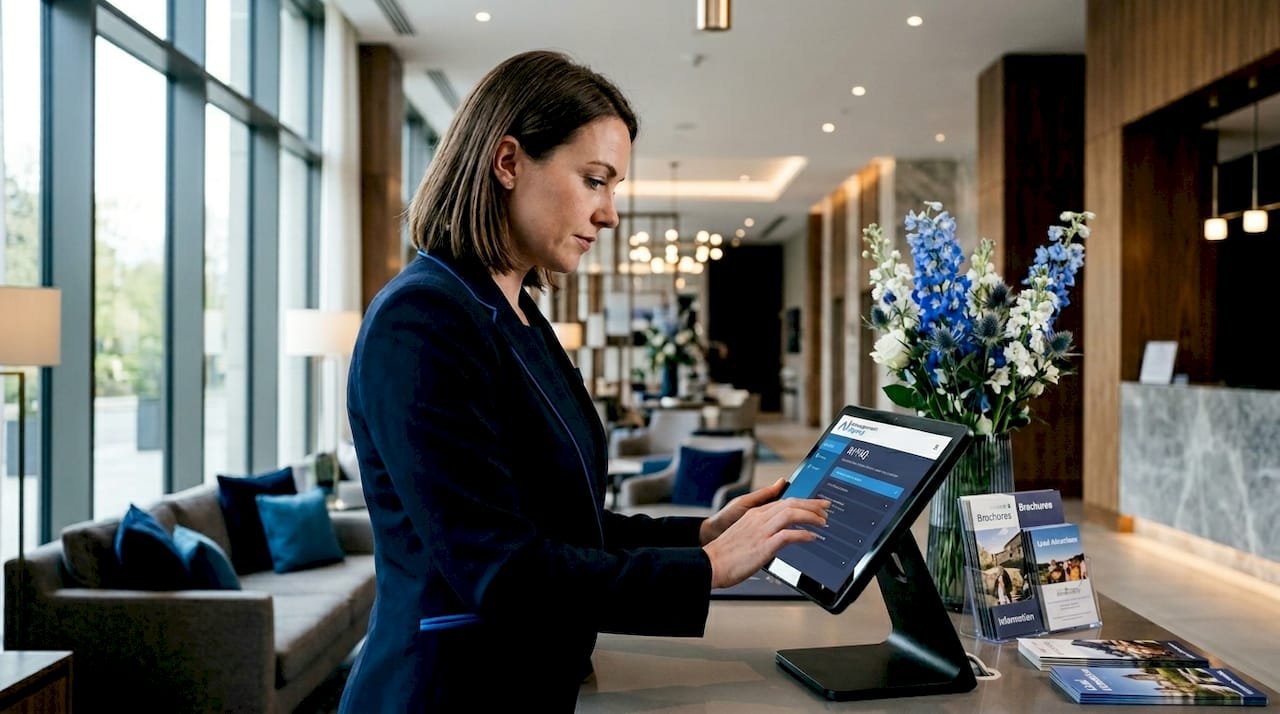
AI for guest FAQs is defined as the automated handling of routine guest questions using artificial intelligence, delivering instant, accurate responses without requiring staff involvement. For UK hotel owners and hospitality managers, this technology addresses one of the most persistent operational drains: the constant repetition of answering the same questions about check-in times, parking, Wi-Fi, and breakfast. Tools like Tourmie’s AI Guest Assistant and platforms built by Aimagency demonstrate that automated guest support can operate 24 hours a day, respond in multiple languages, and free your team to focus on the interactions that genuinely require a human touch.
What types of guest questions can AI for guest FAQs handle?
AI systems built for hospitality FAQs are capable of handling a broader range of questions than most hotel owners initially expect. The technology works by drawing on your existing property data, guest guides, and FAQ content to generate accurate, contextually relevant answers. AI guest assistants commonly answer routine questions about check-in, Wi-Fi, house rules, parking, and breakfast with 24/7 availability, and escalate complex requests to staff when needed. This means your guests receive a reliable answer at 2am on a Sunday without a single member of staff being disturbed.
The most common question categories that AI handles well include:
- Check-in and check-out times, including early check-in availability and late departure requests
- Wi-Fi access, including network names, passwords, and troubleshooting basic connectivity
- Parking arrangements, including on-site availability, nearby alternatives, and pricing
- Amenities and facilities, such as pool hours, gym access, and restaurant booking procedures
- Local directions and recommendations, including transport links and nearby attractions
- House rules, including noise policies, pet policies, and smoking restrictions
The escalation function is where AI FAQ systems prove their operational maturity. When a guest asks something outside the system’s knowledge base, or when a query carries emotional weight such as a complaint or a special accessibility need, the AI routes the conversation to a human member of staff. This prevents the frustration of a guest receiving a generic or irrelevant response at a critical moment.
AI assistants answer FAQs instantly and in multiple languages, which is particularly valuable for UK hotels attracting international visitors. A guest arriving from France or Japan can receive a clear, accurate answer in their own language without your receptionist needing to speak either.

Pro Tip: Build your AI FAQ system from your existing guest welcome guide. If you already have a well-written digital compendium, the AI has everything it needs to start answering questions accurately from day one.
How does FAQ schema improve AI’s ability to answer guest questions?
FAQ schema, formally known as FAQPage JSON-LD structured data, is the technical format that allows AI systems to read and extract your question-and-answer content with precision. It presents your FAQs in a machine-readable structure that AI answer engines, including those powering ChatGPT, Perplexity, and Google’s AI Overviews, can parse and cite directly. Understanding this distinction matters because it separates hotels that appear in AI-generated answers from those that do not.
Hotels with FAQPage schema have 3.2 times higher AI Overview citation rates than those without. That figure means a hotel without schema is effectively invisible to the AI systems that millions of travellers now use to research their stays before booking.
Here is how to implement FAQ schema effectively on your property website:
- Write self-contained answers. Each answer must make sense on its own, without the reader needing to read surrounding content. AI systems extract answers in isolation, so vague responses like “See above for details” will fail.
- Match visible page content. Your schema must reflect exactly what appears on the page. Google’s 2026 guidelines penalise hidden or mismatched structured data.
- Aim for 12 to 20 FAQs per page. Well-structured FAQ content leads to AI-extractable answers of roughly 134 to 167 words, scoring higher on semantic completeness and increasing citation likelihood.
- Avoid duplicating FAQs across multiple pages. Each page should address distinct, property-specific questions relevant to that page’s topic.
- Prioritise commercially relevant questions. Focus on questions guests ask before booking, such as cancellation policies, accessibility features, and what is included in the room rate.
It is worth noting that Google deprecated FAQ rich snippets entirely by May 2026, meaning the visual accordion-style results no longer appear in standard search. However, FAQPage JSON-LD schema remains fully valid and actively parsed by AI answer engines. The strategic value of schema has shifted from visual search results to AI citation, and that shift rewards hotels that act now.
Pro Tip: Use Google’s Rich Results Test tool to verify your schema is correctly implemented. Even a small syntax error in your JSON-LD can prevent AI systems from reading your FAQ content entirely.
| Approach | Effect on AI citation |
|---|---|
| FAQPage schema implemented | 3.2x higher AI Overview citation rate |
| Plain HTML FAQ page, no schema | Low discoverability by AI answer engines |
| Duplicate FAQs across multiple pages | Reduced relevance signals, lower citation priority |
| Self-contained answers, 134 to 167 words | Higher semantic completeness score, more citations |
How do you balance AI automation with genuine hospitality?
The most important operational question for any hotel owner considering AI is not whether it works, but where it belongs. A Mews survey found that 98% of hoteliers now use AI across their operations, yet 59% believe front desk and check-in experiences should remain human-led. That tension is not a contradiction. It reflects a clear-eyed understanding of where AI adds value and where it does not.
AI belongs in the repetitive, transactional layer of guest communication. It does not belong in the moments that define a guest’s emotional memory of their stay. A guest who arrives after a long journey and encounters a warm, attentive receptionist will remember that interaction. A guest who receives an instant, accurate answer to a Wi-Fi question at midnight will simply feel looked after, without ever knowing or caring whether a human or an AI responded.
Automating guest FAQs frees front-desk staff to focus on high-touch, personalised service. One Worldie AI client noted that delegating FAQ handling to AI gave their team the time and mental space to practise intentional hospitality rather than reactive administration.
The risks of over-automation are real and worth naming directly:
- Guests with complex or emotionally sensitive needs may feel dismissed by an AI response
- A poorly configured system can give incorrect information, damaging trust at a critical pre-arrival moment
- Over-reliance on automation can erode the warmth that differentiates independent hotels from large chains
The solution is to treat AI as an augmentation of your team, not a replacement. Smaller hotels can benefit significantly by identifying where AI creates the most value, particularly in guest FAQs, rather than attempting wholesale automation across every touchpoint.
Practical steps for UK small hotel owners to implement AI guest FAQs
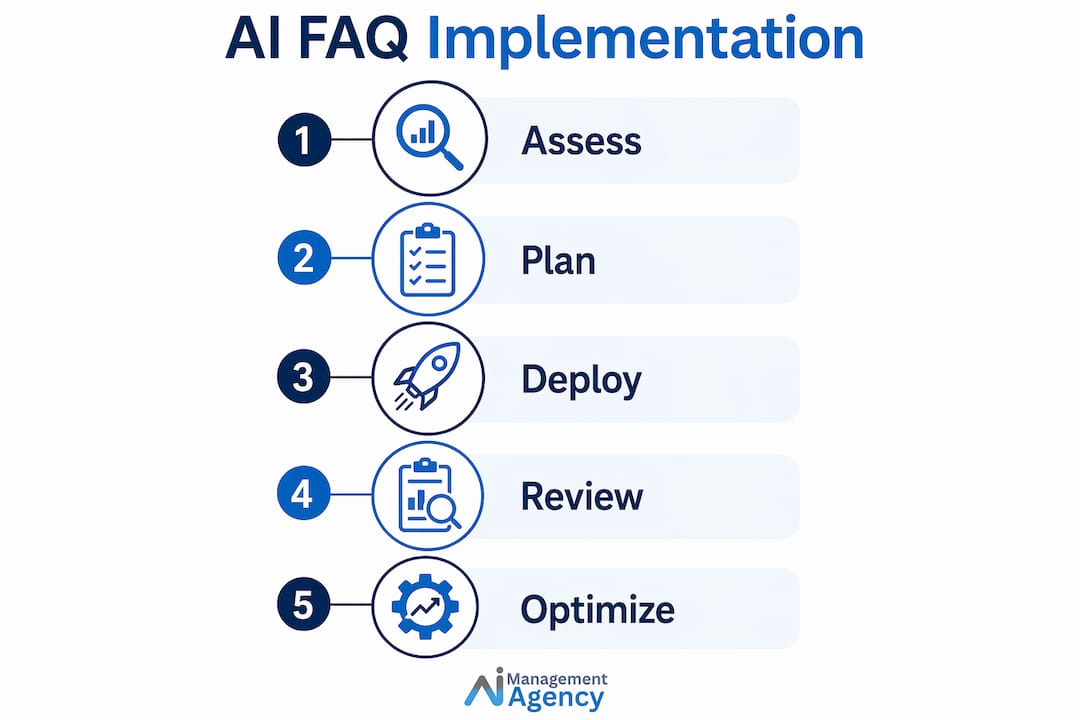
Implementation does not require a large budget or a dedicated IT team. The following steps give you a clear path from decision to deployment.
- Audit your most common guest questions. Review your inbox, WhatsApp messages, and front-desk logs for the past three months. The questions that appear most frequently are your starting point for AI FAQ content.
- Select a tool compatible with your existing systems. Look for AI customer service solutions that integrate with your property management system and can ingest your existing guest guide content. Aimagency builds AI agents specifically configured for hospitality workflows, including FAQ handling and call answering.
- Customise the communication style. Your AI should sound like your property. A boutique country house hotel and a city-centre budget property have different voices. Configure your AI’s tone to match your brand before going live.
- Implement FAQPage schema on your website. Work with your web developer or an agency like Aimagency to add JSON-LD structured data to your FAQ pages, following the 2026 guidelines for self-contained, property-specific answers.
- Train your staff on escalation workflows. Your team needs to know how the AI handles queries, what triggers an escalation, and how to pick up a conversation seamlessly when a guest is transferred from AI to human support.
- Monitor performance and refine regularly. Review which questions the AI answers well and which it struggles with. Guest feedback, particularly any complaints about incorrect or unhelpful AI responses, is your most reliable signal for improvement.
You can explore AI response optimisation strategies specifically designed for small hospitality teams to get a clearer picture of what good configuration looks like in practice.
Pro Tip: Set a quarterly review date in your calendar to assess your AI FAQ performance. Guest questions evolve with seasons, events, and changes to your property. An AI system that was accurate in January may need updating by April.
Key takeaways
AI for guest FAQs delivers the greatest return when it handles repetitive, transactional questions accurately, freeing staff for the high-value human interactions that define guest loyalty.
| Point | Details |
|---|---|
| AI handles routine questions well | Check-in, Wi-Fi, parking, and house rules are prime candidates for full automation. |
| FAQ schema multiplies AI visibility | FAQPage JSON-LD gives hotels 3.2x higher AI Overview citation rates than plain HTML. |
| Human oversight remains non-negotiable | 59% of hoteliers believe check-in should stay human-led, even with 98% AI adoption. |
| Schema quality beats quantity | Self-contained answers of 134 to 167 words score higher on AI semantic completeness. |
| Implementation is incremental | Start with your most-asked questions, configure tone, then expand scope over time. |
Why I think most hotels are implementing AI FAQs in the wrong order
Most hotel owners I speak with start by asking which AI tool to buy. That is the wrong first question. The right first question is: what are the ten questions your guests ask most often, and do you have clear, accurate, written answers to all of them?
AI is only as good as the content it draws on. A system trained on a vague or incomplete guest guide will produce vague or incomplete answers. The hotels that get the most from AI FAQ automation are the ones that have already done the unglamorous work of writing excellent FAQ content before the AI ever touches it.
The second mistake I see regularly is treating AI as a cost-cutting exercise rather than a service improvement. When the primary motivation is reducing staff hours, the implementation tends to be rushed, the escalation protocols are weak, and guests notice. When the motivation is giving guests faster, more accurate answers at any hour of the day, the implementation is more careful and the results are measurably better.
The third thing worth saying plainly: the independent hotel sector in the UK has a genuine competitive advantage over large chains in warmth and personalisation. AI should protect and extend that advantage, not erode it. Use it to handle the questions that consume your team’s time without requiring their judgement. Reserve your team’s energy for the moments that require empathy, creativity, and genuine human connection.
You can see real examples of AI in guest communication from UK hotels in 2026 to understand what well-implemented systems actually look like in operation.
— Geoff
How Aimagency helps UK hotels deploy AI guest FAQ solutions
Aimagency specialises in building AI agents that handle guest FAQs, answer calls around the clock, and route complex queries to your team without friction. If you manage a small UK hotel and want to automate routine guest questions without losing the warmth your guests expect, Aimagency configures AI solutions to match your property’s voice and existing workflows.
From FAQPage schema implementation to full AI receptionist deployment, Aimagency handles the technical setup so you can focus on running your property. Explore the complete 2026 guide to AI agents in hospitality to see exactly how these solutions work for independent UK hotels, or contact Aimagency directly for a personalised consultation tailored to your property’s needs.
FAQ
What is AI for guest FAQs in hotels?
AI for guest FAQs is an automated system that answers routine guest questions, such as check-in times, Wi-Fi details, and parking, instantly and without staff involvement. It draws on your property’s existing content to generate accurate responses 24 hours a day.
Does FAQ schema still matter after Google’s 2026 changes?
Yes. Although Google removed visual FAQ rich snippets by May 2026, FAQPage JSON-LD schema remains valid and is actively parsed by AI answer engines including Google’s AI Overviews, ChatGPT, and Perplexity.
How many FAQs should a hotel page include for best AI results?
Aim for 12 to 20 FAQs per page, with self-contained answers of roughly 134 to 167 words each. This length and structure scores highest on AI semantic completeness and increases citation likelihood.
Will AI replace my front-desk staff?
No. A Mews survey found 59% of hoteliers believe check-in and front-desk interactions should remain human-led. AI is most effective as support for repetitive FAQ handling, freeing staff for personalised guest service.
How quickly can a small UK hotel get AI FAQs up and running?
With the right content already in place, a basic AI FAQ system can be configured and live within days. A full deployment including FAQPage schema, tone customisation, and escalation workflows typically takes two to four weeks with agency support.
Recommended
- AI in hotels: boost service and cut calls by 90% – AI Management Agency
- Enhance guest experience with AI in UK hotels 2026 – AI Management Agency
- AI answering services explained: UK hospitality guide 2026 – AI Management Agency
- AI-driven guest support: boost hotel efficiency in 2026 – AI Management Agency