
TL;DR:
- Most UK hotels have only begun adopting AI, with less than 10% extracting significant value from it.
- Successful implementation depends on improving data quality, staff training, and structured content.
Artificial intelligence in UK hotels is defined as the deployment of AI technologies to automate operations, personalise guest interactions, and optimise revenue management across the full guest journey. 52% of UK travellers now use AI for trip planning, a 12 percentage point rise year on year. That shift means your hotel’s visibility and responsiveness inside AI-driven platforms directly affects bookings. The hotels that act on this now will hold a measurable advantage over those still treating AI as a future consideration.
How are UK hotels currently using AI technologies?
AI in UK hotels covers a wider range of applications than most managers realise. The most visible layer is guest communication. AI-powered chatbots and virtual concierge platforms handle enquiries, room requests, and restaurant bookings around the clock. AI concierge platforms support over 40 languages and integrate directly with property management systems, freeing front-desk staff to focus on high-value guest interactions.
Revenue management is the second major application area. Predictive pricing engines analyse competitor rates, local demand signals, and historical booking patterns to adjust room prices in real time. This approach improves RevPAR without requiring a revenue manager to monitor rates manually every hour.
Operational AI is the third pillar, and it is often underestimated. Hotels are applying machine learning to staff scheduling, predictive maintenance, and energy management. A hotel that predicts a boiler fault before it fails avoids both the repair cost and the guest complaint. AI applications across revenue management, chatbots, and energy efficiency deliver measurable cost reductions alongside revenue gains.
Key current applications include:
- AI guest communication: 24/7 chatbots and voice agents handling FAQs, booking amendments, and upsell requests
- Dynamic pricing: Real-time rate adjustments based on demand forecasting and competitor data
- Predictive maintenance: Sensors and AI models flagging equipment issues before they cause disruption
- Staff scheduling: AI tools matching rota patterns to forecasted occupancy, reducing labour waste
- Energy management: Automated systems adjusting heating, cooling, and lighting based on occupancy data
Pro Tip: Start with AI guest communication before tackling revenue management. It delivers visible results quickly, builds staff confidence, and generates the guest data you need for more advanced applications later.
What challenges do UK hotels face when implementing AI?
The adoption statistics look impressive on the surface. 98% of hotel owners claim to use AI tools. Yet fewer than 10% of hotels are classified as “future built,” meaning they extract substantial, multi-activity value from AI. That gap between claiming adoption and delivering results is the defining challenge for UK hospitality right now.
The barriers fall into three categories:
-
Data quality and silos. AI systems are only as good as the data they process. Most hotels hold guest data across disconnected systems: the property management system, the booking engine, the CRM, and the point-of-sale platform. When these systems do not talk to each other, AI cannot generate reliable insights.
-
Visibility in AI travel planners. Hotels are often invisible to AI because their website content is not structured in machine-readable formats. Traditional SEO alone does not make a hotel discoverable inside AI planning tools like ChatGPT or Perplexity. Without structured data markup using schema.org, AI assistants cannot read or recommend your property.
-
Staff buy-in and cultural resistance. Technology without people is just software. When staff feel threatened by AI rather than supported by it, adoption stalls. Hotels that skip the training and communication phase find that AI tools sit unused or are actively worked around.
“The real barrier to AI in hospitality is not the technology. It is the gap between installing a tool and building the workflows, data pipelines, and staff confidence that make it work.”
The result is a sector where most hotels have dipped a toe into AI without committing to the depth of change required to see a return. Recognising this gap is the first step toward closing it.
How can UK hotels implement AI to improve guest experience?
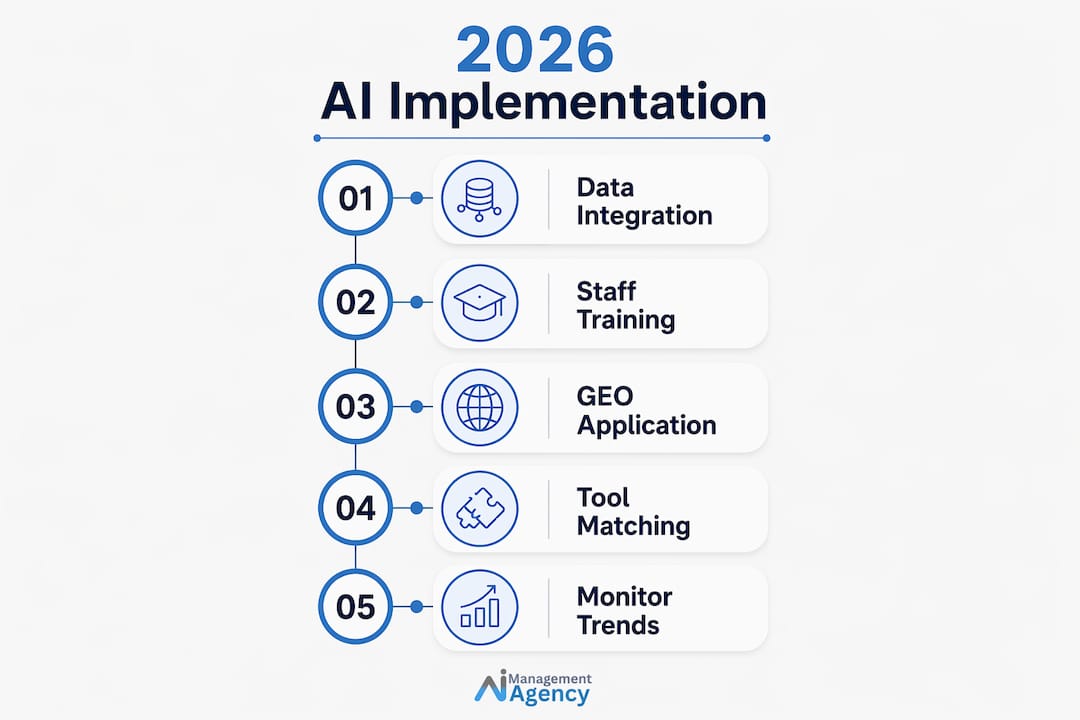
Successful implementation follows a clear sequence. You do not need to deploy every AI application at once. You need to deploy the right ones in the right order, with the right foundations in place.

Build clean data pipelines first
Integrating your property management system, booking engine, and CRM into a single data flow is not optional. Bridging data silos across front desk, revenue management, and marketing is the prerequisite for scaling AI benefits. Without this, every AI tool you add will produce unreliable outputs.
Upskill staff alongside deployment
The Gate London City is a clear example of this done well. The hotel adopted AI specifically to upskill its staff, not replace them. Staff who understand what the AI is doing, and why, use it correctly and catch errors that an untrained team would miss. Training is not a cost. It is the mechanism that turns a software licence into a business result.
Apply Generative Engine Optimisation (GEO)
Generative Engine Optimisation, or GEO, is the practice of structuring your hotel’s content so that AI travel planners can read, interpret, and recommend it. Hotels that apply GEO see booking-engine conversion rates of 44.7%, compared to 25.9% from organic search alone. That is a significant difference. GEO involves implementing schema.org markup, writing content in direct question-and-answer formats, and ensuring your amenities, policies, and room types are described in structured, machine-readable language.
Match AI tools to your hotel’s scale
| Hotel type | Recommended starting point | Expected benefit |
|---|---|---|
| Independent boutique | AI guest communication and FAQ automation | Reduced call volume, faster response times |
| Mid-scale group property | Dynamic pricing engine plus chatbot | Improved RevPAR and direct booking rate |
| Large full-service hotel | Integrated AI platform across all departments | Cross-department efficiency and personalisation at scale |
Pro Tip: Use your AI guest communication data from the first three months to identify the top 20 guest questions. Build your FAQ content and GEO strategy around those exact queries.
What emerging AI trends should UK hotels prepare for?
The next wave of AI in UK hospitality moves beyond automation into what the industry calls agentic AI. These are systems that do not just respond to requests. They anticipate needs, manage disruptions, and act autonomously within defined parameters.
Key trends shaping the near future include:
- AI Commerce channels: AI Commerce solutions allow guests to complete bookings directly through AI assistants, with payments processed inside the conversation. This removes the step of visiting a hotel website entirely.
- Agentic AI for service recovery: When a flight delay affects a group booking, an agentic AI system can automatically adjust check-in times, notify housekeeping, and send personalised messages to affected guests, all without staff intervention.
- Real-time hyper-personalisation: AI systems that combine booking history, in-stay behaviour, and preference data will generate room configurations, dining recommendations, and activity suggestions tailored to each guest before they arrive.
- AI-embedded marketing: Rather than running campaigns and hoping for bookings, hotels will use AI to identify high-value guest segments and deliver personalised offers at the exact moment a traveller is planning a trip.
- Voice AI at the front desk: AI voice agents that answer calls in a natural tone, handle FAQs, and book appointments are already in use. The next step is full integration with property management systems so voice agents can check availability and confirm reservations in real time.
The hotels that prepare their data infrastructure and staff capabilities now will be positioned to adopt these tools as they mature, rather than scrambling to catch up.
Key takeaways
AI in UK hotels delivers measurable results only when data integration, staff training, and structured content work together as a system, not as separate projects.
| Point | Details |
|---|---|
| Adoption does not equal results | 98% of hotels claim AI use, but fewer than 10% extract substantial value from it. |
| GEO is now a booking channel | Structuring content for AI planners drives 44.7% conversion, far above organic search. |
| Staff training is non-negotiable | Hotels that upskill staff alongside AI deployment see better adoption and guest outcomes. |
| Data integration comes first | Clean, connected data pipelines are the foundation every AI application depends on. |
| Agentic AI is the next frontier | Autonomous AI systems will handle service recovery and personalisation without staff input. |
What I have learned from watching UK hotels adopt AI
The hotels that get the most from AI are not the ones with the biggest budgets. They are the ones that treat AI as a management discipline, not a technology purchase. I have seen properties spend significant sums on AI platforms that sit largely unused because no one changed the workflows around them. The tool was fine. The implementation was not.
The adoption-to-execution gap is real, and it is almost always a people and process problem rather than a technology problem. The hotels closing that gap share a common approach: they start small, measure everything, and build outward from a single working use case. An AI voice agent that answers calls and handles FAQs is not glamorous. But it generates data, frees staff, and builds confidence across the team. That confidence is what makes the next implementation faster and more effective.
The concern I hear most often from hotel managers is that AI will reduce the human quality of their service. The evidence points in the opposite direction. When staff are freed from repetitive enquiries and administrative tasks, they have more time for the interactions that actually build guest loyalty. The advantages of AI in hospitality are not about replacing warmth. They are about protecting the time and energy required to deliver it.
My honest advice: do not wait for a perfect strategy before starting. Pick one application, implement it properly, and learn from it. The hotels that will lead in 2027 are the ones making considered moves in 2026.
— Geoff
How Aimagency supports UK hotels with AI implementation
UK hotel managers looking to move from AI curiosity to AI results have a clear next step available. Aimagency specialises in building AI agents that handle real operational tasks: answering calls 24/7 in a natural conversational tone, responding to guest FAQs, and booking qualified appointments without putting guests on hold.
The Aimagency approach is built around your existing workflows. There is no requirement to overhaul your systems before you start seeing results. Whether you manage an independent boutique or a group of properties, the AI agents in hospitality guide sets out exactly how AI agents integrate with hotel operations in 2026. For hotels ready to automate call handling specifically, the call answering automation service page covers what is possible and how quickly it can be deployed.
FAQ
What is AI in UK hotels?
AI in UK hotels refers to the use of artificial intelligence technologies to automate guest communication, manage revenue dynamically, and improve operational efficiency. Applications range from AI chatbots and voice agents to predictive pricing engines and energy management systems.
How many UK hotels are actually using AI effectively?
Fewer than 10% of hotels are classified as “future built” with AI delivering substantial value, despite 98% claiming some form of AI adoption. The gap reflects poor data integration, insufficient staff training, and unclear implementation strategies.
What is Generative Engine Optimisation and why does it matter for hotels?
Generative Engine Optimisation (GEO) is the practice of structuring hotel content so AI travel planners can read and recommend it. Hotels applying GEO achieve booking conversion rates of 44.7%, compared to 25.9% from standard organic search.
Will AI replace hotel staff?
AI in hospitality is designed to augment staff, not replace them. Hotels like The Gate London City have adopted AI specifically to upskill employees, resulting in better guest interactions and higher staff confidence rather than redundancies.
Where should a UK hotel start with AI implementation?
Start with AI guest communication, specifically a voice agent or chatbot that handles FAQs and booking enquiries. This delivers fast, visible results, generates useful guest data, and builds the staff confidence needed for more advanced AI applications.