TL;DR:
- Automating hotel call answering ensures every guest inquiry is handled, increasing bookings and reducing missed calls.
- Small hotel teams benefit from 24/7 AI systems that manage routine questions and booking confirmations seamlessly.
Every missed call is a missed booking. For small UK hotels running on lean teams of two, three, or four people, the phone rings at the worst possible moments: during check-in, at breakfast service, late on a Friday night. Guests who can’t get through don’t leave a voicemail. They book elsewhere. AI-powered call answering solves this problem by ensuring every call is answered, every query handled, and every booking captured, 24 hours a day, without adding a single member of staff.
Table of Contents
- Why automate call answering for your hotel?
- Preparing to automate: What you need to know
- Step-by-step: How to automate call answering
- Avoiding common mistakes and troubleshooting
- Measuring success: What results to expect
- A fresh perspective: The real-world impact of AI call automation
- Discover tailored AI solutions for your hotel
- Frequently asked questions
Key Takeaways
| Point | Details |
|---|---|
| Reduce missed bookings | Automated call answering helps small hotels capture more bookings by eliminating unanswered calls. |
| Boost efficiency | AI can increase staff efficiency by up to 40%, allowing focus on guest experience. |
| Easy integration | Modern AI solutions can be integrated seamlessly with hotel booking platforms. |
| Continuous improvement | Regular monitoring and feedback helps optimise automated call answering over time. |
| Human touch preserved | Automation enables staff to dedicate time to guest relationships, not replace them. |
Why automate call answering for your hotel?
The business case for automation is straightforward. Unanswered calls translate directly into lost revenue. A guest looking to book a room for the weekend has options. If your line is busy or rings out, they will move on within seconds.
For small hotel teams, this is a genuine operational challenge. Staff are stretched across housekeeping, reception, food service, and administration. Answering every call promptly simply isn’t realistic. The result is a cycle of missed opportunities, frustrated guests, and exhausted employees.
Here’s what the numbers tell us:
- 62% of calls to small businesses go unanswered during peak periods
- Hotels using efficient AI answering services report booking increases of up to 30%
- The average guest will call just once before looking at a competitor
- Automated systems can handle multiple simultaneous calls, eliminating queues entirely
📊 Statistic callout: Hotels that implement AI call answering see an average reduction of 45% in missed calls within the first 90 days of deployment.
Automated answering eliminates the bottleneck. An AI Voice Agent answers immediately, speaks naturally, responds to frequently asked questions, and captures booking details without putting anyone on hold. Your team is freed up to focus on the guests already in the building.
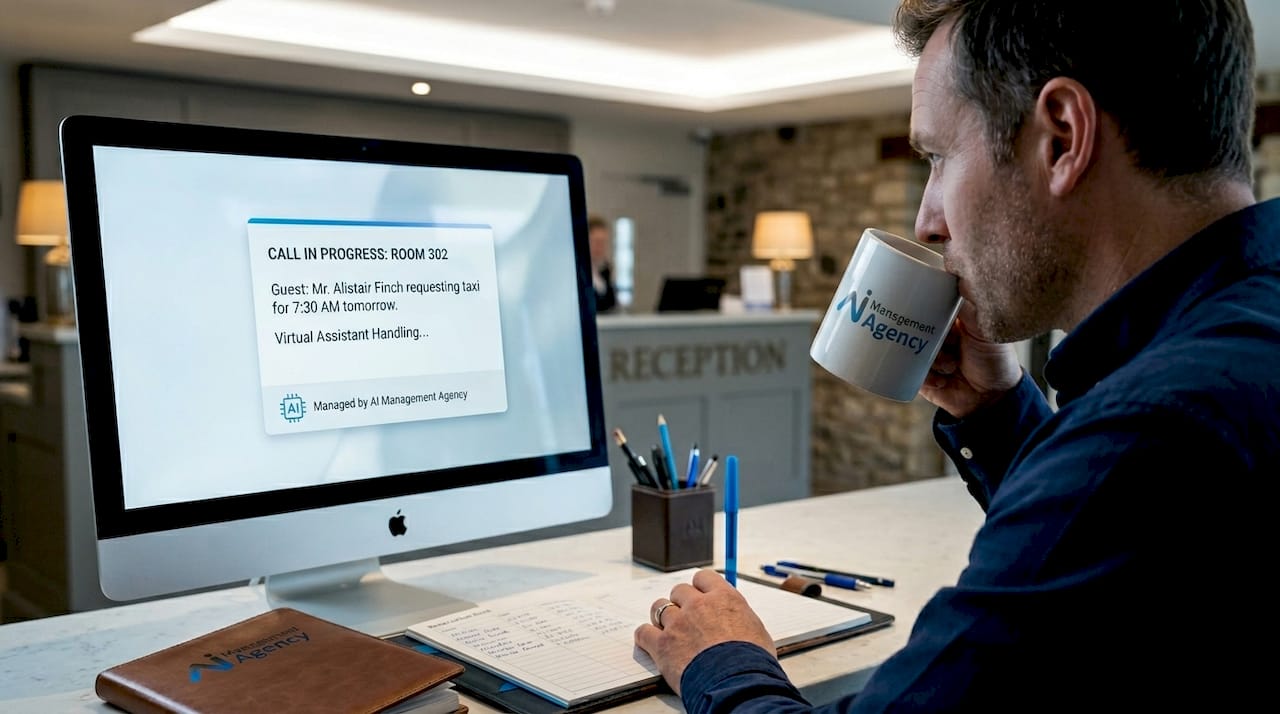
The workload reduction is equally significant. Reception staff at small hotels spend a disproportionate amount of time answering routine enquiries: room availability, parking, check-in times, pet policies. Automation handles all of this, every time, without error or fatigue.
Preparing to automate: What you need to know
Recognising the need is one thing. Getting the implementation right is another. Before you deploy any AI solution, you need a clear picture of your requirements and your current situation.
Start by mapping your calls:
- What is your average daily call volume?
- When do peak call periods occur (evenings, weekends, school holidays)?
- What are the most common questions callers ask?
- How many calls result in a confirmed booking versus a simple enquiry?
This data shapes everything. It tells you how sophisticated your AI system needs to be, what scripts to prioritise, and where the biggest gains are hiding.
Compare your options before committing:
| Feature | Manual answering | AI Voice Agent |
|---|---|---|
| Availability | Business hours only | 24/7, 365 days |
| Call capacity | One at a time | Unlimited simultaneous |
| Consistency | Variable | Always on-brand |
| Cost | Ongoing staff cost | Fixed monthly fee |
| Booking capture | Dependent on staff | Automated and instant |
| Scalability | Requires more staff | Scales with no extra cost |
Understanding the AI receptionist benefits for small businesses helps you evaluate which features matter most for your specific operation. Not every hotel needs the same configuration. A boutique property with 10 rooms has different call patterns than a busy roadside hotel.
Key things to assess before you begin:
- Your current booking platform and whether it supports API integration (a technical connection between software systems)
- Whether your broadband connection is stable and fast enough for cloud-based voice services
- Staff buy-in and training requirements for the new workflow
- Your budget for monthly subscription costs versus the revenue you’re currently losing
Reviewing a solid AI answering service guide tailored to UK small businesses gives you a framework for making these decisions without the guesswork.
Pro Tip: Check your internet connection speed and reliability before deploying any AI voice solution. A stable broadband connection with low latency is essential. If your connection drops regularly, even the best AI system will struggle to perform consistently.
Step-by-step: How to automate call answering
With preparations in place, here’s how to put automation into action step by step.
1. Choose the right AI call answering software
Not all platforms are equal. Look for a solution that offers natural-sounding voice responses, UK English language support, and integration with your existing booking system. Avoid platforms that sound robotic or deliver stilted responses. Guests notice immediately and it damages your brand. Reviewing AI call handling solutions designed specifically for UK businesses gives you a reliable starting point.
2. Integrate with your appointment booking tools
Your AI system needs to connect directly to your booking platform. This allows it to check room availability in real time, confirm reservations, and send instant confirmation messages to guests. Without this integration, you’re creating a manual step that defeats the purpose of automation entirely.
3. Customise your scripts and responses
Generic scripts sound generic. Your AI Voice Agent should reflect your hotel’s character, whether that’s warm and traditional or modern and minimalist. Write scripts that sound like your best receptionist: friendly, clear, and confident. Cover your most common enquiries:
- Room availability and rates
- Check-in and check-out times
- Parking arrangements
- Pet policies
- Local attraction recommendations
- Cancellation and amendment policies
4. Run a thorough test phase
Before going live, test every scenario. Call the system yourself from different devices. Ask colleagues to call with unusual questions to see how the AI handles a curve ball. This phase typically takes one to two weeks and is worth every minute.
5. Monitor performance from day one
Use the reporting dashboard your provider supplies to track call volumes, response rates, booking conversions, and caller drop-off points. This data is invaluable for refinement.
| Step | Timeframe | Key action |
|---|---|---|
| Software selection | Week 1 | Compare providers, check integrations |
| System setup | Week 2 | Configure, connect booking platform |
| Script writing | Week 2-3 | Customise to your hotel’s voice |
| Testing | Week 3-4 | Internal and external call testing |
| Go live | Week 4-5 | Launch with monitoring active |
| Review | Month 2 | Analyse reports, refine scripts |
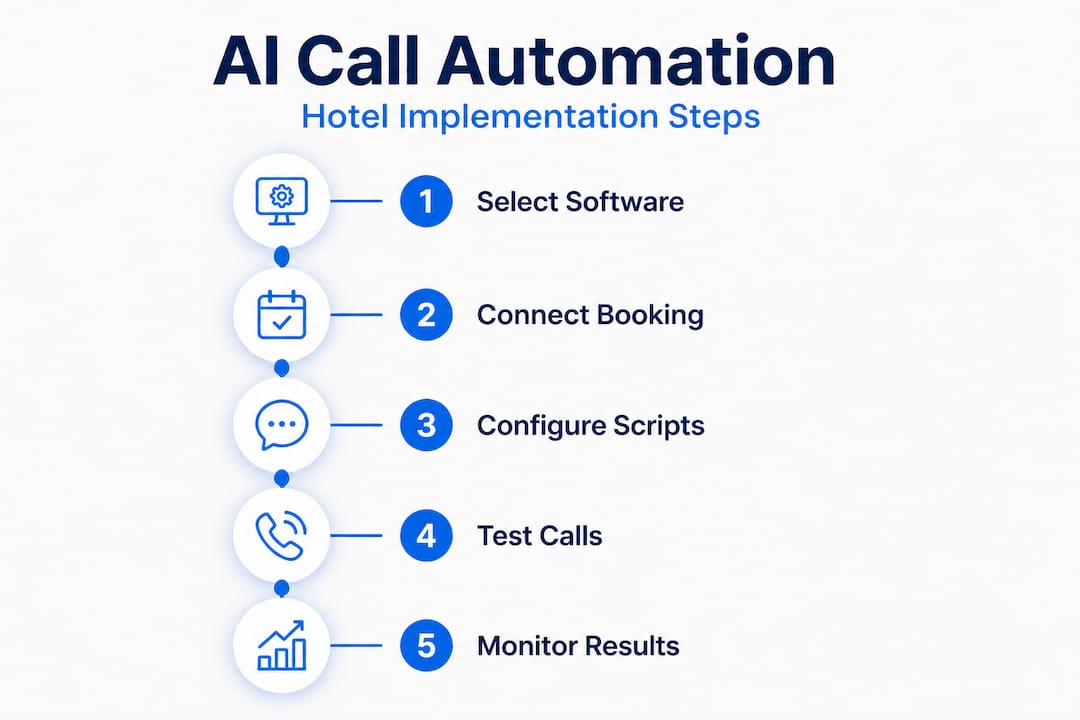
The approach works across industries too. Looking at how an AI receptionist case study transformed another small service business illustrates the workflow and outcomes you can realistically expect.
Pro Tip: Use feedback reports from your first month to refine automated scripts based on real caller scenarios. Pay particular attention to calls where the AI asked the caller to repeat themselves or transferred to a human. These are your improvement opportunities.
Avoiding common mistakes and troubleshooting
After implementation, it’s crucial to maintain and troubleshoot your system to maximise results.
The most common mistake small hotels make is setting up their AI system and then leaving it alone. Automation requires ongoing attention, especially in the early months. Caller behaviour changes, new questions emerge, and your hotel’s policies evolve. Your scripts need to keep pace.
Common pitfalls to avoid:
- Using a generic script: A script that sounds like it could belong to any business will put callers off. Personalise every response.
- Ignoring accent and dialect variation: The UK has extraordinary regional diversity. Ensure your AI system is tested with a range of accents, including Scottish, Welsh, Northern Irish, and regional English dialects, to avoid comprehension errors.
- Skipping regular software updates: Outdated AI software carries security risks and performs less well than current versions. Schedule monthly checks.
- Failing to monitor customer feedback: If guests mention in reviews that your phone system was confusing, that’s a direct signal to update your scripts.
- Not verifying appointment confirmations: Always cross-reference AI-generated bookings with your booking platform to prevent double bookings.
⚠️ Critical note: Always verify that your AI system’s booking confirmations are syncing correctly with your main reservations platform. Double bookings are far more damaging to guest trust than a missed call.
Troubleshooting is straightforward when you have clear reporting. Review call logs weekly in the first two months. Look for patterns: calls that ended quickly, queries the AI couldn’t answer, or callers who asked to speak to a person. Each pattern points to a specific improvement. Understanding how AI receptionist troubleshooting works across different small business contexts helps you approach your own system with a structured mindset.
When to escalate to human support:
- The AI is consistently misunderstanding a specific type of query
- Booking errors are occurring regularly
- Caller satisfaction scores are declining despite script updates
- A significant policy change requires a full script rewrite
Measuring success: What results to expect
Assessing your system’s impact is the final step for long-term value. Without measurement, you’re operating blind. With clear metrics, you can demonstrate the return on investment and identify further opportunities to optimise.
Key performance indicators (KPIs) to track:
- Answered call rate: The percentage of incoming calls successfully handled by the AI without dropping
- Booking conversion rate: How many calls result in a confirmed reservation
- Average handling time: How long each call takes from start to finish
- Transfer rate: How often callers request or are transferred to a human agent
- Customer satisfaction score: Gathered through post-stay surveys or review monitoring
- Revenue attributed to automated bookings: Track bookings captured outside of business hours specifically
📊 Statistic callout: Hotels that successfully implement and maintain AI call automation report efficiency improvements of up to 40%, with the largest gains occurring in out-of-hours booking capture and routine enquiry handling.
Benchmark your results against industry standards. The average call answer rate for manually staffed hotel receptions sits at around 67% during peak hours. A well-configured AI system should reach 95% or higher from the first week of operation.
Use monthly performance reports to drive continuous improvement. Share findings with your team. Involve reception staff in the script refinement process because they know exactly what guests ask and how they ask it. This collaborative approach, combining AI capability with human insight, is where the AI Management Agency homepage philosophy is rooted: automation works best when it’s supported by people who care about the outcome.
Realistic timelines for results:
- Week 1 to 4: System stabilisation, initial data collection
- Month 2 to 3: Measurable reduction in missed calls, early booking uplift
- Month 4 to 6: Booking conversion rates stabilise at new, higher baseline
- Month 6 onwards: Compounding efficiency gains as scripts are refined and the system learns from real interactions
A fresh perspective: The real-world impact of AI call automation
Here’s what many articles miss about real-world automation adoption.
The biggest barrier we encounter with small UK hotel owners isn’t technical. It’s emotional. There’s a genuine fear that introducing AI will strip away the personal, warm character that makes a small hotel special. Guests choose independent properties precisely because they expect a human connection. That fear is understandable. It’s also, in most cases, unfounded.
Well-designed AI Voice Agents don’t replace personality. They protect it. When your reception team isn’t buried under a queue of routine calls, they have more time to deliver the thoughtful touches that generate five-star reviews. The handwritten welcome note. The local restaurant recommendation. The early check-in arranged as a gesture of goodwill. These moments are only possible when staff aren’t tethered to the phone.
The hotels that get the most from automation are the ones that treat their AI system as a team member, not a tool. They invest time in training it with real guest conversations. They update its scripts seasonally. They use it to handle the predictable and empower their people to handle the exceptional.
There’s also a common assumption that AI call answering is only viable for large hotel groups with dedicated IT teams. This is simply not true. The AI receptionist expertise available to independent UK hotels today is sophisticated, affordable, and designed specifically for lean operations. The technology that was exclusive to major chains five years ago is now accessible to a three-bedroom guesthouse in the Cotswolds.
The biggest gains don’t come from the technology alone. They come from the combination of reliable automation and attentive human oversight. Automation handles the volume. Your team handles the nuance. Together, they deliver a guest experience that neither could achieve alone.
Discover tailored AI solutions for your hotel
If you’re ready to boost efficiency and stop losing bookings to unanswered calls, the tools to do it are already available.
AI Management Agency works with small UK hotels to implement AI call answering, booking automation, and guest management workflows that genuinely fit your operation. Our AI call handling for hotels solutions are built around natural-sounding voice agents that reflect your brand and operate 24/7 without any ongoing management burden on your team. We also offer a free consultation and access to real case studies from small hotel operators who have made the switch. Explore hotel appointment scheduling automation to see exactly how the booking process can be streamlined from first call to confirmed reservation.
Frequently asked questions
How does AI automate call answering for hotels?
AI systems use natural language processing to answer incoming calls, handle routine queries, and book appointments automatically, reducing the manual workload on your reception team without losing the personal tone guests expect.
Is automated call answering suitable for small hotel teams?
Yes, it is specifically designed to support small teams by managing routine calls and bookings around the clock, freeing staff to focus on delivering an exceptional in-person guest experience.
Can AI call answering integrate with my existing booking platform?
Most modern AI solutions offer straightforward integration with popular hotel booking platforms, allowing real-time availability checks and instant reservation confirmations without any manual steps.
What metrics should I track to measure success?
Focus on answered call rates, booking conversion rates, out-of-hours booking volume, and customer satisfaction scores compared to your pre-automation benchmarks for the clearest picture of impact.
How do I troubleshoot problems with automated call answering?
Review your call logs weekly, gather feedback from guests and staff, and update your scripts based on real scenarios where the AI underperformed or callers requested a human agent.
Recommended
- 6 Ways to Use AI in Customer Service List for Hotels – AI Management Agency
- 10 Reasons Your Hotel Booking Line is Failing (And How an AI Receptionist Fixes It) – AI Management Agency
- AI Receptionist for Hotels: Improve Bookings & Guest Experience by AIM Agency
- AI Voice Technology: Transforming Small Hotel Service – AI Management Agency
- Top 3 AI chatbot business tools 2026