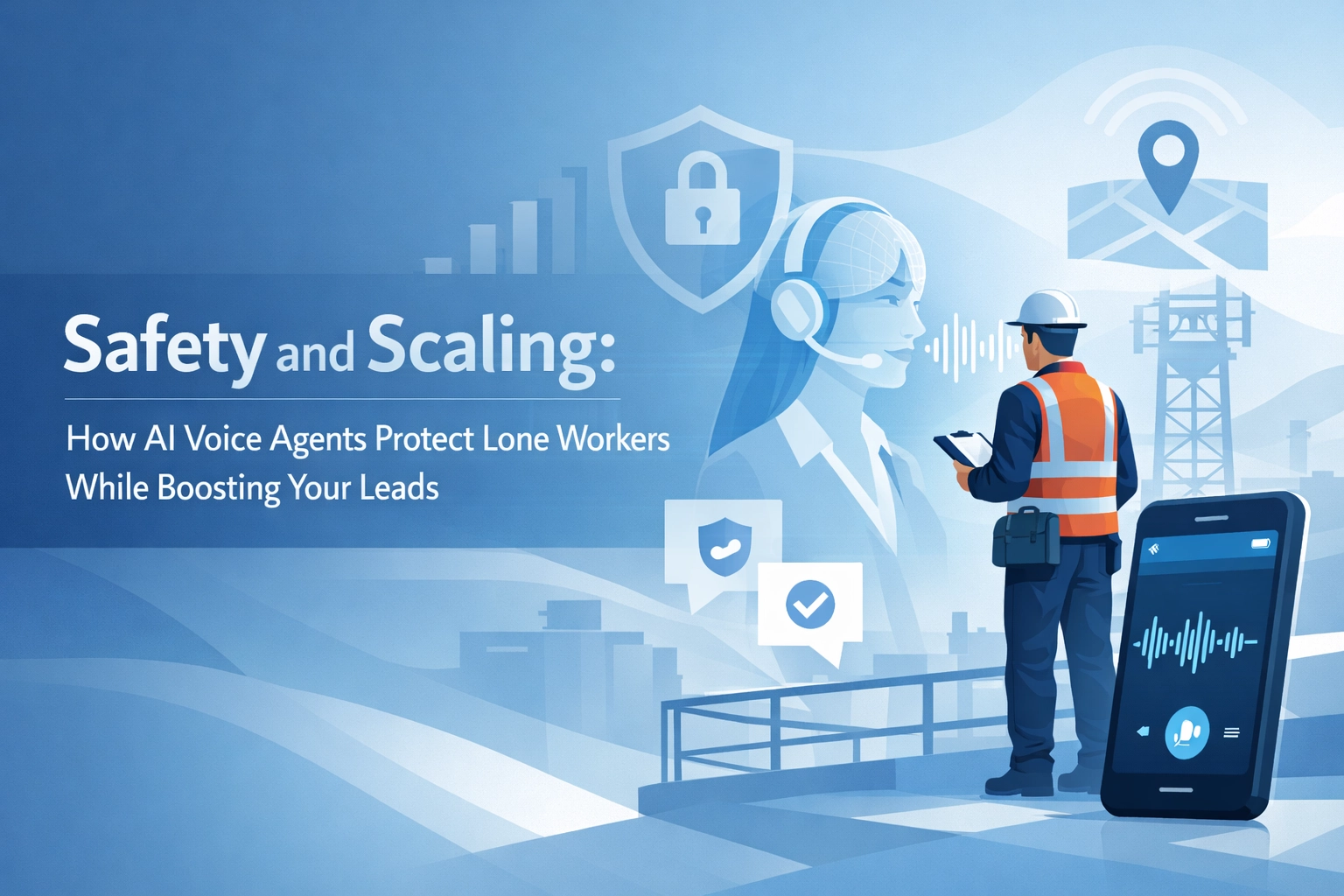
As an AI Agent Consultant, I’ve seen the same pattern repeat across dozens of UK service businesses. A business owner is pulled in two directions: they are legally and morally responsible for the safety of their team out in the field, yet every minute spent on safety compliance or manual "check-in" calls is a minute stolen from sales.
Even worse? While your team is busy on a job, perhaps in a remote area or a noisy plant room, the phone is ringing. And if that call goes to voicemail, there is a 60% chance that lead is already gone, onto the next name on Google.
This is the "service provider’s paradox." You can’t be everywhere at once. But what if your technology could?
The emergence of AI Voice Agents has fundamentally shifted the landscape. We are no longer talking about simple "press 1 for sales" menus. We are talking about intelligent, conversational systems that serve a dual purpose: acting as a safety net for your lone workers and a 24/7 lead generation engine for your bottom line.
Key Takeaways
- Safety Compliance: AI Voice Agents automate lone worker check-ins, reducing response times by up to 90% during incidents.
- Zero Lead Decay: By answering every call instantly, AI eliminates the "revenue leak" caused by missed calls and voicemails.
- Cost Efficiency: One AI agent can manage hundreds of safety pings and sales enquiries simultaneously for a fraction of the cost of a call centre.
- Operational Scaling: Free your human staff from "admin-heavy" monitoring so they can focus on high-value, complex tasks.
1. The Invisible Risk: Why Lone Worker Safety is Your Biggest Liability
For many UK businesses, from HVAC engineers and electricians to home-care providers, lone working is a daily reality. However, the manual processes used to monitor these workers are often flawed.
Traditional methods rely on the worker remembering to "text when they arrive" or "call when they leave." In a high-pressure environment, these tasks are the first to be forgotten. If an accident occurs and your business hasn’t followed HSE (Health and Safety Executive) guidelines for monitoring, the legal and financial repercussions are devastating.
That’s where an AI Voice Agent steps in. Instead of a human supervisor manually dialling numbers, an autonomous agent can be programmed to call workers at specific intervals.
How it works in practice:
- The AI calls the worker at a scheduled time.
- The worker responds via natural voice (hands-free).
- If the worker fails to answer or provides a "duress" code word, the AI instantly triggers an escalation protocol, notifying emergency services or onsite supervisors with the worker's last known location.

2. Converting Every "Hello" into a Lead
While safety is about protecting what you have, scaling is about capturing what you’re currently losing.
For a service provider, every missed call is a lost opportunity. Research shows that if you don't answer a new lead within five minutes, your chances of qualifying them drop by 80%. When your team is on-site (acting as lone workers), they physically cannot answer the phone.
An AI Receptionist solves this by providing a seamless, human-like interaction. It doesn’t just take a message; it qualifies the lead, checks your CRM for availability, and books the appointment directly into your calendar.
This means while your engineer is safely completing a boiler service, the AI is already booking the next three jobs. You are essentially turning a safety necessity into a profit centre.
3. Comparison: Manual Monitoring vs. AI Voice Agents
| Feature | Manual Process (Human-led) | AI Voice Agent (Autonomous) |
|---|---|---|
| Availability | Office hours only | 24/7/365 |
| Response Speed | Dependent on staff workload | Instant (under 1 second) |
| Scalability | Must hire more staff to grow | Handles unlimited concurrent calls |
| Cost | High (Salaries, NI, Pensions) | Low (Fixed monthly or per-min) |
| Data Accuracy | Prone to human error | Logs every word in your CRM |
| Safety Compliance | Inconsistent | 100% automated & auditable |
4. Why Specific Industries are Pivoting to AI Voice Agents
The beauty of this technology lies in its versatility. We are seeing massive adoption across sectors that rely on both "out-of-office" work and high-volume customer enquiries.
Hotels and Hospitality
In the hotel industry, staff are often moving between floors, assisting guests, or working night shifts alone. An AI Receptionist can handle routine guest enquiries, booking a table, checking out-of-hours check-in procedures, or requesting extra towels, while simultaneously acting as a check-in system for the night porter. This ensures the guest journey remains unforgettable without overburdening a skeleton crew.
Restaurants and Service Providers
For restaurants, the "lone worker" might be a delivery driver or a late-night cleaner. But the primary pain point is the "Friday Night Rush." When the kitchen is slammed, the phone goes unanswered. An AI agent can take bookings and handle takeaway orders with a friendly, strategic tone, ensuring no revenue is left on the table.
Professional Service Providers (Plumbers, Electricians, Landscapers)
These businesses are the primary beneficiaries of AI lead generation. When you are up a ladder or under a sink, you are a lone worker. The AI manages your "Duty of Care" by checking in on you, but it also manages your "Duty to the Business" by ensuring every new enquiry is captured and nurtured.
5. The "Caution Tax": Why Delaying AI is Costing You 17%
We often talk about the "17% Caution Tax" at the AI Management Agency. This is the hidden cost of waiting to implement automation while your competitors move ahead. In the context of lone workers and lead gen, this tax is paid in two ways:
- Lower Productivity: Your skilled staff spend hours on admin and "check-in" calls rather than billable work.
- Higher Acquisition Costs: Because you miss leads, you have to spend more on marketing to find new ones to replace the ones you ignored.
In summary, the transition to AI Sales Solutions isn't just about "cool tech", it's about operational survival in an increasingly fast-paced UK market.
6. Frequently Asked Questions (FAQ)
Q: Does an AI Voice Agent sound "robotic"?
A: Not anymore. Modern conversational AI uses advanced Large Language Models (LLMs) and high-fidelity voice cloning. Most customers cannot tell they are speaking to an AI, especially when the agent is programmed with a warm, professional, and helpful tone.
Q: Is it difficult to integrate with my existing CRM?
A: No. Our agents are designed to plug directly into popular platforms like HubSpot, Salesforce, and ServiceMinder. This ensures that every safety log and every new lead is categorised and stored automatically.
Q: How does the AI know when a lone worker is in trouble?
A: You define the parameters. If a worker fails to respond to a scheduled check-in call after three attempts, or if they use a specific "panic word" during a conversation, the AI immediately triggers an alert to your management team.
Q: Can one AI handle both safety and sales?
A: Absolutely. We often configure "Safety-First" agents that prioritise outbound check-ins while remaining available for inbound lead capture. It is the ultimate multi-tasker.

Conclusion: The Future is Autonomous
The businesses that will thrive over the next decade are those that recognise the value of their human talent and refuse to waste it on repetitive, low-value tasks.
By implementing an AI Voice Agent, you aren't just ticking a compliance box for lone worker safety; you are installing a high-performance sales engine that never sleeps, never gets tired, and never misses a "hello."
The question is no longer if you should automate these processes, but how fast you can do it before the "Revenue Leak" becomes a flood.
Are you ready to stop losing leads and start protecting your team more effectively? Explore our Case Studies to see how we’ve helped other UK SMBs scale with precision, or contact us today for a bespoke AI strategy session.