
TL;DR:
- A structured sales qualification process helps identify and prioritize leads most likely to convert, improving pipeline health and forecast accuracy.
- Using appropriate frameworks like BANT or MEDDIC, supported by AI-driven data enrichment and behavioral tracking, enables faster and more precise lead qualification.
- Continuous re-qualification and accurate metric monitoring are essential to maintaining a healthy pipeline and achieving consistent sales success.
The sales qualification process is the structured method of identifying and prioritising leads most likely to convert, ensuring your time and resources focus on genuine sales opportunities rather than wishful thinking. When applied consistently, it directly improves lead conversion rates, pipeline health, and forecasting accuracy. Frameworks such as BANT, MEDDIC, and CHAMP, combined with AI-powered CRM integrations, give sales professionals and business owners a repeatable system for separating real buyers from tyre-kickers before a single proposal is written.
What frameworks drive an effective sales qualification process?
The right qualification framework depends on your deal size, sales cycle length, and the complexity of the buying committee. Choosing the wrong one is not a minor inefficiency. It actively distorts your pipeline and leads to misallocated effort.
The four most widely adopted frameworks each serve a distinct purpose:
| Framework | Best suited for | Core focus |
|---|---|---|
| BANT | High-volume, transactional SMB sales | Budget, Authority, Need, Timeline |
| MEDDIC | Complex enterprise deals above £40,000 | Metrics, Economic Buyer, Decision Criteria, Decision Process, Identify Pain, Champion |
| CHAMP | Mid-market deals with multiple stakeholders | Challenges, Authority, Money, Prioritisation |
| SPICED | SaaS and recurring revenue models | Situation, Pain, Impact, Critical Event, Decision |
BANT suits high-volume transactional sales, while MEDDIC is the preferred choice for complex deals. This matters because applying BANT to a six-figure enterprise deal will under-qualify it, leaving critical stakeholders and procurement steps unmapped. Conversely, running MEDDIC on a £500 transactional sale wastes everyone’s time.
B2B teams can cut pipeline waste by up to 40% by using structured qualification frameworks tailored by deal size. That figure reflects the compounding benefit of disqualifying poor-fit prospects early rather than carrying them through expensive later stages.
A few practical points on framework selection:
- MEDDIC and MEDDPICC are the gold standard for deals with long procurement cycles, legal reviews, and multiple sign-off layers.
- CHAMP reframes the conversation around the prospect’s challenges first, which resonates better with buyers who resist budget discussions early.
- SPICED works particularly well when the “critical event” (a contract renewal, a product launch deadline) is the primary lever for urgency.
Pro Tip: Never treat a framework as a checklist to complete in sequence. Use it as a diagnostic lens. If a prospect cannot clearly articulate their pain or decision process, that is a qualification signal in itself.
How does AI improve lead qualification accuracy?
AI does not replace the sales qualification process. It makes the process faster, more data-driven, and less dependent on a rep’s gut instinct on any given day.
Here is a practical AI-enhanced qualification workflow you can implement today:
-
Data enrichment at entry. When a lead enters your CRM, AI tools pull firmographic data, technographic signals, and intent data from sources such as LinkedIn, G2, and Bombora. This removes the manual research step that typically takes 20 to 40 minutes per prospect.
-
Predictive lead scoring. AI-powered qualification automates scoring and routes leads based on dynamic predictive models and behavioural data. Scores update in real time as prospects engage with emails, attend webinars, or visit pricing pages.
-
Behavioural signal tracking. AI monitors patterns such as repeated visits to your case studies page or a spike in email open rates, flagging prospects who are showing buying intent before a rep has spoken to them.
-
Automated disqualification. Leads that fall below a defined score threshold, or that match known negative ICP attributes (wrong industry, company size, geography), are automatically removed or deprioritised without consuming rep time.
-
Routing to the right rep. AI matches qualified leads to the most appropriate sales rep based on deal type, territory, or vertical expertise, reducing the time between MQL and first meaningful conversation.
AI lead scoring models must be built from historical and behavioural data, continuously refined, and integrated with human insights to maximise accuracy. A model trained on last year’s closed-won data that is never updated will drift out of alignment with your current ICP.
The critical balance is this: AI should surface early-funnel patterns while human judgement focuses on empathy, trade-offs, and relationship-building. Automation handles volume and pattern recognition. Your reps handle nuance and trust. Tools like AI voice agents can handle initial inbound qualification calls, gather key BANT or CHAMP data, and book discovery meetings, freeing your team to focus on deals already in motion.
Pro Tip: Set a minimum of three behavioural signals before a lead is upgraded from MQL to SQL. A single pricing page visit is curiosity. Three signals across different content types indicate genuine intent.
How to build a sales qualification process that actually works
Building a qualification process from scratch requires more than picking a framework and briefing your team. It requires documented criteria, consistent execution, and a culture of honest pipeline management.
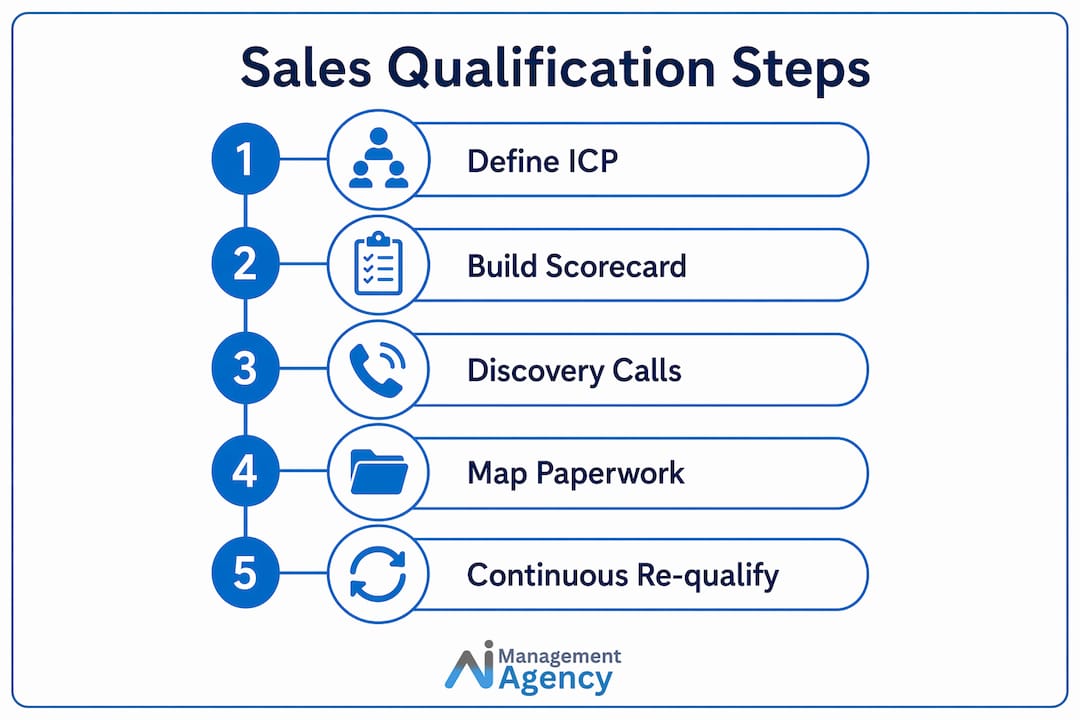
Step 1: Define your ideal customer profile (ICP)
Your ICP is the foundation of every qualification decision. It should specify industry, company size, revenue band, technology stack, geography, and the specific pain points your solution addresses. Without a precise ICP, qualification criteria become subjective and inconsistent across your team.
Step 2: Build a qualification scorecard
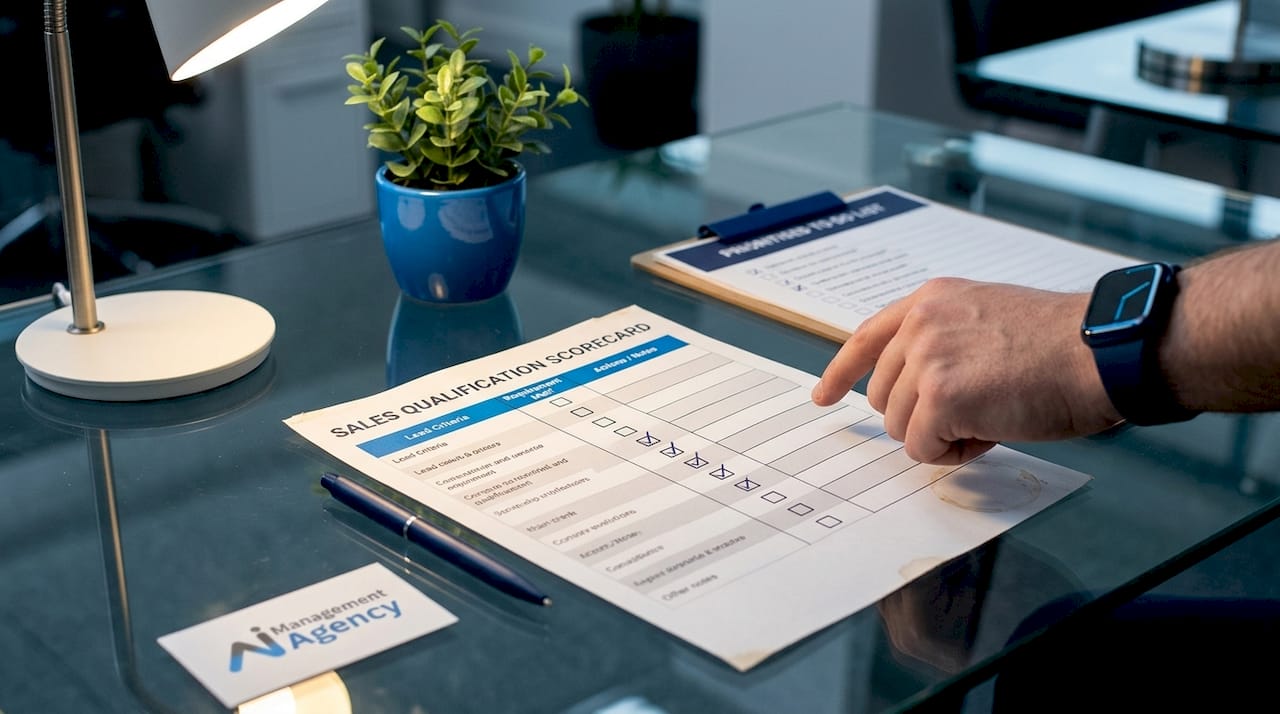
Translate your ICP and chosen framework into a scored checklist. Assign weighted points to each criterion. Budget confirmed at the right level might score 20 points. A named economic buyer might score 25. A defined decision timeline scores 15. A total score above a threshold moves the deal forward. Below it, the deal is either nurtured or disqualified.
Step 3: Conduct structured discovery calls
Discovery calls are your primary qualification instrument. Structure them around your framework’s core questions, but listen for what the prospect does not say as much as what they do. Vague answers about budget or authority are qualification signals, not conversation gaps to fill with your pitch.
Step 4: Map the paper process
Effective deal qualification requires mapping the entire paper process from verbal agreement to signed contract, including legal, procurement, and security audit stages. Unsanctioned verbal agreements lacking documented procurement and legal steps are a leading cause of end-of-quarter deal slips. A verbal “yes” is not a qualified deal.
Step 5: Re-qualify continuously
Qualification is continuous. Deals qualified in January can become unqualified by March due to budget freezes, stakeholder changes, or a lost champion. Build a weekly re-qualification question into your pipeline review: “What has changed since we last spoke?” This single habit prevents pipeline decay.
Common pitfalls to avoid:
- Carrying deals past their compelling event without a new one identified
- Treating a champion’s enthusiasm as a substitute for confirmed budget
- Skipping re-qualification on deals that have been in the pipeline for more than two sales cycles
- Forecasting based on verbal commitments rather than documented next steps
What metrics reveal the health of your qualification process?
Measuring qualification effectiveness is not optional. Without metrics, you cannot distinguish between a pipeline problem and a closing problem.
The metrics that matter most are:
| Metric | What it tells you |
|---|---|
| MQL-to-SQL conversion rate | Whether your lead qualification criteria are calibrated correctly |
| Stage velocity | How long deals spend at each pipeline stage before advancing or dying |
| Win rate by lead source | Which channels produce the highest-quality prospects |
| Forecast accuracy | Whether your qualification rigour translates to predictable revenue |
Healthy MQL-to-SQL conversion benchmarks range from 13% to 20%. If your rate sits below 13%, your qualification criteria are likely too loose, letting too many poor-fit leads through. Above 20% can indicate criteria that are too restrictive, potentially filtering out viable prospects.
86% of B2B purchases stall during the buying process, contributing to an average conversion rate of only 2.9%. That statistic reflects what happens when qualification is treated as a one-time gate rather than an ongoing discipline.
Data hygiene is the unglamorous backbone of accurate measurement. CRM records with missing fields, outdated contacts, or unlogged activity make every metric unreliable. Assign ownership of data quality to a specific role, whether that is a sales operations manager or an AI lead generation system that auto-populates and validates records.
Stalled deals that have passed their compelling event or lost key champions must be quickly disqualified to maintain pipeline health and reliable forecasting. A bloated pipeline full of zombie deals is worse than a lean one, because it distorts your forecast and demoralises your team.
Key takeaways
A rigorous sales qualification process, built on the right framework and supported by AI, is the single most reliable lever for improving pipeline health and close rates.
| Point | Details |
|---|---|
| Match framework to deal size | Use BANT for transactional SMB sales and MEDDIC for complex enterprise deals above £40,000. |
| Qualify continuously, not once | Re-qualify deals weekly as stakeholders, budgets, and timelines change throughout the cycle. |
| Map the full paper process | A verbal yes is not a qualified deal; document every legal, procurement, and approval step. |
| Use AI for scoring, humans for judgement | AI surfaces intent signals and automates routing; reps focus on empathy and negotiation. |
| Disqualify fast to forecast accurately | Remove stalled or champion-less deals promptly to keep your pipeline reliable and your forecast honest. |
Why most sales teams qualify too slowly and too optimistically
After working with sales teams across multiple sectors, the pattern I see most consistently is not that people use the wrong framework. It is that they use the right framework incorrectly, treating it as a formality rather than a genuine filter.
The most damaging habit in sales is the “slow maybe.” A prospect who has not responded in three weeks, whose champion left the business, and whose budget was frozen in Q2 is not a live opportunity. Yet it sits in the pipeline, inflating the forecast and consuming mental energy. Fast disqualification of stalled deals is categorically better than prolonged indecision. A clean pipeline of 20 real deals outperforms a cluttered one of 60 maybes every single time.
The second issue is the confusion between qualification and methodology. Qualification frameworks identify deal status but do not replace a sales methodology, which guides how you advance deals and handle obstacles. Think of MEDDIC as the yard lines on a pitch. Your methodology is the coach’s playbook. You need both, and conflating them leads to teams that can diagnose a deal’s position but have no idea how to move it forward.
The future of qualification sits in AI-human collaboration. AI handles the pattern recognition, the data enrichment, and the early-funnel scoring. Your reps handle the conversations that require genuine understanding of a prospect’s political landscape, risk appetite, and unstated concerns. Neither replaces the other. The teams that will win in 2026 are those that deploy both deliberately.
— Geoff
How Aimagency can accelerate your qualification results
If your team is spending hours on manual lead research, inconsistent discovery calls, and pipeline reviews that reveal more surprises than insights, the problem is structural, not motivational.
Aimagency builds AI agents that handle the qualification groundwork your reps should not be doing manually. From AI voice agents that answer inbound calls 24/7, gather qualification data, and book appointments, to AI sales solutions that score and route leads based on live behavioural signals, the technology exists to make your qualification process faster and more consistent. Explore the AI agent advantages available to UK businesses and see how automation can turn your pipeline from a source of uncertainty into a reliable revenue engine.
FAQ
What is the sales qualification process?
The sales qualification process is a structured method for evaluating whether a prospect has the budget, authority, need, and timeline to become a paying customer. It uses frameworks such as BANT or MEDDIC to determine which leads deserve sales resource and which should be disqualified or nurtured.
Which qualification framework is best for B2B sales?
MEDDIC is the most effective framework for complex B2B deals above £40,000 with multiple stakeholders, while BANT remains the fastest triage tool for high-volume transactional sales. Matching framework complexity to deal size is the key to qualification accuracy.
How does AI help with lead qualification?
AI-powered qualification automates lead scoring, enriches CRM data, and tracks behavioural signals to route the highest-intent prospects to the right reps. It reduces manual research time and improves MQL-to-SQL conversion rates by removing subjectivity from early-funnel decisions.
How often should you re-qualify deals in your pipeline?
Deals should be re-qualified at least weekly, as stakeholders, budgets, and timelines change throughout the sales cycle. A deal qualified in January can become unqualified by March if a champion leaves or a budget freeze occurs.
What is a healthy MQL-to-SQL conversion rate?
Healthy MQL-to-SQL conversion benchmarks range from 13% to 20%. Rates below 13% suggest qualification criteria are too loose; rates above 20% may indicate criteria that are filtering out viable prospects unnecessarily.
Recommended
- Stop Wasting Time on Manual Outreach: Try These 7 AI Sales Automation Hacks – AI Management Agency
- The Ultimate Guide to AI Management: Everything You Need to Scale Your B2B Service Business – AI Management Agency
- Boost sales efficiency with AI for qualification in UK hospitality – AI Management Agency
- From Lead to Booked: How Autonomous AI Agents for B2B Handle the “Grunt Work” While You Sleep – AI Management Agency