
TL;DR:
- A structured, multi-channel sales booking process reliably increases qualified appointments and maintains pipeline flow. Effective use of automation, consistency, and rapid response improves conversion rates and reduces no-shows for small UK businesses. Calibrating the process to deal size and employing automation can significantly enhance booking success.
Sales booking is the systematic process of converting an enquiry or lead into a confirmed, attended sales appointment. Done well, it is the single most controllable lever for growing revenue in a small UK business. A structured step by step sales booking process removes guesswork, reduces no-shows, and gives your pipeline predictability. This guide covers the tools you need, the outreach sequence that works, the confirmation workflows that protect your diary, and the mistakes that quietly kill conversion rates.
What tools and prerequisites does a sales booking process need?

The right setup determines whether your sales booking process runs on autopilot or collapses under manual workload. Three categories of technology are non-negotiable: a CRM, a scheduling tool, and a multi-channel communication platform.
Core technology stack
- CRM (such as HubSpot or Pipedrive): records every lead, tracks outreach history, and triggers follow-up tasks automatically.
- Scheduling software (such as Calendly or Microsoft Bookings): removes the back-and-forth of finding a meeting time and integrates directly with your calendar.
- Multi-channel communication tools: email, LinkedIn Sales Navigator, and a business phone or VoIP system for calls.
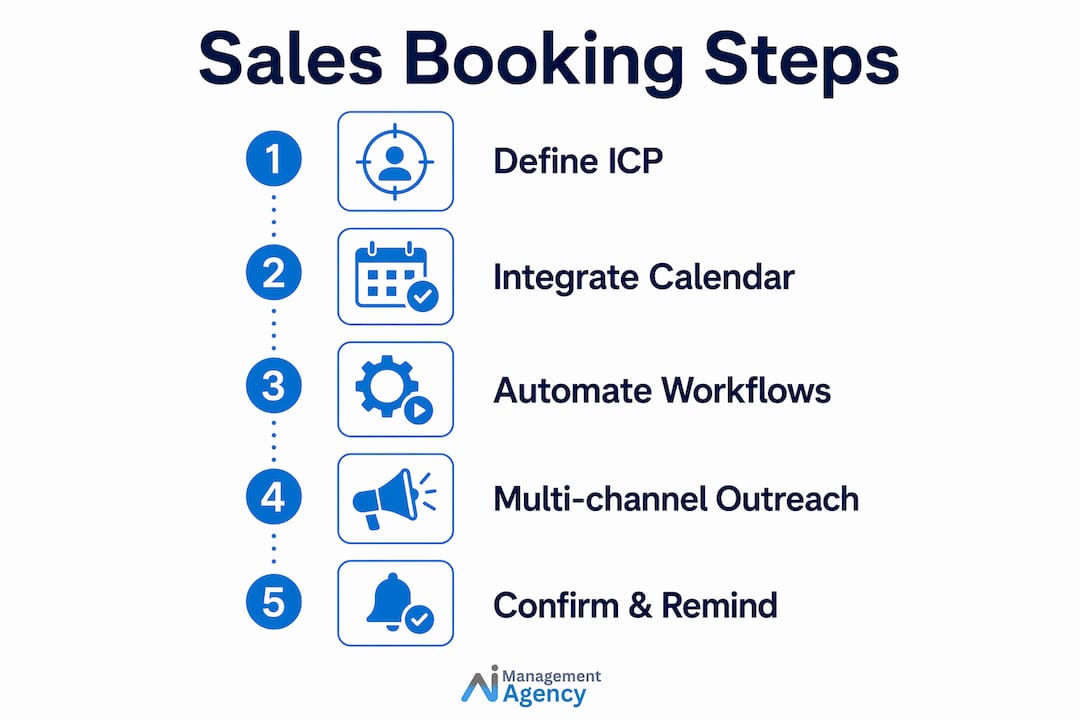
- Automation layer: a workflow tool that connects your CRM to your calendar and sends instant responses when a lead fills in a form.
Building your Ideal Customer Profile
Before any outreach begins, define your Ideal Customer Profile (ICP). Your ICP specifies the industry, company size, job title, geography, and pain point of the prospect most likely to buy. Without it, your list is noise. With it, every message you send is relevant, and signal-based personalisation referencing specific recent events outperforms generic templates by a significant margin.
Calendar integration and automation
Integrated calendars prevent double-bookings and allow prospects to self-book at any hour. Automated workflows handling lead responses within minutes prevent competitors from intercepting your leads and measurably improve conversion. Speed of response is not a courtesy; it is a competitive advantage. Connecting your CRM to your scheduling tool via an automation layer, such as Zapier or Make, takes roughly half a day to configure and pays back immediately.
| Tool category | Primary function | Impact on booking rate |
|---|---|---|
| CRM | Lead tracking and follow-up triggers | High: prevents leads going cold |
| Scheduling software | Self-serve booking and calendar sync | High: removes friction for prospect |
| Multi-channel comms | Email, LinkedIn, phone outreach | High: increases touchpoint coverage |
| Automation layer | Instant response and task creation | Very high: speed wins appointments |
Pro Tip: Set up your CRM to alert you the moment a lead opens an email or visits your pricing page. That signal tells you exactly when to call.
How do you execute a multi-channel sales booking sequence?
A structured outreach sequence is the engine of any effective sales appointment guide. Effective B2B sales sequences include 8–12 touches across multiple channels over 2–3 weeks to significantly increase response rates. Stopping at three touches loses roughly 70% of potential respondents. That statistic alone should change how you plan your outreach.
The multi-channel outreach model
Combine email, LinkedIn, and phone calls in a deliberate order. Each channel serves a different purpose. Email builds familiarity. LinkedIn adds social proof and a human face. Phone calls create real-time dialogue and allow you to handle objections immediately.
A proven 10-touch sequence for small UK businesses looks like this:
- Day 1: Send a personalised connection request on LinkedIn with a short, relevant note.
- Day 2: Send a first email. Lead with a specific observation about their business, not a product pitch. Sell the meeting, not the service.
- Day 4: Follow up by email with a single question that is easy to answer.
- Day 6: Make a phone call. Use the ‘Disarm, Purpose, Question’ framework (see below).
- Day 8: Send a LinkedIn message referencing your call attempt.
- Day 10: Send a second email with a short case study or social proof relevant to their sector.
- Day 12: Make a second phone call.
- Day 14: Send a video message via LinkedIn or email, under 90 seconds.
- Day 16: Send a third email with a direct, time-limited offer to book a 20-minute call.
- Day 18: Send a break-up message. State clearly that you will not contact them again unless they respond. This often generates replies from prospects who were simply busy.
The ‘Disarm, Purpose, Question’ framework on calls
The ‘Disarm, Purpose, Question’ framework is proven to increase appointment booking success on calls. It works in three moves. First, disarm: acknowledge you are calling out of the blue and ask for 30 seconds. Second, state your purpose: one sentence on why this call is relevant to them specifically. Third, ask a question that offers two date and time choices, reducing decision fatigue. For example: “Are mornings or afternoons better for a quick 20-minute call this week or next?”
Pro Tip: Sell the meeting as a valuable, time-limited discovery session, not a product demo. Prospects book time for their benefit, not yours.
Nearly 80% of booked appointments come from follow-up on multiple channels, not from first contact. This is why a single email or one phone call rarely converts. Building a B2B video marketing touchpoint into your sequence, such as a short personalised video message, adds a channel that most small businesses overlook and that prospects remember. For low-ticket offers under £2,000, collapse qualification, discovery, and demo into a single 30-minute appointment to maintain momentum and avoid over-engineering the process.
How do you reduce no-shows after a booking is confirmed?
Booking the appointment is step one. Getting the prospect to attend is step two, and it requires its own workflow. Post-booking confirmation workflows reduce no-show rates significantly when they include an agenda, reminders, and a simple rescheduling option.
The confirmation workflow
Send these four communications after every booking:
- Immediate calendar invite: send within two minutes of booking. Include a clear, short agenda of three bullet points so the prospect knows what to expect. A pre-meeting agenda in the confirmation significantly reduces no-shows and prepares the prospect mentally.
- 48-hour reminder: a brief email confirming the time, the dial-in link, and one prep question. For example: “What is the one outcome you most want from our call?”
- 24-hour reminder: a short, friendly message with the meeting link and a one-click reschedule option.
- Day-of reminder: a text message or WhatsApp sent 60 minutes before the call. Keep it to two sentences.
Why rescheduling options matter
Including a reschedule link in every reminder removes the awkward silence that leads to ghosting. Prospects who cannot attend at the original time will simply not show up if rescheduling feels difficult. A one-click reschedule option converts a cancellation into a rebooked appointment. That is a saved sale, not a lost one.
Pro Tip: Ask one specific prep question in your 24-hour reminder. Prospects who answer it are mentally committed to the call and almost never no-show.
What mistakes undermine a stepwise sales booking process?
The most common failure in any sales booking process is not a bad script. It is inconsistency. Sales teams fail due to ‘process drift’ and overly complex workflows that are not consistently followed. Simpler, repeatable processes yield higher booking consistency than elaborate systems that nobody uses correctly.
The four most costly mistakes
- Stopping outreach too early. Three touches is not a sequence. It is an introduction. Prospects need repeated, relevant contact across channels before they trust you enough to give you their time.
- Mishandling positive but vague replies. When a prospect says “sounds interesting, send me more info,” most salespeople send a brochure and wait. The correct response is one targeted qualification question, not a PDF. Positive but vague replies need immediate targeted questions to maintain momentum.
- Slow follow-up. Responding within minutes to lead form fills greatly increases appointment conversion likelihood. Waiting hours or days hands the lead to a competitor.
- Single-channel outreach. Email-only or phone-only sequences underperform multi-channel approaches by a wide margin.
“Treating booking solely as a copywriting issue is insufficient. It requires a system approach integrating multi-channel touchpoints and fast response. The message matters, but the system around it matters more.”
Measure your sequence at every stage. Track open rates, reply rates, call connection rates, and booking rates separately. When a stage underperforms, adjust the message or timing for that specific step rather than rebuilding the entire process. Appointment setting typically reaches a steady state by month 3, so give your process time to produce reliable data before making wholesale changes.
Key takeaways
A structured, multi-channel sales booking process is the most reliable way for small UK businesses to increase qualified appointments and protect pipeline consistency.
| Point | Details |
|---|---|
| Build the right tech stack | A CRM, scheduling tool, and automation layer are the minimum viable setup for consistent bookings. |
| Use 8–12 touches across channels | Limiting outreach to three touches loses roughly 70% of potential respondents. |
| Apply the ‘Disarm, Purpose, Question’ framework | This call structure lowers prospect resistance and ends with a direct, low-friction booking ask. |
| Send a four-part confirmation workflow | Immediate invite, 48-hour, 24-hour, and day-of reminders cut no-show rates significantly. |
| Keep the process simple and consistent | Process drift kills booking rates; a repeatable sequence outperforms a complex one every time. |
Why discipline beats cleverness in sales booking
I have worked with dozens of small UK businesses on their sales processes, and the pattern is always the same. The owners who book the most appointments are not the ones with the cleverest scripts. They are the ones who follow their sequence every single time, without exception.
The biggest opportunity I see right now is automation. Most small businesses are still doing manually what a well-configured AI agent can handle in seconds: responding to a lead form, sending a calendar link, firing a reminder, and even making an initial qualifying call. Autonomous AI agents for B2B sales can handle the repetitive grunt work of the booking process while you focus on the conversation itself.
The other thing I would push back on is the idea that a great booking process is about persuasion. It is really about alignment. Match your booking process to your customer’s buying velocity. A prospect buying a £500 service does not need three discovery calls. A prospect evaluating a £50,000 contract does. Calibrate your sequence to the deal, and your conversion rate will reflect that.
— Geoff
How Aimagency supports your sales booking process
Small UK businesses that automate their sales booking process book more appointments without adding headcount. Aimagency builds AI agents that respond to enquiries instantly, qualify leads in natural conversation, and book confirmed appointments directly into your calendar, 24 hours a day.
Whether you are starting from scratch or fixing a process that leaks leads, the AI agent advantages for small UK businesses that Aimagency delivers are practical and measurable. From the first call answered at 11pm to the confirmed meeting in your diary by morning, the system works while you sleep. If you want to see what a fully automated sales appointment booking process looks like in practice, Aimagency offers a clear starting point for UK businesses ready to move fast.
FAQ
What is a step by step sales booking process?
A step by step sales booking process is a structured sequence of outreach, qualification, and confirmation steps that converts a lead into a confirmed, attended sales appointment. It combines multi-channel contact, a defined messaging framework, and automated follow-up workflows.
How many touches does it take to book a sales appointment?
Effective B2B sequences require 8–12 touches across email, LinkedIn, and phone over 2–3 weeks. Stopping at three touches loses roughly 70% of potential respondents.
How do I reduce no-shows after booking a sales appointment?
Send an immediate calendar invite with a short agenda, a 48-hour reminder with a prep question, a 24-hour reminder with a reschedule link, and a day-of text message. This four-part workflow cuts no-show rates significantly.
How quickly should I respond to a new sales enquiry?
Respond within minutes. Fast responses to lead form fills pre-empt competitors and double conversion chances. Automated workflows that trigger an instant reply are the most reliable way to achieve this consistently.
When does a sales booking process reach a reliable steady state?
Appointment setting typically reaches steady state by month 3, after the initial 2-week setup and the first 4 weeks of active outreach. Allow at least 90 days before drawing conclusions about what is and is not working.
Recommended
- How to book sales appointments with AI: UK small business – AI Management Agency
- Call answering process guide for UK small businesses – AI Management Agency
- Step-by-step task automation guide for UK small businesses – AI Management Agency
- AI appointment setting: a guide for UK small businesses – AI Management Agency