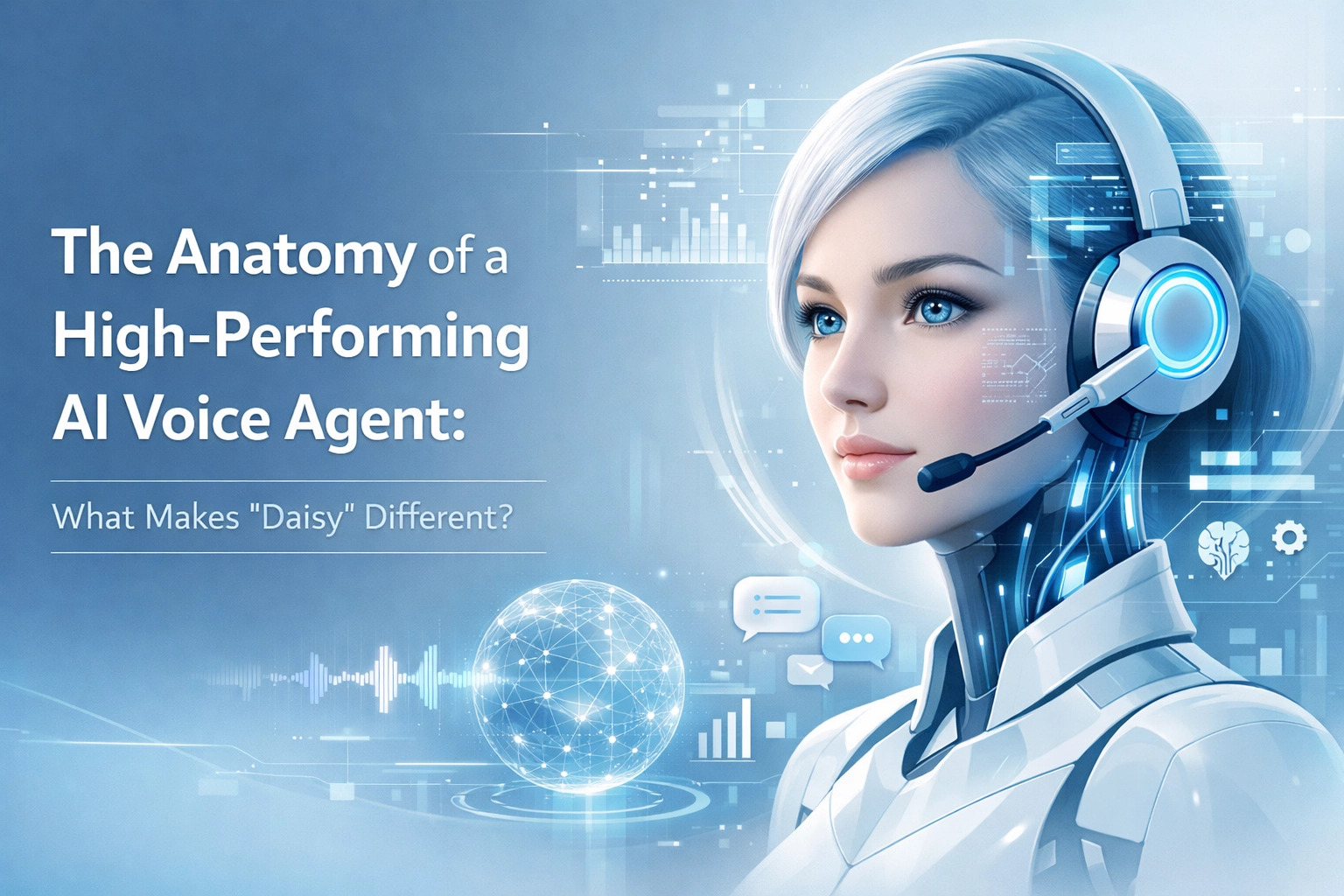
As an AI Agent Consultant, I’ve seen the same story play out in dozens of boardrooms across the UK. A business owner realises they are losing money, specifically, that 60% revenue leak we often talk about, because they simply cannot answer the phone fast enough. They try a basic "off-the-shelf" AI bot, and it fails. It’s clunky, it’s robotic, and customers hang up within five seconds.
The problem isn't AI itself; it’s the quality of the agent. Most businesses are settling for digital "Press 1 for Sales" menus dressed up in a fancy name. But then there’s Daisy. Whether she’s being used to frustrate scammers or, in our world, to handle high-stakes customer enquiries for hotels and service providers, Daisy represents the gold standard of what an AI Voice Agent should be.
This is the shift from a "bot" to a "colleague." If you want to stop the leak and start scaling, you need to understand the anatomy of a high-performing agent.
Key Takeaways
- Speed is Non-Negotiable: Anything over a 1-second delay (latency) kills the illusion of a natural conversation.
- Contextual Intelligence: An AI agent must "know" the caller by integrating directly with your CRM.
- The Personality Layer: High-performing agents use a custom-trained personality to avoid the "Uncanny Valley."
- Industry Agnostic: From hotels to lone worker management, the core tech remains the same, but the deployment is strategic.
1. The Battle Against the "Dead Air" (Low Latency)
The biggest "tell" that you’re talking to a machine isn’t the voice; it’s the silence. Traditional AI agents have a noticeable lag. You speak, the machine thinks, and three seconds later, it responds. In human terms, that’s an eternity. It feels awkward.
High-performing agents like Daisy operate on a multi-stage, real-time architecture. They listen, transcribe, process via a Large Language Model (LLM), and generate speech simultaneously. This reduces latency to sub-second levels. When a customer calls an AI Receptionist, they expect a "Hello?" to be met with an immediate response. If your AI takes too long to think, your lead has already moved on to the next number on Google.

2. Natural Intonation: Moving Beyond the Robot
We’ve all heard the "Siri" voice, flat, monotone, and clearly synthesised. A high-performing AI Voice Agent needs what we call a "Personality Layer."
Daisy stands out because she doesn't just read text; she mimics human speech patterns. This includes:
- Filler words: Occasional "ums" and "ahs" that make the conversation feel organic.
- Dynamic Pitch: Raising the tone for a question or lowering it for a serious confirmation.
- Regional Accents: For UK SMBs, having an agent that sounds like it belongs in the local area builds instant trust.
This isn't just about being "fancy." It’s about psychological comfort. When a guest calls a hotel to book a suite, they want to feel like they are talking to a professional, empathetic human. Daisy achieves this by being built on real-world conversational data, ensuring she sounds like a member of your team, not a piece of software.
3. CRM Integration: The Brain Behind the Voice
An agent without data is just a script-reader. The difference between a £50-a-month bot and a professional AI Sales Solution is the CRM integration.
Imagine a regular customer calls your restaurant.
- Basic AI: "Hello, how can I help you today?"
- High-Performing AI (Daisy): "Hi Mark, welcome back! Are you looking to book the same table for four you had last Friday, or is it something else today?"
This level of context comes from the AI instantly pulling data from your CRM (like HubSpot or Salesforce) the moment the call connects. It knows the caller's name, their history, and their preferences. This eliminates the friction of "Can I take your name and email?" and moves straight to the "Yes."
4. Handling Complex FAQs and Objections
Most "robotic" receptionists break the moment you ask something off-script. If a caller asks, "Do you have disabled access, and is there a lift for my heavy luggage?" a basic bot will probably default to "I'm sorry, I didn't catch that."
A high-performing agent uses Semantic Search. It doesn't just look for keywords; it understands the intent behind the question. Daisy can navigate a complex knowledge base of FAQs, providing specific answers in real-time. Whether it's explaining the terms and conditions of a service contract or detailing the vegan options on a menu, the agent should handle it with the same ease as your best employee.

Comparison: Legacy IVR vs. Standard Bots vs. Daisy-Class Agents
| Feature | Legacy IVR (Press 1) | Standard AI Bot | Daisy-Class Agent |
|---|---|---|---|
| Response Time | Instant (but limited) | 2–4 Seconds | Sub-1 Second |
| Tone of Voice | Pre-recorded Clips | Monotone Synthetic | Natural & Emotional |
| CRM Connection | None | Basic Webhook | Full Two-Way Sync |
| Complex Queries | Fails | Hit-and-Miss | High Accuracy |
| Customer Experience | Frustrating | Functional | Delightful |
5. Why Industry Leaders are Switching Now
The "Why" is simple: Leads don't wait.
In the service provider sector, a missed call is a missed job. If you’re a plumber or a solicitor, and you’re in a meeting or on a job site, that "First Hello" is often the only chance you get. Daisy can act as an AI Receptionist, qualifying the lead, booking the appointment directly into your calendar, and sending a confirmation text: all while you’re busy.
For Hotels and Restaurants:
AI isn't just about taking bookings. It’s about guest experience. An AI agent can handle the 80% of mundane calls ("What time is check-out?" "Do you have parking?"), freeing up your human staff to handle the 20% of "high-touch" guest interactions that actually drive reviews and loyalty.
For Lone Worker Management:
This is an emerging area. AI Voice Agents can be programmed to perform regular "check-in" calls for lone workers in high-risk environments. If the worker doesn't answer or sounds distressed, the AI can immediately escalate the situation to emergency contacts. It’s a level of consistent monitoring that is simply too expensive to do with human staff.
How to Stop the Revenue Leak
If your business is currently relying on a voicemail or an old-school answering service, you are essentially taxed 17% to 60% on your potential revenue. People hate leaving voicemails, and they hate waiting for a call back.
In summary, a high-performing AI Voice Agent like Daisy doesn't just "handle" calls; it converts them. It uses low latency to maintain momentum, natural intonation to build trust, and CRM data to provide a personalised experience.
The question isn't whether AI will be answering your phones in two years: it's whether you'll be the one using it to scale, or the one losing customers to the competitor who did.
FAQ: Common Concerns About AI Voice Agents
Q: Will my customers be annoyed talking to an AI?
A: Only if it's a bad AI. Research shows that customers prefer a fast, helpful AI over a 10-minute hold for a human. When the AI sounds natural and actually solves their problem, the "AI friction" disappears.
Q: Is it difficult to set up?
A: Not with the right partner. We handle the "Personality Layer" and the CRM integrations, so the agent is ready to go with minimal input from your team. You can check our FAQ for more technical details.
Q: Can it handle different languages?
A: Absolutely. Daisy-class agents are polyglots. They can detect the caller's language and switch instantly, making them perfect for international hotels or service providers in multicultural cities.
Q: What happens if the AI gets stuck?
A: A professional deployment always includes a "Human-in-the-Loop" fallback. If the AI detects it cannot solve a query, it can seamlessly transfer the call to a human team member or take a detailed message for immediate follow-up.
Ready to see how Daisy can transform your front-of-house? Get in touch with us today and let's plug that revenue leak.