TL;DR:
- Guest expectations in UK hotels are rising, making 24/7 AI support essential to improve satisfaction without extra staffing. AI enhances operational workflows and personalisation, leading to increased revenue and measurable cost savings. Responsible AI deployment ensures guest trust and streamlines service, especially benefiting smaller hotels with limited staff capacity.
Guest expectations in UK hotels have never been higher, and the pressure on managers to deliver fast, personalised service without inflating headcount is very real. Understanding the hotel AI customer service benefits available today is no longer a theoretical exercise. It is a practical decision that directly affects your occupancy rates, guest satisfaction scores, and bottom line. This guide breaks down the specific advantages AI delivers across guest interactions, back-of-house workflows, and cost management, giving you a clear picture of where AI fits and where it pays off most.
Table of Contents
- Key takeaways
- 1. Round-the-clock guest support with zero waiting time
- 2. Personalisation that increases guest loyalty and ancillary revenue
- 3. Operational efficiency gains that go beyond the front desk
- 4. Real cost savings and smarter use of your team’s time
- 5. Risk management and maintaining guest trust
- 6. The benefits of AI for small hotels in particular
- 7. How AI enhances hotel services through better data and decision-making
- My take on getting AI adoption right in UK hotels
- How Aimagency helps UK hotels unlock these benefits
- FAQ
Key takeaways
| Point | Details |
|---|---|
| 24/7 availability matters | AI agents handle guest enquiries around the clock, reducing response times and improving satisfaction scores. |
| Operational embedding drives ROI | AI built into workflows like housekeeping and maintenance delivers stronger returns than guest-facing tools alone. |
| Cost savings are measurable | AI automation can reduce service costs by up to 30% on standardised interactions. |
| Personalisation increases revenue | AI uses guest data to tailor offers, generating ancillary revenue and encouraging repeat stays. |
| Governance is non-negotiable | Responsible AI deployment requires ongoing monitoring, bias checks, and clear accountability structures. |
1. Round-the-clock guest support with zero waiting time
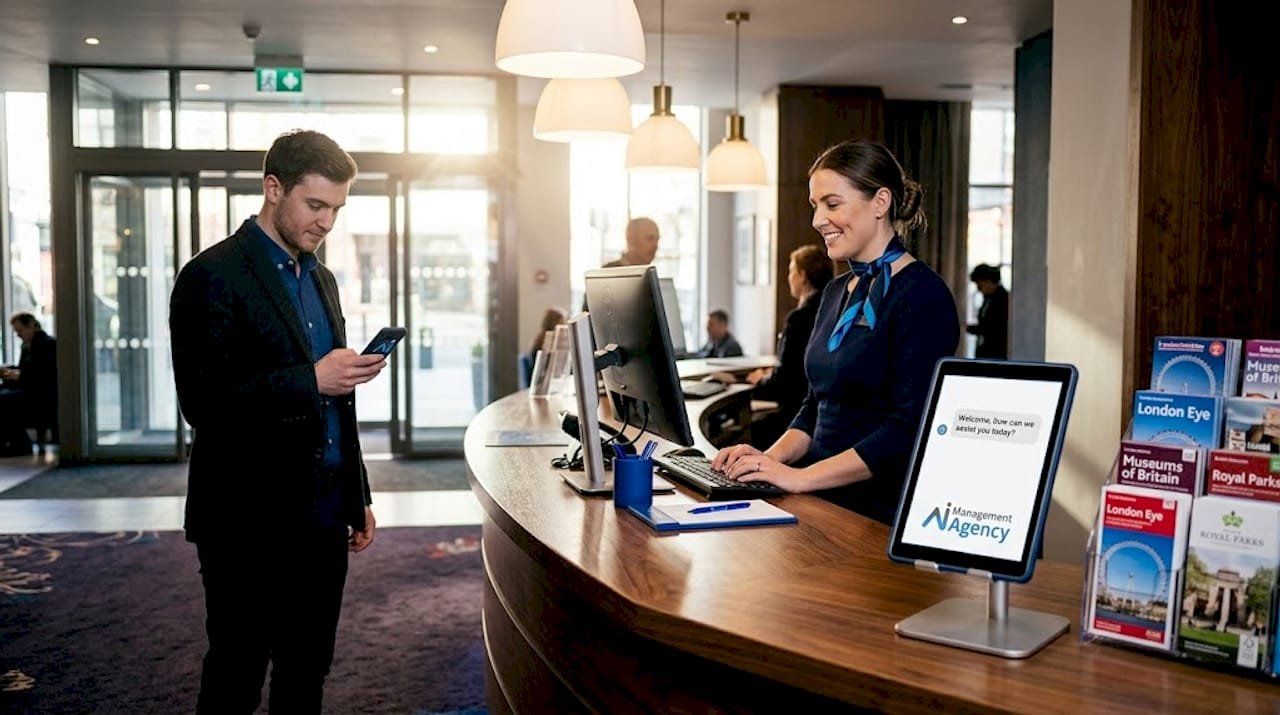
One of the clearest hotel AI customer service benefits is the elimination of response delays. Guests do not keep business hours. They ask questions at midnight, send messages from the airport at 6am, and expect an answer in minutes. AI agents meet that expectation without the cost of overnight staffing.
AI agents handle enquiries across SMS, live chat, WhatsApp, and social media simultaneously, in multiple languages and without dropping context between conversations. They can confirm bookings, answer facility questions, explain cancellation policies, and escalate genuine complaints to the right team member immediately.
The operational impact is significant. Hotels implementing AI support report that enquiry volumes drop by over 90% reaching frontline staff, which frees your reception team to focus on higher-value interactions: a frustrated guest, a complex group booking, or a VIP arrival that requires a personal touch.
Key capabilities to look for in a 24/7 AI support system:
- Natural language processing that understands context, not just keywords
- Multi-channel integration covering phone, web chat, email, and messaging apps
- Automatic handoff to human staff with full conversation history preserved
- Multilingual capability to serve international guests without translation delays
Pro Tip: Set your AI agent to flag any conversation where sentiment turns negative. This gives your front desk team advance warning before a guest reaches the desk in a poor mood, allowing staff to prepare a genuinely helpful response rather than reacting cold.
2. Personalisation that increases guest loyalty and ancillary revenue
74% of travellers want AI to personalise offers and services based on their preferences. That is not a niche preference. It is the majority of your guests expecting an experience that feels considered rather than generic.
AI agents achieve this by drawing on past interaction data, booking history, and stated preferences to tailor every touchpoint. A returning guest who previously booked a spa treatment receives a pre-arrival message with a relevant offer. A guest who mentioned a dietary requirement during check-in last year finds it noted without being asked again. These moments are the difference between a satisfactory stay and a memorable one.
The revenue impact extends well beyond satisfaction scores. AI-driven personalisation in hotels materially increases ancillary revenue through targeted upselling, from room upgrades to dining reservations and experience packages. When an AI agent surfaces the right offer at the right moment in a guest’s journey, conversion rates improve meaningfully compared to generic promotional emails.
There are important considerations when using guest data for personalisation:
- Be transparent about data use in your privacy policy and communications
- Store data securely and limit access to relevant staff and systems
- Comply with UK GDPR requirements when processing personal preferences
- Give guests clear options to update or remove their data at any point
3. Operational efficiency gains that go beyond the front desk
Here is where the conversation about hotel service automation advantages gets genuinely interesting. Most hotels focus AI investment on guest-facing tools first. Chatbots for the website. An AI receptionist for inbound calls. These have real value, but embedding AI into operational workflows is where the ROI becomes transformational.
Consider what happens when housekeeping scheduling is managed by an AI system that reads room occupancy data in real time. Rooms are prioritised correctly without a supervisor manually cross-referencing departure lists. Maintenance requests logged through a guest message are automatically triaged, assigned to the right engineer, and tracked to resolution without a coordinator in the middle. That reduction in internal coordination overhead is significant across a busy property.
The steps to embedding AI effectively into back-of-house operations follow a logical progression:
- Audit existing workflows to identify where delays, miscommunications, or repeated manual tasks occur
- Identify lower-risk starting points such as scheduling, inventory alerts, or maintenance ticketing where AI can assist without direct guest impact
- Integrate AI with existing property management systems to ensure data flows between tools rather than creating isolated processes
- Train staff on working alongside AI outputs so recommendations are acted upon rather than ignored
- Monitor outcomes over 60 to 90 days before expanding AI responsibilities to higher-risk or guest-facing areas
Operational AI that learns your specific hotel’s patterns and preferences becomes a genuine productivity multiplier. The biggest value of AI in hotels often comes precisely from this kind of deep operational integration, not from surface-level tools that guests interact with once.
Pro Tip: Start with maintenance ticketing as your first back-of-house AI application. It has a clear input, a clear output, and measurable resolution times. You will see ROI quickly, and it builds confidence in AI across your team before you tackle more complex processes.
4. Real cost savings and smarter use of your team’s time
Staff costs account for a substantial portion of hotel operating expenses in the UK. AI customer service directly addresses this without requiring redundancies. The model is one of augmentation. AI handles the repetitive, time-consuming enquiries so your people can focus on what genuinely requires human judgement.
Automating standardised guest interactions can reduce service costs by up to 30%, according to McKinsey analysis of hospitality AI deployments. For a mid-sized UK hotel handling hundreds of guest contacts per week, that represents a meaningful operational saving.
The specific areas where cost reduction is most pronounced:
- Inbound call handling: An AI voice agent answers calls immediately, handles standard queries, and only passes complex calls to staff
- Booking management: Automated confirmation, amendment, and cancellation handling without manual input
- Pre-arrival communication: AI sends and responds to pre-stay messages, reducing check-in desk congestion
- Post-stay follow-up: Automated review requests and feedback collection without staff time investment
AI operates at full capacity regardless of the hour, the volume of simultaneous contacts, or seasonal demand spikes. During a bank holiday weekend or a major local event, your AI agent handles the surge without overtime costs or service degradation.
5. Risk management and maintaining guest trust
Deploying AI in your hotel is a business decision that carries real responsibilities. The NIST AI Risk Management Framework offers a practical governance approach built around four functions: govern, map, measure, and manage. Treating this as operational infrastructure rather than a compliance checkbox is what separates hotels that deploy AI confidently from those that run into reputational or regulatory problems.
The table below compares a reactive approach to AI governance with a structured one:
| Governance approach | Reactive (ad hoc) | Structured (NIST-informed) |
|---|---|---|
| Accountability | Unclear | Defined roles and ownership |
| Bias monitoring | Inconsistent | Regular, documented testing |
| Incident response | Case by case | Pre-planned escalation process |
| Regulatory readiness | Vulnerable | Proactively maintained |
| Staff training | One-off at deployment | Ongoing as systems evolve |
Hotels treating AI governance as operational infrastructure are better prepared for regulatory developments and reduce real-world AI risk. This matters particularly as UK AI regulation evolves in 2026, and guests increasingly scrutinise how their data is used.
The core principle is that AI should never operate without a human in the loop for high-stakes decisions. Service recovery conversations, complaint escalation, and anything touching guest safety or data should always have clear human oversight built in.
6. The benefits of AI for small hotels in particular
The perception that AI customer service is only viable for large hotel groups is outdated. The benefits of AI for small hotels are genuine and often proportionally greater than for larger properties. A 30-room boutique hotel does not have the staff depth to cover phones at 11pm, respond to WhatsApp enquiries on a Sunday morning, and maintain personalised follow-up communications throughout the week. An AI agent does all of this without additional headcount.
For independent and smaller UK hotels, the impact on guest experience can be immediate. Guests who previously went unanswered during off-hours now receive a response within seconds. Direct booking enquiries that might have been missed are captured and converted. The playing field with larger competitors narrows considerably.
Smaller properties also benefit from AI’s ability to maintain consistency. When your team changes seasonally or at weekends, AI maintains the same tone, accuracy, and response quality regardless of who is on shift. That consistency builds trust with guests and protects the brand you have worked hard to build.
7. How AI enhances hotel services through better data and decision-making
Understanding how AI enhances hotel services at a strategic level goes beyond individual guest interactions. AI systems generate a continuous stream of data about guest behaviour, request patterns, peak demand periods, and service bottlenecks. Hotels that actively use this data make better decisions about staffing levels, pricing, and service investment.
AI agents capable of autonomous decisions in revenue management and scheduling represent the next step beyond reactive chatbots. They do not just answer questions. They identify patterns, flag anomalies, and surface recommendations that your management team can act on.
A concrete example: an AI system tracking maintenance requests over three months identifies that a specific category of issue spikes after heavy rainfall in a particular room block. Your facilities manager now has data to justify a preventative investment. Without AI aggregating that information, the pattern would likely go unnoticed until it became a guest complaint.
My take on getting AI adoption right in UK hotels
I’ve spent considerable time working with hotels at various stages of AI adoption, and the pattern I see most often is this: hotels invest in a guest-facing chatbot, find it underwhelming after three months, and conclude that AI doesn’t work for hospitality. The problem isn’t AI. It’s the starting point.
What I’ve found consistently is that starting AI in back-of-house workflows where the stakes are lower and the feedback loop is tighter produces far better outcomes. Maintenance ticketing, housekeeping scheduling, and internal task coordination are where AI builds a track record before it faces a guest directly.
I’ve also seen hotels struggle when they let AI generate guest communications wholesale. The tone drifts from the brand, and guests notice. What actually works is the hybrid model, where AI drafts a response and a staff member approves or lightly edits it. You get the speed and consistency of AI with the brand voice of your team. That combination is genuinely powerful.
The one thing I’d push back on firmly is the idea that AI replaces hospitality staff. It doesn’t. What it does is remove the work that was exhausting and repetitive, leaving your team to do the work that actually matters: making guests feel welcome, handling difficult situations with empathy, and delivering the kind of experience that earns a five-star review.
— Geoff
How Aimagency helps UK hotels unlock these benefits
Aimagency specialises in building AI agents designed specifically for the demands of the UK hospitality sector. The flagship AI voice agent, Daisy, answers calls around the clock in a natural, conversational tone, handles FAQs, processes enquiries, and books qualified appointments without any human intervention required. If you’ve been looking for a practical starting point for AI customer service, understanding what makes Daisy different is a strong first step.
Beyond voice, Aimagency provides guidance on embedding AI into your existing workflows so the technology delivers genuine operational impact rather than sitting as an isolated guest tool. For hotels exploring how AI agents compare to basic chatbots before committing to a solution, that distinction matters enormously for long-term ROI.
Speak to the Aimagency team to explore how AI customer service can work specifically for your property.
FAQ
What are the main hotel AI customer service benefits?
AI customer service benefits for hotels include 24/7 guest support, faster response times, personalised interactions based on guest data, reduced staff workload on routine enquiries, and measurable cost savings of up to 30% on standardised interactions.
Can small hotels benefit from AI customer service?
Yes. The benefits of AI for small hotels are significant, particularly for covering out-of-hours enquiries, maintaining consistent communication quality, and capturing direct booking opportunities that would otherwise be missed.
How does AI improve operational efficiency in hotels?
AI enhances hotel efficiency by automating housekeeping scheduling, maintenance ticketing, and internal task coordination, reducing the manual overhead that slows response times and increases the likelihood of errors across shifts.
Is AI customer service safe to deploy in terms of guest data and privacy?
When governed responsibly using frameworks such as the NIST AI RMF, AI customer service can be deployed safely. This requires clear data policies, regular bias monitoring, and defined escalation processes for sensitive interactions.
How quickly can a hotel expect to see results from AI customer service?
Hotels typically see measurable reductions in inbound call volume and response times within the first month of deployment. Operational workflow improvements, such as maintenance resolution times, show clear results within 60 to 90 days of full integration.
Recommended
- 6 Ways to Use AI in Customer Service List for Hotels – AI Management Agency
- 24/7 AI customer service boosts UK bookings by 30% in 2026 – AI Management Agency
- AI in hotels: boost service and cut calls by 90% – AI Management Agency
- AI-driven guest support: boost hotel efficiency in 2026 – AI Management Agency