
TL;DR:
- AI adoption in hospitality is progressing rapidly but remains limited, providing significant opportunities for early movers. Implementing strong governance frameworks and embedding AI across operations create competitive advantages, while well-managed AI agents enhance guest engagement and efficiency. Proper oversight and flexible infrastructure are essential for sustainable success in the AI-driven future of hospitality.
The future of AI in hospitality is arriving faster than most operators realise, yet adoption remains strikingly uneven. Fewer than 10% of hospitality firms are considered “future built” with cutting-edge AI, even as interest in the technology has never been higher. That gap between curiosity and capability is where competitive advantage is being won or lost right now. This guide is written for hospitality decision-makers who want to move beyond pilot programmes and understand which AI applications deliver measurable results, what governance looks like in practice, and how to build an operation that is genuinely ready for what comes next.
Table of Contents
- Key takeaways
- AI trends reshaping hospitality operations
- Responsible AI governance in hospitality
- Competitive advantage through AI-first thinking
- Practical AI agent applications in hospitality
- Preparing your business for what comes next
- My perspective: governance is your competitive moat
- How Aimagency can help your hospitality business
- FAQ
Key takeaways
| Point | Details |
|---|---|
| Adoption is still early | Only a small minority of hospitality businesses have fully integrated AI, creating clear opportunity for decisive movers. |
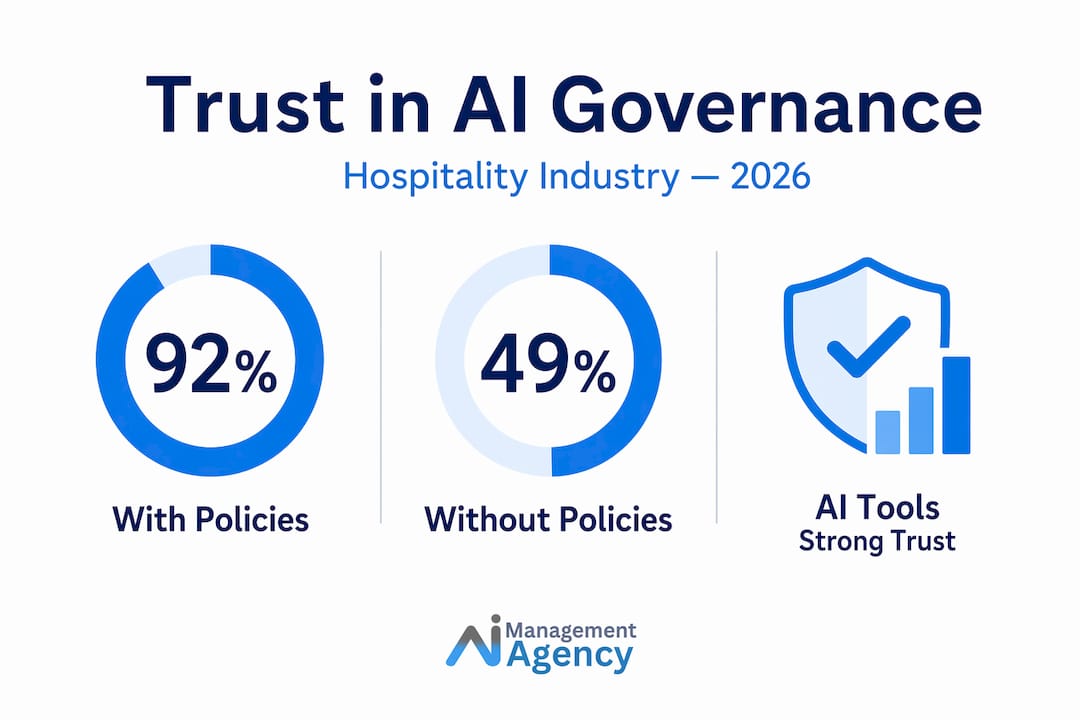
| Governance drives trust | Hotels with formal AI policies report 92% strong trust in AI versus 49% without, making governance a commercial priority. |
| Agents outperform chatbots | AI agents that act and book on behalf of guests produce measurably better revenue outcomes than simple query-answering bots. |
| AI-first beats AI add-on | Embedding AI into distribution, pricing, and operations produces leaner cost structures and stronger guest relationships than bolt-on tools. |
| The tech stack must flex | Adaptable, open data models will outperform unified suites as AI-native distribution reshapes how guests discover and book. |
AI trends reshaping hospitality operations
The headlines about AI in hospitality often focus on chatbots and automated check-in. The reality in 2026 is considerably more sophisticated. Here are the forces genuinely reshaping how hotels and restaurants operate:
- Dynamic pricing in near real time. AI revenue management now processes competitor moves, event calendars, weather data, and guest sentiment simultaneously. The result is that over 15% RevPAR growth has been recorded in hotels using AI-driven rate optimisation at scale.
- Agentic AI for customer engagement. Rather than answering a question and stopping, agentic AI takes action. It books, upsells, and follows up. Over two-thirds of organisations are now exploring or implementing agentic AI, with some reporting a 14-point lift in direct bookings attributable to AI-driven marketing interactions.
- Operational automation. Housekeeping scheduling, predictive maintenance, and inventory management are being handed to AI workflows, freeing staff to concentrate on guest-facing moments that genuinely require human judgement.
- AI-powered content and discovery. As search behaviour shifts toward conversational AI interfaces, hotels that invest in structured data, rich content, and digital footprint quality will be found. Those that do not will be invisible.
- Robotics and AI-influenced design. Some new hotel projects are incorporating AI at the construction and fit-out stage, using predictive models to design spaces that minimise operational friction before a single guest checks in.
The throughline across all of these trends is the same: AI is becoming the backbone of hospitality operations, shifting brand equity toward algorithmic relevance and comprehensive digital presence rather than just physical product.
Responsible AI governance in hospitality
There is a governance conversation that most hospitality technology discussions skip past, and it is one of the most commercially important things to get right. Deploying AI without a governance framework is not bold. It is a liability.
The OECD’s Due Diligence Guidance provides hospitality operators with a clear framework for managing AI risks, with particular focus on data privacy and preventing sensitive guest data from leaking through AI systems. This matters in practical terms. When an AI agent has access to reservation history, dietary requirements, and payment preferences, the consequences of a data handling failure are significant.
The OECD AI Governance Playbook sets out 12 directives that cover strategy, risk, compliance, workforce management, and operational oversight. For hospitality operators, the most useful framing is this: governance is not a legal checkbox. It is the operational infrastructure that allows AI to be trusted and scaled.
Key governance priorities for hospitality businesses include:
- Data privacy controls that prevent guest information from being used to train external AI models or exposed through third-party integrations.
- Escalation protocols that define when an AI agent must hand off to a human, particularly in emotionally sensitive or high-value interactions.
- Confidence thresholds that stop autonomous AI decisions when uncertainty is too high, as outlined in OECD’s operational guidance on agentic AI.
- Regular auditing of AI outputs to catch bias, errors, or drift before they affect guest experience at scale.
Pro Tip: Build your AI governance framework before you need it, not after your first incident. Start with a simple policy document that defines data handling rules, escalation triggers, and staff responsibilities. Hotels with formal AI policies report dramatically higher internal trust in the technology, which directly accelerates adoption and consistent use.
Competitive advantage through AI-first thinking
Incremental AI adoption produces incremental results. The hospitality businesses pulling ahead in 2026 are not adding AI tools on top of existing workflows. They are rewiring their fundamentals so that AI sits at the centre of distribution, pricing, loyalty, and guest relationship management.
Here is what a genuine AI-first strategy looks like in practice:
- Embed AI in distribution from day one. Rather than relying on a single PMS to manage bookings, AI-first hotels use open data architectures that allow AI agents to optimise channel mix in real time, combining direct booking incentives with integrated loyalty programmes to compete effectively with OTA and AI-powered channels.
- Connect pricing to operations. When revenue management AI and operational AI share data, rate changes reflect actual cost pressures, not just demand signals. This produces leaner cost structures and more defensible margins.
- Use AI to enrich, not replace, guest relationships. AI can surface the right upsell at the right moment, remember a guest’s preference for a high floor, or send a pre-arrival message personalised to their booking history. None of this replaces a warm welcome. It makes one more likely.
- Track meaningful KPIs. Direct booking uplift, cost per booking, review scores, and operational cost per occupied room tell you whether AI is working. Vanity metrics about “AI usage” do not.
“The hotels that will win are not the ones that tried AI. They are the ones that redesigned their operations around it.”
The benefits of AI-first hotel design include faster project openings, leaner staffing models, richer personalisation at scale, and higher employee satisfaction because repetitive tasks are automated. The cost of waiting is not just missed efficiency. It is ceding ground to competitors who are moving now.
Practical AI agent applications in hospitality
There is an important distinction that many hospitality operators are only beginning to grasp: the difference between an AI chatbot and an AI agent. A chatbot answers. An agent acts.
| Capability | AI chatbot | AI agent |
|---|---|---|
| Answers FAQs | Yes | Yes |
| Books reservations | No | Yes |
| Handles upsells | No | Yes |
| Manages follow-up | No | Yes |
| Operates 24/7 | Limited | Yes |
| Learns from interactions | Rarely | Yes |
The performance gap between the two is substantial. Agentic AI deployments have reduced review response cycles by 81% and cut the cost per direct booking by 19% within two quarters of deployment. For a mid-scale hotel handling hundreds of guest interactions weekly, those numbers translate directly to revenue and cost savings.
In practical terms, the most impactful AI agent applications for hotels and restaurants right now include AI receptionists that answer calls in a natural tone, handle common queries, and book qualified appointments without human intervention. You can see how this works across hotel service operations where AI call handling has reduced inbound call volumes dramatically while improving response consistency.
On the revenue side, AI-driven sales conversion tools analyse booking patterns and guest behaviour to surface the right offer at the right moment, improving conversion without requiring additional sales headcount.
Pro Tip: When evaluating AI agents for your property, ask vendors specifically about escalation logic. A well-configured agent should know exactly when to pass a conversation to a human, and do so without making the guest feel passed around. That handoff quality is often what separates a good implementation from a frustrating one.
Preparing your business for what comes next
The next wave of AI development in hospitality will not look like a series of feature updates to existing tools. It will look like a restructuring of the entire technology infrastructure that hotels and restaurants depend on.
Several developments are already in motion:
- Vector-based CRMs and AI-native distribution. Traditional property management systems were not built for AI. New agentic distribution layers are emerging that allow personalised, instant guest interactions driven by open data models rather than slow SaaS suites. The operators building on open architectures now will find it far easier to integrate whatever comes next.
- Agentic payment infrastructure. As AI agents handle more of the booking journey, payment flows will adapt. Expect AI-initiated transactions, dynamic deposit logic, and loyalty redemption to be managed without human involvement.
- Staff roles will shift, not disappear. Hospitality professionals recognise that certain guest interactions require human involvement regardless of automation capability. The skill shift is toward managing, auditing, and improving AI systems rather than performing the tasks those systems now handle.
- Personalisation will deepen considerably. AI will move from remembering preferences to anticipating them, using behavioural signals across the entire guest journey to personalise everything from room allocation to food and beverage recommendations.
- Adaptable tech stacks will win. Any operator locked into a single unified suite that cannot expose open APIs will find integration increasingly painful. Prioritise flexibility in your technology decisions now.
The hospitality businesses that will thrive are those treating their tech stack as a living system, continuously updated, not a fixed infrastructure investment.
My perspective: governance is your competitive moat
I have watched a lot of hospitality businesses approach AI the same way they once approached social media: with enthusiasm, without a plan, and then frustration when results were mixed. The pattern repeats because the fundamentals are being skipped.
In my experience, the single biggest predictor of whether an AI deployment delivers lasting value is not the technology itself. It is whether governance was designed into the rollout from the start. I have seen properties where AI agents were producing measurable booking uplifts within weeks, and others where the same class of tool created guest complaints because nobody had defined the escalation logic or audited the outputs.
The uncomfortable truth about how AI is changing hospitality is this: AI rewards preparation. It does not forgive shortcuts. When you deploy an AI agent that speaks to guests on behalf of your brand, every interaction is a brand interaction. That means the quality controls, the confidence thresholds, and the human oversight need to be defined before go-live, not patched in afterwards.
My take is that governance is not a constraint on AI ambition. It is the thing that makes bold AI ambition sustainable. The operators who will look back on 2026 as the year they pulled ahead are the ones treating governance and AI capability as two sides of the same investment, not competing priorities.
The human touch in hospitality is irreplaceable. But AI, when deployed with proper oversight, does not diminish that. It creates more space for it.
— Geoff
How Aimagency can help your hospitality business
If you are ready to move beyond the pilot stage, Aimagency works directly with hospitality businesses to deploy AI agents that handle real workloads: answering calls in a natural tone, managing guest queries around the clock, responding to FAQs, and booking qualified appointments without adding headcount.
The difference Aimagency brings is specificity. These are not generic chatbot deployments. They are AI agents built to reflect your brand, handle your most common guest interactions, and escalate intelligently when human involvement is needed. For hotels looking to increase direct bookings and reduce operational costs simultaneously, the return on investment is measurable and fast. For restaurants, an AI receptionist can manage reservation enquiries and answer questions 24 hours a day, seven days a week. If you want to understand what this looks like for your specific operation, Aimagency offers tailored consultations to match the right solution to your property and your guests.
FAQ
What is the current state of AI adoption in hospitality?
Adoption is growing but uneven. Fewer than 10% of hospitality firms are considered fully future-built with cutting-edge AI, while around 25% are scaling AI across multiple areas of their business.
How does AI governance improve trust in hospitality AI tools?
Hotels with formal AI policies report 92% strong trust in their AI tools compared to just 49% in properties without policies. Governance structures define how AI behaves, which directly builds confidence among staff and guests.
What is the difference between an AI chatbot and an AI agent?
A chatbot answers questions. An AI agent takes action on behalf of the guest, including making bookings, handling upsells, and managing follow-up communications, operating continuously without human intervention.
How does AI affect direct bookings in hotels?
Agentic AI deployments have been shown to reduce the cost per direct booking by 19% and lift direct booking rates by 14 percentage points in some implementations, measured within two quarters of deployment.
What should hospitality operators prioritise when adopting AI?
Start with governance: define data handling rules, escalation triggers, and audit processes before deploying any AI agent. This foundation protects your brand, builds internal trust, and makes it far easier to scale AI successfully.
Recommended
- AI in customer service explained: 86% automation in hospitality – AI Management Agency
- AI in hotels: boost service and cut calls by 90% – AI Management Agency
- Role of AI agents explained: 30% more bookings UK 2026 – AI Management Agency
- Enhance guest experience with AI in UK hotels 2026 – AI Management Agency