
Small UK businesses lose valuable customers every day through unanswered calls. Research shows that 35% of calls go unanswered during business hours, with nearly 90% missed after hours, resulting in significant revenue losses. AI voice bots offer a practical solution, providing round-the-clock call handling and appointment scheduling that transforms how small businesses serve customers whilst dramatically reducing operational costs.
Table of Contents
- The Problem Of Missed Calls And Business Impact
- What Are AI Voice Bots And How They Work
- Business Benefits Of AI Voice Bots For Small UK Businesses
- Common Misconceptions About AI Voice Bots
- Implementing AI Voice Bots: Practical Guidance For Small Businesses
- Discover AI Voice Solutions To Transform Your Small Business
- Frequently Asked Questions
Key takeaways
| Point | Details |
|---|---|
| Availability impact | AI voice bots answer calls 24/7, eliminating the 35% missed call rate during business hours and near-total loss after hours. |
| Cost efficiency | Operating expenses decrease by 40-70% compared to employing human receptionists whilst maintaining superior service levels. |
| Integration capability | Modern bots connect seamlessly with CRM systems and calendars to automate appointment booking and lead capture. |
| Human complement | AI bots handle routine enquiries, freeing your team for complex tasks rather than replacing staff entirely. |
| Implementation approach | Phased deployment with careful provider selection ensures smooth adoption and measurable business results. |
The problem of missed calls and business impact
Missed calls represent one of the most damaging yet overlooked challenges facing small UK businesses today. During standard business hours, 35% of incoming calls receive no answer, whilst nearly 90% go unanswered outside typical trading times. Each missed opportunity carries substantial financial consequences.
The revenue impact proves severe. Every unanswered call potentially costs your business between £40 and £120 in lost sales, depending on your sector and average transaction value. When you multiply these losses across weeks and months, the cumulative effect becomes staggering.
Several factors contribute to this persistent problem:
- Limited staff capacity during peak periods leaves calls queuing indefinitely
- Zero coverage during lunch breaks, evenings, and weekends
- Team members focused on serving in-person customers cannot simultaneously answer phones
- Unexpected absences create coverage gaps
Beyond immediate revenue loss, repeated missed calls erode customer trust and satisfaction. Potential clients quickly move to competitors who answer promptly. Existing customers grow frustrated when they cannot reach you for support or rebooking. Your business reputation suffers as word spreads about poor accessibility.
Small businesses need reliable, cost-effective solutions that ensure every caller receives immediate attention, protecting both revenue streams and hard-earned customer relationships.
What are AI voice bots and how they work
AI voice bots represent sophisticated software systems designed to conduct natural phone conversations with callers whilst executing business tasks automatically. Understanding their core technology helps you appreciate their capabilities and limitations.

The foundation relies on advanced speech recognition that converts spoken words into text with remarkable accuracy. Natural language understanding then interprets caller intent, determining whether someone wants to book an appointment, ask about pricing, or speak with a team member.
Key technical components include:
- Speech-to-text conversion processing regional accents and varied speaking patterns
- Intent recognition identifying what callers actually need
- Dialogue management maintaining conversation context across multiple exchanges
- Text-to-speech synthesis generating natural-sounding responses
- Integration APIs connecting to your calendars, CRM, and business systems
Modern bots achieve remarkably low latency, responding within milliseconds to create fluid conversations that feel genuinely human. Advanced voice synthesis technology has eliminated the robotic monotone of earlier systems, producing warm, engaging voices with natural inflection.
Perhaps most importantly, AI voice bots integrate directly with your existing business tools. They access your calendar to check availability, book appointments in real-time, update customer records in your CRM, and capture lead information for follow-up. This integration transforms them from simple answering services into active business tools.
Unlike human receptionists, bots handle unlimited simultaneous calls without quality degradation. Ten callers or a hundred receive identical service standards. Continuous training and performance improvements refine their accuracy and expand their capabilities over time.
Business benefits of AI voice bots for small UK businesses
The operational and financial advantages of AI voice bots create compelling business cases, particularly for resource-constrained small enterprises. Let’s examine the concrete benefits versus traditional approaches.
| Feature | Human Receptionist | AI Voice Bot |
|---|---|---|
| Operating cost | £18,000-£25,000 annually | £6,000-£9,000 annually |
| Availability | 40 hours weekly maximum | 168 hours weekly |
| Simultaneous calls | One at a time | Unlimited |
| Sick days | 5-10 days annually | Zero |
| Consistency | Variable by mood and fatigue | Identical every interaction |
Operating expenses decrease by 40-70% compared to employing receptionists, delivering immediate bottom-line improvements. These savings compound over time whilst service quality remains consistently high.
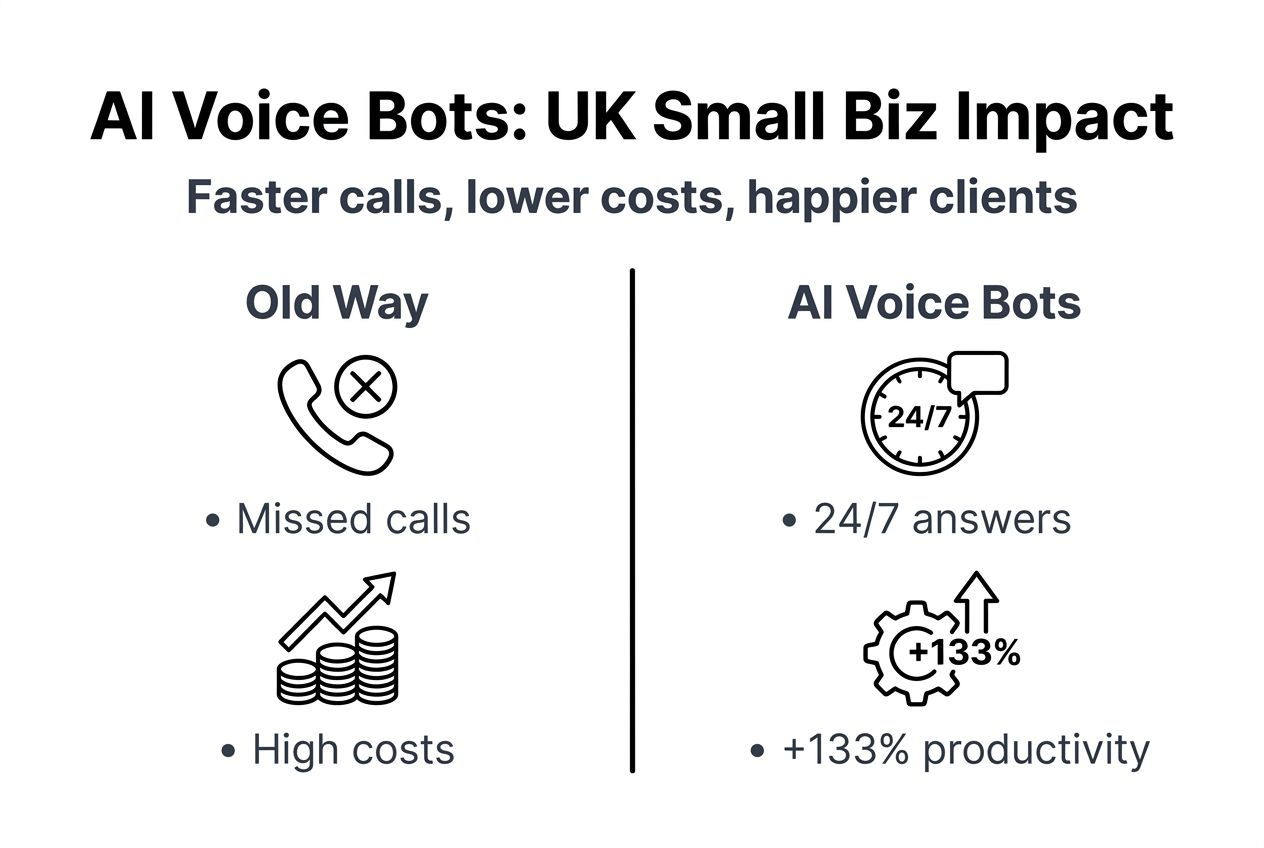
Reliable 24/7 customer service transforms how customers perceive your business. Callers reaching you at 8pm on Saturday receive the same professional attention as those phoning Tuesday morning. Holiday coverage becomes effortless. Your business never sleeps, never takes breaks, never calls in sick.
AI voice bots excel at specific tasks that consume disproportionate staff time:
- Answering frequently asked questions about services, pricing, and availability
- Routing calls to appropriate team members based on caller needs
- Capturing lead information and qualifying prospects
- Booking, rescheduling, and confirming appointments
- Sending automated follow-up messages and reminders
Small UK businesses report productivity improvements reaching 133% after implementing AI voice technologies. Your team redirects time previously spent on routine phone tasks toward higher-value activities like serving customers, developing proposals, or growing the business.
Scalability during high-demand periods provides another crucial advantage. Seasonal businesses handle peak call volumes without temporary staff. AI voice agents managing sales enquiries never experience the overwhelm that causes human operators to rush calls or make mistakes.
Pro tip: Track your current missed call rate and average call handling time for two weeks before implementing an AI voice bot, then measure again after deployment to quantify the precise cost savings and productivity gains your business achieves.
Common misconceptions about AI voice bots
Several persistent myths prevent small business owners from exploring AI voice bot solutions. Addressing these misconceptions directly helps you make informed decisions based on current capabilities rather than outdated assumptions.
Myth one claims AI voice bots will completely replace human receptionists, eliminating jobs. Reality proves far different. Modern bots complement human staff by automating repetitive, routine enquiries whilst escalating complex situations requiring judgement or empathy to team members. Your staff gains time for meaningful customer interactions instead of answering the same basic questions repeatedly.
Myth two suggests bots sound mechanical and robotic, creating poor customer experiences. Today’s advanced speech synthesis produces remarkably natural voices with appropriate emotional tone. Callers frequently cannot distinguish AI responses from human operators during initial exchanges. The technology has progressed enormously from early text-to-speech systems.
Myth three positions AI voice bots as prohibitively expensive luxuries only large enterprises can afford. Small business-focused solutions now cost less than employing part-time reception staff whilst delivering superior availability and consistency. The investment typically recovers within months through reduced missed opportunities and labour savings.
Myth four worries that bots cannot handle anything beyond scripted responses. Modern systems understand context, manage multi-turn conversations, and adapt responses based on caller input. They recognise when situations exceed their capabilities and smoothly transfer to human team members.
Successful adoption requires viewing AI voice bots as components within hybrid service models. They excel at specific, repeatable tasks whilst humans provide creativity, complex problem-solving, and relationship building. This partnership approach maximises strengths of both automation and personal touch.
Pro tip: Request demonstration calls from multiple providers to experience current voice quality and conversation capabilities firsthand before making assumptions about AI adoption limitations.
Implementing AI voice bots: practical guidance for small businesses
Successful AI voice bot deployment follows systematic approaches that minimise disruption whilst maximising benefits. These practical steps guide small businesses through evaluation, selection, and implementation.
-
Identify your specific needs: Document current customer service pain points, call volume patterns, most frequent enquiries, and appointment scheduling challenges. Quantify missed call rates and estimate revenue impact. Clear requirements focus provider selection.
-
Research proven solutions: Investigate AI voice bot providers with demonstrated small business success stories. Examine case studies, request references, and verify experience in your sector. Avoid bleeding-edge experimental platforms.
-
Evaluate integration capabilities: Assess compatibility with your existing CRM, booking systems, and calendars. Seamless integration proves essential for automated appointment scheduling and lead capture. Request technical specifications and integration timelines.
-
Start with pilot deployment: Launch a limited trial handling specific call types or operating during defined hours. Train your team thoroughly on escalation protocols and bot monitoring. Gather customer feedback actively.
-
Monitor and optimise continuously: Track key metrics including call handling rates, appointment bookings, customer satisfaction scores, and cost savings. Refine conversation scripts based on real interactions. Expand capabilities gradually after proving core functionality.
Critical evaluation criteria when selecting providers:
- Voice naturalness and conversation quality during demonstrations
- Scalability supporting business growth without platform changes
- Transparent pricing with no hidden implementation costs
- Responsive technical support and training resources
- Compliance with UK GDPR and data protection requirements
Data privacy deserves careful attention. Ensure your chosen solution encrypts call recordings, stores data within UK or EU servers, and provides clear data retention policies. Verify provider certification to relevant security standards.
Pro tip: Involve your team early in the selection and implementation process to build ownership and ease adoption anxiety. Establish clear escalation protocols so bots transfer seamlessly to humans when situations require personal attention. Consider starting with the AI receptionist for straightforward tasks before expanding to complex scenarios. Explore small business AI setup guides for sector-specific implementation advice.
Discover AI voice solutions to transform your small business
Now that you understand how AI voice bots work and their substantial benefits, exploring tailored solutions designed specifically for UK small businesses represents your next logical step.
Specialised AI voice bot services address unique sector requirements. Estate agents benefit from AI receptionists managing viewing appointments and property enquiries around the clock. Service businesses like plumbers and electricians use AI setups that boost bookings whilst reducing missed emergency calls by 80%.
AIM Agency brings proven expertise implementing, training, and optimising AI voice bots for small enterprises across the UK. Our solutions integrate smoothly with existing systems, require minimal technical knowledge, and deliver measurable results within weeks. Free consultations help identify the right AI voice bot package for your specific business model, budget, and growth objectives. Discover AI-driven solutions that transform customer service whilst controlling costs.
Frequently asked questions
What is the typical cost range for AI voice bots for small UK businesses?
AI voice bot costs typically range from £500 to £750 monthly for small business packages, representing 40-70% savings compared to employing human receptionists. Initial setup fees vary from £1,000 to £3,000 depending on integration complexity and customisation requirements.
How quickly can an AI voice bot be integrated with existing booking systems?
Standard integrations with popular CRM and calendar platforms complete within one to three weeks. Complex custom integrations requiring bespoke development may extend to four to six weeks. Most providers offer pre-built connectors for common small business tools, accelerating deployment.
Can AI voice bots handle complex customer queries or only basic calls?
Modern AI voice bots manage multi-turn conversations, understand context, and address moderately complex enquiries effectively. They recognise situations exceeding their capabilities and transfer seamlessly to human team members. Ongoing training expands their handling capacity over time.
Are AI voice bots compliant with UK data protection laws?
Reputable AI voice bot providers ensure full GDPR compliance, encrypting call data, storing information on UK or EU servers, and maintaining transparent data retention policies. Verify provider certifications and data handling practices before contracting to ensure regulatory adherence.
Do AI voice bots require ongoing maintenance or updates?
Providers typically handle technical maintenance, security patches, and platform updates automatically. Your responsibility involves periodic conversation script refinement based on customer feedback and evolving business needs. Most services include ongoing support within monthly subscription fees.