
TL;DR:
- Effective agent management involves continuous oversight of AI agents to ensure they operate ethically, reliably, and aligned with business goals, especially in small enterprises. It includes setting clear objectives, defining guardrails, coordinating workflows, and monitoring outcomes to prevent risks, costs, and security issues from accumulating over time. Proper management systems centralize governance, observability, and lifecycle control, making active supervision essential for translating AI potential into consistent business performance.
Agent management is the continuous process of controlling, monitoring, and improving AI agents to ensure they execute business tasks reliably, ethically, and in alignment with your goals. For small business owners, this discipline is the difference between an AI agent that delivers consistent results and one that drifts off course, runs up costs, or creates security risks. Platforms like Microsoft Learn, Workday, and Airtable have each published frameworks that treat agent management as an operational discipline in its own right, separate from simply building or deploying an agent. Understanding what AI agents are is the starting point, but knowing how to manage them is what determines whether they actually improve your business.

What is agent management and why does it matter?
Agent management is defined as the ongoing oversight of AI agents across their full operational lifecycle, covering everything from setting objectives to retiring outdated versions. The industry also refers to this as agentic AI governance or AI agent operations, and both terms describe the same core discipline. The critical distinction is that management is not the same as building an agent. Building is a design activity. Management is what happens every day after the agent goes live.
Active management of AI agents keeps them aligned with evolving business priorities and prevents operational and security risks from accumulating over time. For a small enterprise, the stakes are tangible. An unmanaged AI receptionist might book appointments outside your available hours, mishandle sensitive customer data, or fail to escalate a complaint that needs a human response. None of those failures happen at the build stage. They happen in production, which is precisely where management lives.
The advantages of AI agents for small businesses are well documented, but those advantages only materialise when the agents are actively supervised. Management is the mechanism that converts potential into performance.
What are the key steps to effectively manage AI agents?
Workday and Microsoft Learn specify five key steps for operational success when managing AI agents at scale. These steps apply equally to small businesses running a single AI receptionist or a handful of task-specific agents.
-
Define clear objectives and decision scope. Every agent needs a precise remit. An AI receptionist should know exactly which questions it can answer, which appointment types it can book, and where its authority ends. Vague objectives produce unpredictable behaviour.
-
Establish guardrails and escalation paths. Setting precise runbooks and guardrails is more important for trust and safety than the AI model itself. Define the conditions under which the agent must hand off to a human, such as a complaint, a refund request, or an ambiguous enquiry.
-
Coordinate human and agent workflows. Delineate responsibilities clearly. Your team should know which tasks the agent owns and which require human judgement. Overlapping responsibilities create confusion and duplication.
-
Orchestrate agents across systems. If you run more than one agent, or if your agent connects to a CRM, a calendar, and a phone system simultaneously, you need to manage how those interactions are sequenced to avoid conflicts.
-
Monitor outcomes and refine behaviour. Practitioners treat agent management as a feedback loop, improving agents by monitoring and redeploying rather than treating setup as a one-time event. Review call transcripts, booking accuracy, and escalation rates on a regular cadence.
Pro Tip: Set a fortnightly review of your agent’s performance metrics from day one. Most issues surface within the first two weeks of live operation, and catching them early prevents compounding errors.
Which tools define an agent management system for small businesses?
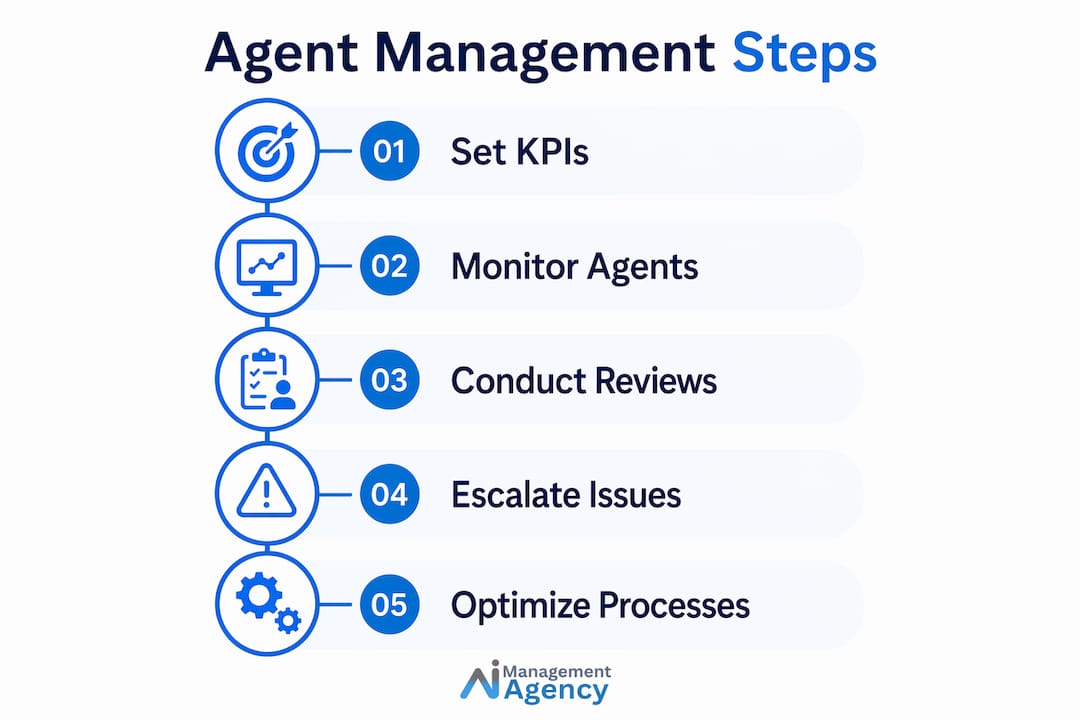
An agent management system is defined as a unified operational layer that centralises workflows, approvals, data, governance, and monitoring for AI agents. Airtable defines AI agent management platforms as shared environments where all of these elements coexist, rather than being scattered across separate tools.
For small businesses, the core capabilities to look for in agent management software are:
- Governance and security controls. Role-based access ensures that only authorised team members can modify agent behaviour or access sensitive data. Quota limits prevent runaway API costs.
- Observability and monitoring. Dashboards, logs, and alerts give you visibility into what the agent is doing in real time. Effective production management links alerts directly to corrective actions rather than passive monitoring.
- Lifecycle and version management. Agents need to be updated as your business changes. A proper system tracks versions, manages rollbacks, and handles retirement of outdated agent configurations.
- Cost controls. Budget caps and usage quotas prevent a single misconfigured agent from generating unexpected expenditure.
- Audit trails and human approval gates. Enterprise-grade control planes implement identity verification, policy enforcement, and human approval gates to maintain accountability for every agent action.
| Capability | Why it matters for small businesses |
|---|---|
| Role-based access | Prevents unauthorised changes to agent behaviour or data exposure |
| Observability dashboards | Gives real-time visibility without requiring technical expertise |
| Version management | Allows safe updates without disrupting live operations |
| Cost controls | Protects budgets from unexpected usage spikes |
| Audit trails | Provides accountability and supports compliance requirements |
How does agent management differ from orchestration and automation?
Agent management, orchestration, and automation are related but distinct concepts, and confusing them leads to gaps in oversight. Orchestration is the routing and sequencing of tasks among agents, while management is the wider discipline that encompasses the full lifecycle, including observability, cost control, and memory management. Orchestration is a component of management, not a substitute for it.
Traditional automation follows fixed rules. An automated email responder sends the same reply every time a specific trigger fires. Agentic AI, by contrast, makes autonomous decisions based on context. An AI receptionist does not just follow a script. It interprets the caller’s intent, decides how to respond, and takes action. That autonomy is what makes agentic AI powerful, and it is also what makes management non-negotiable.
Agent building is the design phase. It covers architecture, training data, integrations, and initial configuration. Management begins the moment the agent goes live and continues for as long as the agent operates. Autonomy in agentic AI must be explicitly designed into workflows with clear handoffs and feedback mechanisms that enable human correction. Without those mechanisms, the agent operates without a safety net.
Pro Tip: Think of agent management as the operational control loop that sits above orchestration. Orchestration handles the “what” and “when.” Management handles the “why,” the “how well,” and the “what next.”
As agents scale and begin taking real-world actions such as booking appointments, sending communications, or updating records, the consequences of unmanaged behaviour grow proportionally. A small business that deploys an AI receptionist without a management framework is not saving time. It is accumulating risk.
What best practices help optimise agent performance and trust?
Effective agent supervision requires a structured approach that combines technical controls with human oversight. TechTarget highlights redesigning workflows with clear boundaries, approval points, and ongoing monitoring as the foundation of sound management practice.
The following best practices apply directly to small business contexts:
- Set measurable KPIs for each agent. Define what good performance looks like before the agent goes live. For an AI receptionist, this might include call resolution rate, booking accuracy, and escalation frequency.
- Implement human-in-the-loop checkpoints. Identify the scenarios where human review is mandatory, such as refund requests, complaints, or high-value bookings, and build those checkpoints into the workflow from the start.
- Conduct regular performance reviews. Harvard Business Review describes agent managers as operational leaders who use data dashboards, scorecards, and continuous performance reviews to supervise AI agents across multiple functions. Apply the same discipline at small business scale.
- Calibrate role-based access carefully. Limit which team members can alter agent configurations and restrict the data the agent can access to what it genuinely needs.
- Maintain transparency with your team. Employees who understand what the agent does and does not do are more likely to trust it and flag issues early.
- Guard against shadow AI. Transitioning from a deployment focus to continuous management prevents shadow AI, budget overruns, and security gaps as agents scale. Shadow AI refers to agents or automations that team members set up independently, outside any governance framework.
You can find a detailed breakdown of governance and operational workflows for UK businesses in Aimagency’s dedicated resource.
Pro Tip: Create a one-page agent brief for every AI agent you deploy. It should cover the agent’s purpose, its decision boundaries, its escalation triggers, and the person responsible for its performance. This document becomes your management baseline.
Key takeaways
Effective agent management is the operational discipline that determines whether AI agents deliver consistent value or accumulate risk, cost, and governance debt over time.
| Point | Details |
|---|---|
| Management vs. building | Building is a one-time design activity; management is the ongoing daily discipline that follows. |
| Five core steps | Define objectives, set guardrails, coordinate workflows, orchestrate systems, and monitor outcomes continuously. |
| System of record | An agent management system centralises governance, observability, lifecycle control, and cost management in one place. |
| Orchestration is a subset | Orchestration sequences tasks; management governs the full lifecycle including security, cost, and performance. |
| Human oversight is non-negotiable | Escalation paths and human-in-the-loop checkpoints are the safety net that keeps autonomous agents trustworthy. |
Why agent management is the role small businesses cannot afford to skip
I have worked with small business owners who assumed that once their AI agent was set up and running, the job was done. That assumption is the single most common mistake I see. The agent goes live, performs well for a few weeks, and then something shifts. A product changes, a process is updated, or the volume of enquiries spikes. Without active management, the agent keeps operating on its old instructions, and the gap between what it does and what the business needs quietly widens.
What strikes me most about the businesses that get this right is that they treat their AI agent the way they would treat a new member of staff. They set clear expectations, check in regularly, and adjust when performance drifts. The businesses that struggle treat the agent as a piece of software that runs itself. It does not.
The other thing I would push back on is the idea that agent management is only relevant for large enterprises with dedicated AI teams. A single AI receptionist handling inbound calls for a small trades business has just as much potential to go wrong as a complex multi-agent deployment. The consequences are just more immediate and personal. A missed escalation on a customer complaint, a double-booked appointment, or a data handling error can damage a small business’s reputation in a way that a large corporation can absorb but a small firm cannot.
My honest view is that agent management should be the first conversation, not the last. Before you ask what an agent can do, ask how you will oversee it. The answer to that question determines whether the investment pays off.
— Geoff
How Aimagency helps small businesses manage AI agents effectively
Aimagency specialises in building and managing high-quality AI agents designed specifically for small UK businesses. From AI receptionists that answer calls 24/7 in a natural tone to agents that handle FAQs and book qualified sales appointments, every solution is built with management frameworks in place from day one. That means clear objectives, defined escalation paths, performance monitoring, and human oversight baked into the workflow rather than bolted on afterwards.
If you are ready to explore what a properly managed AI agent could do for your customer service and task delegation, discover the advantages for small UK businesses or get in touch with the Aimagency team directly to discuss a bespoke solution.
FAQ
What is agent management in simple terms?
Agent management is the ongoing process of overseeing AI agents to ensure they perform correctly, stay within defined boundaries, and continue to meet business objectives after deployment. It covers monitoring, updating, and refining agent behaviour throughout its operational life.
How does an agent management system differ from basic automation?
An agent management system governs autonomous AI agents that make contextual decisions, whereas basic automation follows fixed rules. Management systems include governance controls, observability dashboards, version tracking, and cost controls that standard automation tools do not require.
What are the most important best practices for managing AI agents?
The most important practices are setting measurable KPIs, establishing human-in-the-loop escalation paths, conducting regular performance reviews, and maintaining role-based access controls. These steps prevent governance drift and keep agents aligned with business goals.
Do small businesses really need agent management software?
Any business running an AI agent in a live customer-facing or operational role needs some form of management framework. Even a single AI receptionist requires monitoring, escalation protocols, and periodic review to remain reliable and trustworthy.
What is the difference between agent orchestration and agent management?
Orchestration handles the routing and sequencing of tasks among agents, while management covers the full operational lifecycle including security, cost control, performance monitoring, and version updates. Orchestration is one component within the broader management discipline.
Recommended
- What is an AI agent? A guide for UK small businesses 2026 – AI Management Agency
- AI agent advantages for small UK businesses – AI Management Agency
- AI agents vs chatbots: What UK small businesses need to know – AI Management Agency
- AI agent best practices for UK businesses in 2026 – AI Management Agency