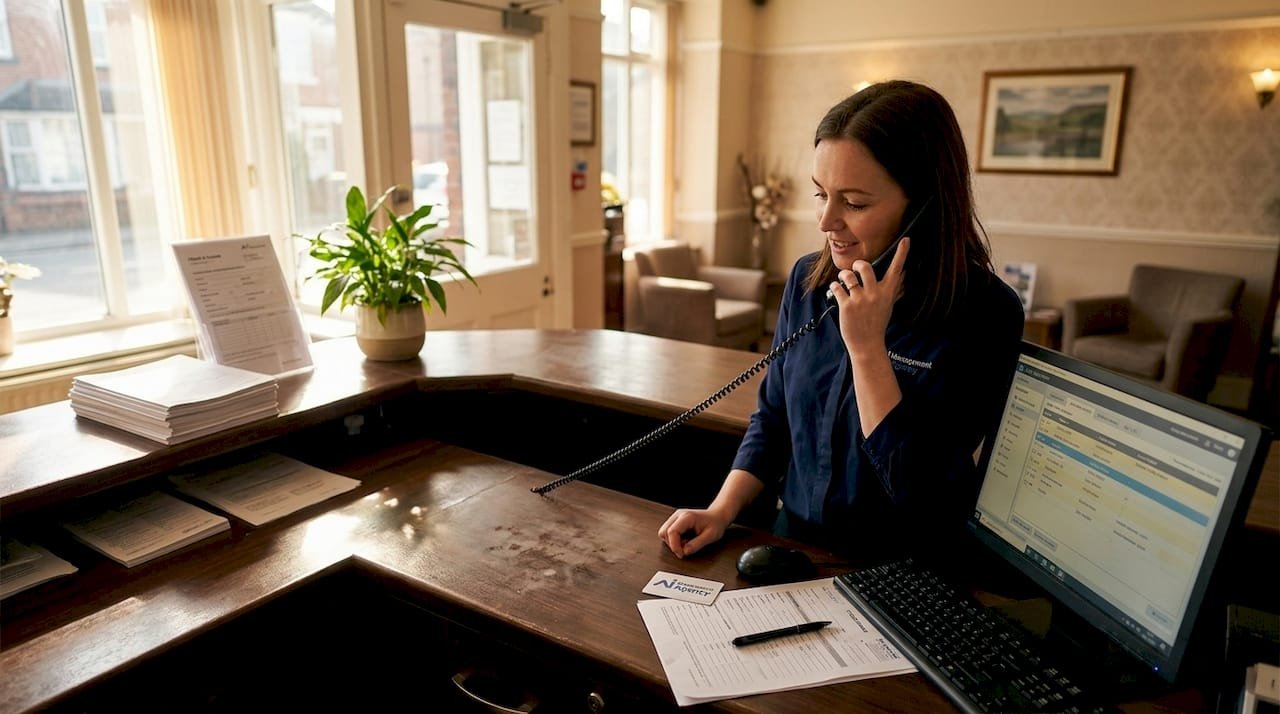
Many small hotel owners assume voice AI is reserved for luxury chains with massive budgets and technical teams. The reality is quite different. Voice AI technology has become accessible and affordable for independent UK hotels, offering measurable improvements in guest service whilst reducing operational strain. This guide explains what voice AI actually does, how small hotels across the UK are using it to cut costs and boost bookings, the risks you need to manage, and practical steps to implement it successfully in your property.
Table of Contents
- Key takeaways
- Understanding voice AI basics for small hotels
- Benefits and results from UK small hotel implementations
- Nuances and risks to know before adopting voice AI
- Practical steps to implement voice AI in UK small hotels
- Discover AI solutions tailored for UK small hotels
- Frequently asked questions
Key Takeaways
| Point | Details |
|---|---|
| Automates guest interactions | Voice AI handles calls and routine tasks to save staff time while maintaining service levels. |
| Fewer calls, more revenue | UK small hotels report up to 90 per cent fewer calls and around two thousand pounds of extra monthly revenue from direct bookings. |
| Risks and oversight | Misinterpretations can occur and human review is needed for complex requests. |
| PMS integration benefits | Start with a PMS integrated voice AI to reduce night staffing costs and maintain guest service. |
| Hospitality specific AI | Choose AI tuned for hospitality to avoid incorrect promises and ensure accurate information. |
Understanding voice AI basics for small hotels
Voice AI uses natural language processing to interact with guests through phone calls, WhatsApp messages, and other communication channels. Unlike traditional automated phone systems with rigid menu options, modern voice AI understands conversational requests and responds naturally. The technology analyses what guests say or type, interprets their intent, and provides relevant information or completes tasks like booking confirmations.
For small hotels, voice AI works best when integrated with your existing property management system. This connection allows the AI to access real-time room availability, pricing, and guest preferences without manual data entry. Lancashire’s Park Hall hotel deployed an AI concierge accessible via phone and WhatsApp to manage rising operational costs whilst maintaining service quality. Their system handles routine enquiries automatically, allowing staff to focus on guests with complex needs.
Common applications include:
- Answering incoming calls 24/7 without human staff
- Responding to frequently asked questions about facilities, policies, and local attractions
- Capturing booking requests when reception is busy or closed
- Sending confirmation messages and pre-arrival information
- Managing simple requests like extra towels or wake-up calls
The technology has evolved significantly from early chatbots. Modern ai voice technology for hotels understands context, remembers previous interactions within a conversation, and escalates to human staff when situations require judgement or empathy. For small hotels operating with lean teams, this means maintaining guest responsiveness without hiring additional overnight or weekend staff.
Benefits and results from UK small hotel implementations
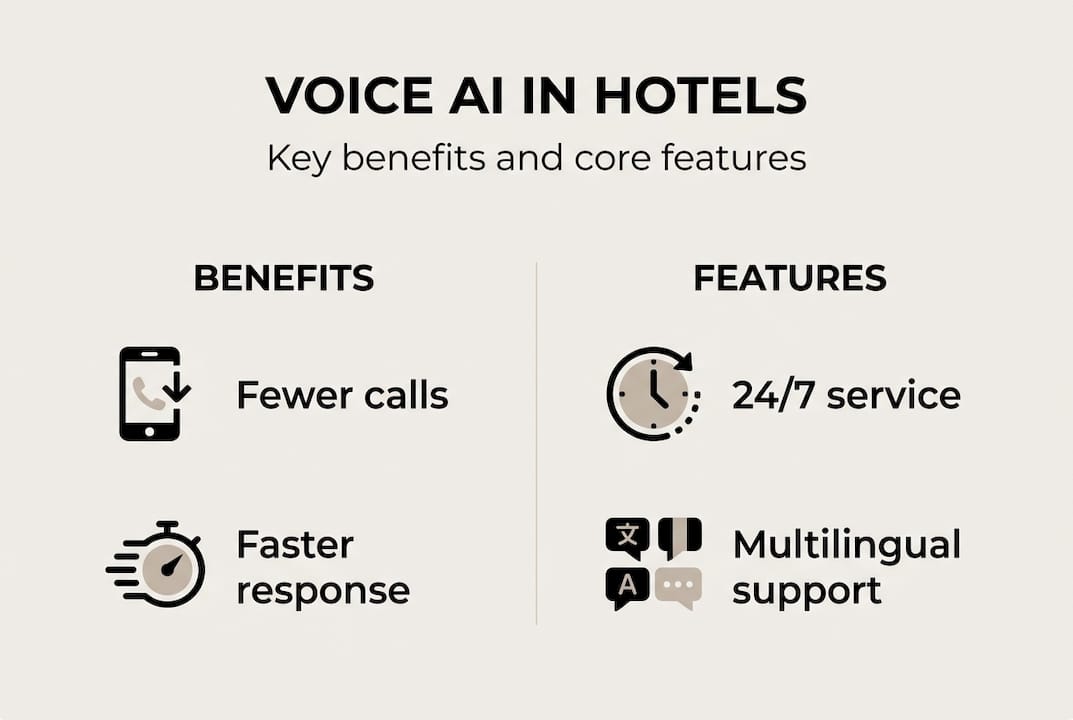
Small UK hotels implementing voice AI report measurable operational improvements and revenue gains. Snoozebox, a UK hotel operator, achieved 90% reduction in emails and calls after deploying voice AI, whilst generating approximately £2,000 in additional monthly revenue from direct bookings that would have been missed outside reception hours.

The financial impact extends beyond direct bookings. Industry data shows hotels miss up to 40% of incoming calls during peak periods. Each missed call represents a potential booking lost to competitors. Voice AI eliminates this gap by answering every call instantly, capturing guest details, and either completing the booking or scheduling a callback for complex requests.
| Benefit category | Typical improvement | Impact for small hotels |
|---|---|---|
| Call handling | 90% reduction in manual calls | Staff focus on high-value guest interactions |
| Revenue capture | £2,000+ monthly from missed calls | Direct bookings without OTA commission |
| Review response | 71% of 4-star hotels use AI for reputation management | Faster responses improve ratings and visibility |
| Staffing costs | 30-50% reduction in overnight reception needs | Lower wage bills without service compromise |
Voice AI particularly benefits guest reputation management. Research shows 71% of 4-star hotels now use conversational AI to improve review response speed, which directly impacts online ratings and booking conversion. Guests increasingly expect immediate responses to enquiries. Voice AI meets this expectation consistently, even during traditionally unstaffed hours.
Beyond cost savings, voice AI improves service consistency. Human staff have off days, forget details, or provide inconsistent information about policies. Voice AI delivers the same accurate information every time, reducing guest confusion and complaints. The technology also captures detailed interaction logs, helping you identify common guest questions and refine your service offerings.
Pro tip: Start by automating your three most common guest requests to build trust gradually. Monitor guest feedback closely during the first month, adjusting AI responses based on actual interactions. This measured approach helps staff and guests adapt whilst you refine the system’s accuracy.
Small hotels report particular success using voice AI for guest communication, where consistent, immediate responses differentiate their service from competitors. The technology works especially well for international guests who appreciate multilingual support without language barriers affecting service quality.
Nuances and risks to know before adopting voice AI
Voice AI delivers significant benefits but introduces operational risks that small hotels must actively manage. The technology can mishandle diverse UK accents or multilingual requests, leading to guest frustration when the system misinterprets their needs. Regional accents from Scotland, Wales, or Northern England sometimes challenge AI systems trained primarily on standard English pronunciation.
More concerning are AI hallucinations, where the system invents information or makes promises your hotel cannot fulfil. A voice AI might confirm a late checkout that conflicts with your actual policy, or describe amenities you do not offer. These false promises damage guest trust and create operational problems when guests arrive expecting services you never agreed to provide.
Research indicates 15-26% of voice AI interactions may result in empty or failed exchanges without proper configuration and data integration. These failures occur when the AI lacks access to current information, cannot understand the guest’s request, or attempts to handle situations beyond its programmed capabilities.
Key risk areas include:
- Accent and dialect recognition failures causing repeated misunderstandings
- Hallucinated amenities, policies, or availability that contradict reality
- Inability to detect guest emotion or frustration requiring human empathy
- Data privacy concerns when handling payment information or personal details
- System failures during peak booking periods creating service gaps
Human staff oversight remains essential for voice AI success. Complex situations involving complaints, special requests, or emotional guests require human judgement and empathy that AI cannot replicate. Your team needs clear protocols for when the AI should escalate to a person, and guests must know how to reach human help quickly when needed.
“Human oversight is essential to maintain trust and avoid guest disappointment. Voice AI should enhance your team’s capabilities, not replace human judgement in situations requiring empathy or complex problem-solving.”
Pro tip: Choose hospitality-specialised AI rather than generic conversational systems. Hotel-specific AI understands industry terminology, common guest requests, and appropriate service boundaries. Establish clear standard operating procedures for AI-to-human handoffs, training your team to monitor AI interactions and intervene proactively when conversations show signs of confusion or frustration.
The ai answering services designed specifically for UK hospitality include built-in safeguards against common risks, with escalation triggers that route complex situations to human staff automatically. Generic AI solutions lack this industry context and require significantly more configuration to operate safely in hotel environments.
Practical steps to implement voice AI in UK small hotels
Successful voice AI implementation follows a structured approach that minimises disruption whilst building staff confidence and guest trust. Start with PMS integration to ensure your AI accesses accurate, real-time information about room availability, pricing, and guest reservations. This connection eliminates manual data entry and prevents the AI from providing outdated information.
Prioritise communication channels your guests actually use. Phone calls remain essential for UK hotels, but WhatsApp and SMS increasingly matter for international guests and younger travellers. Your voice AI should cover the channels generating the most enquiries, not every possible platform.
Set realistic goals focused on measurable outcomes. Reducing night staffing costs and capturing missed calls represent clear targets. Aim for less than 25% of conversations escalating to human staff, indicating the AI handles routine requests effectively whilst recognising its limitations.
-
Assess your current communication needs and PMS compatibility. Document your most common guest enquiries and identify which systems your voice AI must integrate with for accurate information access.
-
Choose hospitality-focused AI with proven UK hotel implementations. Generic conversational AI lacks hotel-specific context and requires extensive customisation. Request case studies from similar-sized properties.
-
Pilot with limited tasks before full deployment. Start with FAQ responses and basic booking enquiries rather than attempting to automate everything immediately. This measured approach helps you refine the system based on real guest interactions.
-
Train staff on managing AI escalations and monitoring system accuracy. Your team needs clear protocols for when to intervene, how to access conversation logs, and how to update AI responses based on recurring issues.
-
Monitor performance metrics and refine regularly. Track escalation rates, guest satisfaction scores, and booking conversion rates. Adjust AI responses monthly based on actual conversation patterns and guest feedback.
| Solution | Key features | Typical cost | Integration ease | Best for |
|---|---|---|---|---|
| Hospitality-specific platforms | PMS integration, hotel terminology, booking handling | £200-500/month | High (pre-built connectors) | Full automation with booking capture |
| Generic conversational AI | Customisable, multi-channel, flexible | £100-300/month | Medium (requires configuration) | FAQ and basic enquiries only |
| Telephony-focused systems | Call handling, voicemail transcription | £150-400/month | Medium (phone system integration) | Phone-heavy properties |
| Messaging-first solutions | WhatsApp, SMS, social media | £100-250/month | High (API-based) | International guest communication |
The ai receptionist for hotels represents the most comprehensive solution, combining phone, messaging, and booking capabilities in one system. This integrated approach simplifies management and provides consistent guest experiences across all communication channels.
Implementation typically requires 4-6 weeks from initial setup to full deployment. The first two weeks focus on system configuration and PMS integration. Weeks three and four involve staff training and pilot testing with limited guest interactions. The final two weeks expand to full deployment whilst monitoring performance closely.
Your staff’s role evolves rather than disappears. They shift from answering routine enquiries to handling complex guest needs, managing AI escalations, and using conversation insights to improve service. This transition requires clear communication about how voice AI enhances their capabilities rather than threatening their positions.
Small hotels successfully implementing voice AI report that boosting sales with AI requires ongoing optimisation rather than one-time setup. Regular review of conversation logs reveals patterns in guest questions, allowing you to refine responses and identify service gaps your hotel can address.
Discover AI solutions tailored for UK small hotels
Navigating voice AI options can feel overwhelming when you are managing daily hotel operations. AI Management Agency specialises in creating high-quality AI agents specifically designed for UK small hotels, including AI receptionists that speak naturally, answer calls 24/7, respond to FAQs, and book qualified sales appointments without human intervention.
Our clients typically see 30% increases in direct bookings whilst reducing staffing costs significantly. We handle the technical complexity of PMS integration, staff training, and ongoing optimisation so you can focus on delivering exceptional guest experiences. Whether you are exploring what AI agents can do for your property or ready to implement a complete solution, our team provides personalised guidance based on your specific operational needs.
Discover how AI agents transform UK hospitality operations by automating routine tasks whilst maintaining the personal touch that distinguishes small hotels from large chains. Our AI receptionist solutions integrate seamlessly with your existing systems, requiring minimal disruption during implementation whilst delivering immediate improvements in guest responsiveness and booking capture.
Frequently asked questions
What tasks can voice AI handle in small hotels?
Voice AI manages incoming calls, responds to frequently asked questions about facilities and policies, captures booking requests with guest details, sends confirmation messages, and handles simple requests like wake-up calls or extra amenities. It works 24/7 without breaks, ensuring guests receive immediate responses regardless of when they contact your hotel.
How does voice AI improve guest experience specifically?
Guests receive instant responses to enquiries rather than waiting for staff availability, which matters especially outside traditional reception hours. The technology provides consistent, accurate information every time, eliminating the confusion that occurs when different staff members give conflicting answers. Multilingual capabilities help international guests communicate comfortably without language barriers affecting service quality.
Is voice AI expensive to implement for small hotels?
Modern voice AI costs between £100-500 monthly depending on features and call volume, significantly less than hiring additional reception staff. Most small hotels recover this investment within the first month through captured bookings that would have been missed outside staffed hours. Implementation requires 4-6 weeks and integrates with existing property management systems without expensive infrastructure changes.
What are common challenges with voice AI adoption?
Accent recognition difficulties affect some UK regional dialects, requiring system training with actual guest conversations. Staff resistance occurs when team members fear job loss rather than understanding how AI handles routine tasks so they can focus on complex guest needs. Initial configuration demands time to programme accurate responses about your specific facilities, policies, and local area information.
How can hotels ensure voice AI doesn’t make mistakes with guests?
Choose hospitality-specific AI trained on hotel interactions rather than generic conversational systems. Establish clear escalation protocols so complex situations route to human staff automatically. Monitor conversation logs weekly during the first three months, refining responses based on actual guest interactions. Maintain human oversight for situations requiring empathy, complaint resolution, or judgement beyond programmed capabilities.
Recommended
- AI Voice Technology: Transforming Small Hotel Service – AI Management Agency
- Voice AI for Hospitality – Boosting Guest Service Efficiency – AI Management Agency
- AI Management Agency: Discover AI Success with Our Case Studies & Results
- AI Receptionist for Hotels: Improve Bookings & Guest Experience by AIM Agency
- Voice Agent: 24/7 für Deine Kunden da – trendymarketing | Deine Zukunft beginnt jetzt
- SoftBank lanciert „SoftVoice“: Was das neue Deeskalations‑System für Contact Center strategisch bedeutet