
Traditional phone systems leave many small hotel owners in the United Kingdom facing missed calls and frustrated guests, especially outside regular hours. Keeping up with bookings and guest queries when you have a five-person team feels impossible. With AI voice technology, small hotels can offer round-the-clock support, instant answers, and personalised experiences—features once reserved for the big chains. This article shows how smart voice solutions go far beyond standard phones, helping you deliver seamless service and never lose a potential booking again.
Table of Contents
- Defining AI Voice Technology for Hospitality
- Major Types and Use Cases for Hotels
- How AI Voice Receptionists Operate
- Legal, Privacy, and Compliance Factors
- Comparing Costs and Avoiding Common Pitfalls
Key Takeaways
| Point | Details |
|---|---|
| AI Voice Technology Enhances Guest Interaction | AI voice systems provide 24/7 availability, allowing hotels to respond to guest inquiries instantly and improve customer satisfaction. |
| Cost-Effective Solution for Small Hotels | Implementing AI can significantly reduce personnel costs by automating routine tasks, thus freeing staff for more complex guest interactions. |
| Compliance is Crucial | Ensuring compliance with data protection laws like GDPR is essential to protect guest information and maintain trust. |
| Seamless Integration is Key | Proper integration of AI systems with existing software is critical to avoid operational pitfalls and ensure accurate booking processes. |
Defining AI Voice Technology for Hospitality
AI voice technology for hotels isn’t science fiction anymore—it’s a practical solution sitting on your desk right now. At its core, AI voice technology uses natural language processing and machine learning to enable computers to understand and respond to human speech in real time.
For small hotels like yours, this means a system that can answer guest calls 24/7, handle frequently asked questions, and book appointments without requiring human intervention. The technology recognises what guests are asking and provides intelligent responses tailored to their specific needs.
What Makes It Different from Standard Phone Systems
Traditional phone systems route calls to staff members. AI voice systems do the heavy lifting themselves. They understand context, remember guest preferences, and handle multiple conversations simultaneously—something your five-person team simply cannot do around the clock.
Key capabilities include:
- Recognising guest inquiries and responding with relevant information
- Booking qualified appointments directly into your system
- Answering common questions about room rates, amenities, and house policies
- Transferring complex issues to your team when needed
- Learning from conversations to improve future interactions
The technology works through conversational agents and natural language processing, which allow the system to understand what guests actually mean, not just the exact words they use. A guest asking “Can you give me a room with a view?” is handled as intelligently as “I’d like a room overlooking the garden.”
Here’s a comparison of traditional phone systems and AI voice technology for hotel operations:
| Aspect | Traditional Phone Systems | AI Voice Technology |
|---|---|---|
| Availability | Staff hours only | 24/7, including nights and holidays |
| Response Speed | Varies, may require hold time | Immediate, real-time |
| Handling Volume | Limited by staff count | Unlimited simultaneous conversations |
| Personalisation | Depends on staff memory | Remembers guest preferences |
| Cost Structure | Salaries, overtime, training | Monthly subscription, minimal staff training |
How It Operates in Your Hotel
When a guest calls or chats, the AI voice system processes their request in milliseconds. It evaluates what they’re asking for and responds conversationally. If they want to book a room, the system captures their dates, preferences, and contact details before confirming the reservation.
The whole interaction feels natural—guests don’t realise they’re speaking to AI because AI systems use behavioral understanding and intelligent recognition capabilities to engage like a trained receptionist would.
Three core functions deliver value:
- 24/7 Availability: Your system works while you sleep, handle guest needs across time zones, and never takes a break
- Instant Response: Guests get answers immediately instead of waiting on hold or sending emails
- Lead Qualification: The system captures booking intent and ensures only genuinely interested guests reach your team
Small hotel owners often worry that technology feels impersonal. But here’s the reality: having no one answer the phone at night is far worse than having an AI answer helpfully and route urgent matters to you immediately.
AI voice technology transforms your hotel from operating during staff hours into operating around the clock, turning missed opportunities into confirmed bookings.
Pro tip: Start by identifying your most frequent guest questions—booking inquiries, check-in procedures, cancellation policies. These become your first AI voice system priorities, delivering maximum impact immediately.
Major Types and Use Cases for Hotels
AI voice technology isn’t one-size-fits-all. Different systems solve different problems in your hotel. Understanding which type matches your specific needs means investing wisely rather than chasing trends.
The main categories break down into guest-facing applications and operational tools. Guest-facing systems handle direct interactions—answering phones, taking bookings, answering questions. Operational systems manage behind-the-scenes tasks like scheduling staff, managing inventory, and analysing energy consumption.

Guest-Facing Voice Solutions
These are what your guests experience directly. A virtual concierge powered by voice AI can answer questions about local restaurants, book taxis, provide room service recommendations, and handle requests without waking your night staff.
Virtual assistants and chatbots handle common inquiries and personalised guest experiences through voice interactions. A guest calling at 11 PM asking about breakfast times gets an instant answer instead of waiting until morning.
Booking systems represent another critical application. Voice-enabled booking allows guests to reserve rooms, check availability, and confirm dates through simple conversation. No forms to fill. No confusing websites. Just speak, and it’s done.
Key guest-facing use cases:
- Answering frequently asked questions about amenities, policies, and services
- Processing new bookings and capturing guest preferences
- Handling special requests (cot needed, dietary requirements, accessibility needs)
- Providing local recommendations and tourist information
- Managing check-in and check-out processes
Operational Efficiency Applications
Behind the scenes, AI voice handles tasks your team dreads. Process automation through voice systems reduces manual workload significantly. Staff no longer manually log guest requests or transcribe notes—the system captures everything automatically.
Multilingual support becomes effortless. A single AI voice system serves French, Spanish, German, and Mandarin-speaking guests without hiring translators. Your three-person front desk suddenly communicates globally.
Staff can focus on what humans do best—creating genuine experiences. Instead of answering “What time is breakfast?” for the hundredth time, they spend time addressing guest concerns that require empathy and judgment.
Operational benefits include:
- Reducing repetitive call handling by 60-70%
- Capturing guest data automatically for personalisation
- Identifying upsell opportunities (mentioning premium room options, dining packages)
- Freeing staff time for complex problem-solving
- Providing 24/7 availability without overtime costs
AI voice systems excel at handling volume—the 50 calls at night that would otherwise go unanswered become 50 qualified leads captured automatically.
Small hotels often think they’re too small for this technology. The truth: you benefit most. A single AI voice agent replaces a night receptionist, working endlessly without fatigue or salary costs.
Pro tip: Map your three highest-frequency guest inquiries first—typically booking rates, cancellation policies, and check-in procedures. These become your system’s immediate focus, delivering measurable ROI within weeks.
How AI Voice Receptionists Operate
AI voice receptionists work through a three-step process that happens in milliseconds. A guest calls your hotel, speaks naturally, and the system understands exactly what they need. No scripts. No “press 1 for bookings.” Just conversation.
The magic lies in how the technology processes language. Voice recognition converts spoken words into text, while natural language processing interprets what guests actually mean—not just the literal words they use. A guest saying “I’d like a room for next weekend” and “Got availability Friday to Sunday?” both trigger the same booking process.
The Three-Stage Process
Understanding the mechanics helps you see why this works so well for small hotels.
Stage 1: Listening and Understanding
When a guest calls, the system listens and converts speech to text instantly. It then interprets intent—is this a booking inquiry, a question, or a complaint? Context matters. A guest asking “Do you have rooms?” at 2 AM needs availability information, not your breakfast menu.
Stage 2: Intelligent Response
The system searches your database for relevant information. If a guest asks about room rates, it pulls current pricing. If they want to book, it checks availability against your real-time calendar and captures their preferences. All automatically.
The AI system learns from every conversation. After handling 100 booking calls, it refines how it asks qualifying questions and processes guest data more efficiently.
Stage 3: Seamless Handoff
Some situations require human expertise—an angry guest, complex group bookings, or special circumstances. The system recognises these moments and transfers the caller to your team with full context already captured. Your staff knows everything: who they are, what they want, and what the AI already tried.
Why This Matters for Your Hotel
You’re not replacing your team. You’re amplifying them. The AI receptionist answers routine calls whilst your staff focuses on guests needing genuine human touch.
Key operational features:
- Processing multiple calls simultaneously (something one person cannot do)
- Capturing guest information automatically into your system
- Available at midnight, 3 AM, weekends, and bank holidays
- Providing consistent, professional responses every time
- Learning continuously from interactions
AI receptionists don’t tire, don’t take breaks, and don’t miss calls—they simply handle volume your small team cannot physically manage.
Small hotels often worry about sounding impersonal. But a missed call at 2 AM is worse than an AI handling it professionally. Your team can focus on the guests who are already in your hotel, making their stay exceptional.
Pro tip: Set up your AI receptionist to capture guest names, booking dates, and special requests first. These three pieces of information allow your team to personalise service when guests arrive, creating the human touch that matters most.
Legal, Privacy, and Compliance Factors
AI voice systems collect guest data. Names, phone numbers, booking preferences, dietary requirements, accessibility needs. This creates legal responsibility you cannot ignore. The United Kingdom operates under strict regulations that protect guest privacy, and non-compliance carries serious financial and reputational consequences.
If your hotel operates across Europe or serves European guests, GDPR compliance is mandatory. If you’re UK-based, UK data protection law applies. Violating these laws results in fines up to £17.5 million or 4% of annual turnover—whichever is higher. For a small hotel, that’s catastrophic.
Data Protection Requirements
When deploying an AI voice system, transparency in data collection and consent management become essential foundations. Guests must know their data is being recorded and understand how it will be used.
Your AI system must:
- Inform guests that they’re speaking to AI (not a human receptionist)
- Explain what data is being captured and why
- Obtain clear consent before processing personal information
- Store data securely with encryption
- Delete data when no longer needed
Many small hotel owners assume “implied consent” from booking is enough. It isn’t. Guests must specifically consent to AI voice recording and data processing. Your privacy policy must be clear, not buried in legal jargon.
Below is a summary of legal and compliance requirements for AI voice systems in UK hospitality:
| Compliance Area | Requirement | Consequence of Non-Compliance |
|---|---|---|
| Data Transparency | Inform guests about AI and data use | Loss of guest trust, legal penalties |
| Consent | Explicit guest approval needed | Fines up to £17.5 million |
| Secure Storage | Encrypted and controlled access | Potential data breaches |
| Data Minimisation | Collect only necessary information | Increased compliance burden |
| Retention Policy | Define data retention and deletion | Unlawful data storage |
Managing Guest Data Responsibly
Hospitality providers must implement thorough data governance, avoid bias, and secure guest data through proper access controls. This means only authorised staff access guest information, and your system logs who accesses what.
Data minimisation matters too. Collect only what you genuinely need. If you don’t need a guest’s email address to process their booking, don’t collect it. This reduces your compliance burden and protects guests.
Key compliance steps:
- Document what data your AI system collects and processes
- Establish a data retention policy (how long you keep information)
- Create guest access rights (guests can request what data you hold)
- Implement data breach procedures (reporting incidents within 72 hours)
- Train staff on data handling standards
Emerging AI-Specific Regulations
The EU AI Act introduces new requirements for AI systems classified as “high-risk.” Guest-facing AI voice systems may fall into this category. This means additional testing, documentation, and monitoring obligations.
The good news: UK compliance officers are actively monitoring these developments. Working with an AI provider experienced in hospitality ensures your system meets current and emerging standards automatically.
Non-compliance isn’t just a legal risk—it damages guest trust. When guests discover their data was mishandled, reputation recovery costs more than getting compliance right from the start.
Small hotels sometimes delay compliance worrying it’s too complex. The reality: implementing basic safeguards from day one takes less effort than fixing problems later.
Pro tip: Before deploying any AI voice system, request a data processing agreement from your provider in writing. This document specifies exactly how guest data is protected, stored, and deleted—giving you documented compliance proof and peace of mind.
Comparing Costs and Avoiding Common Pitfalls
AI voice systems cost money. But the real question isn’t “How much does it cost?” It’s “What do I save, and what mistakes should I avoid?” Understanding both sides prevents expensive regrets.
For small hotels, the financial case is straightforward. A night receptionist costs £20,000-£25,000 annually. An AI voice system handles that job without salary, benefits, or holiday pay. The maths work. But implementation mistakes can erase these savings quickly.
Understanding the Real Costs
AI voice systems typically operate on a monthly subscription model. Small hotels pay £200-£800 monthly depending on call volume and features. Some providers charge per call, others charge fixed fees. Compare both structures against your expected usage.
Integration costs matter too. Your AI system must connect to your Property Management System (PMS)—your booking software. Integration ranges from “plug and play” to “requires technical work.” Factor this into your budget. Poor integration creates the first major pitfall.
Typical cost breakdown:
- AI voice system subscription: £300-£600 monthly
- Integration and setup: £500-£2,000 (one-time)
- Staff training: Minimal (usually 2-4 hours)
- Ongoing optimisation: Included or small monthly fee
Compare this against replacing one full-time night receptionist. You recoup investment within 2-3 months. After that, it’s pure savings.
Common Implementation Mistakes
Successful implementations focus on seamless PMS integration, ongoing optimisation, and maintaining balance between automation and human touch. Hotels that skip these basics fail.
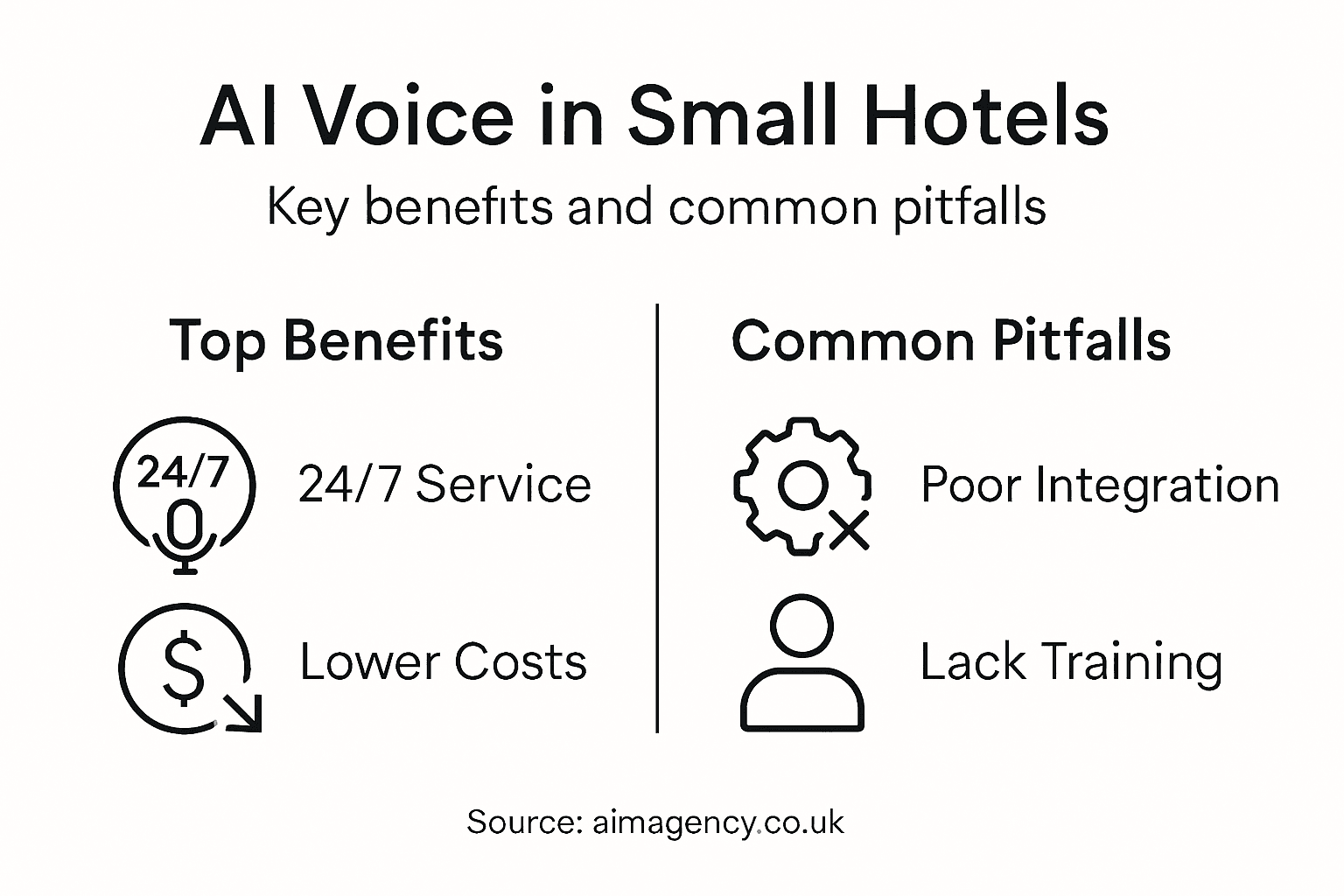
Pitfall 1: Poor System Integration
Your AI voice system must read your real availability. If it books rooms you don’t have, guests arrive to cancellations. Integration isn’t optional—it’s fundamental.
Pitfall 2: Unrealistic ROI Expectations
Some owners expect immediate returns. Reality: systems need 4-6 weeks to optimise. During this period, your staff refines how the AI handles calls. Patience pays off.
Pitfall 3: Minimal Staff Training
Your team must understand how the system works, when to intervene, and how to access captured guest information. Untrained staff frustrates guests with slow handoffs.
Pitfall 4: Setting and Forgetting
The system improves continuously. Review call recordings monthly. Identify where it struggles and request adjustments. Neglecting this wastes potential.
The difference between success and failure isn’t the technology—it’s commitment to making the system work for your specific operation.
Small hotels that succeed treat AI voice implementation like any business process: they document workflows, train staff properly, and monitor performance. They don’t just switch it on and hope.
Pro tip: Request a trial period from your provider before committing. Run it for two weeks, measure how many calls it answers correctly, and assess integration quality. This small investment prevents costly mistakes later.
Unlock 24/7 Hotel Service with AI Voice Technology
Small hotels face the exact challenge this article highlights: managing guest calls around the clock without the cost or fatigue of night staff. The key pain points you share are missed bookings, slow response times, and the need for personalised, intelligent guest interaction beyond office hours. AI voice technology provides a natural tone receptionist that understands, responds to FAQs, and books qualified appointments seamlessly. This means never losing opportunities and delivering consistent guest service even at 3 AM.
Discover how Ai Marketing – AI Management Agency crafts tailored AI agents to handle your unique hotel demands. With proven results you can explore in our case study – AI Management Agency, our solutions empower you to focus on creating memorable guest experiences while your AI receptionist takes care of routine and high-volume calls.
Experience the transformation yourself at https://aimagency.co.uk. Act now to implement an AI voice system that guarantees 24/7 availability, instant responses, and qualified lead capture. Don’t let another guest call go unanswered or a booking slip away when you can elevate your hotel’s service today.
Frequently Asked Questions
What is AI voice technology for small hotels?
AI voice technology employs natural language processing and machine learning to enable systems to understand and respond to guest inquiries in real time. It can handle bookings, answer questions, and provide relevant information without human intervention.
How does AI voice technology improve customer service in hotels?
AI voice technology allows hotels to offer 24/7 service, providing immediate responses to guest queries without hold times. This enhances guest satisfaction by ensuring their needs are addressed promptly, even outside of regular business hours.
What are the key differences between traditional phone systems and AI voice technology?
Unlike traditional phone systems that require staff to manage calls, AI voice technology can handle multiple conversations simultaneously, understand context, and remember guest preferences, providing a more efficient and personalised experience.
What compliance considerations should hotels be aware of when implementing AI voice technology?
Hotels must ensure compliance with data protection regulations, including obtaining explicit consent from guests for data collection and processing. It’s crucial to inform guests that they are interacting with AI and manage personal data securely.
Recommended
- Role of AI in Small Business Customer Service – AI Management Agency
- AIM Agency: Boutique Hotel Cuts Admin by 60% with AI in 2026
- 6 Essential AI Customer Interaction Tips for Boutique Hotels – AI Management Agency
- How to Optimise AI Responses for Small Hospitality Teams – AI Management Agency
- Role of AI in B2B Sales – Driving Efficiency and Growth
- How Enterprise Content Teams Are Adopting AI Tools in 2025 – 40Q
- AI Archives – MonsterWP