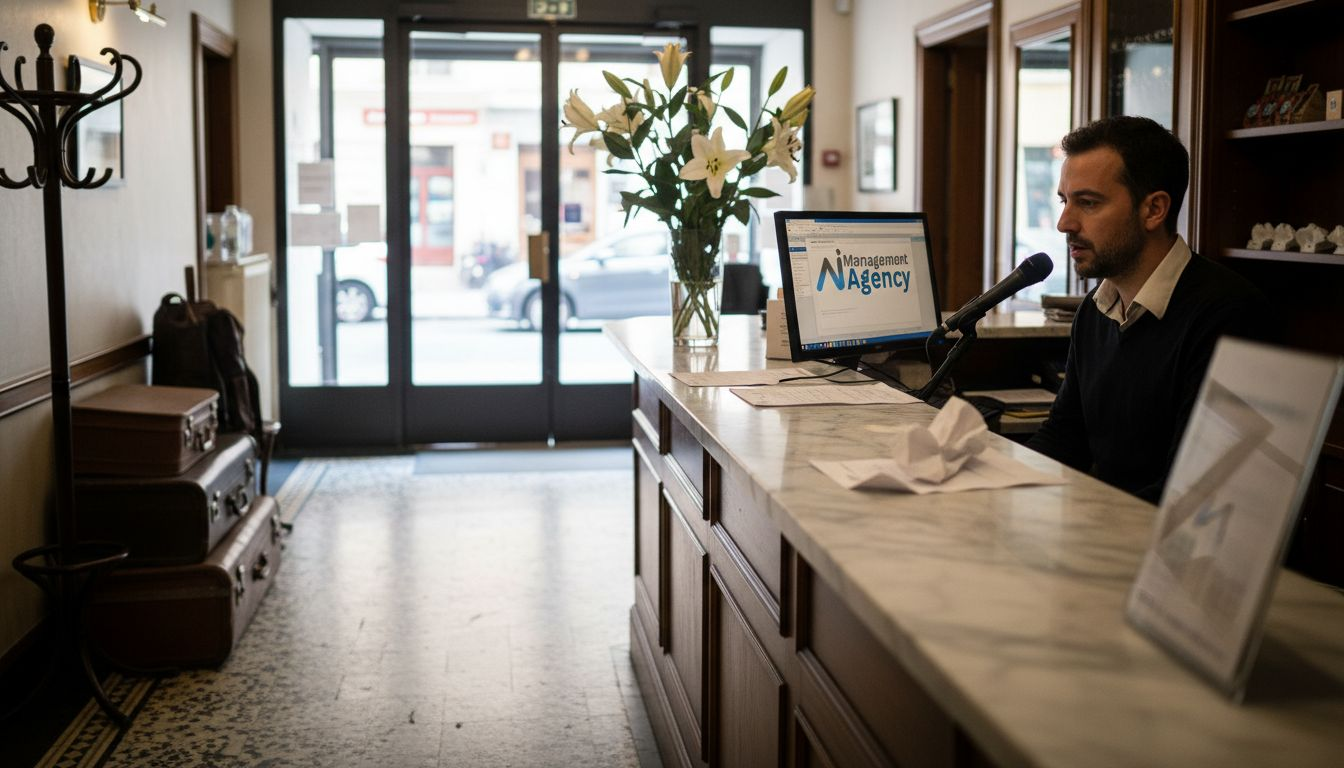
Every UK hospitality business owner with a lean team knows the pressure of juggling calls, guest questions, and booking requests, often all at once. When each missed call could mean lost revenue, efficient solutions become vital. Adopting voice AI technology empowers your business to answer guest calls instantly, provide round-the-clock information, and manage appointments with accuracy—relieving your team from the cycle of repetitive enquiries so they can focus on creating genuine guest experiences.
Table of Contents
- Voice AI Technology In Hospitality Explained
- Core Functions And Key System Types
- Real-World Use Cases For Small Teams
- Benefits, Challenges, And Legal Concerns
- Comparing Voice AI With Manual Processes
Key Takeaways
| Point | Details |
|---|---|
| Voice AI Enhances Efficiency | Voice AI technology allows small hospitality businesses to automate guest interactions, reducing the need for additional staff and enhancing operational efficiency. |
| 24/7 Availability | Unlike traditional systems, voice AI operates continuously, providing instant responses to guest inquiries at any time. |
| Seamless Integration | Effective voice AI systems integrate with existing booking and management tools, ensuring accurate information and real-time availability. |
| Focus on Human Interaction | By handling routine enquiries, voice AI enables staff to dedicate time to complex guest interactions, enhancing overall guest satisfaction. |
Voice AI Technology in Hospitality Explained
Voice AI transforms how small hospitality businesses handle guest interactions. Rather than hiring additional staff, you deploy an intelligent system that answers calls, responds to frequently asked questions, and books qualified appointments—24 hours a day, 7 days a week.
What exactly is voice AI in hospitality?
Voice AI combines natural language processing and machine learning to understand what guests say, interpret their needs, and respond conversibly. Unlike rigid automated systems, voice AI technology learns from interactions and improves over time, delivering more human-like conversations.
For small hotel owners and boutique hospitality businesses, this means your reception desk operates continuously without staffing costs multiplying.
How voice AI differs from traditional phone systems
Traditional phone systems route calls to staff members. Voice AI answers directly, handles common requests immediately, and escalates only when necessary.
Key differences include:
- Availability: Traditional systems close when staff leave; voice AI operates round-the-clock
- Consistency: Every guest receives the same professional response quality
- Speed: Voice AI answers instantly, eliminating hold times
- Cost efficiency: One system replaces multiple team members during off-hours
Voice AI isn’t about replacing your team—it’s about freeing them to focus on complex guest interactions that require human judgment and warmth.
The technology behind the scenes
Your AI voice system works through three interconnected processes.
First, it listens and transcribes what the guest says using automatic speech recognition. Second, it understands intent—not just the words, but what the guest actually wants. Third, it generates a natural response using machine learning and natural language processing capabilities tailored to your business.

This happens in milliseconds, creating seamless conversations.
Why it matters for your small business
With tight budgets and lean teams, you cannot afford staff sitting idle at reception answering repetitive questions. Voice AI handles the volume whilst your team manages guest experiences that genuinely matter.
Guests appreciate instant responses. They book appointments without waiting for callback. They get answers to common questions immediately. You gain operational breathing room.
- Reduces missed calls and booking inquiries
- Captures qualified leads automatically
- Provides 24/7 availability without shift costs
- Handles peak call volumes during busy seasons
Small hospitality businesses with 2-5 staff members see immediate impact—fewer interruptions for reception staff, fewer missed bookings, clearer capacity planning.
Real capability: what it actually handles
Your voice AI system manages specific, defined tasks exceptionally well. It answers standard questions about room rates, check-in times, amenities, and policies. It qualifies caller intentions and books appointments into your calendar. It captures guest names, contact details, and booking preferences accurately.
What it doesn’t do: it doesn’t handle complex negotiations, unusual complaints requiring empathy and judgment, or situations demanding immediate human expertise.
Pro tip: Design your system to handle 60-70% of incoming calls completely, escalating the remainder to your team. This ratio maximises efficiency whilst ensuring every guest receives appropriate attention.
Core Functions and Key System Types
Voice AI systems for hospitality perform distinct functions, each designed to solve specific business challenges. Understanding what each system type does helps you choose the right fit for your guest service needs.
The primary functions voice AI handles
Your voice AI system performs several core tasks simultaneously. It answers incoming calls without requiring staff intervention. It responds to frequently asked questions about rates, policies, amenities, and availability. It captures guest information accurately and books appointments or reservations directly into your calendar.
Beyond basic responses, modern systems integrate with property management and CRM systems, allowing real-time availability checks and instant confirmation details.
Key functions include:
- Answering and routing incoming calls intelligently
- Responding to standard guest inquiries without escalation
- Capturing qualified lead information automatically
- Booking reservations, appointments, and experiences
- Handling peak-season call volumes without staff strain
- Following up with guests via voice or messaging
The best voice AI systems don’t just answer calls—they qualify leads, book appointments, and capture the information your team needs to deliver exceptional service.
System types: matching technology to your needs
Different voice AI systems specialise in different guest interactions. The virtual receptionist handles inbound calls, answers common questions, and books appointments. It’s your frontline for every incoming call.
The concierge assistant goes deeper. Beyond basic inquiries, it suggests experiences, handles upselling, and personalises recommendations based on guest profiles. It works particularly well for upmarket properties offering premium services.
The task management system focuses on operational efficiency. It schedules maintenance requests, manages staff tasks, and coordinates between departments using voice commands.
Each type serves different business needs:
- Virtual receptionist: Best for high call volume; handles 60-80% of inquiries independently
- Concierge assistant: Best for upselling and personalised service; requires guest data integration
- Task management system: Best for internal operations; reduces staff coordination time
Small hospitality businesses typically start with a virtual receptionist, which delivers immediate cost savings and availability improvements.
Here’s a quick comparison of voice AI system types and their strongest applications:
| System Type | Best Use Case | Key Advantage |
|---|---|---|
| Virtual receptionist | High call volume, routine questions | Maximises booking efficiency |
| Concierge assistant | Personalised upselling, recommendations | Delivers enhanced guest experience |
| Task management system | Internal operations management | Streamlines staff coordination |
How systems integrate with your existing tools
Your voice AI doesn’t operate in isolation. Speech recognition and natural language processing capabilities connect directly to your booking system, calendar, and guest database.
This integration means your AI knows real-time availability, can confirm bookings instantly, and provides accurate information every single time. No more conflicting information between systems.
Integration handles:
- Real-time calendar synchronisation
- Automatic booking confirmations
- Guest history access for personalised responses
- Multilingual support across different guest demographics
- Escalation protocols to your team’s communication tools
Without integration, your system becomes a standalone tool providing surface-level responses. With proper integration, it becomes a genuine extension of your service operation.
Pro tip: Start with mapping your top 20 guest questions and booking scenarios, then configure your system to handle these first. This focused approach delivers quick wins whilst you refine responses based on real interaction data.
Real-World Use Cases for Small Teams
Voice AI isn’t theoretical—it’s solving genuine problems for small hospitality businesses right now. These practical examples show how teams like yours are gaining competitive advantage with minimal operational disruption.
The midnight booking scenario
Your business receives a call at 11 PM from a potential guest searching for last-minute accommodation. Your staff have finished for the day. Without voice AI, this call goes to voicemail and the booking disappears.
With voice AI, the system answers immediately, confirms availability, takes guest details, and books the room into your system. Your team arrives tomorrow morning to find a confirmed booking with all necessary information captured. The guest receives instant confirmation via SMS.
This happens across dozens of calls whilst your team rests. Revenue you would have lost is now secured.
Managing the summer rush
During peak season, your small team handles triple the normal call volume. A 3-person operation suddenly needs 6 people just to answer phones. Voice AI becomes your temporary reception staff.
Instead of hiring temporary workers, your voice AI answers 70% of incoming calls completely. Your team focuses on complex requests, special arrangements, and guest relationships. Call wait times drop from 15 minutes to zero.
Automating routine tasks reduces staff workload whilst maintaining personal touches where guests genuinely need human interaction.
Key benefits during peak periods:
- No missed calls or booking inquiries
- Instant availability confirmation
- Reduced staff stress and burnout
- Consistent response quality across all interactions
- Measurable booking increases
Small teams succeed during peak seasons not by hiring more people, but by automating what machines handle better—repetitive enquiries and booking processes.
The multilingual guest challenge
Your boutique hotel attracts international guests. A French couple arrives and needs to book a restaurant reservation. Your team speaks only English. The guest feels frustrated and unheard.
Voice AI handles this seamlessly. Multilingual guest support allows the system to respond in the guest’s preferred language, making bookings, answering questions, and providing recommendations.
Your team receives all information in English. The guest experiences personalised, language-appropriate service. Everyone wins.
Follow-up and guest retention
A guest checks out after a 3-night stay. Your small team lacks capacity for follow-up calls. The guest never hears from you again, reducing the likelihood of repeat bookings.
Voice AI handles post-stay follow-ups automatically. It thanks guests, asks for feedback, and mentions special offers or loyalty benefits. Personal touches that would normally require staff time happen consistently and cost-effectively.
Repeat booking rates increase noticeably when guests receive timely, genuine follow-up contact.
Practical applications:
- Post-checkout satisfaction surveys
- Loyalty programme enrolment
- Seasonal promotional calls
- Birthday or anniversary messages
- Special offer announcements
Small hospitality teams with 2-5 staff members see immediate impact because voice AI handles volume constraints—the primary operational bottleneck for lean teams.
Pro tip: Start your voice AI implementation with one specific scenario that causes your team the most stress—typically weekend bookings or after-hours inquiries. Prove the value in a single use case before expanding to other functions.
Benefits, Challenges, and Legal Concerns
Voice AI delivers genuine business value, but successful implementation requires understanding both the advantages and the real obstacles you’ll face. Being honest about challenges helps you plan properly from the start.
The tangible benefits for your business
Voice AI reduces operational costs immediately by handling call volume without hiring additional staff. Your team stops spending time on repetitive questions and focuses on complex guest interactions where human judgment matters.
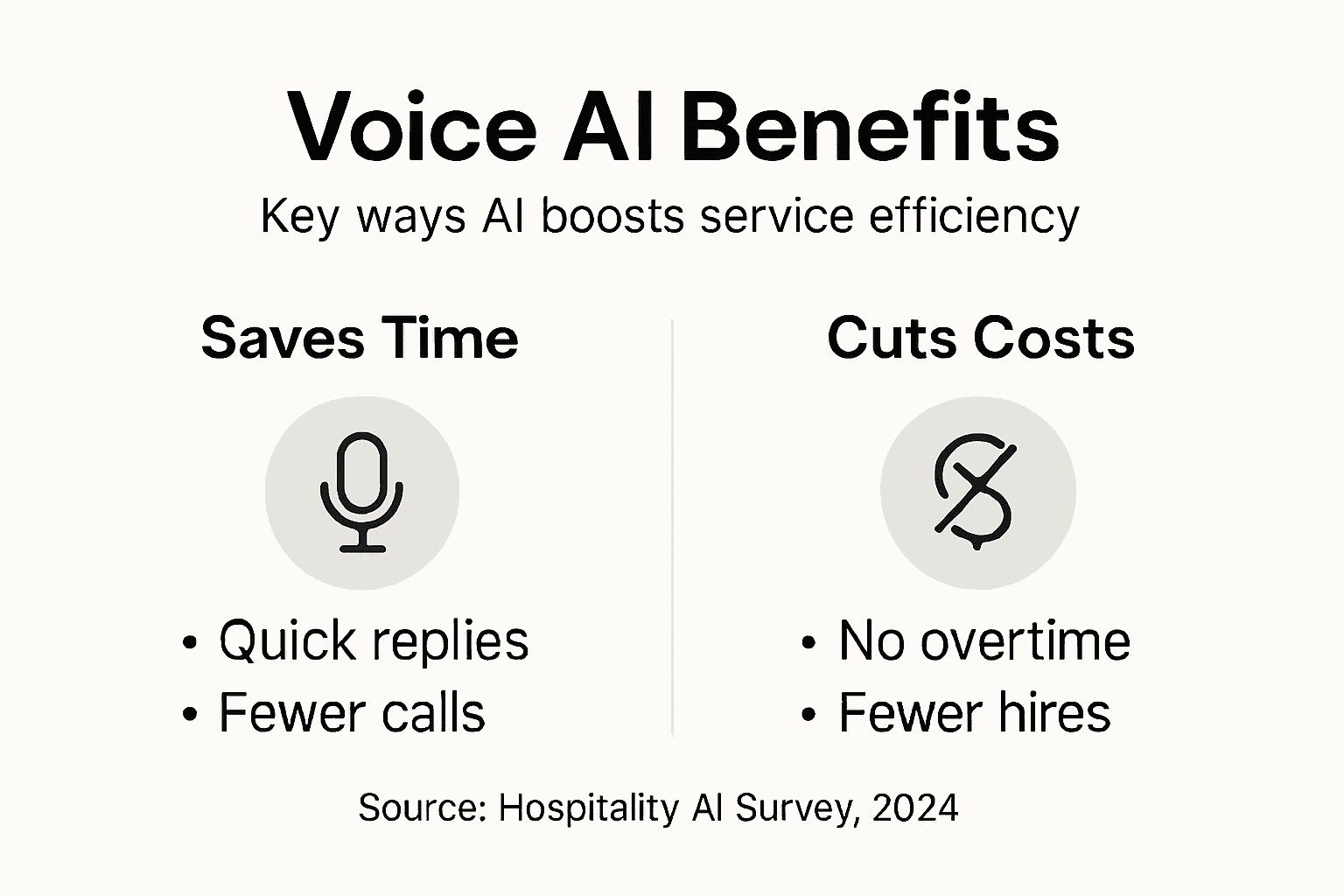
Guest experience improves noticeably. Callers get instant answers instead of holding for minutes. Bookings happen immediately without follow-up delays. Availability information is always accurate because the system queries your calendar in real time.
Key business outcomes:
- Cost savings from reduced staff requirements during off-hours
- Increased booking conversion from answered calls
- Improved guest satisfaction through faster response times
- Consistent service quality regardless of team availability
- Data capture for better business insights
- 24/7 availability without hiring round-the-clock staff
The real value isn’t flashy technology—it’s capturing revenue you currently lose and freeing your team to do work that truly requires human skill.
The genuine challenges you’ll encounter
Implementation requires clear configuration. Your voice AI needs accurate information about rates, policies, availability, and booking procedures. If your system data is wrong, the AI gives wrong answers.
Guests with unusual requests frustrate basic systems. A guest asking “Can I bring my emotional support peacock?” requires human judgment, not automation. Your system must recognise when escalation is necessary.
Data privacy and consent requirements add complexity. You’re recording voices and capturing guest information. Compliance with UK data protection regulations isn’t optional.
Common implementation challenges:
- Integrating with existing booking and management systems
- Training your team to manage the new workflow
- Handling edge cases and unusual guest requests
- Maintaining accurate system data as policies change
- Managing guest expectations about automation versus human service
Legal and regulatory concerns you must address
Data protection is non-negotiable. Voice recordings contain personal data. You must comply with UK GDPR requirements for consent, storage, and deletion. Your guests must know their calls are being recorded and understand why.
Call recording regulations require explicit consent before recording. Simply having a voice AI system doesn’t grant automatic permission. Many businesses fail here and face compliance violations.
Accuracy and liability matter legally. If your system provides incorrect information about cancellation policies or rates, and a guest suffers financial loss, you bear responsibility.
Responsible AI adoption requires addressing data security and ethical concerns before implementation, not after problems arise.
Essential legal safeguards:
Below is a summary of legal essentials when deploying voice AI in UK hospitality:
| Requirement | Why It Matters | Example Action |
|---|---|---|
| Guest consent for recording | Complies with UK GDPR | Play announcement at start |
| Secure data storage | Prevents data breaches | Use encrypted servers |
| Documentation of limitations | Avoids legal disputes | Maintain accuracy records |
| Escalation protocol | Manages complex issues | Refer non-standard calls |
- Obtain explicit consent for call recording
- Maintain transparent privacy policies
- Implement secure data storage and encryption
- Establish clear escalation protocols for edge cases
- Document system limitations and accuracy rates
- Maintain human oversight of all bookings and commitments
The workforce displacement concern
Honestly, voice AI changes your team’s role. It doesn’t eliminate jobs; it transforms them. Your receptionist stops answering basic questions and starts managing guest relationships, handling complaints, and processing special requests.
This requires training and mindset shifts. Some team members embrace the change; others resist. Planning for this transition matters more than the technology itself.
Small teams often adapt quickly because they see immediate relief from repetitive tasks, freeing capacity for work they find more rewarding.
Pro tip: Before implementing voice AI, have honest conversations with your team about how roles will change. Involve them in configuration so they understand what the system handles and why. Teams that feel part of the solution embrace the technology faster than teams told “the machine replaces you.”
Comparing Voice AI With Manual Processes
Understanding how voice AI differs from traditional manual reception work helps you make informed decisions about implementation. The comparison reveals where AI excels and where human judgment remains irreplaceable.
Speed and availability: the most obvious difference
Manual processes have inherent limitations. Your receptionist answers one call at a time. During peak hours, callers queue. After 5 PM, calls go unanswered. During holidays, nobody picks up at all.
Voice AI answers every call instantly, twenty-four hours daily. No waiting. No missed opportunities. This alone transforms booking conversion rates for small businesses.
Operational efficiency improvements through AI automation enable hotels to handle peak volumes without hiring temporary staff.
Key speed advantages:
- Instant call answering with zero wait times
- Simultaneous handling of multiple enquiries
- Immediate booking confirmations and calendar updates
- 24/7/365 availability regardless of staff schedules
- Consistent response quality across all interactions
The difference isn’t just faster service—it’s capturing bookings that would otherwise disappear because nobody was there to answer.
Consistency and accuracy
Your staff bring personality, but they also bring variability. One receptionist sounds professional; another sounds rushed. One remembers the current promotional rate; another quotes outdated pricing.
Voice AI delivers identical responses every single time. It never forgets information. It never has a bad day. It applies your policies consistently across thousands of interactions.
Guests appreciate this consistency. They also appreciate accuracy—voice AI doesn’t make the mistakes humans make under pressure, like booking someone into a room that’s already occupied.
Cost comparison: the financial reality
Hiring a full-time receptionist costs roughly £18,000 to £24,000 annually in the UK, plus National Insurance contributions and holiday pay. That’s for daytime coverage only.
Voice AI costs a fraction of this. You pay for what you use—typically a few pounds per booking or monthly subscription. Scale increases don’t dramatically increase costs the way hiring additional staff does.
However, implementation requires upfront configuration time. You must set up your system, test it thoroughly, and train your team on managing the workflow. Budget one to two weeks for proper setup.
Cost considerations:
- Initial setup: 10-20 hours of configuration work
- Monthly operating costs: typically £100-300 depending on call volume
- Staff retraining: minimal, most teams adapt within days
- ROI timeline: typically 2-4 months for small operations
Where manual processes still win
Humans excel at nuance. A guest describing a specific health requirement needs empathy and judgment. A complaint requires genuine understanding and problem-solving. Complex negotiations benefit from human intuition.
Consumer experiences reveal that reduced emotional connection remains a concern when automation replaces all human interaction. Guests value human warmth alongside efficiency.
This is where the hybrid approach works best. Voice AI handles routine enquiries, freeing your team to manage situations requiring emotional intelligence and complex decision-making.
The hybrid reality: AI plus humans
The comparison isn’t actually “AI versus humans.” It’s “AI handling routine tasks so humans can focus on complex ones.”
Your receptionist stops answering “What’s your checkout time?” fifty times daily. Instead, they manage the guest who needs accommodation for their elderly mother, discussing accessibility requirements and special considerations. That interaction benefits from human experience.
Small teams with 2-5 staff members see the biggest advantage because voice AI removes the volume constraint that currently limits what they can accomplish.
Pro tip: Don’t view voice AI as a receptionist replacement. View it as a call screener that filters routine enquiries so your team handles only bookings and issues requiring genuine problem-solving. This mindset shift determines whether implementation succeeds or feels forced.
Transform Your Guest Service with Voice AI Solutions Today
Managing guest interactions efficiently is a challenge many small hospitality businesses face. As highlighted in the article, repetitive enquiries, missed bookings, and limited after-hours availability strain your team and impact revenue. Voice AI technology offers a powerful solution by handling 60-70% of incoming calls with natural tone responses, booking qualified appointments 24/7, and reducing operational costs without sacrificing personal touch.
Experience these benefits firsthand with our expertly designed AI agents at AI Marketing – AI Management Agency. Our AI receptionists ensure your guests receive instant answers to frequent questions while your team focuses on complex, human-driven interactions.
Ready to boost your hospitality service efficiency and never miss a booking again? Visit AI Management Agency now to discover how our tailored voice AI agents can transform your guest experience starting today. For proven results, explore our case study – AI Management Agency and see real success stories from businesses like yours.
Frequently Asked Questions
What is voice AI technology in hospitality?
Voice AI technology combines natural language processing and machine learning to understand and respond to guest interactions in a conversational way. It helps small hospitality businesses automate common inquiries and bookings without the need for constant staffing.
How does voice AI differ from traditional phone systems?
Unlike traditional phone systems that require staff to handle calls, voice AI answers calls directly and manages common requests automatically, ensuring 24/7 availability, consistency in responses, and quicker service for guests.
What functions can voice AI perform for small hospitality businesses?
Voice AI can manage various tasks, including answering incoming calls, handling frequently asked questions, capturing guest information, booking reservations, and managing peak call volumes effectively, allowing staff to focus on more complex guest interactions.
What challenges should businesses consider when implementing voice AI?
Businesses must ensure accurate integration with existing systems, maintain up-to-date data, manage exceptional guest requests that require human judgement, and comply with data privacy laws to avoid potential legal issues.
Recommended
- AI Voice Technology: Transforming Small Hotel Service – AI Management Agency
- AIM Agency: Boutique Hotel Cuts Admin by 60% with AI in 2026
- Role of AI in Small Business Customer Service – AI Management Agency
- 6 Essential AI Customer Interaction Tips for Boutique Hotels – AI Management Agency
- The Human-AI Balance Needed for Great CX