
Long hours spent chasing bookings and answering endless guest queries can drain even the most dedicated owners of small British hotels. For many, juggling manual admin means less time focused on guests. By taking a closer look at your current process, you can pinpoint where AI transforms guest interactions whilst improving operational efficiency. This guide highlights practical ways smart booking agents tackle everyday frustrations and show where automation delivers real value.
Table of Contents
- Step 1: Assess Booking Management Needs
- Step 2: Select And Configure An AI Booking Agent
- Step 3: Integrate AI With Your Booking Platforms
- Step 4: Test And Refine The AI Booking Workflow
- Step 5: Monitor Results And Optimise Performance
Quick Summary
| Significant Insight | Detailed Explanation |
|---|---|
| 1. Assess booking management challenges | Identify specific issues in your booking process to determine how AI can help. Common areas include manual errors and slow response times. |
| 2. Select a suitable AI booking agent | Choose an AI solution that integrates well with your existing systems and meets your hotel’s specific needs for guest interactions. |
| 3. Ensure seamless integration with platforms | Connect your AI to all relevant booking systems to provide real-time data, preventing overbookings and outdated information. |
| 4. Thoroughly test the AI workflow | Conduct rigorous testing of your AI system to identify and fix potential issues before going live for guests. |
| 5. Monitor AI performance continuously | Regularly track key metrics to evaluate your AI’s effectiveness and identify areas for improvement over time. |
Step 1: Assess booking management needs
Before implementing AI for your hotel bookings, you need to understand exactly what’s slowing you down. Take time to identify the specific challenges in your current booking process, whether that’s manual entry errors, time spent responding to booking enquiries, or difficulty managing rates across platforms.
Start by examining your current workflow:
- How much time do staff spend handling booking-related tasks daily?
- Which booking platforms are you using, and how are they integrated?
- Where do most booking errors occur?
- Are you losing direct bookings to third-party platforms?
- How quickly do you respond to booking enquiries?
The goal is to pinpoint where real-time pricing optimisation and automated distribution could save you the most time and money. Understanding these pain points helps you choose the right AI solution.
Look at your revenue management too. Can you adjust prices quickly based on demand? Are rate discrepancies causing problems across channels? These are areas where AI transforms guest interactions whilst improving operational efficiency.
Identifying your specific booking challenges now prevents wasted investment in features you don’t actually need.
Consider also what success looks like for your hotel. Is it reducing admin time by 40-60%, increasing direct bookings, or improving guest satisfaction? Small hotels with limited staff often see the biggest gains because AI handles repetitive tasks that consume valuable time.
You might also explore how other boutique properties have tackled these challenges. Understanding what worked for similar hotels—particularly regarding admin reduction and booking optimisation—gives you realistic expectations.

Pro tip: Document your current booking process for a typical day: count every task, every platform check, and every guest interaction. This baseline makes the before-and-after comparison obvious once you implement AI solutions.
Below is a comparison of pre- and post-AI implementation booking workflows:
| Workflow Aspect | Traditional Process | AI-Enhanced Process |
|---|---|---|
| Enquiry Handling | Manual email or phone | Automated instant response |
| Booking Entry | Staff input into system | Direct guest input via AI |
| Availability Checks | Cross-check by staff | Real-time by AI agent |
| Rate Adjustments | Manual updates | AI-driven synchronisation |
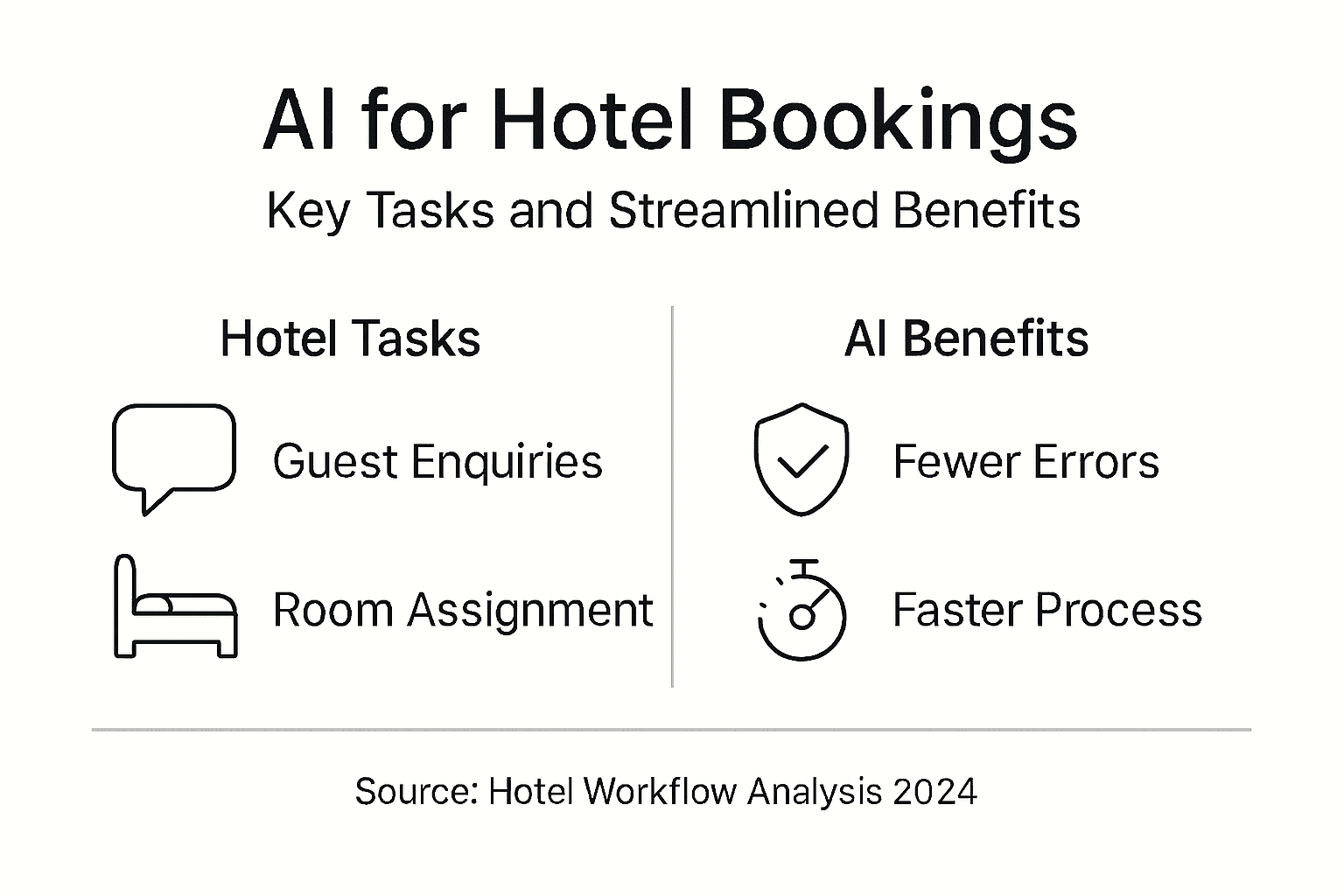
Here is a summary of how AI booking agents impact hotel operations:
| Area of Operation | Impact of AI Integration | Example Benefit |
|---|---|---|
| Administrative Tasks | Automation reduces manual effort | Less data entry for staff |
| Guest Communication | Faster, more consistent replies | 24/7 online booking response |
| Revenue Management | Dynamic pricing adjustments | Optimised room rates daily |
| Error Reduction | Automated checks and updates | Fewer double bookings |
Step 2: Select and configure an AI booking agent
Now that you understand your booking challenges, it’s time to choose an AI solution that matches your hotel’s needs. Selecting the right AI booking agent involves looking for systems that integrate seamlessly with your existing property management software and can handle your specific guest interaction patterns.
Start by evaluating what your AI agent needs to do. Intelligent virtual assistants that handle inquiries, check availability, and process reservations in real time should be your baseline expectation. Consider what matters most to your operation.
Key features to look for include:
- Real-time availability checking across all your platforms
- Ability to process complete bookings without human intervention
- Natural conversational interfaces that guests actually enjoy using
- Integration with your property management system for live data
- 24/7 operation without staff involvement
- Upselling capabilities for add-ons like room upgrades or parking
Configuration is where the real value emerges. Your AI agent must connect directly to your reservation software to pull accurate, live booking data. This integration prevents the frustrating situation where guests book something that’s already sold or receive outdated pricing information.
The best AI booking agent is worthless if it can’t talk to your existing systems.
Think about customisation too. Can you adjust how the AI responds to guests? Does it reflect your hotel’s tone and personality, or does it sound generic and robotic? Your agent represents your brand 24/7, so personality matters.
Consider starting with a solution that offers natural conversational interfaces for seamless guest interactions. This approach means guests feel they’re speaking with a helpful receptionist, not a machine, which boosts direct booking confidence.
Test the configuration thoroughly before going live. Run through typical guest scenarios: late-night booking enquiries, requests for special rooms, questions about cancellation policies. Make sure the AI handles edge cases gracefully rather than frustrating guests with robotic responses.
Pro tip: Start with a limited rollout—perhaps just your website enquiry form—before deploying the AI agent across all channels. This lets you refine how it interacts with your guests and iron out any integration issues with your property management system.
Step 3: Integrate AI with your booking platforms
Integration is where your AI booking agent truly comes to life. Without proper connection to your booking platforms, your AI will operate in isolation and create more problems than it solves. This step ensures your AI can access real-time data and synchronise information across all your channels.
Start by mapping which systems need to talk to each other. Your AI agent must connect with your property management system, reservation engine, and any third-party distribution channels you use. Real-time synchronisation of availability, pricing, and personalised guest communications prevents the chaos of overbooking or showing guests outdated rates.
The integration process typically involves these steps:
- Identify all your current booking systems and platforms
- Check which ones have API access or integration capabilities
- Test the connection between your AI agent and each system
- Verify that availability updates in real time across channels
- Confirm pricing changes sync instantly
- Run test bookings to ensure end-to-end accuracy
Data flow is critical. When a guest books through your AI agent, that reservation must immediately update in your property management system. When you change a room rate on your website, the AI must see that change instantly. Delays create double bookings and frustrated staff.
Broken integrations aren’t just inconvenient—they damage your reputation and cost money through overbooking penalties.
Staff training matters here too. Your team needs to understand how the AI connects to their daily workflows. They should know how to check AI-processed bookings in your system, how to handle exceptions, and what to do if the integration fails temporarily.
Consider how AI customer interaction impacts your sales conversion during integration. The AI should not just take bookings—it should gather guest preferences, suggest upgrades, and capture data that helps your team provide better service when guests arrive.
Test everything thoroughly in a safe environment before going live. Run multiple test bookings across different times and booking sources. Verify that your staff can see these bookings immediately and that pricing is accurate everywhere.
Pro tip: Ask your AI provider about their integration support and response times for technical issues. Integration problems can tank your booking revenue, so you need a partner with fast, reliable technical support available when you need it most.
Step 4: Test and refine the AI booking workflow
Before your AI booking agent handles real guest reservations, you need to test it thoroughly. This step ensures your automation delivers a smooth experience rather than frustrating guests or creating headaches for your staff. Testing catches errors early when they’re cheap to fix.
Start with rigorous regression testing of booking systems and end-to-end process validation to confirm every part of your workflow functions correctly. Test these critical scenarios first:
- A guest books a standard room with no add-ons
- A guest requests a room type you don’t have available
- A guest books during off-peak and peak pricing periods
- A guest books with a special request or question
- A guest attempts to book an already-sold room
- A guest cancels or modifies a booking
Run these tests across different times of day and booking channels. Test on your website, through email, and via any other platforms your AI handles. Each channel might behave slightly differently.
Monitor what actually happens during testing. Watch for booking confirmation delays, pricing errors, incorrect availability displays, or confusing AI responses. Document every issue you find, no matter how small.
A problem you catch in testing is a disaster you prevent in production.
Refinement comes next. Use feedback from your test bookings to improve how the AI responds. Does it sound natural or robotic? Does it answer guest questions clearly? Does it suggest upgrades without being pushy? Optimising AI responses for your team’s workflow ensures it actually helps rather than hinders.
Involve your staff in testing. They’ll spot issues a designer never would. They know how guest interactions really work in your hotel. Ask them what frustrates them about current booking processes and ensure the AI doesn’t create the same problems.
Once you’re live, continue monitoring. Track booking errors, guest complaints, and response times. Small refinements based on real usage data significantly improve performance over weeks and months.
Pro tip: Create a test booking log where you document what you tested, what worked, and what needed fixing. This record helps you troubleshoot future issues and proves to your team that testing actually identified real problems worth fixing.
Step 5: Monitor results and optimise performance
Your AI booking agent is now live, but the work doesn’t stop here. You need to monitor its performance continuously and refine it based on real data. This ongoing process transforms a good system into an excellent one that consistently delivers results.
Start by tracking the metrics that matter to your hotel. Occupancy forecasting, real-time pricing effectiveness, channel optimisation, and booking error reduction reveal whether your AI is actually solving the problems you identified in step one. Measure these key performance indicators weekly:
- Direct booking volume and percentage
- Average response time to booking enquiries
- Booking completion rate (enquiries that become actual reservations)
- Number of booking errors or system failures
- Guest satisfaction with the AI interaction
- Revenue per available room (RevPAR)
- Administrative time spent on booking tasks
Analyse the data your AI generates. AI-driven predictive analytics help anticipate demand fluctuations and adjust booking strategies accordingly. Look for patterns in when guests book, which room types sell fastest, and where pricing adjustments improve revenue.
Listen to guest feedback carefully. If multiple guests mention that the AI was confusing or unhelpful, that’s a refinement opportunity. Equally, positive feedback tells you what’s working well and should be emphasised.
Data without action is just noise. Use what you learn to make real improvements.
Refine your AI based on what you discover. If it’s making the same mistake repeatedly, adjust how it responds. If guests consistently ask questions it doesn’t answer well, improve its knowledge base. Small tweaks compound into significant performance gains over time.
Consider how balancing investment costs against operational savings affects your decision to expand AI capabilities. Once you see concrete returns from your booking agent, you might add AI to other tasks like email responses or guest queries.
Schedule regular reviews. Check your metrics monthly and compare them against your baseline from before implementing AI. Celebrate the wins, analyse the shortfalls, and plan refinements for the next month.
Pro tip: Set up a simple spreadsheet tracking your five most important metrics each week. This visual record makes performance trends obvious and helps you spot when something’s broken immediately rather than weeks later.
Transform Your Hotel Booking Experience with AI Agents
The article highlights common challenges such as managing manual booking errors, slow response times to guest enquiries, and difficulties in synchronising rates across channels. If you aim to reduce administrative tasks by up to 60% and provide guests with natural, seamless interactions, AI-powered booking agents can revolutionise your hotel operations. Our AI solutions specialise in delivering intelligent virtual assistants that speak in a natural tone, answer calls 24/7, respond to FAQs, and book qualified sales appointments, perfectly addressing these pain points.
Discover how our expertly configured AI agents integrate flawlessly with your current systems, offering real-time availability checks, dynamic pricing updates, and personalised guest communication. Explore real-world successes in AI hospitality technology through our AI Management Agency Case Studies: See AI Solutions in Action (2026).
Ready to streamline your booking workflow and enhance guest satisfaction today Then visit https://aimagency.co.uk to learn more about how our AI solutions can transform your hotel tasks. For strategic insights and future-proof marketing approaches, check out AI Marketing in 2026: Strategies, Case Studies & Solutions by Aimagency and start your journey towards smarter hospitality now.
Frequently Asked Questions
How can I assess my hotel’s booking management needs before implementing AI?
You should begin by identifying the specific challenges in your current booking process, such as manual errors or time spent on enquiries. Document your daily workflow and track the time spent on booking tasks to identify areas for optimisation.
What features should I look for in an AI booking agent?
Key features to consider include real-time availability checking, automated booking processing, and natural conversational interfaces. Ensure the AI can integrate seamlessly with your property management system to enhance guest interactions and streamline operations.
How do I integrate my AI booking agent with existing booking platforms?
To integrate your AI agent, identify the systems that need to connect, such as your property management system and distribution channels. Test the connection to ensure real-time updates for availability, pricing, and bookings to prevent errors like double bookings.
What are the critical tests I should run before launching my AI booking agent?
You should conduct rigorous testing on various scenarios, including standard bookings, cancellation requests, and peak pricing situations. This ensures the AI handles all potential guest interactions smoothly and is ready for live operations.
How can I monitor and optimise the performance of my AI booking agent?
Track vital metrics such as direct booking volume, response times, and booking error rates to evaluate performance. Regularly review this data and make adjustments to the AI’s responses based on guest feedback to enhance the booking experience and improve efficiency.
What initial improvements can I expect after implementing AI for bookings?
You can expect to reduce administrative time spent on booking tasks by approximately 40-60% and see an increase in direct bookings due to enhanced guest interactions. Set clear performance metrics to measure improvements within the first few weeks after implementation.
Recommended
- 6 Ways to Use AI in Customer Service List for Hotels – AI Management Agency
- 6 Essential AI Customer Interaction Tips for Boutique Hotels – AI Management Agency
- Role of AI in Sales Conversion for Hotels – AI Management Agency
- AI Voice Technology: Transforming Small Hotel Service – AI Management Agency