Only about 1 in 3 UK small businesses currently adopt AI as of 2025, creating a substantial competitive advantage for early adopters in hospitality. AI automation enables 24/7 personalized guest service, operational efficiency, and dramatic cost savings. This guide will help UK small hospitality businesses understand and apply AI automation successfully.
Table of Contents
- Introduction To AI Automation In Hospitality
- How AI Automation Enhances Customer Service
- Operational Efficiency And Cost Savings Through AI
- Common Misconceptions About AI Automation In Hospitality
- Framework For Implementing AI Automation In Small Hospitality Businesses
- Comparing AI Automation Solutions For Small Hospitality Businesses
- Bridging Understanding To Practical Application
- Discover AIM Agency’s AI Solutions For Hospitality
- Frequently Asked Questions
Key Takeaways
| Point | Details |
|---|---|
| Efficiency Gains | AI automation handles up to 80% of routine guest inquiries, freeing staff for complex tasks. |
| Personalization Boost | AI-driven personalization can increase customer satisfaction by up to 30% through data insights. |
| Cost Reduction | Implementing AI can reduce operational costs by 10–25% while maintaining human touch. |
| Job Security | AI supports rather than replaces hospitality staff, with 0% complete job displacement reported. |
| Implementation Path | A structured five-step framework helps small hospitality businesses adopt AI effectively. |
Introduction to AI Automation in Hospitality
AI automation transforms how small hospitality businesses interact with guests and manage operations. It encompasses tools like chatbots, virtual assistants, and AI receptionists that handle repetitive tasks without human intervention. For small UK hospitality businesses facing staffing challenges and rising costs, AI automation offers practical solutions.
Small hospitality operators struggle with limited staff handling bookings, answering FAQs, and managing guest communications around the clock. Traditional approaches leave gaps in service coverage, especially outside business hours. AI automation fills these gaps by providing instant responses and booking capabilities 24/7.
The competitive landscape is shifting. With only 33% of UK SMEs currently using AI, early adopters gain significant advantages. AI-powered chatbots and virtual assistants automate bookings, answer FAQs, and upsell services while freeing staff to focus on higher-value interactions.
Conversational AI interfaces and multilingual support improve guest experience by providing instant responses on popular platforms like WhatsApp and Messenger. This capability extends your service reach without proportional increases in staffing costs.
Key AI automation features for small hospitality firms include:
- 24/7 guest inquiry handling without human intervention
- Automated booking and reservation management
- Multilingual support for diverse guest demographics
- Intelligent FAQ responses based on common queries
- Upselling and cross-selling opportunities during interactions
- Seamless integration with existing booking systems
- Real-time data collection for optimising AI responses
Understanding the role of AI in small business customer service helps you identify which tasks to automate first. Start with high-volume, repetitive interactions that consume staff time without requiring emotional intelligence or complex problem-solving.
Pro Tip: Map your current guest interaction touchpoints before implementing AI. Identify which interactions are simple information requests versus those needing human empathy, then automate the former while preserving human attention for the latter.
How AI Automation Enhances Customer Service
AI transforms customer service by handling routine interactions that traditionally required staff attention. AI chatbots can handle up to 80% of routine guest inquiries automatically, from checking availability to explaining amenities. This automation doesn’t diminish service quality but rather enables faster, more consistent responses.
Guests benefit from immediate answers regardless of time or day. Automated messaging is among the top 3 technologies UK travelers expect, with response times cut by 50% compared to traditional methods. When a guest messages your restaurant at midnight asking about tomorrow’s opening hours, AI responds instantly rather than leaving them waiting until morning.
Personalization reaches new levels through AI’s data analysis capabilities. By examining booking history and preference patterns, AI tailors recommendations and communications to individual guests. A returning visitor might receive suggestions for new menu items similar to their previous orders, creating a more memorable experience.
Multilingual support removes language barriers that often challenge small hospitality businesses. AI handles inquiries in multiple languages seamlessly, expanding your potential guest base without hiring multilingual staff. This capability is especially valuable in diverse UK cities attracting international visitors.
The ways to use AI in customer service extend beyond basic FAQs:
- Instant booking confirmations and modifications
- Proactive service alerts about delays or changes
- Personalized upselling based on guest profiles
- Post-stay feedback collection and analysis
- Complaint triage and initial resolution attempts
- Special request logging and fulfillment tracking
Conversion rates improve when guests receive immediate, accurate responses during their decision-making process. AI in sales conversion for hotels demonstrates how reducing friction in the booking journey directly impacts revenue. A potential guest comparing multiple venues often books with whoever responds first and most helpfully.
Pro Tip: Design your AI conversational flows to recognize when escalation to human staff is needed. Complex complaints, emotional concerns, or unusual requests should trigger immediate handoff to preserve the personal touch that defines hospitality.
Operational Efficiency and Cost Savings Through AI
Labor costs continue rising across UK hospitality, with minimum wage increasing to £10/hr for 18-20-year-olds from April 2026 while average profit margins remain between 5-15%. These pressures force small operators to find efficiency gains without sacrificing service quality. AI automation offers a practical solution by handling tasks that traditionally consumed significant staff time.
Implementing AI for business efficiency typically reduces operational costs by 10-25% through task automation and improved resource allocation. The savings accumulate from multiple sources: reduced overtime, fewer administrative errors, and optimized staff deployment to high-value activities.
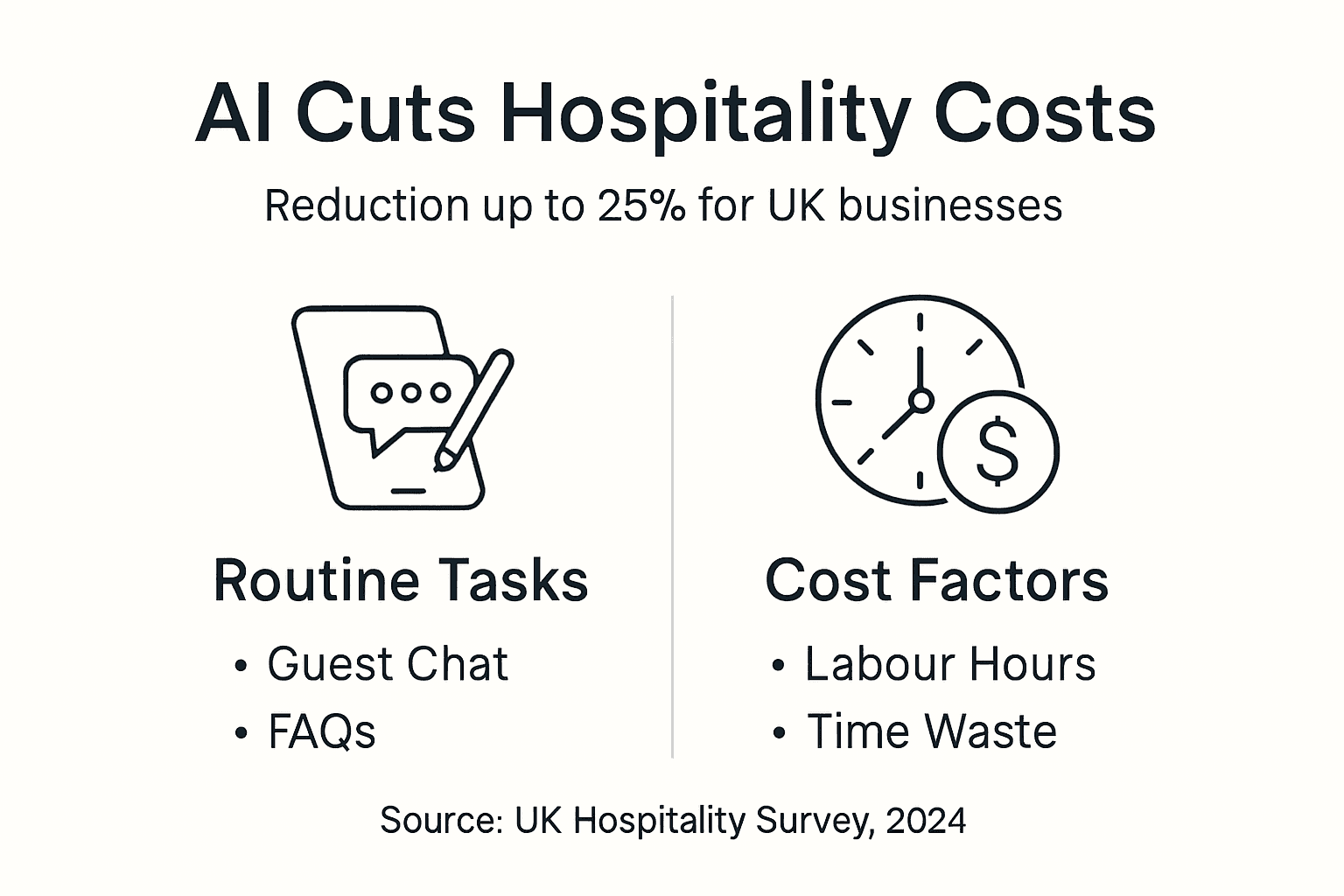
Time waste represents a hidden cost drain. Studies show that 286 hours annually are wasted on system switching, with integrated AI solutions reducing this by 30-50%. When staff toggle between reservation systems, payment platforms, and communication tools, productivity suffers. AI consolidates these touchpoints into streamlined workflows.
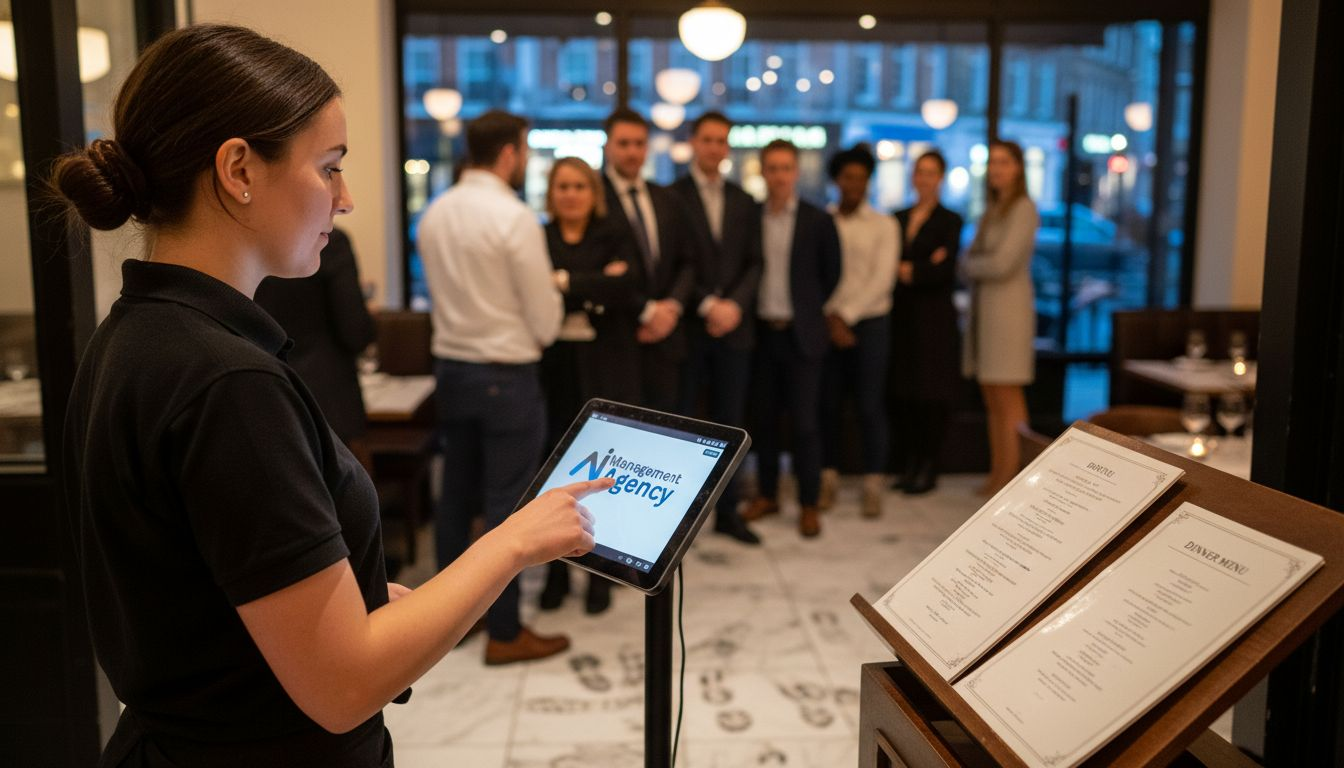
Consider how an AI receptionist for restaurants handles simultaneous tasks during peak hours. While your human host greets arriving guests, the AI manages phone inquiries, processes online bookings, and sends confirmation messages. This parallel processing capability effectively multiplies your front-of-house capacity without additional wages.
| Metric | Traditional Approach | AI-Enabled Approach | Improvement |
|---|---|---|---|
| Daily inquiry handling | 50-60 calls/bookings | 200-250 calls/bookings | 300% capacity |
| Average response time | 15-20 minutes | Under 1 minute | 95% faster |
| After-hours service | Voicemail only | Full service 24/7 | Infinite availability |
| Staff hours on admin | 20-25 hrs/week | 5-8 hrs/week | 70% reduction |
| Monthly labor cost | £2,000-£2,500 | £1,500-£1,875 | 25% savings |
| Booking error rate | 3-5% | Under 1% | 80% fewer errors |
The ROI timeline for AI implementation typically ranges from 6-12 months depending on business scale and automation scope. Initial setup costs are offset by immediate labor savings and increased booking conversions from improved responsiveness.
Pro Tip: Start by automating your most time-consuming manual processes first. Calculate current staff hours spent on tasks like answering common questions or managing reservations, then project savings from AI handling these automatically. This creates a clear business case for investment.
Common Misconceptions about AI Automation in Hospitality
Fears about AI replacing human hospitality staff persist despite evidence showing a different reality. Many small business owners hesitate to adopt AI due to misconceptions that don’t reflect actual implementation outcomes. Addressing these concerns directly helps you make informed decisions based on facts rather than fears.
The most prevalent myth is that AI eliminates hospitality jobs entirely. Hospitality experts agree AI supports human roles, with 0% complete job replacement but significant task automation. The distinction matters: AI handles repetitive, predictable tasks while staff focus on activities requiring emotional intelligence, judgment, and personal connection.
Another common concern is that AI depersonalizes guest interactions, creating robotic, cold experiences. In practice, well-implemented AI enhances personalization through data analysis and consistent service delivery. Guests receive faster responses and more relevant recommendations while still interacting with human staff for complex needs.
Cost concerns also deter adoption, with owners assuming AI requires massive investment beyond small business budgets. Modern AI solutions scale to different business sizes, with subscription models and clear ROI timelines making them accessible. The cost of not adopting AI may exceed implementation costs when you consider lost bookings and competitive disadvantages.
Key misconceptions versus reality:
- Misconception: AI replaces all front-of-house staff positions. Reality: AI handles administrative tasks, allowing staff to focus on guest experience and relationship building.
- Misconception: AI is too expensive for small hospitality businesses. Reality: Scalable solutions with 6-12 month ROI make AI accessible across business sizes.
- Misconception: Guests prefer human interaction and dislike AI responses. Reality: Guests value speed and accuracy; they appreciate instant AI responses for simple queries while human staff handle complex needs.
- Misconception: AI implementation is technically complex and disruptive. Reality: Modern AI tools integrate with existing systems with minimal disruption and include implementation support.
- Misconception: AI makes impersonal recommendations that miss guest preferences. Reality: AI analyzes guest data more comprehensively than humans can, enabling highly personalized suggestions.
Understanding the role of AI in small business hospitality means recognizing it as a support tool rather than a replacement. Your staff’s hospitality skills remain irreplaceable for creating memorable experiences, resolving conflicts, and building guest loyalty. AI simply removes the burden of repetitive tasks that prevent staff from applying those skills fully.
The competitive reality is that businesses adopting AI gain advantages while those avoiding it fall behind in efficiency and guest satisfaction. Misconceptions shouldn’t prevent you from exploring how AI might strengthen rather than threaten your hospitality operation.
Framework for Implementing AI Automation in Small Hospitality Businesses
Successful AI adoption requires a structured approach rather than random tool deployment. The AI Automation Maturity Framework provides five progressive stages that guide small hospitality businesses from initial awareness through full optimization. Understanding where you are in this journey helps you take appropriate next steps.
The framework stages are:
- Awareness: Recognizing AI automation potential and learning about available solutions
- Exploration: Testing specific tools through pilots and evaluating fit with business needs
- Implementation: Deploying chosen AI solutions and training staff on usage
- Integration: Connecting AI with existing systems for seamless workflows
- Optimization: Continuously improving AI performance based on data and feedback
Most small hospitality businesses currently sit in Awareness or early Exploration stages. Moving through these stages systematically prevents common pitfalls like adopting inappropriate tools or facing staff resistance.
Practical implementation steps:
- Identify your highest-pressure tasks consuming disproportionate staff time. Common targets include booking management, inquiry responses, and reservation modifications.
- Choose AI tools matching those specific needs rather than general-purpose solutions. An AI receptionist for restaurants differs from hotel chatbots in functionality and integration requirements.
- Train staff thoroughly on AI collaboration, emphasizing that tools augment rather than replace their roles. AI receptionist training includes teaching staff when to let AI handle interactions versus when to intervene.
- Monitor AI performance through metrics like response accuracy, guest satisfaction scores, and conversion rates. Staff training and regular monitoring are critical for balancing AI with human interaction.
- Optimize continuously by analyzing conversation logs, adjusting responses based on guest feedback, and expanding AI capabilities as comfort grows.
Common pitfalls and how to avoid them:
- Insufficient staff training: Dedicate time to hands-on practice rather than just explanatory sessions. Staff need to experience how AI supports their work.
- Ignoring business-specific needs: Generic AI solutions miss industry nuances. Ensure your chosen tools understand hospitality workflows and terminology.
- Poor change management: Introduce AI gradually rather than wholesale replacement. Start with one department or function, demonstrate success, then expand.
- GDPR non-compliance: Verify that AI tools handle guest data according to UK privacy regulations. Data collection and storage must meet legal requirements.
- No clear success metrics: Define measurable goals before implementation so you can objectively assess whether AI delivers promised benefits.
Balance remains essential. AI excels at consistency and availability but lacks the warmth and flexibility that define excellent hospitality. Your implementation should preserve opportunities for human staff to create memorable guest moments while AI handles the routine groundwork that makes those moments possible.
Comparing AI Automation Solutions for Small Hospitality Businesses
Selecting the right AI tool requires understanding how different solutions match specific operational needs. Three primary categories serve small hospitality businesses: AI chatbots, AI receptionists, and AI voice agents. Each offers distinct capabilities, costs, and integration complexity.
| Solution Type | Core Capabilities | Typical Monthly Cost | Best Operational Fit | Typical ROI Timeline |
|---|---|---|---|---|
| AI Chatbot | Text-based messaging on websites and social platforms; FAQ responses; basic booking | £50-£150 | Small cafes, single-location pubs with primarily web traffic | 6-9 months |
| AI Receptionist | Phone and message handling; appointment booking; guest screening; CRM integration | £200-£400 | Restaurants, boutique hotels, venues needing full communication coverage | 8-12 months |
| AI Voice Agent | Natural conversation; complex inquiry handling; multilingual phone support; sentiment analysis | £300-£600 | Multi-location businesses, high-volume booking operations, premium service brands | 10-14 months |
AI chatbots suit businesses where guests primarily interact through websites or social media. If most inquiries come via Facebook Messenger or your booking page, a chatbot handles these efficiently. Implementation is straightforward, requiring minimal technical integration. However, chatbots struggle with complex conversations and phone interactions.
AI receptionist solutions for hospitality offer broader coverage by handling both digital messages and phone calls. For restaurants where phone bookings remain common, this hybrid capability proves essential. Hotel AI receptionist options typically include property management system integration, allowing real-time availability checks and automatic reservation logging.
AI voice agents provide the most sophisticated interactions, conducting natural phone conversations that guests often cannot distinguish from human staff. These agents excel at gathering detailed information, handling objections, and adapting responses based on conversation flow. The higher cost reflects advanced natural language processing and customization.
Integration complexity varies significantly. Chatbots often operate as standalone tools with simple website embedding. AI receptionists require connections to booking systems, calendars, and possibly payment processors. Voice agents need telephony integration and may require custom scripting for your specific workflows.
Customization depth matters for hospitality businesses with unique processes. Can the AI learn your specific menu items, room types, or service packages? Does it understand your pricing structure and promotional offers? Generic solutions work for basic needs, but customized AI handles nuanced conversations more effectively.
Consider your business scale when evaluating tools. A single-location café with 30-40 daily inquiries has different needs than a restaurant group managing 200-300 daily interactions across multiple venues. Volume directly impacts which solution provides the best cost-to-benefit ratio.
Most providers offer trial periods allowing you to test functionality before committing. Use these trials to evaluate response quality, integration smoothness, and staff comfort levels. The best technical solution fails if your team resists using it.
Bridging Understanding to Practical Application
AI automation delivers measurable benefits for small UK hospitality businesses willing to adopt thoughtfully. Cost savings of 10-25%, combined with improved guest satisfaction and 24/7 service availability, create compelling business cases. The question shifts from whether to adopt AI to how to implement it effectively.
Your decision criteria should prioritize three factors: ease of integration with existing systems, total cost including setup and monthly fees, and interaction quality that reflects your brand’s hospitality standards. Tools that excel in all three areas justify higher investment through faster returns and fewer operational headaches.
Clear next steps guide you from consideration to implementation:
- Conduct an honest business needs analysis identifying which tasks create the most pressure or consume excessive staff time.
- Choose a pilot AI tool addressing your highest-priority need, starting small rather than attempting comprehensive automation immediately.
- Train staff thoroughly on AI collaboration, emphasizing how automation frees them for more rewarding guest interactions.
- Monitor results closely through guest feedback, staff input, and measurable metrics like response times and booking conversions.
- Optimize based on data, adjusting AI responses and expanding capabilities as you gain confidence and identify new opportunities.
A phased approach balances innovation with operational stability. Implementing AI across all touchpoints simultaneously risks disruption and staff overwhelm. Success comes from demonstrating value in one area, then expanding to others once processes are refined.
What most small hospitality businesses miss in early AI projects:
- Insufficient staff buy-in: Technology works only when people use it properly. Involve staff in solution selection and address concerns proactively.
- Neglecting data compliance: GDPR requirements apply to AI-collected guest information. Ensure your chosen tools handle data legally and transparently.
- Unrealistic expectations: AI improves efficiency and consistency but cannot solve deeper operational or service design problems.
- Ignoring guest preferences: Some guest segments prefer human interaction for all touchpoints. Provide options rather than forcing AI-only paths.
- Poor ongoing management: AI requires continuous refinement based on conversation analysis and changing guest needs.
The AI automation insights for business owners emphasize that successful adoption combines technology with human judgment. AI handles predictable tasks brilliantly but lacks the creativity and empathy that define exceptional hospitality experiences. Your role is orchestrating this partnership for optimal results.
Competitive pressure will intensify as more hospitality businesses adopt AI. Early movers gain experience and optimization advantages while competitors still evaluate options. The window for competitive differentiation through AI adoption remains open but narrows as adoption accelerates industry-wide.
Discover AIM Agency’s AI Solutions for Hospitality
AIM Agency specializes in creating AI agents that transform how small UK hospitality businesses handle guest communications and bookings. Our AI receptionist for restaurants speaks in natural tones, answers calls 24/7, responds to FAQs accurately, and books qualified appointments without human intervention. This reduces administrative burden while improving guest experience through instant, consistent responses.
Small hospitality operators gain immediate benefits from our tailored solutions. Whether you run a boutique hotel, restaurant, or multi-location hospitality group, our AI call handling solutions scale to your specific needs and integrate seamlessly with existing booking systems. You maintain full control over conversation flows and responses while AI handles the execution.
Our approach focuses on preserving your brand’s unique hospitality character while automating routine interactions. The AI receptionist doesn’t replace your staff’s warmth and judgment but frees them to focus on creating memorable guest experiences rather than answering the same questions repeatedly.
Contact AIM Agency to discuss how customized AI automation can reduce your operational costs, improve booking conversions, and enhance guest satisfaction. We provide implementation support, staff training, and ongoing optimization to ensure your AI solution delivers measurable ROI within 6-12 months.
Frequently Asked Questions
What is AI automation in hospitality and how does it work?
AI automation uses software like chatbots and virtual assistants to handle guest communications, bookings, and routine inquiries without human intervention. These tools analyze guest data, learn from interactions, and engage customers 24/7 across multiple platforms including phone, website, and messaging apps. The technology improves efficiency by managing predictable tasks while staff focus on complex guest needs.
Can small hospitality businesses afford AI automation?
AI tools are increasingly affordable with scalable solutions designed specifically for small operations. Many providers offer subscription models starting from £50-£150 monthly for basic chatbots and £200-£400 for comprehensive AI receptionists. ROI typically occurs within 6-12 months through labor savings, increased bookings from improved responsiveness, and reduced administrative errors.
Will AI replace human staff in hospitality?
AI automates routine tasks but does not replace the emotional intelligence, judgment, and personalized guest interactions that human staff provide. Research shows 0% complete job displacement from AI adoption in hospitality. Instead, AI handles repetitive inquiries and bookings while staff focus on creating memorable experiences and resolving complex situations that require human empathy.
How can I start implementing AI automation in my small hospitality business?
Begin by identifying tasks creating the most pressure, such as booking management and FAQ responses. Select AI tools specifically addressing those needs, then train your staff on collaboration rather than replacement. Start with a pilot project in one area, monitor performance through guest feedback and metrics, and optimize continuously. A phased approach prevents disruption while demonstrating clear value before expanding to additional functions.
Recommended
- AI for Business Owners: Transforming UK Hospitality – AI Management Agency
- How to Optimise AI Responses for Small Hospitality Teams – AI Management Agency
- AI Management Agency: Discover AI Success with Our Case Studies & Results
- Train AI Agents: Cut Errors 30% in 12 Weeks for UK SMEs – AI Management Agency