Small UK hotels face rising labour costs, fierce competition from OTAs, and unpredictable demand patterns that squeeze profit margins. AI technology offers a practical path to increase direct bookings by up to 25%, improve guest service around the clock, and free your team from repetitive tasks. This guide shows how small hotels can leverage AI for competitive advantage and operational efficiency, delivering measurable revenue growth without massive investment.
Table of Contents
- Why AI Matters For Small UK Hotels
- Prerequisites: Preparing Your Hotel For AI Implementation
- Step 1: Implement AI-Driven Dynamic Pricing And Revenue Management
- Step 2: Deploy AI Receptionists And Automated Booking Agents
- Step 3: Enhance Guest Experience With AI Personalisation
- Troubleshooting And Common Mistakes In AI Adoption
- Expected Results And Measurable Outcomes
- Future Trends: Advanced And Agentic AI In Hospitality
- Discover AI Solutions Tailored For UK Hotels
Key takeaways
| Point | Details |
|---|---|
| AI dynamic pricing | Real-time rate adjustments can boost revenue by 10-25% within 12 months |
| 24/7 AI receptionists | Instant guest responses increase booking conversion by up to 15% |
| Personalised experiences | AI-driven guest preferences raise satisfaction scores by 20% and loyalty |
| Data and integration | Clean data and connected systems are critical prerequisites for AI success |
| Compliance and training | GDPR adherence and staff education ensure smooth AI adoption |
Why AI matters for small UK hotels
UK hospitality operators contend with escalating energy bills, wage inflation, and mounting pressure from online travel agencies. Traditional manual processes cannot match the speed and precision required to optimise pricing, respond to guest queries instantly, or personalise every interaction. AI adoption is accelerating across the sector as hotels discover measurable gains in efficiency and revenue.
Small properties benefit disproportionately because AI levels the playing field. You gain the same real-time pricing intelligence, round-the-clock guest service, and data-driven insights previously reserved for large chains. Understanding the role of AI agents explained helps clarify how these tools operate autonomously to handle guest interactions and booking workflows.
Key advantages for small UK hotels include:
- Automated revenue management that adjusts rates based on demand, competitor pricing, and booking patterns
- Virtual receptionists that field inquiries, answer FAQs, and capture bookings 24/7 without additional staffing
- Personalised guest communication that increases repeat bookings and positive reviews
- Operational cost savings by reducing manual administrative tasks
Exploring the role of AI in call centres reveals similar principles applied to guest communication, where AI handles routine queries and escalates complex issues to human staff.
Prerequisites: preparing your hotel for AI implementation
Successful AI deployment depends on foundational work completed before you activate any tools. Clean and structured data is the foundation for accurate AI processing. Inconsistent guest records, fragmented booking data, or outdated property management system entries will produce unreliable AI outputs.
Start by auditing your data quality. Ensure guest profiles, booking histories, and room inventories are current, complete, and formatted consistently. AI systems require machine-readable information to generate accurate recommendations and responses.
Integration across your property management system, customer relationship management platform, and booking engine is equally vital. AI tools extract value by connecting data silos. A unified view of occupancy, guest preferences, and revenue streams enables dynamic pricing and personalised service.
Staff training and ethical considerations including GDPR compliance are essential for responsible AI use. Your team must understand how AI tools function, when to override automated decisions, and how to safeguard guest privacy. GDPR mandates explicit consent for data processing, transparent communication about AI use, and robust security measures.
Critical preparation steps:
- Cleanse and standardise all guest and booking data across systems
- Integrate your PMS, CRM, and channel manager for seamless data flow
- Conduct staff training sessions on AI tool capabilities and limitations
- Establish GDPR-compliant data handling policies and consent mechanisms
- Document your AI implementation plan with clear responsibilities and timelines
Pro Tip: Appoint an AI champion within your team, someone enthusiastic about technology who can troubleshoot issues and encourage adoption among colleagues.
Review resources like AI for business owners UK hospitality to understand strategic planning and change management best practises.
Step 1: implement AI-driven dynamic pricing and revenue management
AI pricing models continuously analyse market conditions, competitor rates, local events, and historical booking patterns to recommend optimal room prices. Dynamic pricing can improve revenue by 10-25% within the first 12 months by capturing demand peaks and filling inventory during slower periods.
Technical requirements include real-time data feeds from your property management system, competitor rate monitoring tools, and market demand indicators. The AI engine processes this information to adjust pricing automatically or suggest rate changes for manual approval.
Implementation follows these steps:
- Select an AI revenue management platform compatible with your existing PMS and booking channels
- Configure data connections to supply occupancy levels, booking pace, and revenue targets
- Set pricing boundaries such as minimum acceptable rates and maximum increases
- Run the AI in recommendation mode for two weeks to validate suggestions before enabling automated adjustments
- Monitor performance metrics including RevPAR, occupancy rates, and average daily rate weekly
- Refine AI parameters based on actual outcomes and seasonal patterns
Expected results vary by property size and market conditions:
| Metric | Baseline | After AI Implementation |
|---|---|---|
| Revenue per available room | £65 | £75-£80 |
| Occupancy rate | 68% | 72-75% |
| Average daily rate | £95 | £105-£115 |
| Manual pricing time | 8 hours/week | 1 hour/week |
Pro Tip: Start with shoulder seasons when demand is unpredictable. AI shines in volatile conditions where manual pricing struggles to keep pace with rapid market shifts.
Explore detailed guidance in this AI-powered revenue management guide and connect pricing strategies with broader AI in sales conversion hotels tactics.
Step 2: deploy AI receptionists and automated booking agents
AI receptionists provide instant responses to guest inquiries around the clock, eliminating wait times and capturing bookings when human staff are unavailable. AI-powered virtual receptionists can increase booking conversion rates by up to 15% with instant responses, particularly for late-night or early-morning queries when potential guests research accommodation.
These systems handle frequently asked questions about amenities, check-in times, pet policies, and local attractions. They escalate complex requests or complaints to human team members, ensuring guests receive appropriate attention whilst reducing routine workload.
Key benefits include:
- 24/7 availability captures bookings outside traditional reception hours
- Instant response times improve guest satisfaction and reduce bounce rates
- Multilingual support accommodates international visitors without additional staffing
- Consistent brand voice and accurate information across all guest interactions
- Automated booking confirmations, pre-arrival communications, and upsell prompts
Implementation requires selecting an AI receptionist platform that integrates with your booking engine and property management system. Natural language processing capabilities enable the AI to understand guest intent even when queries are phrased informally or contain typos.
Vendor considerations include data security standards, customisation options for your brand tone, and the escalation workflow for complex issues. Test the AI receptionist thoroughly with common and unusual queries before launching to guests.
Learn more about AI in customer service for hotels and practical deployment guidance in using AI for bookings hotel. Additional insights appear in this AI agents for hotels resource.
Step 3: enhance guest experience with AI personalisation
AI unifies data from your property management system, customer relationship management platform, and loyalty programme to construct comprehensive guest profiles. Personalisation-driven guest satisfaction scores can increase by 20%, leading to higher repeat bookings and positive online reviews.
The AI analyses past stays, dining preferences, room choices, and service requests to anticipate needs before guests articulate them. A returning guest who previously requested extra pillows receives them automatically. A couple celebrating an anniversary finds a personalised welcome note and complimentary champagne.
Pre-arrival communications become tailored experiences. AI sends relevant recommendations for spa treatments, restaurant reservations, or local tours based on guest interests gleaned from previous interactions. During the stay, the system adjusts room temperature, lighting, and entertainment preferences automatically.
Upselling opportunities emerge naturally when AI identifies guest interests. A business traveller who frequently uses meeting rooms receives an offer for a discounted conference package. Families with children learn about kids’ activity programmes and babysitting services.
Implementation steps:
- Consolidate guest data from all touchpoints into a unified CRM platform
- Configure AI algorithms to identify patterns and preferences across guest histories
- Establish automated workflows for personalised pre-arrival emails, in-stay adjustments, and post-departure follow-ups
- Train staff to act on AI-generated insights and override recommendations when appropriate
- Monitor guest feedback to validate that personalisation enhances rather than intrudes on the experience
Discover more about AI receptionist hotels capabilities and review AI customer interaction tips for boutique properties. Additional context appears in this AI hotel industry benefits article.
Troubleshooting and common mistakes in AI adoption
Up to 40% of AI projects fail due to fragmented data and inadequate change management. Small UK hotels can avoid these pitfalls by addressing common mistakes proactively.
Poor data hygiene produces unreliable AI outputs. Garbage in, garbage out applies ruthlessly to AI systems. Invest time cleansing records before deploying AI tools. Inconsistent guest names, duplicate profiles, or outdated contact information undermine personalisation and booking automation.
Siloed systems prevent AI from accessing the comprehensive data it requires. If your property management system, booking engine, and customer relationship platform do not communicate, AI cannot deliver integrated insights. Prioritise integration over adding new tools.
Insufficient staff training breeds resistance and misuse. Team members who do not understand AI capabilities either ignore the technology or trust it blindly without applying critical judgment. Conduct hands-on training sessions and establish clear protocols for when to override AI recommendations.
Ignoring GDPR compliance risks substantial fines and reputational damage. Ensure you obtain explicit consent for AI-driven data processing, provide transparent explanations of how AI uses guest information, and implement robust security measures.
Common fixes:
- Dedicate resources to data cleansing before launching AI initiatives
- Invest in middleware or API integrations to connect disparate systems
- Schedule regular training refreshers and create an internal AI knowledge base
- Audit GDPR compliance quarterly and update consent mechanisms as AI capabilities expand
- Appoint a project manager responsible for change management and stakeholder communication
Pro Tip: Run a pilot programme with one AI tool in a limited capacity before scaling. Test dynamic pricing on 20% of your inventory or deploy an AI receptionist for after-hours inquiries only. Learn from small-scale deployment before committing fully.
“The hotels that succeed with AI treat it as a strategic transformation, not a technology purchase. They invest in people, processes, and data quality alongside the software.”
Revisit foundational guidance in AI for business owners UK hospitality and explore industry perspectives in this AI trends in hotels 2026 report.
Expected results and measurable outcomes
Small UK hotels typically observe noticeable sales uplift within three to six months of AI implementation. The timeline depends on data readiness, integration complexity, and staff adoption rates. Properties with clean data and enthusiastic teams see results faster.
Revenue increases of 10 to 25% are common through dynamic pricing optimisation and improved occupancy rates. Booking conversion improvements of up to 15% result from AI receptionists responding instantly to guest inquiries. Guest satisfaction gains around 20% emerge when personalised AI experiences enhance stays.
Operational efficiency improves as AI handles repetitive tasks. Manual pricing time drops from eight hours weekly to one hour. Routine guest queries are resolved instantly without staff intervention. Administrative workload decreases, allowing your team to focus on high-value guest interactions and service delivery.
| Outcome | Timeline | Expected Improvement |
|---|---|---|
| Revenue per available room | 3-6 months | 10-25% increase |
| Booking conversion rate | 1-3 months | 10-15% increase |
| Guest satisfaction score | 3-6 months | 15-20% increase |
| Staff time on admin tasks | 1-2 months | 40-60% reduction |
| Direct booking percentage | 6-12 months | 15-30% increase |
Track key performance indicators monthly to validate AI impact. Compare revenue per available room, occupancy rates, average daily rate, and guest review scores against baseline periods. Monitor booking source mix to confirm growth in direct bookings versus OTA dependence.
Review AI in sales conversion hotels for additional metrics and benchmarking approaches.
Future trends: advanced and agentic AI in hospitality
Generative AI tools like chatbots and content generators represent the current wave of automation. Agentic AI can reduce manual tasks by up to 50% and offers autonomous decision-making, marking the next evolution. Agentic AI systems act independently to achieve goals, not merely respond to prompts.
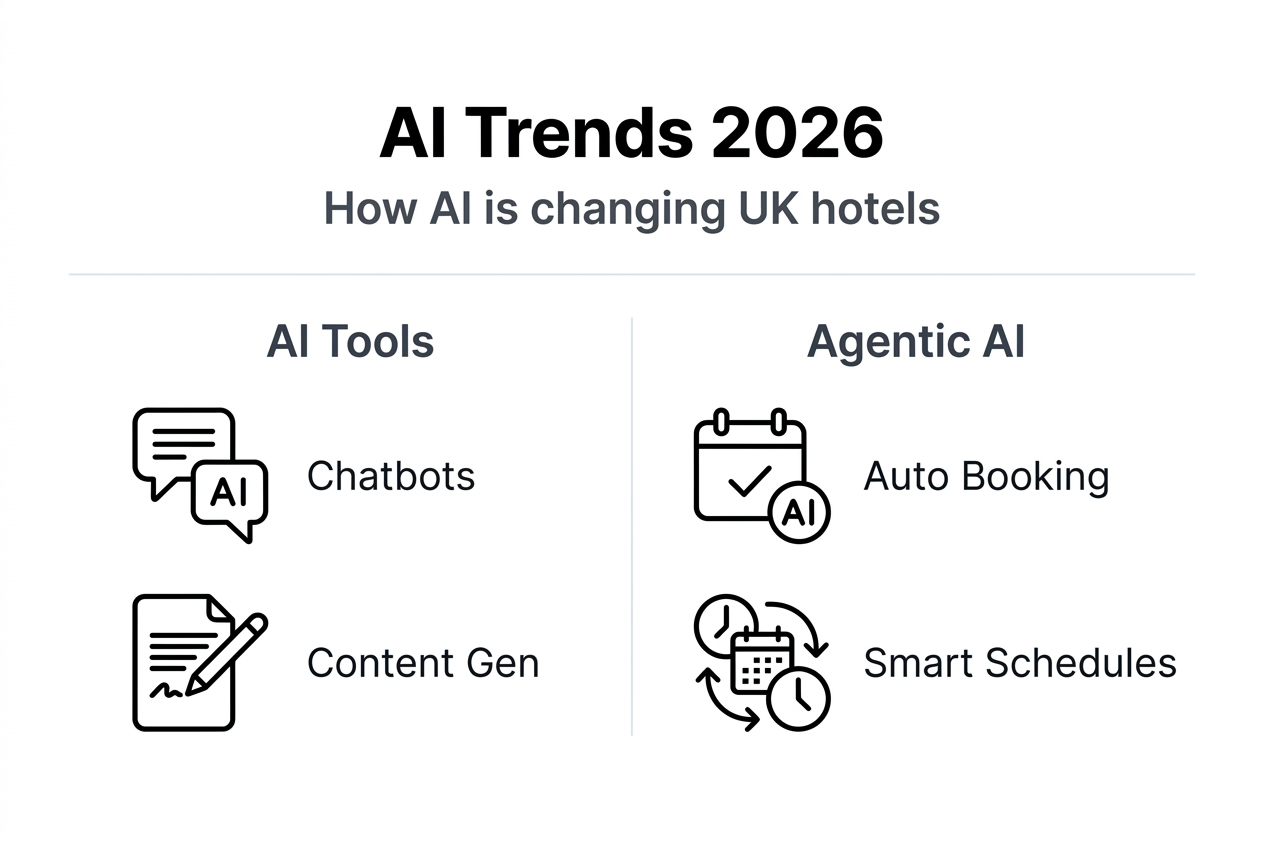
In hospitality, agentic AI could autonomously negotiate group booking contracts, optimise housekeeping schedules based on real-time occupancy changes, or coordinate with suppliers to manage inventory without human oversight. These systems learn continuously, adapting strategies based on outcomes.
Small UK hotels should monitor agentic AI developments whilst focusing on current implementations. Establish a foundation with dynamic pricing, AI receptionists, and personalisation tools. As agentic capabilities mature and become affordable, your data infrastructure and team experience will position you to adopt advanced systems smoothly.
Strategic planning considerations:
- Stay informed about agentic AI advancements through hospitality technology publications and vendor roadmaps
- Build data quality and integration foundations now to support future AI capabilities
- Cultivate a culture of continuous learning and technology experimentation within your team
- Evaluate ROI rigorously before adopting bleeding-edge technologies, balancing innovation with practical business needs
Explore the distinctions in agentic AI vs AI automation and review this agentic AI in hospitality 2026 analysis for deeper context.
Discover AI solutions tailored for UK hotels
Small UK hotels need AI technology that integrates seamlessly with existing systems and delivers measurable results without overwhelming your team. AI Management Agency specialises in creating high-quality AI agents that handle tasks like answering calls 24/7, responding to FAQs, and booking qualified sales appointments.
Our AI receptionist solutions speak in a natural tone, providing the round-the-clock guest service that increases booking conversions by up to 15%. Explore how role of AI agents explained 30 bookings UK hospitality demonstrates practical implementations tailored for the UK market. Discover specialised tools at AI receptionist hotels and learn about broader AI-driven solutions for sales and marketing designed specifically for hospitality operators seeking competitive advantage.
FAQ
What types of AI tools are most effective for small UK hotels?
Dynamic pricing systems, AI receptionists, and guest personalisation platforms deliver the strongest returns for small properties. These tools address critical pain points like revenue optimisation, 24/7 guest service, and loyalty building. Choosing solutions compatible with your existing AI receptionist hotels infrastructure and reviewing AI in sales conversion hotels strategies ensures smooth integration and rapid results.
How long does it take to see sales results after AI implementation?
Most small hotels observe booking increases and revenue gains within three to six months of deploying AI tools. The timeline depends on data quality, system integration complexity, and staff adoption. Properties that invest in thorough preparation, including data cleansing and team training, accelerate results and achieve the upper end of expected performance improvements.
What are common mistakes to avoid when adopting AI in hotels?
Fragmented data and siloed systems undermine AI accuracy and limit its effectiveness. Ensure your property management system, booking engine, and customer relationship platform communicate seamlessly. Insufficient staff training leads to resistance or misuse of AI tools. Invest in hands-on education and establish clear protocols for when human judgment should override AI recommendations. Maintain strict GDPR compliance by obtaining explicit consent, providing transparent communication about AI use, and implementing robust security measures to protect guest information.
Is AI cost-effective for small hotels with limited budgets?
Moderate AI investments generate substantial returns through 10 to 25% revenue uplifts and operational efficiency gains. Starting with a focused deployment like an AI receptionist can boost booking conversions by up to 15% with minimal ongoing costs. Many AI platforms offer tiered pricing that scales with property size, making enterprise-grade technology accessible to small operators. Prioritise tools that integrate with existing systems to avoid costly infrastructure overhauls.