TL;DR:
- AI receptionists are transforming small UK businesses by providing 24/7, cost-effective, and consistent front-of-house services. They handle routine inquiries, bookings, and client communication, leading to higher response rates and improved guest satisfaction. Early adoption offers a competitive edge, with measurable savings and enhanced operational efficiency for hotels, legal firms, and SMEs.
Small businesses and hotels across the UK have long assumed that truly seamless, 24/7 reception is a luxury only large corporations can afford. That assumption is now outdated. AI receptionists are reshaping what is possible for independent firms, boutique hotels, and growing SMEs, delivering professional, natural-sounding service around the clock at a fraction of traditional staffing costs. This article breaks down exactly what AI receptionists do, what measurable results businesses are seeing, and how you can implement one with confidence.
Table of Contents
- What is an AI receptionist?
- Top benefits of AI receptionists for small businesses
- AI for hotels: transforming guest experience and operations
- Common challenges and practical tips for a smooth AI receptionist rollout
- Why most small businesses underestimate the value of AI receptionists
- Enhance your business with AI: next steps
- Frequently asked questions
Key Takeaways
| Point | Details |
|---|---|
| Save on staffing costs | AI receptionists can cut expenses by up to 60% for small UK businesses. |
| Improve efficiency and availability | AI systems provide 24/7 service, reducing missed calls and bookings. |
| Boost guest satisfaction | Hotels see more bookings and happier guests thanks to seamless AI service. |
| Easier scaling | AI receptionists make it simple to handle growth and seasonal business changes. |
What is an AI receptionist?
An AI receptionist is a software agent designed to handle the front-of-house communication tasks that a human receptionist would typically manage. That includes answering incoming calls, responding to frequently asked questions, booking appointments, and routing urgent enquiries to the right team member.
What separates today’s AI receptionists from older automated phone systems is the quality of the conversation. Modern AI receptionists use advanced voice, chat, and appointment-scheduling technologies to streamline front-of-house operations in a way that feels natural rather than robotic. Callers are not pressing numbers on a dial pad. They are having a genuine, flowing conversation.
The technologies behind this capability include:
- Natural language processing (NLP): Allows the AI to understand what someone is saying, even if they phrase a question in an unusual way
- Machine learning: Enables the AI to improve its responses over time based on past interactions
- Integration with scheduling tools: Connects directly to your calendar or booking system so appointments are confirmed in real time
- CRM compatibility: Links with your customer relationship management system to personalise greetings and retain context across multiple calls
The range of industries already using this technology is growing fast. Hotels are deploying AI for hotel reception to manage guest enquiries and room bookings outside of staffed hours. Law firms are using AI in legal reception to handle client intake calls, qualify enquiries, and schedule consultations without tying up fee earners. The principle is the same across sectors: let the AI handle the routine communication so your team can focus on higher-value work.
Pro Tip: When setting up your AI receptionist, invest time in building a thorough FAQ library. The more accurately you capture how real clients phrase their questions, the more naturally your AI will respond from day one.
Top benefits of AI receptionists for small businesses
Once you understand what an AI receptionist actually does, the business case becomes very clear. The advantages are not just about novelty. They translate directly into measurable improvements across cost, availability, and service consistency.
At a glance: AI vs traditional reception
| Factor | AI receptionist | Traditional receptionist |
|---|---|---|
| Monthly cost | Low fixed subscription | Salary, NI, holiday, sick pay |
| Availability | 24 hours, 7 days a week | Typically 9am to 5pm |
| Onboarding time | Hours to days | Weeks to months |
| Error rate | Consistently low | Variable, higher under pressure |
| Scalability | Instant, no hiring delays | Requires recruitment and training |
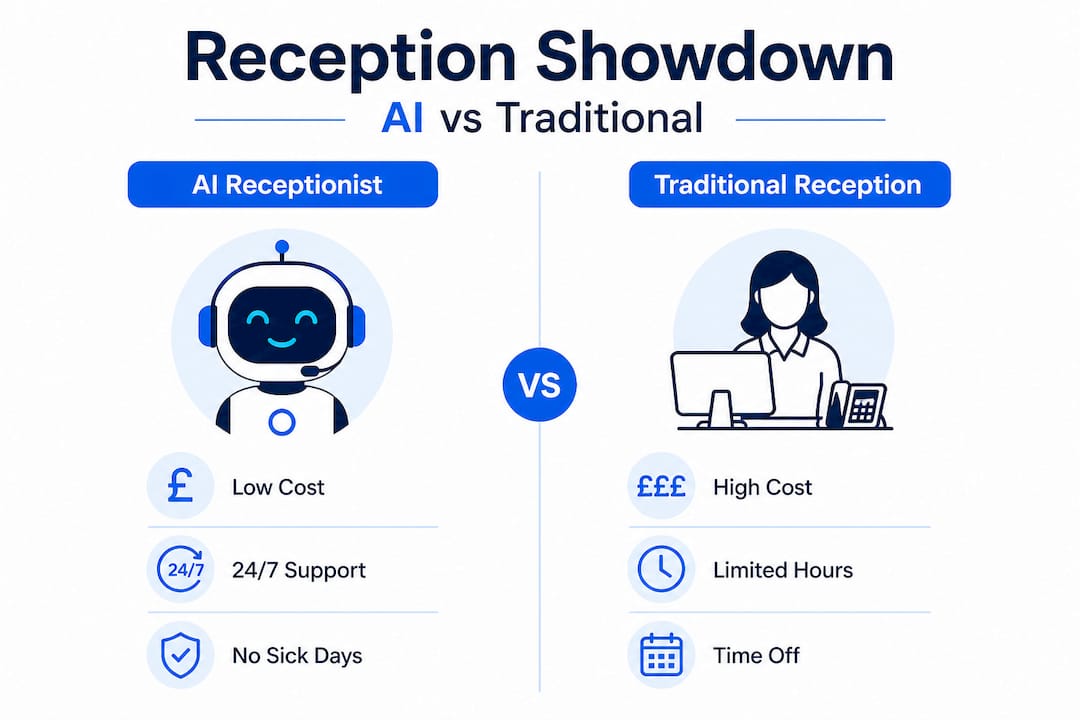
The difference in running costs alone is significant. Switching to AI can cut costs by up to 60% compared to staffed receptionists for UK SMEs. For a small business paying a full-time receptionist, that saving can be reinvested directly into growth.
Key benefits for small UK businesses
-
Dramatically lower overheads. No salary, no employer National Insurance contributions, no sick days, no annual leave. The fixed cost of an AI receptionist is predictable and manageable, even for a sole trader or micro-business.
-
True 24/7 availability. A caller who rings at 8pm on a Friday gets the same quality of service as one who rings at 10am on a Tuesday. No more missed enquiries from people who cannot call during office hours.
-
Higher call answer rate. Human receptionists can only handle one call at a time. An AI system handles multiple simultaneous calls, meaning no caller hears an engaged tone or gets sent to voicemail during a busy period.
-
Consistent brand experience. Every caller receives the same professional, on-brand greeting and tone. There is no variation caused by a rushed morning or a difficult previous call.
-
Faster scaling. When your business grows, your AI receptionist scales instantly. There is no recruitment process, no notice period, and no gap in service coverage.
Thinking about lowering receptionist costs while actually improving your service quality is no longer a contradiction. It is exactly what AI makes possible.
Up to 60% cost savings for UK SMEs switching from staffed to AI reception. That is a significant budget shift that can fund other priorities across your business.
AI for hotels: transforming guest experience and operations
The hospitality sector has some of the most demanding reception requirements of any industry. Guests expect instant answers, seamless bookings, and personalised service, often outside standard working hours. This is where AI receptionists can genuinely be a game changer.
Before and after: hotel AI reception metrics
| Metric | Before AI | After AI |
|---|---|---|
| Booking conversion rate | Average | Over 30% increase reported |
| Administrative hours per week | High | Reduced by up to 40% |
| After-hours enquiry response | Missed or delayed | Instant |
| Guest satisfaction scores | Variable | Consistently improved |
| Admin time at boutique hotels | Baseline | Dropped by up to 60% |
These are not theoretical projections. Boutique hotels report admin time drops of up to 60% after deploying AI booking support. That time does not disappear; it gets redirected to delivering a better in-person guest experience.
Here is how AI receptionists are specifically helping hotels day to day:
- Instant guest query handling: Questions about check-in times, room availability, local attractions, and parking are answered immediately, regardless of the hour
- Seamless booking management: The AI connects directly to your booking engine to confirm availability and complete reservations without human intervention
- Personalised communication: Returning guests can be greeted by name with relevant information about their previous stay preferences
- Reduced no-shows: Automated confirmation messages and reminders reduce the number of guests who forget or miss their bookings
- Multilingual capability: International guests can communicate in their own language, improving both conversion and satisfaction
“After integrating AI into our booking workflow, the volume of unanswered evening enquiries dropped to near zero. We converted guests we would simply have never reached before.”
Pro Tip: If you manage a hotel or guest house, explore AI appointment scheduling for hotels that integrates directly with your property management system. This is the step that prevents double bookings and missed sales from after-hours enquiries. Getting this integration right from day one saves considerable time fixing errors later.
Beyond bookings, streamlining hotel operations through AI means your front desk team spends less time on repetitive admin and more time on meaningful guest interactions. That shift in focus tends to reflect directly in your guest review scores.
Common challenges and practical tips for a smooth AI receptionist rollout
The benefits are clear, but a successful rollout does not happen by accident. Like any operational change, deploying an AI receptionist requires preparation, communication, and a structured approach. Here are the most common challenges and how to address them.
Typical challenges to expect
- Staff resistance: Some team members may worry that AI threatens their role. In practice, AI handles the repetitive tasks so staff can do more rewarding work, but this needs to be communicated clearly.
- Data integration: Connecting your AI receptionist to existing booking systems, CRMs, or phone infrastructure requires a degree of technical setup. Working with an experienced provider avoids common pitfalls.
- Customer trust: Some clients, particularly older demographics, may initially be uncertain about speaking with an AI. A transparent, natural-sounding voice and clear purpose goes a long way in building confidence.
- Training the AI accurately: If your FAQ library or call scripts are vague or incomplete at launch, the AI will struggle with edge cases. This is why thorough setup matters more than speed.
Steps for a smooth rollout
-
Communicate with your team early. Explain what the AI will handle, what it will not handle, and how it changes their day-to-day responsibilities. Staff who understand the purpose are far more likely to support it.
-
Run a phased test before going live. Pilot the system with a limited set of call types or enquiries, gather feedback, and refine the AI’s responses before full deployment. Successful implementation often requires clear communication with staff and phased testing to ensure a smooth transition.
-
Collect feedback consistently. In the first few weeks, actively monitor call transcripts, flag any errors, and adjust the AI’s responses. Treat this as an ongoing refinement process, not a one-time setup.
-
Integrate with existing tools. Connect your AI receptionist to your calendar, booking engine, and CRM from the start. Disconnected systems create friction for both callers and your team.
-
Review performance monthly. Track metrics such as call answer rate, booking conversion, and missed enquiries. Use this data to demonstrate ROI internally and identify further improvements.
Pro Tip: Always inform clients and guests that they are interacting with an AI system. Transparency builds trust rather than eroding it. Most people care far more about getting a fast, accurate response than about whether a human or AI provided it. You can also look at legal receptionist case studies to see how regulated industries handle this disclosure effectively.
Why most small businesses underestimate the value of AI receptionists
Here is what most articles on this topic do not say directly: the hesitation many small business owners feel about AI receptionists is not really about the technology. It is about a fear of appearing impersonal to clients. That fear, while understandable, is based on how early automated systems behaved, not how modern AI voice agents perform.
The reality is that most customers calling a business are not looking for a deep human connection. They want a quick, accurate answer. They want to know if you are available on Thursday, what your cancellation policy is, or whether you have a room free for two nights in August. An AI receptionist handles all of that instantly, without placing the caller on hold or asking them to ring back tomorrow.
The hidden cost that very few business owners actually track is missed calls. Every unanswered call is a potential lost booking, an unsatisfied existing customer, or a referral that went elsewhere because no one picked up. When you add up those missed opportunities across a year, the cost of not having an AI receptionist is often greater than the cost of deploying one.
Early adopters are already seeing this play out. Estate agencies using estate agent AI experience report improved review scores and higher staff morale because their team is no longer buried in repetitive calls. Boutique hotels are winning back guests who previously enquired and heard nothing. These are not small improvements. They compound over time.
The businesses that trial AI receptionist technology now are building a responsiveness advantage that will be very difficult for slower-moving competitors to close. Waiting to see how others get on is a reasonable instinct. But the window for gaining an early-mover advantage in your local market is open now, not indefinitely.
Enhance your business with AI: next steps
If the case studies and data in this article resonate with your situation, the logical next step is to see how an AI receptionist would work specifically for your business type.
At AI Management Agency, we build high-quality AI agents tailored to your industry, whether you run a hotel, an estate agency, a restaurant, or operate in financial services. Our AI receptionists speak in a natural tone, answer calls 24/7, handle FAQs, and book qualified appointments directly into your calendar. We also work closely with estate agent businesses looking to improve response rates and client satisfaction. Get in touch today for a tailored consultation and find out how quickly you could be live.
Frequently asked questions
How much does an AI receptionist typically cost compared to hiring staff?
AI receptionists for UK small businesses can reduce costs by up to 60% versus traditional staffed reception, with no additional overheads such as employer National Insurance, sick pay, or holiday cover.
Can AI receptionists handle both voice calls and online enquiries?
Yes. Most AI receptionists use advanced voice, chat, and scheduling technologies to manage phone calls, book appointments, and respond to online queries across multiple channels simultaneously.
What measurable benefits have UK hotels seen from adopting AI reception?
Hotels have observed over 30% more bookings and admin time drops of up to 60% after deploying AI reception and booking support tools.
Will customers mind if my business uses an AI receptionist?
Most customers prioritise prompt and accurate service above all else. Being transparent about using AI and ensuring the voice sounds natural typically results in positive customer experiences rather than complaints.
Recommended
- AI receptionists: better service, lower costs for small firms – AI Management Agency
- AI reception for UK hospitality: boost efficiency in 2026 – AI Management Agency
- Efficient AI answering service guide for UK small firms – AI Management Agency
- AI Receptionist Office Cleaning – AI Management Agency
- How to redirect business calls for better service | PhoneNumbers Store