TL;DR:
- AI appointment booking automates scheduling by interacting directly with customers to manage bookings in real time. It reduces no-shows, increases capacity, and enables 24/7 availability, delivering measurable operational benefits for UK businesses. Successful implementation depends on proper integration, clear service setup, and adherence to data privacy requirements.
AI appointment booking is defined as the automated process where artificial intelligence manages scheduling by interacting directly with customers to book, confirm, and adjust appointments without manual intervention. The industry term for this technology is “intelligent appointment scheduling,” though AI appointment booking and automated appointment system are the terms most UK business owners will encounter in practice. Systems like the NHS App, Google Calendar AI integrations, and conversational AI agents from providers such as Aimagency already handle millions of bookings. The core promise is straightforward: fewer missed appointments, less staff time spent on admin, and scheduling that never sleeps.
What is the definition of AI appointment booking?
AI appointment booking is an automated scheduling system that uses artificial intelligence to handle the full lifecycle of an appointment. That lifecycle runs from the first customer enquiry through to confirmation, reminders, and rescheduling if needed. Unlike a basic online booking form, an AI system holds a conversation with the customer, asks qualifying questions, checks live calendar availability, and completes the booking in real time. The distinction matters because a form is passive. An AI booking agent is active. It can handle objections, offer alternative slots, and update your calendar without anyone on your team lifting a finger. For UK business owners, this means the definition of automated booking extends well beyond a simple diary entry. It covers the entire customer communication flow around that appointment.
How does AI appointment booking work?
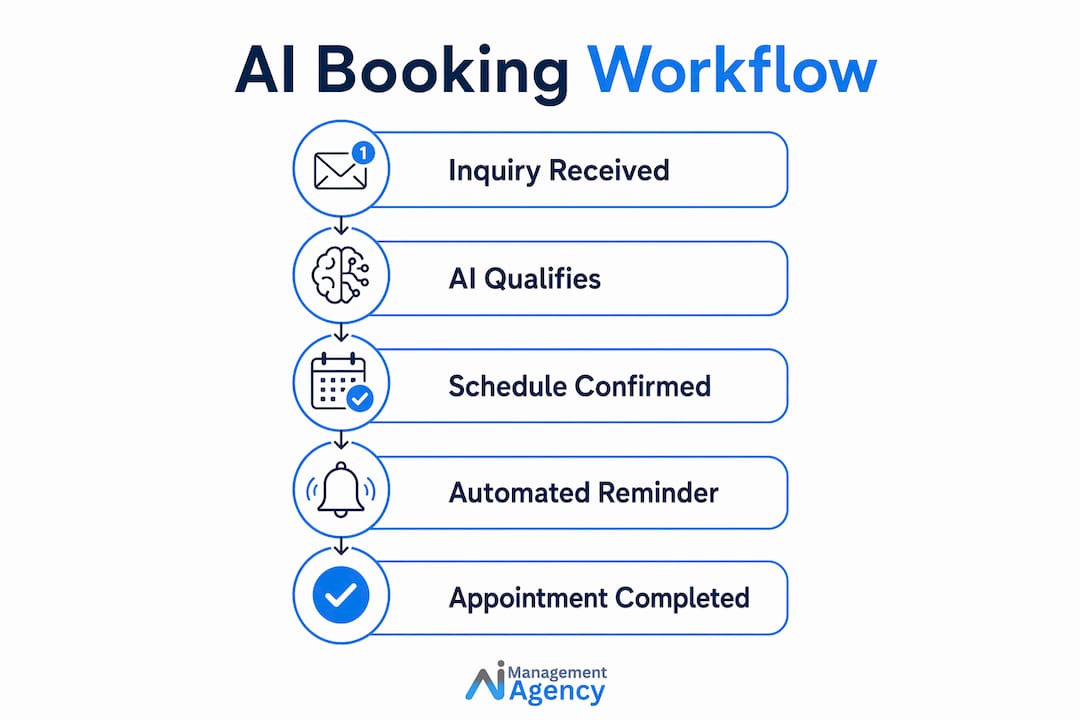
The end-to-end workflow of an AI scheduling system follows a clear sequence. Understanding each step helps you assess whether a system will fit your existing operations.
- Inbound request handling. A customer contacts your business via phone, WhatsApp, web chat, or email. The AI agent receives the message and begins the conversation.
- Qualifying questions. The agent asks relevant questions: service type, preferred date, location, or any other criteria your business requires. This mirrors what a receptionist would ask.
- Live availability check. The system queries your calendar in real time, whether that is Google Calendar, a specialist booking platform, or a clinical system. Real-time availability checks are what separate AI agents from static booking forms.
- Slot presentation and confirmation. The agent presents available times, the customer selects one, and the booking is confirmed instantly. A confirmation message goes to both parties.
- Automated follow-ups. The system sends reminders at intervals you configure, reducing the likelihood of a no-show. It can also handle rescheduling and cancellation requests without staff involvement.
- Workflow routing. Once booked, the appointment triggers downstream actions: staff notifications, intake forms, or status updates in your business management software. Workflow integration ensures the booking does not sit in isolation.
A practical example of this in action is an AI-powered WhatsApp receptionist. Clients message on WhatsApp, receive automated replies, get real-time availability checked, and have their booking confirmed directly in Google Calendar. No app download required for the customer. No manual input required from your team.
Pro Tip: Configure your AI booking agent to ask one qualifying question beyond date and time, such as the nature of the enquiry. This pre-qualifies appointments and saves your team from dealing with mismatched bookings.

What are the operational benefits for UK businesses?
The business case for AI scheduling software is built on four measurable outcomes. Each one addresses a cost or inefficiency that most UK business owners recognise immediately.
- Reduced no-shows. NHS England reported DNA (Did Not Attend) rates dropped by up to 25% after implementing automated rescheduling. That figure translates directly to private sector contexts: fewer empty slots means more revenue per day.
- 24/7 booking capability. An NHS accelerator case study found that 42.7%–45.4% of AI virtual assistant booking activity happened outside standard 9am–5pm hours. Your customers want to book at 9pm on a Tuesday. An AI system lets them.
- Staff workload reduction. When an AI agent handles inbound booking calls and messages, your reception team focuses on higher-value tasks. The time saved on phone calls, manual diary entries, and reminder calls adds up to hours per week for a busy practice or service business.
- Increased capacity. A North East London NHS Foundation Trust case study showed that automated virtual assistant booking increased appointment capacity by 1,400 slots in just four months. More capacity from the same resource base is a direct efficiency gain.
- Alignment with digital expectations. Over 41 million users access the NHS App for appointment management, and around half of NHS trusts now send digital reminders. UK customers increasingly expect digital self-service. Businesses that offer it gain a competitive edge.
The benefits of AI booking systems compound over time. Each automated reminder that prevents a no-show, and each booking completed at midnight, represents a direct saving in staff cost and lost revenue.
AI appointment booking vs traditional scheduling software
The difference between AI scheduling software and a standard online booking tool is not cosmetic. It is architectural.
| Feature | Traditional Scheduling Software | AI Appointment Booking System |
|---|---|---|
| Booking interface | Form or calendar widget | Conversational chat or voice |
| Availability logic | Rule-based, fixed slots | Real-time, dynamic checking |
| No-show prevention | Basic email reminder | Predictive analytics and automated rescheduling |
| Rescheduling | Customer self-service form | AI agent manages the dialogue |
| Learning capability | None | Learns patterns to optimise routing |
| Integration depth | Calendar sync | Full workflow and CRM integration |
The critical distinction is the intelligence layer. AI booking agents connect conversations directly to real booking systems to check availability and take action. A standard chatbot responds with information. An AI booking agent actually makes the booking. That difference is what UK business owners evaluating these tools need to understand first. You can read more about this distinction in our guide on AI agents vs chatbots.
Custom AI booking systems go further still. They can use predictive analytics to anticipate no-shows and automatically route bookings to the most appropriate staff member based on skill, availability, or location. That level of intelligence is simply not available in rule-based scheduling tools.
Pro Tip: When evaluating AI scheduling software, ask the vendor specifically whether the system writes back to your calendar in real time or batches updates. Real-time write-back is non-negotiable for busy service businesses.
What should UK businesses consider before implementing?
Adopting an automated appointment system requires more than switching on a new tool. The following considerations will determine whether your deployment succeeds or stalls.
Calendar and system integration. Your AI booking agent must connect bi-directionally with your existing calendar. Bi-directional integration with existing business systems is the single most important technical requirement. Without it, double bookings and missed updates will undermine trust in the system immediately.
Business hours and service configuration. Define your service types, durations, and staff assignments before go-live. An AI agent can only offer what it has been told is available. Spend time on this setup and you will avoid customer-facing errors in the first weeks.
Data privacy and UK compliance. Any system handling customer personal data must comply with UK GDPR. Check where your booking data is stored, how long it is retained, and whether the vendor holds appropriate certifications. This is not optional for UK businesses.
Customer communication expectations. Decide which channels your AI agent will cover. WhatsApp, phone, web chat, and email each serve different customer segments. A conversational AI receptionist operating on WhatsApp, for example, requires no new app for the customer and fits naturally into how many UK consumers already communicate with businesses.
Customisation versus off-the-shelf. Off-the-shelf AI scheduling tools deploy quickly but may not reflect your specific workflows. A customised AI agent, built around your service types and customer journey, delivers a more consistent experience. For businesses with complex booking requirements, such as multi-location services or tiered appointment types, customisation is worth the additional investment. You can explore how this applies to your sector in the AI appointment setting guide for UK small businesses.
Key takeaways
AI appointment booking delivers measurable operational gains for UK businesses by automating the full scheduling lifecycle, from first contact through to confirmation, reminders, and rescheduling, without manual staff involvement.
| Point | Details |
|---|---|
| Core definition | AI appointment booking automates the full scheduling lifecycle using conversational AI and real-time calendar integration. |
| 24/7 availability | Nearly half of all AI booking activity occurs outside standard business hours, capturing demand your team would otherwise miss. |
| No-show reduction | Automated reminders and rescheduling cut DNA rates by up to 25%, directly protecting revenue. |
| AI vs traditional tools | AI agents write bookings directly to live calendars; standard scheduling tools only present information. |
| Implementation priority | Bi-directional calendar integration is the most critical technical requirement for a successful deployment. |
Why i think most UK businesses are still underestimating this technology
I have spent considerable time working with UK business owners who assume AI appointment booking is either too complex or only relevant to large organisations like the NHS. Both assumptions are wrong, and the NHS evidence actually makes the strongest case for small and medium businesses.
The NHS data is compelling precisely because it is conservative. A public sector organisation, operating under procurement constraints and legacy systems, still achieved a 25% reduction in missed appointments and added 1,400 booking slots in four months. A private service business with a modern tech stack and a single decision-maker can move faster and see results sooner.
What I find most telling is the out-of-hours booking figure. Nearly half of all AI booking activity happens outside 9am to 5pm. That is not a marginal gain. That is a structural shift in when your customers want to engage with you. Businesses that rely solely on a human receptionist are, by definition, invisible to those customers.
The practical challenge I see most often is not technical. It is psychological. Business owners worry that an AI agent will feel impersonal or will frustrate customers who prefer speaking to a human. The evidence does not support that concern. When an AI agent speaks naturally, answers questions accurately, and books the appointment in under two minutes, most customers simply do not care whether it is human or automated. They care that it worked.
My advice is to start with one channel, one service type, and a clear integration with your existing calendar. Measure the no-show rate before and after. The numbers will make the case for expanding the system far better than any vendor pitch.
— Geoff
How Aimagency helps UK businesses book more appointments
Aimagency builds AI agents that handle the full appointment booking workflow for UK businesses, from answering inbound calls in a natural tone to qualifying leads and confirming bookings directly in your calendar.
Whether you run a trade business, a financial services firm, or a professional practice, Aimagency’s AI receptionist operates 24/7, responds to FAQs, and books qualified sales appointments without adding headcount. The system integrates with your existing calendar and workflows from day one. Explore the advantages of AI agents for small UK businesses to see how the technology maps to your specific operational needs, or read our practical guide on how to book sales appointments with AI for a step-by-step overview.
FAQ
What is the definition of AI appointment booking?
AI appointment booking is defined as an automated scheduling process where artificial intelligence interacts with customers to book, confirm, and manage appointments in real time, without manual staff input.
How does AI appointment booking differ from a standard booking form?
A standard booking form is passive and only captures data. An AI booking agent actively converses with the customer, checks live calendar availability, and completes the booking end to end.
Can AI booking systems reduce no-shows?
NHS England reported DNA rates dropped by up to 25% after implementing automated rescheduling and reminders. The same principle applies to private sector businesses of any size.
Is AI appointment booking suitable for small UK businesses?
AI scheduling software is available at a range of price points and can be configured for a single-location business with a small team. The key requirement is integration with your existing calendar system.
What channels can an AI booking agent operate on?
AI booking agents can operate across phone, WhatsApp, web chat, and email. WhatsApp is particularly effective for UK businesses because customers already use it and no new app is required.