TL;DR:
- Most hotel AI strategies lack connected workflows, which limits their ability to generate measurable returns. Embedding AI across guest communication, revenue, and operational systems improves service and efficiency. Success depends on cloud data architecture and strategic focus rather than isolated AI tools.
Artificial intelligence in hospitality is defined as embedded intelligence across hotel workflows, not a collection of isolated tools bolted onto legacy systems. The current trends in hotel AI reveal a stark divide: 98% of hotel owners use AI in some capacity, yet fewer than 10% are “AI future-built” with measurable returns across core operations. That gap is where competitive advantage is won or lost. Hotels that treat AI as a feature add-on will fall behind those redesigning workflows around AI strengths. This guide gives hoteliers a clear picture of where AI is heading in 2026 and how to act on it.
What are the current trends in hotel AI operations?
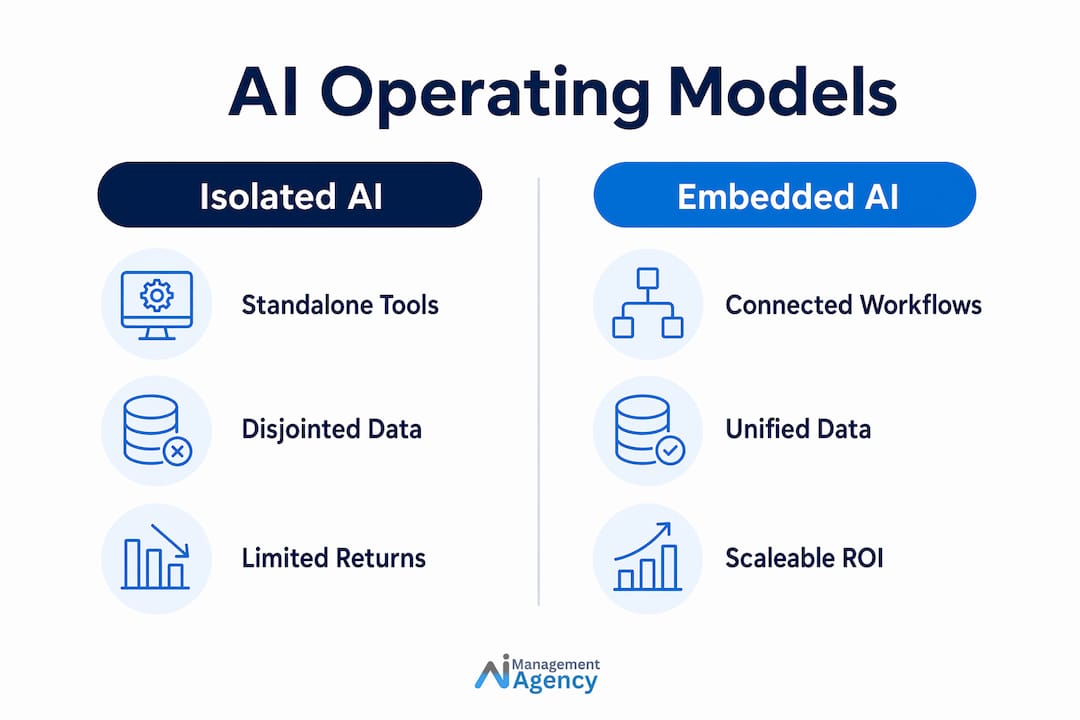
The defining shift in hotel AI is from standalone tools to connected, operational intelligence. Rather than deploying a chatbot here and a pricing widget there, leading properties now embed AI across guest communication, revenue management, housekeeping scheduling, and front-desk workflows in one joined-up system.

Only 25% of hospitality companies have reached the “AI-scaling” stage where returns flow across multiple functions. That figure tells you most hotels are still experimenting rather than executing. The ones generating real returns have moved past the pilot phase and redesigned their operating models around AI strengths.
The most advanced properties follow an AI-first operating model by building workflows around predictive scheduling, automated revenue management, and real-time guest data. Human staff are then freed to focus on empathetic interaction and creative problem-solving. That is not a cost-cutting exercise. It is a service quality upgrade.
The table below shows the practical difference between isolated AI features and an embedded AI operating model.
| Feature | Isolated AI approach | Embedded AI operating model |
|---|---|---|
| Guest communication | Standalone chatbot with no CRM link | AI messaging connected to guest profile and booking data |
| Revenue management | Separate pricing tool updated manually | AI pricing engine fed by live occupancy, demand, and competitor signals |
| Housekeeping | Fixed rota based on check-out times | Predictive scheduling driven by real-time occupancy and guest behaviour |
| Front desk | Staff handle all enquiries manually | AI handles routine queries; staff resolve complex issues |
| Data flow | Siloed by department | Unified data pipeline shared across all functions |
Pro Tip: Before investing in any new AI tool, audit your current tech stack for data silos. A connected data pipeline is the foundation every other AI capability depends on.
What impact do AI-powered guest engagement tools have?
AI-powered guest engagement tools directly increase revenue and reduce operational load. AI-powered booking engines with structured content achieve a 44.7% conversion rate compared with 25.9% from traditional organic search. That is not a marginal improvement. It is a fundamental shift in how bookings are won.
AI voice agents and chatbots now handle reservations, answer FAQs, and manage upsell offers around the clock. An AI receptionist for hotels can answer calls at 2AM, qualify the enquiry, and book a confirmed appointment without any human involvement. That capability removes one of the most persistent revenue leaks in hospitality: missed calls outside office hours.
Personalisation is where AI engagement tools create the deepest loyalty. AI analyses behavioural data from previous stays, browsing patterns, and booking history to surface offers that feel relevant rather than generic. A guest who always books a spa treatment on arrival should receive a pre-arrival offer for exactly that, not a blanket discount on breakfast.
Hybrid hospitality is the operating model that makes this work at scale. AI handles logistics, confirmations, and routine queries. Human staff step in for empathetic moments: a complaint, a special occasion, a guest who simply wants a conversation. Neither replaces the other.
Best practices for guest-facing AI deployment:
- Connect AI tools to your property management system so guest data is current and accurate.
- Set clear escalation rules so AI hands off to a human when sentiment turns negative.
- Train AI on your property’s tone of voice so responses feel on-brand, not generic.
- Use AI to send pre-arrival messages that confirm details and offer relevant upgrades.
- Review AI conversation logs weekly to identify gaps in knowledge or missed revenue opportunities.
Pro Tip: The fastest wins in guest-facing AI come from automating the top 10 most frequently asked questions. Pull your call logs, identify those questions, and build your AI knowledge base around them first.
How is AI changing hotel digital discovery and direct bookings?
Traditional search is losing ground fast. Search traffic in travel is declining by around 25% as AI-generated summaries replace standard link lists. Hotels that built their visibility strategy around Google rankings alone are now exposed.
65% of Google searches that trigger an AI Overview end without a single click. On mobile, that figure rises to 78%. When a traveller asks an AI assistant “What is the best boutique hotel in Edinburgh for a weekend break?” and receives a direct answer, your property either appears in that answer or it does not. There is no page two.
The response is Generative Engine Optimisation, or GEO. This means structuring your hotel’s content, data, and digital presence so that AI models can read, cite, and surface it accurately. Over 90% of accommodation sites remain undetected by AI models because they lack proper structured data. That is an enormous opportunity for properties that act now.
The table below compares traditional SEO performance with an AI-optimised content approach.
| Metric | Traditional SEO | AI-optimised content (GEO) |
|---|---|---|
| Primary traffic source | Google organic rankings | AI-generated answers and conversational search |
| Click-through dependency | High (requires user to click) | Low (AI surfaces answer directly) |
| Content format | Keyword-rich pages | Structured data, schema markup, cited facts |
| Booking conversion rate | 25.9% from organic search | 44.7% from AI-powered booking engines |
| Visibility risk | Algorithm updates | Absence from AI training and citation pools |
Only 11% of hotels deploy AI agents capable of end-to-end booking, loyalty, and pricing orchestration in real time. The remaining 89% are still optimising channels that are shrinking. Shifting your distribution strategy to account for conversational AI search is not a future consideration. It is a 2026 priority.
Pro Tip: Add schema markup for your hotel’s name, location, room types, amenities, and pricing to every key page. This is the single most effective step to improve your visibility in AI-generated search results.
What operational challenges do hotels face when scaling AI?
The adoption-to-execution gap is the defining challenge in hotel AI right now. Fragmented data and lack of strategic clarity make most AI scaling efforts fragile. Hotels run siloed systems that produce incomplete guest profiles, which in turn limits what AI can personalise or predict.
The technical root cause is architecture. Legacy property management systems were not designed to share data in real time. When your booking engine, CRM, housekeeping system, and revenue management tool each hold separate records of the same guest, AI cannot build a coherent picture. Cloud-based, microservices-driven tech stacks are the foundation that makes AI integration work. Without them, even the best AI tools underperform.
Organisational buy-in is equally critical. AI projects stall when they are owned by IT alone and not championed by operations, revenue, and guest experience teams together. Strategic clarity means defining what measurable outcome you want before selecting any tool.
Steps to operationalise AI effectively in your hotel:
- Audit your data infrastructure. Map every system that holds guest or operational data and identify where records are duplicated or disconnected.
- Define one measurable outcome. Choose a specific metric to improve, such as direct booking conversion, average response time, or housekeeping efficiency.
- Migrate to a cloud-based architecture. Legacy on-premise systems cannot support real-time AI integration at scale.
- Start with high-frequency, low-complexity tasks. Call handling, FAQ responses, and booking confirmations are ideal first use cases.
- Connect AI tools to a unified data pipeline. Every AI capability depends on clean, current, connected data.
- Review performance monthly. Set KPIs before launch and hold the AI accountable to them just as you would any member of staff.
Explore AI use cases in hotels to see which functions deliver the fastest returns for properties at different stages of AI maturity.
Pro Tip: Assign a cross-departmental AI lead, not just an IT contact. The person responsible for AI outcomes should sit at the intersection of operations and guest experience, not in a back-office technical role.
Key takeaways
The most effective hotel AI strategy embeds intelligence across connected workflows, not isolated tools, to deliver measurable returns in bookings, efficiency, and guest satisfaction.
| Point | Details |
|---|---|
| Adoption gap is wide | 98% of hotels use AI, but fewer than 10% generate returns across core operations. |
| Embedded AI outperforms add-ons | Connected AI across booking, housekeeping, and revenue management delivers far greater returns than standalone tools. |
| AI booking engines convert better | AI-powered booking engines achieve a 44.7% conversion rate versus 25.9% from traditional organic search. |
| GEO is now a priority | Over 90% of hotels are invisible to AI search models; structured data markup is the fix. |
| Architecture determines success | Cloud-based, microservices-driven tech stacks are the prerequisite for effective AI integration. |
Where I think hoteliers are getting this wrong
The conversation around AI in hospitality focuses too heavily on tools and not nearly enough on architecture and intent. I see hotels investing in AI chatbots, AI pricing engines, and AI upsell platforms as separate purchases, then wondering why the returns are disappointing. The tools are not the problem. The absence of a connected data foundation is.
What genuinely excites me about the direction of hybrid hospitality is that it gives human staff a more meaningful role, not a diminished one. When AI handles the routine, your team handles the remarkable. That is a better job and a better guest experience simultaneously.
The hoteliers I respect most are not asking “which AI tool should I buy?” They are asking “what outcome do I need, and what data infrastructure do I need to achieve it?” That question leads to real ROI. The other question leads to a growing list of subscriptions and a shrinking sense of progress.
My practical advice: pick one workflow, connect it properly, measure it rigorously, and then expand. The hotels that will lead in 2026 are not the ones with the most AI tools. They are the ones with the clearest strategy and the cleanest data.
— Geoff
AI agents built for hospitality: how Aimagency can help
Deploying AI effectively in a hotel requires more than selecting the right software. It requires a clear implementation strategy, properly configured agents, and ongoing management to ensure performance holds.
Aimagency specialises in building high-quality AI agents for hospitality businesses, including AI receptionists that answer calls 24/7 in a natural tone, respond to guest FAQs, and book qualified appointments without human intervention. For hoteliers ready to close the gap between AI adoption and real operational returns, Aimagency’s AI agents in hospitality guide is the right starting point. Whether you need to automate call handling, improve direct booking conversion, or build a connected guest communication workflow, Aimagency delivers agents that work from day one.
FAQ
What are the main current trends in hotel AI for 2026?
The leading trends are embedded AI across connected hotel workflows, AI-powered guest communication and booking engines, and Generative Engine Optimisation for conversational search visibility. Hotels are moving from isolated AI tools to integrated operating models that deliver measurable returns.
How does AI improve direct booking conversion in hotels?
AI-powered booking engines with structured content achieve a 44.7% conversion rate compared with 25.9% from traditional organic search. AI personalises offers based on guest behaviour, reducing drop-off and increasing confirmed bookings.
What is Generative Engine Optimisation for hotels?
Generative Engine Optimisation, or GEO, is the practice of structuring hotel content and data so that AI search models can read and cite it accurately. Over 90% of accommodation sites are currently invisible to AI models due to missing structured data markup.
Why do most hotel AI projects fail to deliver ROI?
Most hotel AI projects fail because of fragmented data and siloed systems that prevent AI from building accurate guest profiles. Without a cloud-based, connected data architecture, even well-chosen AI tools cannot perform at their potential.
What is hybrid hospitality?
Hybrid hospitality is an operating model where AI handles routine tasks such as reservations, FAQs, and scheduling, while human staff focus on empathetic guest care and complex problem-solving. This approach improves both service quality and staff satisfaction.