TL;DR:
- Many small businesses underestimate the benefits of AI receptionists, which handle calls, bookings, and inquiries 24/7 with high accuracy. These voice-based AI agents improve customer experience, reduce costs, and ensure no calls are missed, leveling the playing field with larger competitors. Selecting the right AI system involves assessing integration, speech accuracy, and ongoing support, enabling businesses to deliver professional, round-the-clock service efficiently.
Most small business owners assume AI receptionists are something reserved for large hotel chains or corporate call centres with six-figure technology budgets. That assumption is wrong, and it’s costing smaller firms real money every day. A missed call during a busy Saturday lunch service, a reservation enquiry left unanswered at 11pm, a new customer who simply rings the competitor instead — these are not minor inconveniences. They are revenue walking out the door. This guide explains exactly what an AI receptionist is, how it works, what it costs, and why UK small businesses in hospitality and beyond are adopting this technology faster than ever before.
Table of Contents
- Defining an AI receptionist: more than just automation
- How AI receptionists work: the technology explained
- Benefits of AI receptionists for small businesses and hospitality
- Choosing the right AI receptionist for your business
- Why AI receptionists are changing the face of UK hospitality
- Ready to upgrade your front desk? Explore trusted AI solutions
- Frequently asked questions
Key Takeaways
| Point | Details |
|---|---|
| AI receptionist defined | An AI receptionist uses advanced speech, language, and automation technologies to handle front desk tasks in real time. |
| Benefits for small business | UK small businesses can save money, boost efficiency, and improve customer service with AI-powered receptionist solutions. |
| Choosing the right fit | Pick an AI receptionist with accurate speech tech, business system integration, and flexible support for your industry. |
| Hospitality advantage | Hospitality businesses gain 24/7 cover, fewer missed bookings, and a consistent guest experience using AI receptionists. |
Defining an AI receptionist: more than just automation
Having explored why AI receptionists matter, it’s vital to clarify what actually makes an AI receptionist tick. Many people conflate them with basic chatbots or old-fashioned phone menus. They are neither.
An AI receptionist is a voice-based AI agent that handles real telephone conversations in natural language. It listens, understands context, makes decisions, and responds — all without a human operator in the loop. According to research on front desk operations, AI receptionists combine ASR, LLMs, decision engines, and TTS to perform front desk tasks rapidly and accurately. That is a significant step beyond anything a basic phone menu or keyword chatbot can achieve.
Here is what a modern AI receptionist can do:
- Answer inbound calls at any time of day or night, 365 days a year
- Book and amend appointments or reservations directly into your calendar system
- Respond to FAQs about opening hours, pricing, location, menus, and availability
- Transfer calls to the right team member when a human is genuinely needed
- Qualify sales enquiries and pass warm leads to your team
- Handle complex instructions, such as dietary requirements or room preferences, without confusion
This is fundamentally different from a basic Interactive Voice Response (IVR) system that simply says “Press 1 for reservations, press 2 for enquiries.” An AI receptionist holds an actual dialogue. It can handle a curve ball, follow up within a conversation, and adapt its responses based on what the caller says next.
Our full AI receptionist guide explores how these systems are configured for specific industries, including hospitality, trades, and professional services.

Pro Tip: When evaluating any AI receptionist solution, ask for the speech recognition error rate. Look for providers delivering less than 5% error to ensure callers are understood accurately, even with regional accents or background noise.
How AI receptionists work: the technology explained
Now that you understand what an AI receptionist is, let’s unpack how this advanced technology actually handles everyday interactions. The process sounds complex in theory but is elegantly simple in practice.
The four-step interaction flow
-
Input capture. A caller rings your number. The AI receptionist picks up immediately. Automatic Speech Recognition (ASR) technology, powered by engines such as Deepgram or Whisper, converts the caller’s spoken words into text in real time.
-
Intent recognition. A Large Language Model (LLM) processes that text to extract intent, entities, and context. It understands not just the words but the meaning. “I’d like a table for four on Friday evening” is correctly parsed as a reservation request, with date, party size, and timing captured automatically.
-
Decision and action. A decision engine acts on the extracted intent by calling the relevant APIs. It connects to Google Calendar, your CRM, your booking platform, or your property management system to check availability and confirm the booking. Core AI mechanics including ASR, LLMs, and TTS enable responses in under 800 milliseconds, which means the caller experiences a natural, fluid conversation.
-
Response delivery. Text-to-Speech (TTS) technology, using tools such as ElevenLabs, converts the system’s response back into natural-sounding speech. The caller hears a calm, professional voice confirming their booking, answering their question, or routing them appropriately.
Comparison: AI receptionist vs. human vs. IVR
| Feature | AI receptionist | Human receptionist | Basic IVR |
|---|---|---|---|
| Availability | 24/7, no breaks | Business hours only | 24/7 but limited |
| Simultaneous calls | Unlimited | One at a time | Multiple but inflexible |
| Natural language understanding | High | Very high | None |
| Booking/CRM integration | Full automation | Manual input | None |
| Response time | Under 1 second | Variable | Instant but scripted |
| Monthly cost | Low fixed fee | Salary plus overheads | Low but rigid |
| Scalability | Instant | Hire and train | Limited |
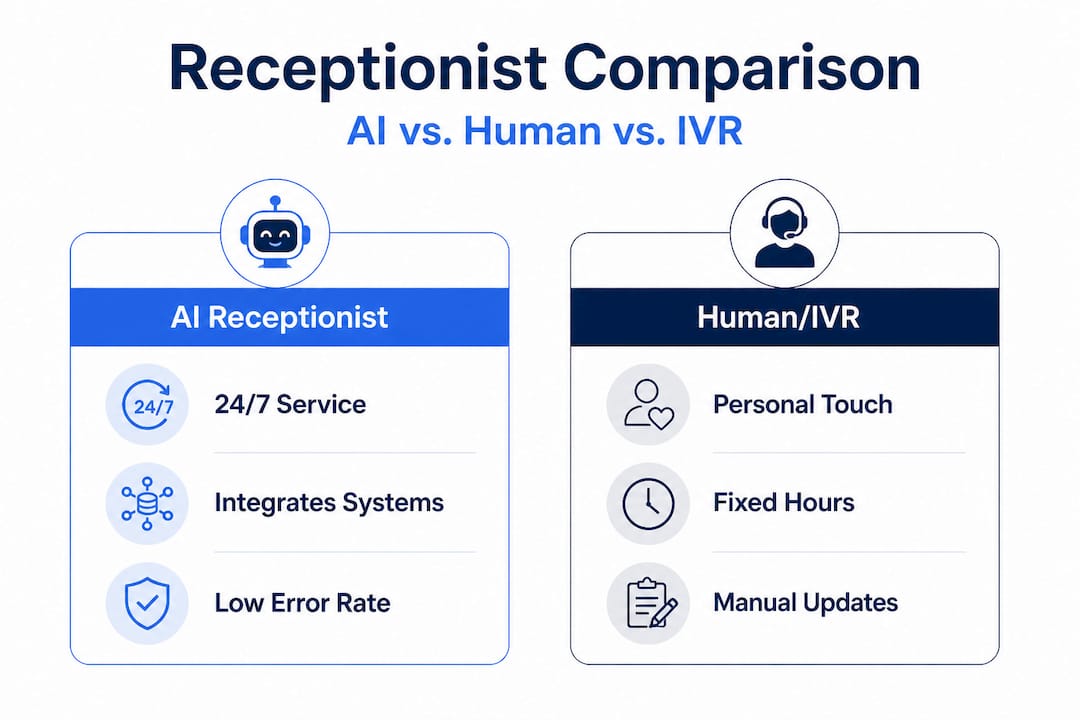
The contrast is stark. A human receptionist is exceptional at empathy and complex problem-solving, but cannot be in two places at once and does not work at midnight. A basic IVR handles volume but frustrates callers with rigid menus. An AI receptionist sits squarely between the two, offering the flexibility and intelligence of human interaction at the availability and scale of automated technology.
Consider this real-world scenario: a guest rings your boutique hotel at 10:30pm to enquire about availability for a bank holiday weekend. Your AI receptionist answers immediately, checks availability in your property management system, confirms the room type, takes the guest’s contact details, and sends a follow-up confirmation — all without a single staff member being disturbed. For businesses exploring this for trades and service industries, our AI receptionist for electricians page shows how similar workflows apply across sectors.
Benefits of AI receptionists for small businesses and hospitality
Understanding the technology is only half the story. Let’s see why these capabilities translate directly into measurable gains for small businesses.
The headline benefit is simple: you never miss a call again. But the advantages run considerably deeper than that.
Key benefits at a glance
- 24/7 availability without fatigue, sick days, or inconsistency in tone
- Simultaneous call handling, so a busy Friday evening never means a missed reservation
- Consistent, accurate responses every single time, regardless of call volume
- Immediate booking confirmation, reducing the back-and-forth that loses customers
- Lower operating costs compared to employing additional front desk staff
- Scalability on demand, handling ten calls or a hundred without additional spend
- Qualified lead capture, ensuring your sales team only speaks to genuinely interested prospects
Research consistently shows that AI receptionists transform front desk operations with measurable improvements in speed, accuracy, and round-the-clock efficiency.
Typical gains reported by small businesses
| Metric | Before AI receptionist | After AI receptionist |
|---|---|---|
| Missed calls per week | 15 to 25 | Near zero |
| Booking errors | 5 to 10% | Less than 1% |
| After-hours enquiries handled | 0% | 100% |
| Receptionist staff cost (monthly) | £1,800 to £2,500 | Fixed AI fee |
| Customer response time | Minutes to hours | Under 1 second |
These are not hypothetical figures. Small hotels and service firms across the UK are reporting exactly these kinds of shifts after adopting AI voice agents. The ability to handle efficient customer communication at scale is no longer a luxury — it is a competitive baseline.
“The biggest shift isn’t the cost saving. It’s the consistency. Every caller gets the same warm, accurate, professional experience whether they ring at 9am or 9pm.”
Pro Tip: Use your AI receptionist to handle peak-time call overflow rather than replacing your team entirely. Let staff focus on face-to-face service and high-value interactions while the AI manages the phone queue. This hybrid approach delivers the best of both worlds and is particularly effective in restaurant and hotel environments.
For hospitality businesses specifically, our page on AI receptionist in restaurants covers practical deployment strategies in detail.
Choosing the right AI receptionist for your business
The right AI receptionist makes all the difference, but how do you choose the best fit for your specific needs and budget?
Selecting the right solution involves more than picking the lowest price. The right fit depends on your call volume, your existing systems, and the complexity of the conversations your business needs to handle. As research on AI receptionist selection confirms, choosing the right system involves evaluating speech accuracy, calendar and CRM integration, and vendor responsiveness.
Steps to assess the right fit
-
Map your top five call types. What do callers most commonly ask? Reservations, opening hours, pricing, directions, complaints? Your AI receptionist needs to handle these fluently before anything else.
-
Audit your existing systems. What booking platform, CRM, or calendar tool do you currently use? Confirm the AI receptionist can integrate via API before signing any contract.
-
Evaluate speech accuracy with real examples. Ask providers to demonstrate the system using your actual FAQs and typical caller phrases. Regional accents, background noise, and industry-specific terminology all affect performance.
-
Assess vendor support. What happens when the system encounters an unusual query? How quickly can the vendor update scripts or improve the agent’s responses? Ongoing support is as important as initial setup.
-
Review data security and GDPR compliance. Any system handling caller data must comply with UK data protection regulations. Ask explicitly how caller information is stored, processed, and deleted.
Questions to ask any AI receptionist provider
- What is your average speech recognition error rate across UK accents?
- Which booking and CRM platforms do you integrate with natively?
- How long does initial setup and training take?
- Can the agent be updated quickly if our FAQs or pricing change?
- Do you offer a live trial period before we commit?
- What escalation path exists for calls the AI cannot resolve?
For professional service firms and regulated industries, our finance AI receptionist solutions page covers compliance considerations in more depth.
Pro Tip: Always run a pilot with real customer calls before going fully live. Use a sample of your busiest call types over two to four weeks, review the transcripts, and refine the agent’s responses. This step alone significantly improves accuracy and caller satisfaction from day one. Reviewing guidance on professional phone service standards can also help you define what excellent looks like before you begin.
Why AI receptionists are changing the face of UK hospitality
With these practical selection steps in mind, consider the deeper cultural shift AI receptionists bring to service-driven businesses.
There is a persistent fear in hospitality that AI means the end of personal service. In our experience, the opposite is true. AI receptionists do not diminish hospitality; they make space for more of it.
When your team is not anchored to the phone, they are free to be present with the guests who are standing in front of them. A host who is not juggling a handset can make proper eye contact, offer a genuine welcome, and remember a returning guest’s name. That is not something an AI can replicate — and it is not something an AI should try to replicate. The real advantage lies in letting each do what it does best.
There is also a strategic dimension that many small business owners overlook. An AI receptionist allows a boutique hotel or independent restaurant to present the same level of professional, immediate responsiveness as a large chain. A caller cannot tell whether your business has fifty staff or five — they simply experience a prompt, informed, courteous response to their enquiry. That levels the playing field considerably.
The firms making the most of AI receptionists are not using them to cut their teams. They are using them to enhance efficiency and professionalism while redirecting their people towards the interactions that genuinely require human empathy, judgement, and warmth.
UK hospitality is entering a period where the expectation of instant, 24/7 service is becoming standard. Guests who cannot get through after hours will simply book elsewhere. AI receptionists are not a luxury add-on — they are becoming the baseline for competitive businesses. For professional firms looking at similar shifts, our AI for professional firms page is worth exploring.
The businesses that adopt this technology thoughtfully, pairing AI efficiency with genuine human hospitality, will set a new standard that others will follow.
Ready to upgrade your front desk? Explore trusted AI solutions
For UK business owners ready to act on these insights, trusted AI receptionist solutions are just a click away.
At AI Management Agency, we build high-quality AI voice agents that speak naturally, answer calls around the clock, handle your FAQs accurately, and book qualified appointments directly into your calendar. Getting started is straightforward. We configure your agent around your specific business needs, integrate it with your existing systems, and support you through every stage of deployment. Whether you run a restaurant, an estate agency, or a trades business, there is a solution built for your sector. Explore our AI for estate agents, AI for double glazing companies, or AI for restaurants pages to see exactly how the technology is tailored to your industry.
Frequently asked questions
How accurate is an AI receptionist at understanding callers?
With less than 5% error rates in leading speech recognition systems, top AI receptionists understand both straightforward and complex caller requests reliably, including regional UK accents.
Can an AI receptionist integrate with my business systems?
Yes. Modern AI receptionists connect to calendars, CRMs, and booking tools via APIs, as confirmed by AI receptionist integration research, enabling fully automated workflows without manual data entry.
Is switching to an AI receptionist expensive for small firms?
Adopting an AI receptionist is typically far more affordable than hiring additional staff. Many businesses report lower running costs and higher efficiency within the first month of deployment.
What tasks can an AI receptionist do for hospitality businesses?
AI receptionists can answer calls, take reservations, respond to FAQs, direct enquiries to the right person, and manage basic changes or cancellations. Research confirms that AI receptionists manage calls and bookings with consistent speed and accuracy, day and night.
Recommended
- AI receptionists: better service, lower costs for small firms – AI Management Agency
- AI reception for UK hospitality: boost efficiency in 2026 – AI Management Agency
- Efficient AI answering service guide for UK small firms – AI Management Agency
- AI Receptionist Estate Agent – AI Management Agency
- Unlock global insights: guide to call centers for market research