
TL;DR:
- Hospitality AI terminology is the specialized vocabulary that helps hotel staff understand and manage artificial intelligence systems effectively. It spans concepts like machine learning, NLP, and guardrails, which are essential for responsible AI deployment in hotel operations. Mastering this language enables organizations to improve guest service, ensure security, and maintain brand integrity in AI integrations.
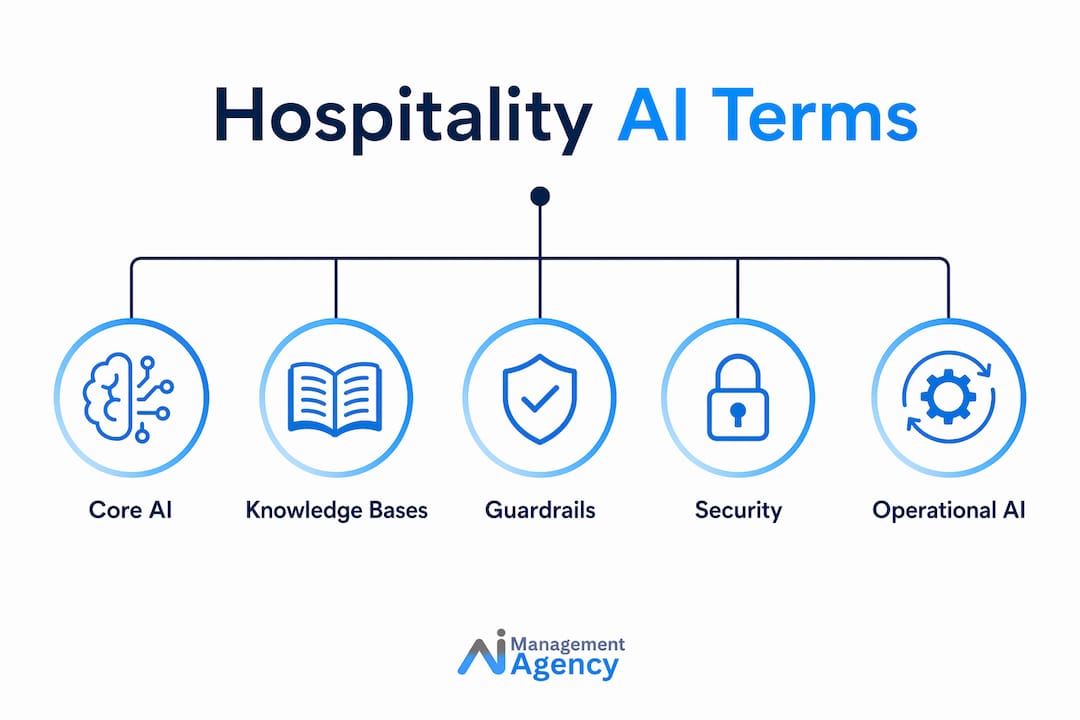
Hospitality AI terminology is defined as the specialised vocabulary that enables hotel operators, revenue managers, and guest services teams to understand, deploy, and govern artificial intelligence across their operations. AI in hospitality now spans marketing, operations, guest services, and revenue management. Without fluency in the core terms, you cannot challenge vendor claims, write effective governance policies, or protect your brand from AI errors. This guide decodes the most critical concepts, from foundational definitions to advanced frameworks, so you can apply them with confidence in 2026.
What are the core hospitality AI terminology concepts to know?
Artificial Intelligence is defined as the capability of computer systems to perform tasks that normally require human intelligence, such as understanding language, recognising patterns, and making decisions. In hospitality, AI powers everything from chatbots answering guest FAQs to dynamic pricing engines adjusting room rates in real time. The term covers a wide family of technologies, each with a distinct role.
The key foundational terms every hospitality professional should understand are:
- Artificial Intelligence (AI): The broad field covering any system that mimics human cognitive tasks. In hotels, AI handles guest communication, demand forecasting, and staff scheduling.
- Machine Learning (ML): A subset of AI where systems learn from data without being explicitly programmed. A practical example is a cancellation prediction model trained on historical booking patterns at your property.
- Deep Learning: A more advanced form of ML using layered neural networks. Hotels use it for voice analysis in AI receptionists and image recognition in security systems.
- Generative AI: AI that creates new content, such as text, images, or audio, based on patterns in training data. Tools like ChatGPT and Google Gemini use this to draft personalised guest communications or marketing copy.
- Transformers and Large Language Models (LLMs): The underlying architecture powering most modern AI assistants. GPT-4 and Claude are LLMs built on transformer architecture. When a vendor says their tool is “AI-powered,” they almost certainly mean it uses an LLM.
- Natural Language Processing (NLP): The ability of AI to understand and generate human language. NLP is what allows an AI voice agent to hold a natural telephone conversation with a guest.
Pro Tip: When a vendor claims their product uses “AI,” ask specifically which of these technologies it uses and how it was trained. A vendor who cannot answer clearly is one to question further.
How do advanced AI systems support hospitality operations?
Understanding individual AI terms is useful. Understanding how they combine into operational systems is where real value lies. Three advanced concepts define how well-built hospitality AI actually works: Retrieval-Augmented Generation, Knowledge Bases, and Guardrails.

Retrieval-augmented generation (RAG) explained
Retrieval-Augmented Generation, known as RAG, is a framework where an AI system retrieves specific data from a defined knowledge base before generating a response. The RAG framework retrieves hotel-specific data first, then generates responses constrained by brand policies. This prevents the AI from inventing answers or contradicting your official rates and policies.
Knowledge bases: guest, property, and commercial
A Knowledge Base is a structured data store that the AI draws from when answering queries. The most effective hospitality AI systems segment knowledge bases into three distinct categories. Separating these reduces hallucinations and keeps every AI interaction brand-safe.
| Knowledge Base | Data Sources | Primary Function |
|---|---|---|
| Guest Knowledge Base | CRM records, booking history, preferences | Personalised responses and upsell recommendations |
| Property Knowledge Base | Room types, amenities, policies, FAQs | Accurate factual answers about the hotel |
| Commercial and Price Knowledge Base | PMS rates, promotions, availability | Correct pricing and booking confirmations |
Guardrails and orchestration layers
Guardrails are explicit constraints that prevent AI from producing unsafe, inaccurate, or non-compliant outputs. A guardrail might block the AI from quoting an unauthorised discount or making a policy statement your legal team has not approved. Without guardrails, even a well-trained AI will occasionally produce responses that damage trust or create liability.
An orchestration layer connects your AI to live systems such as your Property Management System (PMS), Customer Relationship Management (CRM) platform, and pricing engine. This is what allows an AI to check real-time availability, confirm a booking, and update a guest profile in a single conversation. AI terminology becomes truly operational when workflows reflect real hotel operations rather than isolated IT projects.
Pro Tip: Ask any AI vendor to show you their guardrail configuration and which knowledge bases their system draws from. If they cannot demonstrate this clearly, the system likely lacks the controls your property needs.
What security and ethical risks come with hospitality AI?
Security terminology is the area most hospitality professionals overlook until something goes wrong. Two concepts demand your attention before you deploy any AI system that interacts with guests or connects to booking tools.
Prompt injection: more than a content problem
Prompt injection is a security attack where malicious instructions are hidden inside user input to manipulate an AI system into performing unintended actions. Prompt injection attacks can steer AI to perform unwanted booking or payment actions if access controls fail. The critical misunderstanding is that this is primarily an access-control problem, not a content moderation problem. Filtering offensive language will not stop a well-crafted injection attack.
Practical risks for UK hotels include:
- A guest submitting a booking enquiry containing hidden instructions that redirect the AI to apply an unauthorised discount.
- Multilingual injection attempts, where instructions are embedded in a language different from the system’s primary operating language.
- Chained tool commands, where one injected instruction triggers a sequence of automated actions across your PMS, CRM, and payment systems.
Agentic AI and runtime authorisation
Agentic AI refers to AI systems that can take autonomous actions, such as modifying bookings, sending emails, or processing payments, without human approval for each step. Agentic AI in hospitality introduces operational risk that demands identity checks and permission controls for every sensitive action. The solution is runtime authorisation: a policy layer that verifies whether the AI has permission to perform a specific action at the moment it attempts it.
Practical security measures for hotel AI deployment:
- Implement runtime authorisation policies that restrict which tools the AI can invoke and under what conditions.
- Segment AI access so the guest-facing chatbot cannot directly modify payment records.
- Conduct regular red-team testing where staff attempt to manipulate the AI through unusual guest inputs.
- Require vendors to document their injection defences and authorisation workflows in writing.
How can UK hospitality professionals apply AI terminology practically?
Knowing the terms is the starting point. Applying them within your organisation requires a structured approach that connects technology to operations and people. Terminology literacy allows operators to demand better vendor accountability and implement responsible AI governance.
Human-centred AI and calm AI
Human-Centred AI is the design principle that AI systems should support and enhance human decision-making rather than replace it. Calm AI is a related concept describing technology that operates in the background, reducing friction without demanding constant attention from staff or guests. Hospitality AI adoption must prioritise human experience orchestration, with technology that reduces friction without diminishing human connection. A well-deployed AI receptionist handles routine calls at 2am so your team can focus on complex guest needs during peak hours.
Shadow AI and governance literacy
Shadow AI refers to AI tools used by staff without organisational approval or oversight. It is the hospitality equivalent of staff using personal email to handle guest complaints: the intent may be good, but the risk is uncontrolled. Governance literacy means your management team understands enough AI terminology to write policies, evaluate tools, and hold vendors accountable.
Steps to integrate AI tools responsibly in your property:
- Audit current AI use. Identify every AI tool your staff currently uses, including free consumer tools like ChatGPT, and assess the data risks.
- Define your knowledge base structure. Decide which data sits in your Guest, Property, and Commercial knowledge bases before selecting a vendor.
- Write guardrail requirements. Document the specific outputs your AI must never produce, such as unauthorised pricing or unverified policy statements.
- Establish runtime authorisation rules. Define which actions the AI can take autonomously and which require human approval.
- Train cross-departmental teams. Revenue management, front office, and marketing must share a common AI vocabulary to avoid misaligned expectations.
- Review vendor contracts for AI governance clauses. Confirm who owns your data, how the model is updated, and what happens if the AI produces a harmful output.
Pro Tip: Use the Pertlink AI in Hospitality Lexicon as a shared reference document when onboarding new staff or briefing vendors. A common vocabulary prevents costly miscommunication.
Key takeaways
Effective hospitality AI deployment requires fluency in core terminology, structured knowledge bases, runtime security controls, and cross-departmental governance to protect both guest experience and brand reputation.
| Point | Details |
|---|---|
| Core AI terms matter operationally | Understanding ML, LLMs, and NLP helps you evaluate vendor claims with confidence. |
| RAG and knowledge bases reduce errors | Segmenting Guest, Property, and Commercial data prevents AI hallucinations and brand risk. |
| Guardrails are non-negotiable | Explicit output constraints protect against unauthorised discounts and policy misstatements. |
| Prompt injection is an access issue | Runtime authorisation policies, not content filters, are the correct defence against injection attacks. |
| Governance literacy drives safe adoption | Cross-departmental AI vocabulary and shadow AI audits are the foundation of responsible deployment. |
Why terminology is the real competitive advantage in 2026
I have spent considerable time working with hospitality businesses across the UK, and the pattern I see most often is this: operators who struggle with AI are not struggling because the technology is too complex. They are struggling because they do not have the vocabulary to ask the right questions.
When a vendor demonstrates a chatbot that “uses AI to personalise guest responses,” most operators nod along. A terminology-literate operator asks: “Which knowledge base does it draw from? What guardrails are in place? How does it handle prompt injection?” Those three questions alone will reveal whether you are looking at a genuinely controlled system or a general-purpose LLM with a hotel logo on it.
The concepts of Calm AI and Human-Centred AI are not marketing language. They represent a genuine design philosophy that separates tools built for hospitality from tools adapted for it. The difference shows up in guest complaints, brand incidents, and staff frustration. I have seen properties deploy AI receptionists that confidently quoted incorrect rates because no one had configured a Commercial Knowledge Base. The cost was not just a refund. It was trust.
My honest view is that governance literacy is the most undervalued skill in hospitality technology right now. The properties that will lead in 2026 are not those with the most AI tools. They are the ones where the general manager, revenue manager, and front office lead all understand what a guardrail is and why it matters.
— Geoff
Ready to put this terminology to work?
Understanding AI terminology is one thing. Deploying it through a well-governed, hospitality-specific AI agent is another. Aimagency builds AI agents designed specifically for UK hospitality businesses, including AI receptionists that answer calls 24/7, respond to guest FAQs in a natural tone, and book qualified appointments without human intervention.
If you want to see how these concepts translate into a working system for your property, explore the AI agents in hospitality guide from Aimagency. For smaller properties looking at the business case, the AI agent advantages page covers exactly what to expect in terms of efficiency gains and guest service improvements. The terminology you have learned here is the foundation. Aimagency provides the build.
FAQ
What is hospitality AI terminology?
Hospitality AI terminology is the specialised vocabulary covering concepts such as Machine Learning, Retrieval-Augmented Generation, Guardrails, and Agentic AI that hospitality professionals use to understand and govern AI systems in hotel operations.
What is RAG in the context of hotel AI systems?
RAG stands for Retrieval-Augmented Generation. It is a framework where the AI retrieves data from defined knowledge bases before generating a response, ensuring answers are accurate and brand-compliant rather than invented.
What is prompt injection and why does it matter for hotels?
Prompt injection is a security attack where hidden instructions in guest input manipulate an AI system into performing unauthorised actions such as modifying bookings or applying incorrect discounts. It is an access-control issue requiring runtime authorisation policies, not just content filters.
What is the difference between agentic AI and a standard chatbot?
A standard chatbot responds to queries. Agentic AI takes autonomous actions, such as processing payments or updating CRM records, without human approval for each step. This capability requires strict permission controls to prevent misuse.
What does shadow AI mean in hospitality?
Shadow AI refers to AI tools used by hotel staff without organisational approval or oversight. It creates data security and brand risks, and is best addressed through governance policies and a shared AI vocabulary across departments.