TL;DR:
- Different hotel AI agents serve varying functions, from answering guest questions to fully automating operations. Selecting the appropriate type depends on system integration, operational goals, and compliance requirements, especially in the UK. Prioritizing data quality and clear problem-solving ensures AI implementation delivers measurable operational and guest experience improvements.
Not all AI agents for hotels do the same thing. Some answer questions. Others book appointments, coordinate housekeeping, or autonomously adjust pricing across multiple systems. For UK hotel managers weighing up the right technology, the differences between types of hotel AI agents are not cosmetic. They determine what you can automate, what level of oversight you need, and how much operational impact you can realistically expect. This guide breaks down each type clearly, with practical comparison and selection criteria built for the UK hospitality context.
Table of Contents
- Key takeaways
- 1. How to evaluate types of hotel AI agents
- 2. Conversational and FAQ AI agents
- 3. Intelligent booking agents for direct reservations
- 4. Task automation AI agents for operational workflows
- 5. Agentic AI systems for autonomous hotel operations
- 6. Comparison of AI agent types for UK hotels
- My honest take on AI agents in UK hospitality
- How Aimagency helps UK hotels find the right AI agent
- FAQ
Key takeaways
| Point | Details |
|---|---|
| Three core capability levels | Hotel AI agents fall into conversational, task automation, and agentic categories, each with distinct operational impact. |
| Integration determines results | AI agents must connect with your PMS, CRM, and channel manager to deliver reliable guest and operational outcomes. |
| UK compliance matters | Automated decision-making in UK hotels triggers ICO data protection obligations that must be addressed before deployment. |
| Start with clear goals | Matching the right AI agent type to your hotel size and objectives avoids costly over-engineering or underperformance. |
| Agentic AI carries the highest reward and complexity | Fully autonomous agents offer the broadest capability but require the strongest operational guardrails and integration quality. |
1. How to evaluate types of hotel AI agents
Before selecting any AI solution, you need a framework. AI agents vary significantly in capability, from simple FAQ assistants to fully autonomous agentic systems that co-ordinate actions across your entire technology stack.
When evaluating your options, consider:
- Capability level. Can the agent only respond, or can it also act? True AI agents are goal-directed systems that iterate toward outcomes, not just reply to inputs.
- Integration depth. Does the agent connect with your property management system, CRM, and channel manager? Without structured data from live systems, results are unreliable.
- Guest interaction style. Do you need text-based chat, voice, or fully autonomous task execution?
- Data privacy and compliance. UK ICO draft guidance places specific obligations on hotels when automated decisions affect guests significantly.
- Operational control. What fallback mechanisms exist when the agent encounters incomplete or inconsistent data?
Pro Tip: Before speaking to any vendor, write down the three operational problems you most want to solve. The right AI agent type becomes obvious when you are specific about the problem, not the technology.
2. Conversational and FAQ AI agents
Conversational AI agents are the most widely deployed type in hotels. Their core function is dialogue. They field guest questions about check-in times, room amenities, parking, local attractions, and policies, without requiring a staff member to pick up the phone or reply to a message.
Hotel chatbots range from basic scripted bots to sophisticated large language model agents capable of personalised, contextual responses. The simpler end handles predictable FAQs with keyword matching. The more advanced end uses natural language processing to understand intent, handle follow-up questions, and maintain context across a conversation.
Key capabilities of this type include:
- 24/7 availability across web chat, WhatsApp, SMS, and email
- Multi-language support for international guests
- Reduced front desk call volume for routine enquiries
- Consistent, branded tone across every interaction
The limitations are equally worth noting. Conversational agents do not execute tasks. They inform. They cannot update a booking, raise a maintenance ticket, or confirm a room upgrade without a human completing the action. For hotels with high enquiry volumes and stretched front desk teams, this type delivers genuine relief. For hotels wanting automation of outcomes, it is a starting point rather than a destination.
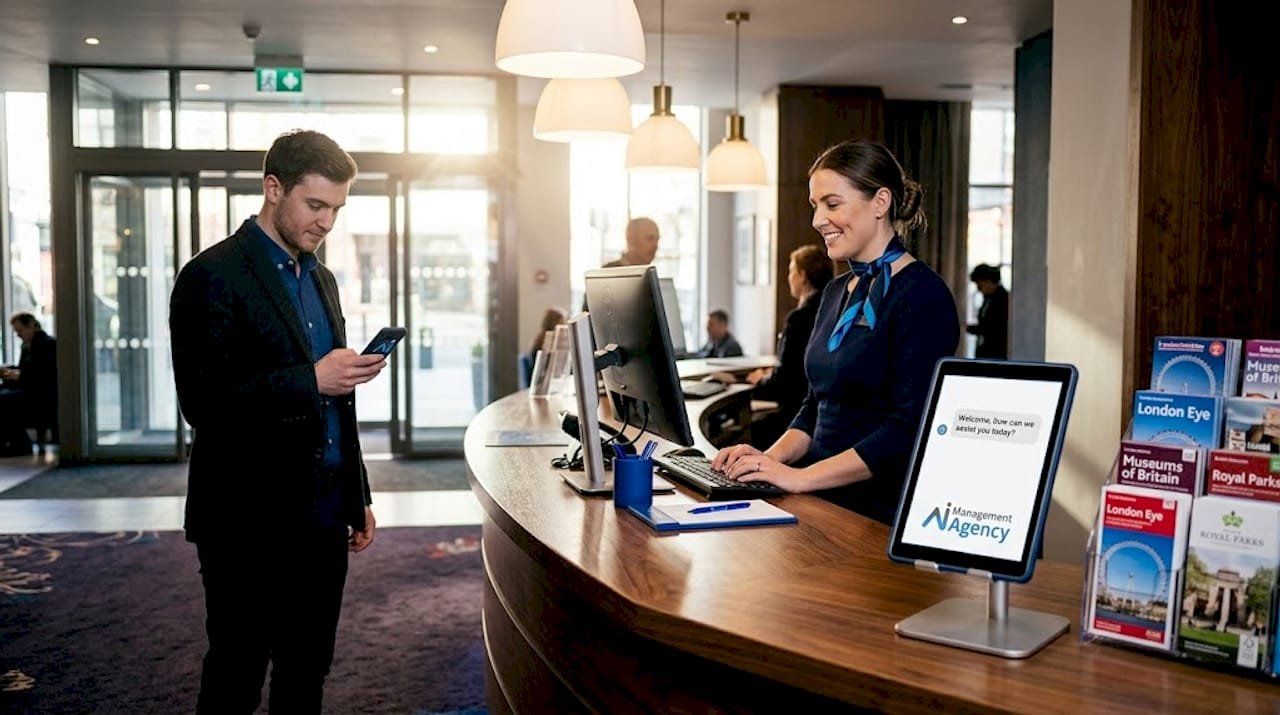
Voice AI agents sit within this category and are worth specific attention. A well-built voice agent answers calls in a natural tone, handles FAQs, and captures enquiries outside staffed hours. At Aimagency, this is one of the most requested solutions for UK hospitality clients.
3. Intelligent booking agents for direct reservations
Intelligent booking agents sit a step above pure conversational AI. They still interact with guests through natural dialogue, but they are connected to live pricing, availability, and reservation systems. The result is an agent that can guide a guest from initial interest through to a confirmed booking without human involvement.
Booking-focused AI agents filter availability and match guests to the right room type. The quality of that matching depends entirely on how current and structured your PMS and channel management data is. Hotels with stale or inconsistent listings will find these agents produce unreliable recommendations that erode guest trust.
The practical value for UK hotels is in capturing direct bookings during off-hours. A guest enquiring at 11pm about a weekend break in November should not receive an automated holding message. An intelligent booking agent can answer, qualify, and convert that enquiry in real time.
Pro Tip: If your direct booking rate is below 30% of total reservations, an intelligent booking agent is likely your highest-return starting point. The agent pays for itself by reducing OTA commission on conversions it captures directly.
4. Task automation AI agents for operational workflows
Task automation agents move beyond conversation into execution. They take defined inputs, such as a new reservation, a guest complaint, or a check-out notification, and trigger structured workflows without waiting for a human to initiate the next step.
Practical examples in hotel operations include:
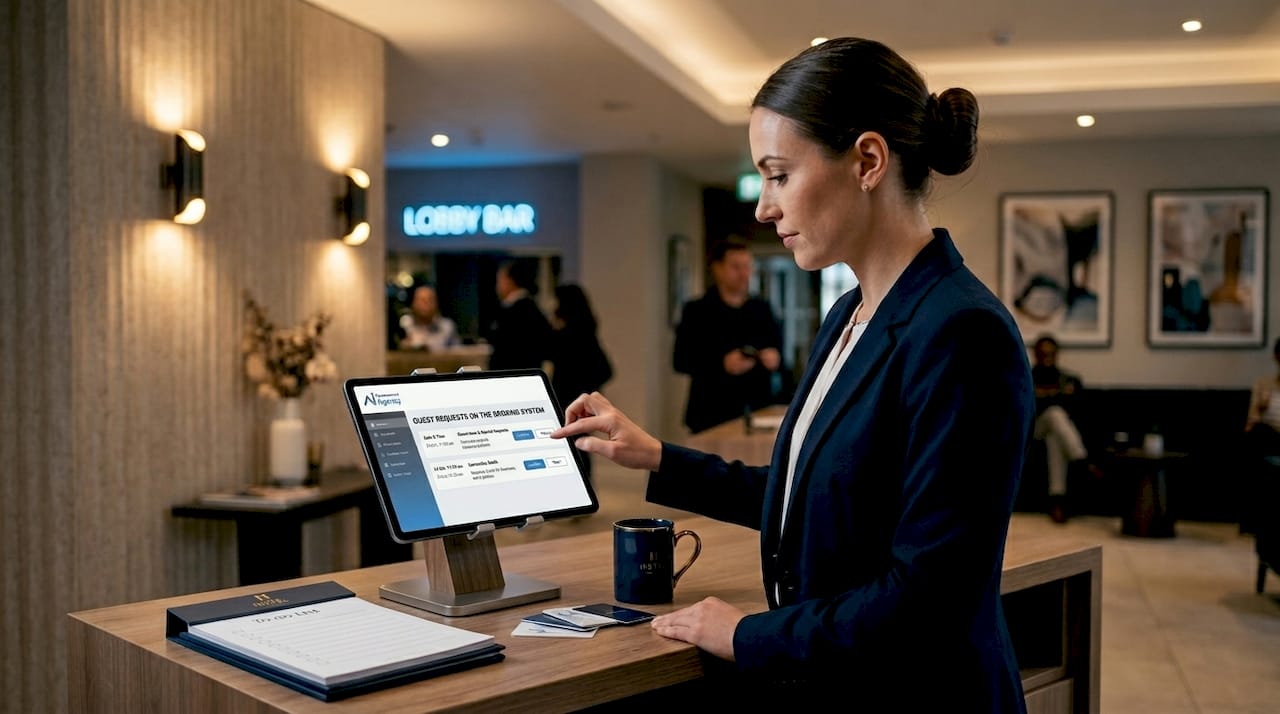
- Automatically assigning housekeeping rooms based on check-out time and staff availability
- Raising and routing maintenance requests when guests report issues
- Sending pre-arrival messages with check-in instructions and upsell offers
- Updating room status in the PMS after housekeeping completion is confirmed
The critical enabler here is integration. AI agents must connect cleanly with your PMS, ticketing systems, and messaging platforms to execute these workflows reliably. Without that connection, the agent becomes an isolated tool with limited scope.
Task automation agents reduce human error in repetitive processes and free staff to focus on guest-facing interactions that genuinely require human judgement. For independent hotels and small chains, even a modest reduction in manual co-ordination delivers measurable time savings across a week.
The constraints are that these agents operate within fixed parameters. They execute the workflow they are configured for. If a situation falls outside that scope, they cannot reason their way to a solution. Human oversight remains necessary for edge cases, complaints, and decisions requiring contextual judgement.
5. Agentic AI systems for autonomous hotel operations
Agentic AI represents the most advanced category. These systems do not just respond or execute predefined tasks. They act as an action layer across your PMS, CRM, point-of-sale, and IoT systems, maintaining guest memory and orchestrating multi-step workflows autonomously.
The distinction from chatbots and task automation agents is meaningful. Agentic systems evaluate progress toward a goal, decide their next action based on current data, and course-correct when circumstances change. They automate guest messaging, housekeeping co-ordination, pricing adjustments, review responses, and operational alerts without requiring manual triggers for each task.
Consider what this looks like in practice. When a VIP guest checks in, an agentic system can cross-reference their past preferences, assign their preferred room type if available, notify the restaurant of a dietary requirement noted from a previous stay, and trigger a personalised welcome message. All of this without a staff member co-ordinating any step.
AI agents in hospitality that operate at this level improve guest engagement, revenue generation, and operational efficiency simultaneously. Hilton’s generative AI concierge beta illustrates the guest-facing dimension, offering interactive trip planning and recommendation narrowing through follow-up questioning.
Agentic AI does carry the highest implementation complexity:
- Requires clean, current data across all connected systems
- Needs clearly defined guardrails for permitted autonomous actions
- Must include human approval workflows for high-impact decisions
- UK ICO compliance requires transparency when AI makes decisions that significantly affect guests
Pro Tip: Define what the system cannot do before you define what it can. Operational guardrails are not a limitation. They are what separates reliable autonomous operation from unpredictable behaviour that damages guest trust.
6. Comparison of AI agent types for UK hotels
Choosing the right type comes down to your hotel’s size, goals, current systems, and appetite for implementation complexity. The table below provides a direct comparison.
| Feature | Conversational / FAQ | Task automation | Agentic AI |
|---|---|---|---|
| Core function | Answers guest questions | Executes defined workflows | Orchestrates multi-system goals autonomously |
| Integration required | Low to moderate | Moderate to high | High |
| Autonomy level | Responds only | Acts within fixed parameters | Iterates and adapts toward goals |
| Suitable for | Any hotel size | Mid-size to large operations | Larger hotels or ambitious independents |
| Implementation complexity | Low | Moderate | High |
| Compliance considerations | Minimal | Moderate | Significant (UK ICO) |
| Typical ROI driver | Reduced call volume, faster response | Labour savings, fewer errors | Revenue optimisation, scalability |
Small independent hotels in the UK often find the best entry point is a combination of conversational AI with basic task automation. The conversational layer handles enquiries and booking capture. The automation layer reduces manual administration. Together, they deliver a measurable improvement in both guest experience and operational efficiency without the integration demands of a fully agentic system.
Larger hotels and chains with mature PMS infrastructure are well positioned to move toward agentic AI, particularly where AI-driven booking performance and guest personalisation at scale are priorities.
The most common pitfall at any size is deploying an AI agent without first auditing data quality. An AI system is only as reliable as the information it can access. If your room availability data, guest records, or maintenance logs are fragmented across systems with no clean integration, results will disappoint regardless of the AI agent type you choose.
My honest take on AI agents in UK hospitality
I’ve spent considerable time working with UK businesses on AI agent implementation, and the pattern I see most often is hotels selecting technology based on excitement rather than operational readiness.
Conversational AI is genuinely transformative when it replaces the 11pm unanswered phone call or the Monday morning backlog of enquiry emails. But I’ve seen hotels deploy chatbots, tick the AI box, and then wonder why nothing changed. The answer is almost always that the bot was not connected to anything meaningful.
What I’ve learned is that the distance between an AI agent working well in a demo and one working well in a live hotel environment is almost entirely about integration quality and operational design. The technology itself is ready. The surrounding infrastructure often is not.
My view is that UK hotel managers should prioritise getting their data house in order before chasing the most advanced agent type available. A well-integrated conversational and booking agent on clean data will consistently outperform a sophisticated agentic system running on fragmented, inconsistent information.
The future is absolutely agentic. Multi-system, goal-directed AI that co-ordinates your entire operation is not a distant prospect. It is deployable today for hotels that are ready. But ready means having the foundations in place, not just the ambition.
Start specific. Define one or two operational problems clearly. Choose the agent type that solves those problems cleanly. Build from there.
— Geoff
How Aimagency helps UK hotels find the right AI agent
Aimagency specialises in building and deploying high-quality AI agents for UK businesses, including hotels of all sizes. Whether you need an AI receptionist that answers calls 24/7 in a natural tone, a booking agent that captures direct reservations overnight, or a fully integrated solution that automates guest communications across departments, Aimagency builds it to your operational requirements.
The starting point is always a clear brief. Aimagency works with hotel managers to identify the right AI agent type, audit existing system integrations, and deploy solutions that deliver from day one. For UK hotels ready to act, AI agent advantages are well documented and the implementation pathway is more accessible than most expect. Discover how AI agents are driving bookings across UK hospitality in 2026 and speak to the Aimagency team about your next step.
FAQ
What are the main types of hotel AI agents?
The three main types are conversational AI agents that answer guest questions, task automation agents that execute defined operational workflows, and agentic AI systems that autonomously co-ordinate across multiple hotel platforms toward broader goals.
Which type of hotel AI agent suits a small independent hotel?
Most small independent hotels benefit from starting with a conversational or booking-focused AI agent, as these deliver strong ROI with lower integration requirements and manageable implementation complexity.
How is an AI agent different from a hotel chatbot?
AI agents are goal-directed systems that iterate, evaluate progress, and decide next steps. Standard chatbots respond to inputs without this purposeful, iterative behaviour, making them less reliable for complex operational tasks.
Do UK hotels need to comply with specific regulations when using AI agents?
Yes. The UK ICO has issued draft guidance placing transparency and safeguard obligations on hotels that use automated decision-making, particularly when those decisions significantly affect individual guests.
What is agentic AI in hotel operations?
Agentic AI operates as an action layer across hotel systems including PMS, CRM, and point-of-sale, maintaining guest memory and executing complex workflows autonomously without constant human input.
Recommended
- Boost sales with AI: a 2026 guide for small UK hotels – AI Management Agency
- Enhance guest experience with AI in UK hotels 2026 – AI Management Agency
- Role of AI agents explained: 30% more bookings UK 2026 – AI Management Agency
- AI in hotels: boost service and cut calls by 90% – AI Management Agency