TL;DR:
- AI call analytics enables hospitality businesses to identify guest intent, emotional tone, and cancellation signals across all calls, improving conversion rates and reducing cancellations. It provides real-time insights, automated trend detection, and objective coaching metrics, transforming guest interactions into a data-driven advantage. Small UK hotels can achieve significant benefits by starting with focused pilots, ensuring GDPR compliance, and gradually scaling their use of this technology.
Every phone call your hospitality business receives contains more useful information than most managers ever extract. Booking intentions, hidden objections, emotional frustration, cancellation signals — they are all there in the dialogue, waiting to be noticed. The problem is that humans cannot reliably spot patterns across hundreds of calls. AI call analytics changes that completely. Hotels using this technology have seen cancellations drop by 18% and booking conversions rise by 30%, which means the calls you are already taking could be your most underused business asset.
Table of Contents
- What is AI call analytics and why does it matter?
- Key benefits for hospitality businesses
- How AI call analysis works: from data to actionable insight
- Implementing AI call analytics in your hospitality business
- Why most small businesses miss out on the full value of AI call analytics
- Explore more AI-driven solutions for your hospitality business
- Frequently asked questions
Key Takeaways
| Point | Details |
|---|---|
| Reveal hidden call value | AI call analytics can surface patterns and insights that manual call handling misses. |
| Boost efficiency and sales | Hospitality businesses see fewer cancellations and higher bookings using AI-driven analysis. |
| Start with GDPR consent | Gaining explicit call recording consent is a legal and ethical priority for UK SMEs. |
| Track real performance metrics | Monitor FCR and CSAT to ensure AI delivers both efficient and high-quality service. |
| Begin with pilots | You do not need to overhaul everything—start with routine calls and scale success from there. |
What is AI call analytics and why does it matter?
AI call analytics is the practice of using artificial intelligence to automatically analyse telephone conversations. The system listens for trends, detects customer intent, measures emotional tone, and generates reports that help managers make faster, better decisions. It goes far beyond simple keyword spotting.
A traditional quality monitoring process might involve a supervisor listening back to a handful of recorded calls each week. AI call analytics reviews every single call, scores them against key criteria, and flags anything that needs immediate attention. That is a fundamentally different level of insight. You can learn more about the basics through AI call screening and how it connects to broader business advantages of AI for small businesses.
Key capabilities include:
- Sentiment detection: Measures whether a guest sounds frustrated, satisfied, or uncertain during a call.
- Cancellation flagging: Identifies language patterns that suggest a guest is about to cancel, allowing staff to intervene in real time.
- Empathy scoring: Rates how well a member of staff acknowledges guest concerns, creating a coachable metric.
- Intent classification: Differentiates between a routine enquiry and a genuine sales opportunity.
- Trend reporting: Shows which issues come up most frequently so you can fix root causes rather than individual complaints.
A common concern is GDPR compliance. In the UK, you must obtain explicit consent before recording a call. Most hospitality businesses already use a standard recorded message for this purpose, so adding AI analysis to that existing workflow is straightforward. The data is processed by the analytics platform, and reputable providers store it securely in line with UK data protection law.
| Feature | Traditional monitoring | AI call analytics |
|---|---|---|
| Calls reviewed | Sample only (5-10%) | 100% of all calls |
| Speed of insight | Days or weeks | Real time or same day |
| Empathy scoring | Subjective | Consistent and data-driven |
| Trend spotting | Manual and unreliable | Automatic and accurate |
| Cost per insight | High (supervisor time) | Low (automated) |
The AI analytics reduction in cancellations by 18% and the 30% boost in conversions are not exclusive to large hotel chains. Small UK hospitality businesses with a handful of staff are achieving similar gains by starting with a focused pilot.
Pro Tip: If you are worried about sounding “robotic” to guests, remember that AI analytics works silently in the background. Your staff still handle the call naturally. The AI simply listens and reports.
Key benefits for hospitality businesses
Understanding what AI call analytics is matters less than understanding what it will do for your bookings, your team, and your guest satisfaction scores. The evidence is compelling.
Hotels reduced cancellations by 18% and increased booking conversions by 30% after introducing AI call analysis into their customer service workflow. That is not a marginal improvement. For a 20-room boutique hotel handling 200 booking calls a month, a 30% uplift in conversions could mean dozens of additional room nights per month.
Here is how those gains break down in practical terms:
- Real-time cancellation intervention: When the AI detects specific phrases or negative sentiment during a live call, it can alert a supervisor immediately. That supervisor can step in, offer a solution, or empower the receptionist to make a goodwill gesture before the guest hangs up.
- Empathy-based coaching: Staff who score consistently low on empathy are identified automatically. Managers can address this through targeted coaching rather than guessing which team members need support.
- Distinguishing routine from revenue: Not every call is a sales opportunity, but some are. AI analytics learns to tell the difference between a guest asking for directions and a caller ready to make a group booking for a wedding party. Prioritising those calls correctly is a direct revenue lever.
- Guest satisfaction prediction: With predictive accuracy up to 87%, AI can forecast which guests are likely to leave a negative review before they even check out. That window of opportunity to turn things around is enormously valuable.
| Metric | Without AI analytics | With AI analytics |
|---|---|---|
| Cancellation rate | Baseline | Down 18% |
| Booking conversion rate | Baseline | Up 30% |
| Guest satisfaction prediction | Reactive | 87% accuracy predictive |
| Empathy monitoring | Ad hoc | Consistent and scored |
Explore the full range of ways to use AI in hotels and how AI in call centres for hotels is reshaping frontline guest communication.
Statistic spotlight: A 30% increase in booking conversions from existing call volume means more revenue without spending a penny more on marketing. AI call analytics monetises calls you are already receiving.
The shift from reactive to proactive guest management is the real prize here. Instead of reading negative reviews after the fact, you are preventing them. Instead of losing guests to competitors because your phone team missed the signals, you are converting them.
How AI call analysis works: from data to actionable insight
The technology can seem opaque from the outside. Breaking it down into clear steps makes it far less daunting.
- Call recording: Every inbound or outbound call is recorded, with consent given at the start of the conversation. This is your raw data.
- Transcription: The AI converts speech to text in real time or shortly after the call ends. Modern systems handle accents and hospitality terminology accurately.
- Emotion and language analysis: Natural language processing (NLP) scans the transcript for sentiment, tone shifts, specific trigger phrases, and patterns of dissatisfaction or enthusiasm.
- Intent classification: The system categorises each call. Was it a booking enquiry, a complaint, a cancellation request, or a general question?
- Empathy scoring: Staff responses are rated based on acknowledgement language, solution-offering, and tone alignment with the guest.
- Trend detection: Across hundreds of calls, patterns emerge. Are guests frequently asking about parking? Is a particular staff member struggling with upselling? Are cancellations spiking on Friday afternoons?
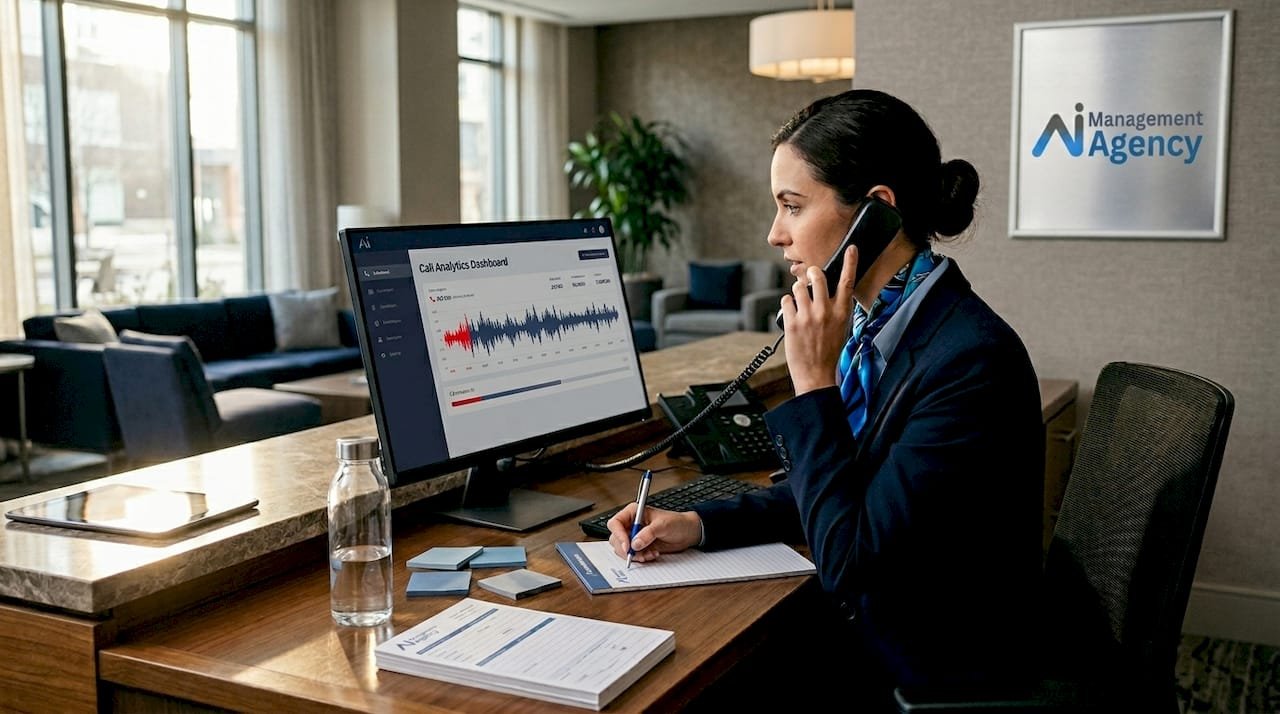
- Reporting and alerts: Managers receive dashboards, exception alerts, and coaching reports. Some systems push real-time notifications during live calls.
A practical example: a guest calls a UK boutique hotel to cancel a booking. Within seconds of detecting cancellation-intent language, the AI flags the call. A supervisor sees the alert, checks availability for flexible rate options, and messages the receptionist with a suggested retention offer. The guest stays on the line and rebooks at a different date. That sequence, powered by AI-driven analysis, happens without disrupting the natural flow of the conversation.
Practical sales call strategies suggest that well-timed empathetic responses during the first objection window are the biggest driver of conversion. AI analytics makes sure your team knows exactly when that window is opening.

Pro Tip: Track First Call Resolution (FCR) alongside Customer Satisfaction (CSAT) scores from day one. FCR tells you how often guests get their issue resolved in a single call. CSAT tells you how they felt about it. Together, they give you a balanced picture of efficiency and quality. Predictive satisfaction scoring reaching 87% accuracy only adds further value to these baseline metrics.
Implementing AI call analytics in your hospitality business
Moving from interest to action is where most businesses stall. A structured approach makes adoption straightforward and keeps your team on board from the start.
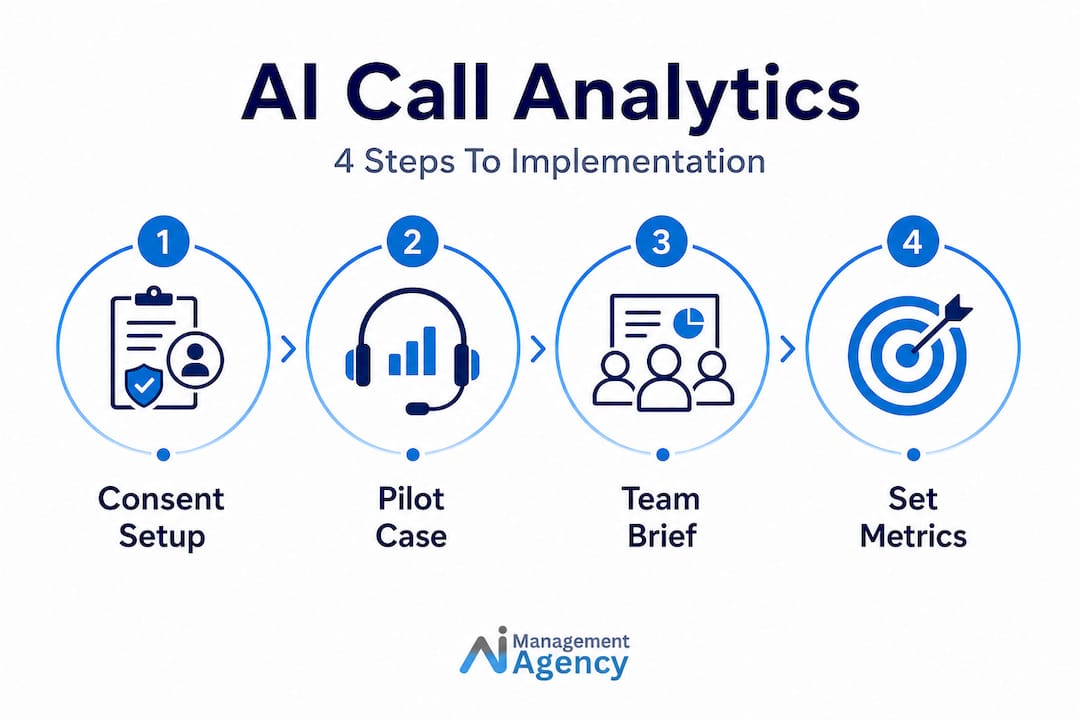
Step 1: Establish GDPR-compliant recording consent
Update your call introduction message to clearly inform callers that the call may be recorded and analysed for quality purposes. This is a legal requirement in the UK and a straightforward one to implement.
Step 2: Choose a focused pilot use case
Do not try to analyse every type of call at once. Start with booking enquiries. This is where cancellation risk and conversion opportunity are highest, and where your ROI will be most visible. UK hospitality businesses that pilot call analytics on routine queries can deflect over 40% of simple calls and improve key service metrics significantly.
Step 3: Brief your team honestly
Staff engagement is critical. Explain that the AI is a coaching tool, not a surveillance system. Share the data with them, involve them in setting performance targets, and celebrate improvements visibly. Teams that understand the purpose of analytics use it as a source of professional development rather than a source of anxiety.
Step 4: Set clear success metrics
Before the pilot launches, agree on what success looks like. Define your baseline FCR, CSAT, and conversion rate. Set a realistic target for improvement over 60 to 90 days. AI productivity tools work best when paired with clear measurement frameworks from the outset.
Step 5: Review, adjust, and scale
At the end of your pilot period, review the data honestly. Did cancellations fall? Did conversion rates improve? Where did the empathy scores lag? Use the findings to refine your training and then extend the analytics to other call types such as complaints or group bookings.
Key considerations during implementation:
- Always appoint one internal champion who owns the analytics dashboard.
- Schedule fortnightly team briefings using AI-generated call reports.
- Use low-empathy call recordings (with staff consent) as anonymous coaching examples.
- Set up automated alerts for high-risk cancellation calls from day one.
- Review your GDPR consent process with your data protection officer before going live.
Why most small businesses miss out on the full value of AI call analytics
Here is the honest reality: many small UK hospitality businesses know AI call analytics exists, investigate it briefly, and then quietly decide it is “for bigger operations.” That assumption is one of the most costly mistakes you can make.
The hesitation usually comes from two places. First, fear of complexity. Business owners imagine months of technical setup, IT consultants, and disruption to daily operations. Second, fear of privacy risk. Nobody wants a data protection incident on their hands. Both fears are understandable and both are largely misplaced when you work with the right provider.
The real risk is not in adopting AI analytics. The real risk is continuing to manage guest calls without it. Every week you operate without call analytics, you are losing bookings to undetected cancellation signals, missing coaching opportunities with your team, and making operational decisions based on anecdote rather than data.
The businesses that extract the most value from this technology are not the ones with the largest budgets or the most sophisticated setups. They are the ones who started a modest pilot, measured it carefully, and iterated from there. A predictable growth case study from our own client portfolio demonstrates exactly this: small, deliberate steps with AI produced measurable commercial gains within 90 days.
The contrarian truth is this: waiting for a perfect, fully integrated solution means waiting indefinitely. A humble pilot on booking calls, run for two months, will teach you more than a year of research. Start narrow. Measure honestly. Scale what works.
Explore more AI-driven solutions for your hospitality business
If this article has sparked ideas about how AI can improve your call handling, guest experience, and operational efficiency, there is a clear next step available to you.
At AI Management Agency, we specialise in building high-quality AI agents designed specifically for businesses like yours. Our AI receptionists speak in a natural, professional tone, answer calls around the clock, handle FAQs, and book qualified appointments directly into your calendar. Explore our full range of AI call handling solutions or browse practical AI appointment examples tailored for UK hotel and hospitality operations. Whether you are starting your first pilot or ready to scale, we have the tools and expertise to move you forward.
Frequently asked questions
How accurate are AI call analytics for predicting satisfaction?
AI call analytics can predict guest satisfaction with up to 87% accuracy, based on real-world hotel data. This predictive capability gives hospitality businesses a genuine opportunity to intervene before a guest experience turns negative.
Is AI call analysis GDPR compliant for UK hospitality businesses?
Yes, it can be compliant, provided you always inform callers that their call is being recorded and processed, in line with GDPR call recording consent requirements. Working with a reputable provider who stores data securely within approved jurisdictions is equally important.
Can my small hotel really benefit, or is AI just for big chains?
Even small UK hospitality businesses have seen measurable results. Hotels saw cancellations fall by 18% and booking conversions rise by 30% using AI call analytics, regardless of property size. A focused pilot on booking calls is all you need to start generating that evidence for your own business.
What metrics should I track to measure AI call analytics success?
Focus on First Call Resolution (FCR) and Customer Satisfaction (CSAT) as your primary indicators. These two metrics together balance efficiency with service quality and will tell you clearly whether your AI analytics investment is delivering results worth scaling.
Recommended
- AI-Powered Sales Call Analysis: Improve Sales with Aimagency in 2026
- Aimagency: AI-Driven Solutions for Sales & Marketing Growth in 2026
- Case Study: From Missed Calles to Predictable Growth with AI Sales & Receptionist Support – AI Management Agency
- Why use AI phone agents? Boost efficiency 24/7 – AI Management Agency