
TL;DR:
- A multilingual AI agent understands and communicates in multiple languages seamlessly, enhancing customer interactions across diverse markets. Unlike translation engines, native agents preserve cultural nuances, reduce latency, and handle code-switching effectively in real-time. Deploying such systems provides businesses with faster response times, consistent branding, and scalable multilingual support, giving a significant competitive advantage.
A multilingual AI agent is an artificial intelligence system that understands, processes, and communicates in multiple languages with native-level nuance, going far beyond word-for-word translation. These systems power everything from AI voice receptionists to automated customer service platforms, and in 2026, models like GPT-4 support 50 to 100+ languages with practical deployment capability. That breadth matters enormously for businesses operating across diverse markets, where a single AI agent can handle customer queries in Mandarin, Arabic, or Spanish without switching systems or hiring additional staff. The core technology relies on cross-lingual transfer, shared embedding spaces, and multilingual pretraining, making these agents genuinely capable rather than simply clever translators.
What is a multilingual AI agent and how does it differ from translation?
A multilingual AI agent is not a translation engine with a chatbot bolted on top. The distinction is architectural and consequential. Standard translation tools convert text from one language to another, losing register, cultural context, and conversational tone in the process. A true multilingual AI system understands language natively, applying cross-lingual transfer to carry reasoning, sentiment detection, and contextual awareness across languages without retraining the model from scratch for each one.
This matters in practice. When a customer contacts a business in Hindi and switches mid-conversation to English, a translation-based system struggles. A native multilingual conversational agent recognises the shift, processes both languages simultaneously, and responds in whichever language the customer prefers. The result is an interaction that feels natural rather than mechanical. For businesses, that difference directly affects customer satisfaction and conversion rates.
The term “multilingual AI agent” is the widely used descriptor, but the recognised industry framing is cross-lingual AI or multilingual large language model (LLM) deployment. Both terms refer to the same capability set, and understanding the technical vocabulary helps when evaluating vendors or briefing development teams.
How multilingual AI works: architecture and core principles
The technology behind these agents operates across three interconnected layers: speech-to-text (STT), a large language model (LLM), and text-to-speech (TTS). Each layer must handle multiple languages natively for the system to perform well.
Here is how each component contributes:
- Speech-to-text: Transcribes spoken input in the user’s language, preserving accent and dialect signals rather than normalising everything to a standard accent.
- Large language model: Processes the transcribed text using multilingual embeddings, where semantically related content in different languages occupies the same vector space. Cross-lingual retrieval allows the model to find relevant information regardless of the query language, without explicit translation.
- Text-to-speech: Generates a response in the user’s language, matching tone, register, and dialect rather than producing a generic synthetic voice.
The critical architectural principle is avoiding mid-pipeline translation to English. End-to-end multilingual architectures propagate language tags, dialect markers, and style signals through every layer, preserving cultural nuance and reducing latency. Routing everything through English first introduces delay and flattens the cultural texture of the response, which customers notice immediately.
For voice-based AI agents, sub-second turn-taking performance is the industry standard in 2026, achieved through incremental STT, streaming LLM processing, and streaming TTS. That responsiveness is what makes a voice agent feel like a conversation rather than a query system.
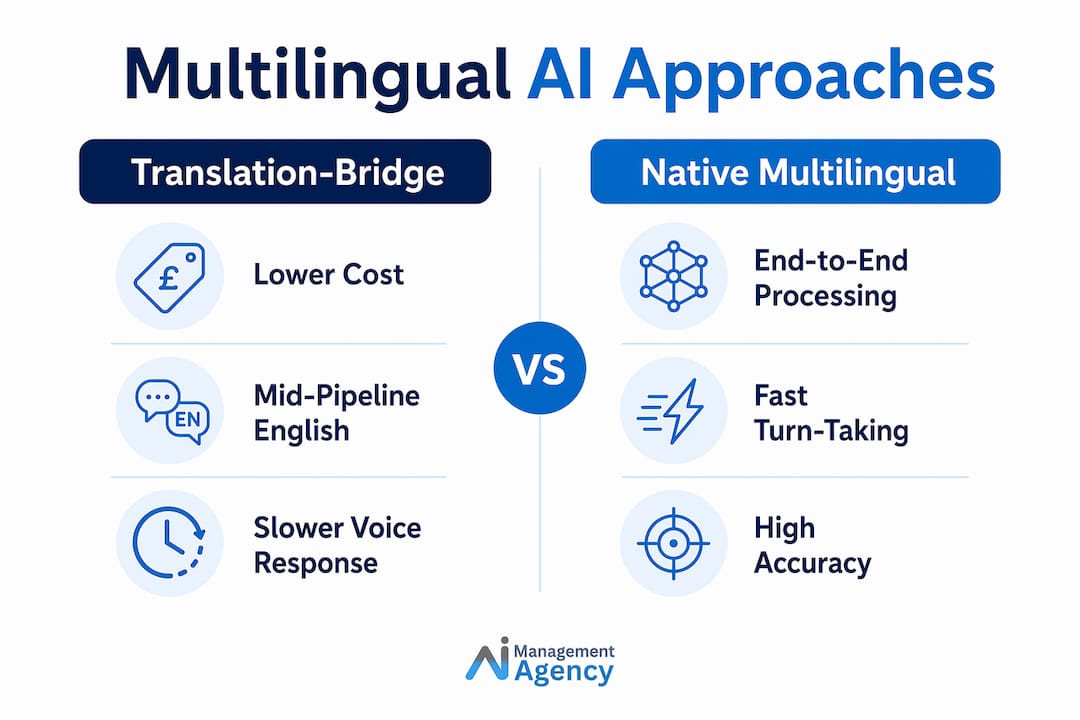
Pro Tip: When evaluating a multilingual AI voice agent, ask the vendor whether the pipeline translates to English at any point. If it does, expect higher latency and reduced cultural accuracy, particularly for tonal languages like Mandarin or Vietnamese.
Translation-based vs native multilingual approaches: which is right for your business?
The two dominant architectural approaches each carry genuine trade-offs, and the right choice depends on your use case, budget, and the languages you need to support.
| Approach | Strengths | Weaknesses | Best suited for |
|---|---|---|---|
| Translation-bridge | Lower initial cost, easier to implement, broad language coverage via existing APIs | Higher latency, cultural flattening, poor performance on idiomatic speech | Text-based FAQs, simple query routing, low-stakes interactions |
| Native multilingual model | Lower latency, culturally accurate, handles code-switching and dialect | Higher compute cost, requires more data for low-resource languages | Voice agents, sales conversations, complex customer service |
| Hybrid model | Balances cost and quality, uses native processing for priority languages | Complexity in managing two systems, inconsistent quality across languages | Businesses with a primary market language plus secondary support languages |
The translation-bridge approach works acceptably for written text where a half-second delay is invisible. For voice AI agents, that delay is disqualifying. A customer calling a business expects a response in under a second. Translation pipelines cannot reliably deliver that.
Native multilingual models, built on architectures like mBERT or GPT-4, handle this well for high-resource languages. The challenge emerges with less common languages, where training data is sparse and model performance degrades noticeably. Hybrid approaches address this by applying native processing to the languages that matter most to a business and using translation as a fallback for edge cases.
Challenges unique to multilingual AI agents and current solutions
Deploying a multilingual AI system in a real business environment surfaces problems that rarely appear in controlled testing. These are the four most significant challenges, and the current best-practice responses to each.
-
Low-resource language performance. Models trained on English and Mandarin perform poorly on languages with limited digital text corpora. Fine-tuning addresses this directly. Adapting a base model like Gemma 4 with 15.9 million examples over approximately seven days of compute time produces near-native fluency for specific low-resource languages at a cost of roughly £500. That is a viable investment for businesses serving specific regional markets.
-
Code-switching. Users frequently mix languages within a single sentence, particularly in multilingual regions like India, Singapore, or South Africa. Effective agents handle this through multi-signal language detection, calculating the proportional use of each language in a query (for example, 75% Hindi and 25% English) rather than forcing a single-language classification. The agent then responds in the dominant language while acknowledging the mixed input naturally.
-
Transliteration and script matching. A user might type a Hindi word using Latin characters rather than Devanagari script. Without transliteration normalisation at the indexing level, the agent fails to match the query to the correct document or response. Adding transliterated variants of terms to the index at build time solves this without adding query-time processing overhead.
-
Cultural register and quality assurance. Grammatical accuracy is not sufficient. A response that is technically correct but culturally inappropriate damages customer trust. Native-speaker review before full deployment remains best practice, particularly for complex languages or markets where formality conventions differ significantly from English norms.
Pro Tip: Build a language-specific test set using real customer queries before deploying any multilingual agent. Synthetic test data rarely captures the code-switching and colloquial phrasing that actual users produce, and failures in production are far more costly than failures in testing.
Benefits of multilingual AI agents for businesses in diverse markets
The practical case for deploying multilingual conversational agents is straightforward, and the operational benefits compound across multiple business functions.
- Customer service at scale. A single AI agent can handle inbound queries in dozens of languages simultaneously, without the staffing overhead of a multilingual human team. For UK businesses with international customers, this removes a significant barrier to market expansion.
- Reduced response times. Customers receive answers in their preferred language immediately, rather than waiting for a bilingual agent to become available. This is particularly impactful for AI business communication where speed directly affects customer satisfaction scores.
- Consistent brand voice across languages. Human multilingual teams vary in quality and tone. An AI agent applies the same register, terminology, and brand guidelines in every language, every time.
- Sales and appointment booking. AI language agents can qualify leads, answer product questions, and book appointments in the customer’s language without human intervention. Aimagency’s AI receptionist does exactly this, operating 24/7 across languages and booking qualified sales appointments without dropping calls or losing context.
- Analytics across language groups. Multilingual agents capture structured data from every interaction regardless of language, giving businesses a unified view of customer behaviour across markets. This feeds directly into AI-driven workflows that improve over time as the agent learns from real interactions.
The types of AI agents deployed in multilingual contexts range from voice receptionists and sales assistants to support bots and outbound calling agents. Each type benefits from native multilingual architecture for the same reasons: lower latency, higher accuracy, and better customer experience.
Key takeaways
A multilingual AI agent delivers genuine cross-lingual understanding through native architecture, not translation, making it the only viable solution for businesses that need accurate, fast, and culturally appropriate customer interactions across multiple languages.
| Point | Details |
|---|---|
| Definition is architectural | A multilingual AI agent uses cross-lingual transfer and shared embeddings, not translation pipelines. |
| Avoid mid-pipeline translation | End-to-end multilingual architectures reduce latency and preserve cultural nuance in every response. |
| Code-switching requires multi-signal detection | Agents must calculate language proportions in mixed-language queries to respond accurately. |
| Low-resource languages need fine-tuning | Adapting base models with domain-specific data produces near-native fluency for underserved languages. |
| Native-speaker QA is non-negotiable | Human review before deployment catches cultural and register errors that automated testing misses. |
Why true multilingual AI is no longer optional
I have worked with businesses that assumed a translation API was sufficient for multilingual customer engagement. It rarely is, and the failure mode is always the same: the agent sounds foreign to the customer, trust erodes, and conversion drops. The problem is not the translation quality. It is that translation, even excellent translation, signals to a customer that the business has not genuinely invested in speaking their language.
The shift to native multilingual models changes that dynamic entirely. When an AI voice agent responds in natural, contextually appropriate Urdu or Polish, the customer’s experience is indistinguishable from speaking with a fluent human. That is not a marginal improvement. It is the difference between a customer who feels served and one who feels processed.
My advice for developers building these systems: prioritise the streaming architecture from day one. Retrofitting sub-second latency into a pipeline that was designed around translation is expensive and often impossible without rebuilding from scratch. And for business owners evaluating vendors: ask for a live demonstration in your target language, not a polished demo in English. The gap between the two is where the real capability of a multilingual AI system becomes visible.
The businesses that deploy genuine multilingual AI agents in 2026 will have a structural advantage in international markets. Those that rely on translation workarounds will find that advantage increasingly difficult to close.
— Geoff
How Aimagency helps UK businesses deploy multilingual AI agents
Aimagency specialises in building high-quality AI agents that handle real business tasks, including multilingual voice receptionists that answer calls 24/7, respond to FAQs, and book qualified sales appointments in the customer’s language.
Whether you are a small UK business looking to serve international customers or a developer building a multilingual customer service platform, Aimagency provides bespoke AI agent solutions tailored to your market and language requirements. The team designs agents that operate natively across languages, not through translation shortcuts, so your customers always receive accurate, culturally appropriate responses. Explore the advantages of AI agents for small UK businesses, or review the AI agent best practices guide to understand what a well-deployed multilingual agent looks like in production. Contact Aimagency directly to discuss a solution built around your specific languages and use case.
FAQ
What is a multilingual AI agent in simple terms?
A multilingual AI agent is an AI system that understands and responds in multiple languages natively, using cross-lingual models rather than translation. It handles customer queries, books appointments, and manages conversations in the user’s preferred language without switching systems.
How does a multilingual AI agent handle mixed-language input?
The agent uses multi-signal language detection to calculate the proportion of each language in a query, for example 75% Hindi and 25% English, then responds in the dominant language. This approach, known as code-switching handling, produces natural, context-aware responses rather than forcing a single-language classification.
Which languages can multilingual AI agents support?
Models like GPT-4 support 50 to 100+ languages with varying quality. High-resource languages such as English, Spanish, and Mandarin perform at near-native levels. Low-resource languages require additional fine-tuning with domain-specific data to reach comparable fluency.
Is a multilingual AI agent better than hiring multilingual staff?
For high-volume, repeatable interactions such as FAQs, appointment booking, and initial customer qualification, a multilingual AI agent is faster, more consistent, and available 24/7. Human agents remain superior for complex, emotionally sensitive, or high-stakes conversations where nuanced judgement is required.
How long does it take to deploy a multilingual AI agent?
Deployment timelines vary by complexity and the number of languages required. Fine-tuning a base model for a specific low-resource language takes approximately seven days of compute time. Full deployment including quality assurance and integration with existing workflows typically takes several weeks for a production-ready system.