Most small business owners assume AI is either too expensive or too complicated to be worth exploring. That assumption is costing them time and money. AI efficiency gains of 70% and cost reductions of 35 to 50% in customer service are now being recorded by UK SMEs that have made targeted, affordable AI investments. This guide cuts through the noise. You will learn what AI actually means for a micro-business, which tools deliver real results, what risks to watch for, and how to take your first confident step without blowing your budget.
Table of Contents
- What does AI mean for your small business?
- Key benefits of AI in business communication
- Typical use cases: how UK micro-businesses apply AI
- Risks, pitfalls and what to watch for
- Getting started: a practical AI adoption roadmap
- Expert help and next steps for AI in your business
- Frequently asked questions
Key Takeaways
| Point | Details |
|---|---|
| Easy, affordable tools | UK micro-businesses can start using AI for communication for less than £50 a month. |
| Fast ROI and efficiency | Most firms see 70% efficiency boosts and big cost savings within months. |
| Keep the human touch | AI handles repetitive tasks well but human oversight is vital for complex situations. |
| Pilot, measure, refine | Best results come from starting with one process, tracking KPIs, and regular review. |
What does AI mean for your small business?
AI in business communication is not about robots or science fiction. For a small firm with up to five employees, it simply means software that automates, answers, and organises customer contacts on your behalf. Think of it as a tireless team member who never takes a lunch break.
Here is what AI typically handles for micro-businesses:
- Responding to common customer questions around the clock
- Scheduling appointments and sending reminders automatically
- Sorting and routing incoming emails or messages
- Handling FAQ queries on your website via live chat
- Following up with leads so nothing slips through the cracks
The good news is that you do not need a large budget to get started. Affordable tools designed specifically for small firms are widely available, and understanding the AI agent basics is far simpler than most people expect.
The numbers back this up. Businesses that adopt AI correctly see a 392% ROI in under a year, and most achieve this using basic chat or email tools rather than complex systems. UK micro-businesses using AI report saving between £500 and £2,000 a month in admin time alone. That is a meaningful figure for any small team.
Key benefits of AI in business communication
With the basics out of the way, let us look at exactly how AI delivers value to micro-businesses every day.
The core advantages are straightforward:
- Automation of repetitive tasks: Follow-ups, scheduling, and FAQ responses happen without you lifting a finger.
- More time for what matters: When admin is handled, you can focus on sales, relationships, and growth.
- Round-the-clock availability: Customers get answers at 10pm on a Sunday, not just during office hours.
- Lower admin costs: Reduced reliance on human resource for routine queries cuts your monthly spend.
- Smarter, faster responses: AI pulls from your data to give personalised, accurate replies at speed.
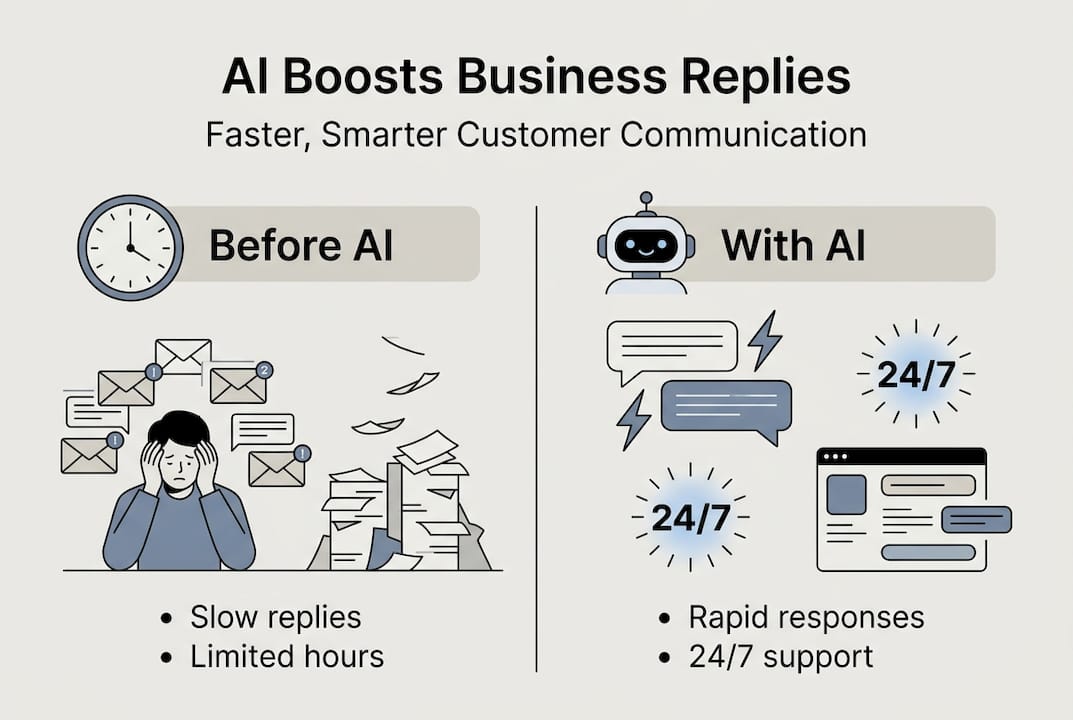
Here is a snapshot of what AI-powered communication can deliver:
| Metric | Before AI | After AI |
|---|---|---|
| Average response time | 4 to 8 hours | Under 2 minutes |
| Out-of-hours coverage | None | 24/7 |
| Monthly admin cost | £800 to £1,500 | £200 to £400 |
| Customer satisfaction score | 65% | 85%+ |
The results are compelling, but context matters. Only 30% of small businesses that adopt AI see significant productivity gains, even though 89% are using it in some form. Success depends almost entirely on how you implement it, not just whether you use it.
Explore AI-powered efficiency examples and smart AI tools built for SMEs to see what is working for businesses like yours.
“The businesses seeing the biggest returns are not using the most sophisticated AI. They are using the right AI for the right task, consistently.”
Pro Tip: Start with the channel where you receive the most messages, whether that is email or web chat. Nail one channel before expanding to others.
Typical use cases: how UK micro-businesses apply AI
Understanding the benefits is just the start. Let us see how real SMEs are applying AI right now.
The most common and effective applications for micro-businesses include:
- Live chatbots on your website that answer queries instantly, day or night
- AI email autoresponders that handle out-of-hours and holiday enquiries professionally
- Automated appointment booking with calendar integration and reminder messages
- AI voice assistants that manage inbound phone calls and route them intelligently
For continuous AI support around the clock, voice and chat tools are the most impactful starting points. You can also read our AI answering guide for a step-by-step breakdown of how these tools work in practice.

Here is a comparison of popular tools suited to UK micro-businesses:
| Tool | Best for | Starting cost | Key strength |
|---|---|---|---|
| Tidio | Web chat and email | From £29/month | Easy setup, great for e-commerce |
| HubSpot AI | CRM and follow-ups | Free tier available | Integrates with sales workflows |
| ChatGPT (API) | Custom responses | From £20/month | Flexible, highly customisable |
| AI receptionist | Phone and booking | From £50/month | Handles calls 24/7, books appointments |
UK micro-companies are advised to prioritise tools like these, with most starting from around £50 per month for chat or email automation. You can also explore practical AI use cases for further inspiration.
To pilot your first AI tool, follow these steps:
- Identify your busiest communication channel (email, phone, or web chat)
- Choose one affordable tool from the comparison above
- Set it up with your most common FAQs and business information
- Run it live for two to four weeks with real customer queries
- Review the results and refine before expanding
Risks, pitfalls and what to watch for
While the upside is real, it is critical you are aware of the potential risks, even if you are just starting out.
The most common problems micro-businesses encounter include:
- AI hallucinations: The tool gives a confident but incorrect answer, confusing or misleading your customer
- Poor handling of emotional queries: A frustrated customer needs empathy, not a scripted response
- GDPR and privacy risks: Storing or processing customer data incorrectly can lead to serious compliance issues
- Over-reliance without oversight: Assuming the AI is always right without checking its outputs regularly
Signs you need more human oversight in your AI setup:
- Customers are complaining about irrelevant or confusing replies
- Your AI is handling sensitive complaints without escalation
- You have not reviewed AI outputs in more than two weeks
- Your tool has no clear handover process to a real person
Understanding the hidden risks of AI automation is essential before you go live. You should also review AI answering service pitfalls and AI voice bot challenges specific to small firms. For guidance on data handling, review GDPR and privacy measures relevant to your setup.
“This only works with clear escalation rules and regular review. Without them, you are handing your customer experience to a tool that has no judgement.”
Pro Tip: Before going live, define your red, yellow, and green flag queries. Green flags the AI handles alone. Yellow flags it handles but flags for your review. Red flags go straight to a human every time.
Getting started: a practical AI adoption roadmap
Ready to put AI to work for you? This practical roadmap will get you confident and results-focused from the outset.
Follow these steps to launch your first AI communication tool successfully:
- Pick one process to automate first, such as web chat or email responses
- Choose a GDPR-compliant tool with EU-based data processing and clear privacy policies
- Load it with your FAQs and key business information before going live
- Set escalation rules so complex or sensitive queries reach a real person
- Monitor your KPIs weekly: track response time, resolution rate, and customer satisfaction
- Run a weekly audit for the first month to catch errors and refine responses
- Expand gradually once your first channel is performing consistently well
Piloting one channel and measuring KPIs like response time is the proven approach for sustainable results. It is also worth noting that 76% of AI failures in small businesses come down to skills gaps and poor implementation, not the technology itself.
For detailed AI rollout steps and real-world UK case studies, explore what other small firms have achieved. Research also highlights the importance of maintaining human touch alongside automation, particularly for relationship-driven businesses.
Pro Tip: Always choose providers with EU servers and a clear data processing agreement. This keeps you GDPR compliant from day one and protects your customers’ information.
Expert help and next steps for AI in your business
If you want to move faster, expert support helps avoid roadblocks and realises AI’s full value safely and effectively.
Knowing where to start is one thing. Getting it right from the beginning is another. Working with specialists who understand both the technology and the realities of running a small UK business means you avoid the costly trial-and-error phase that trips up so many first-time adopters.
At AI Management Agency, we build high-performing AI agents that speak naturally, handle calls around the clock, respond to FAQs, and book qualified sales appointments directly into your calendar. Our AI receptionist solutions are designed specifically for small UK businesses that want professional, reliable customer communication without the overhead of additional staff. Visit AI Management Agency to explore our solutions, read client success stories, and speak with a specialist about what AI can do for your business today.
Frequently asked questions
What’s the best first step for adding AI to my small business communication?
Start by automating your busiest channel, usually web chat or email, using a simple tool and monitor results for a few weeks before expanding.
How much does AI for customer communication cost UK micro-businesses?
Most tools start from under £50 a month, and typical monthly savings range from £500 to £2,000, meaning payback is rapid even for the smallest teams.
Will AI replace my need for staff?
AI handles basic and repetitive tasks efficiently, but human touch remains key for nuanced, emotional, or relationship-driven conversations that require genuine judgement.
What’s the biggest risk with AI in small business use?
The main risk is incorrect or confusing responses if you do not set clear rules. AI hallucinations and poor output require regular human review to catch and correct.
Can I use AI and stay GDPR compliant?
Yes. Choose providers with strong privacy policies, EU data processing agreements, and schedule regular audits to maintain full compliance.
Recommended
- How to Optimise AI Responses for Small Hospitality Teams – AI Management Agency
- Top AI solutions for founders: boost efficiency, win customers – AI Management Agency
- AI Automation Solutions: Drive B2B Revenue Growth with AI – Book Now
- Uses of AI in SMEs: boost efficiency with smart tools 2026 – AI Management Agency
- Practical AI Insights for Clients: Key Takeaways from the 2025 Meltwater Summit