
TL;DR:
- A virtual agent is AI-powered software that automates tasks, integrates with enterprise systems, and enables natural conversations, unlike basic chatbots. Its operational success depends on deep system integration, proactive engagement, and continuous improvement, which deliver significant benefits such as reduced workload and improved customer satisfaction. Treating virtual agents as workflow infrastructure rather than simple chat tools ensures genuine return on investment for UK businesses.
A virtual agent is AI-powered software that engages users through natural conversation, automates tasks, and connects to enterprise systems to deliver measurable operational results. The term is often used interchangeably with “chatbot” or “virtual assistant,” but those labels describe fundamentally different technologies. Understanding the distinction matters enormously if you are a UK business owner evaluating where AI can genuinely reduce costs and improve service. Platforms such as IBM Watson Assistant, Zoom Virtual Agent, and NiCE Cognigy represent the current generation of this technology, and UK enterprises are already deploying them at scale.

What is a virtual agent and how does it differ from a chatbot?
A virtual agent is AI-powered conversational software that combines natural language processing, machine learning, and enterprise system integration to handle dynamic, unscripted interactions. Unlike a basic chatbot, it does not simply match keywords to pre-written answers. It understands intent, retrieves live data, executes tasks, and adapts its responses based on context.
The definition of virtual agent technology sits at the intersection of conversational AI and workflow automation. A chatbot answers a question. A virtual agent answers the question, checks your account balance, reschedules your appointment, and sends you a confirmation, all within the same interaction. That operational depth is what separates the two categories.
The term “digital agent” is also used in some UK enterprise contexts, particularly when referring to autonomous AI systems that initiate actions without waiting for a human prompt. Whether the label is virtual agent, AI agent, or digital agent, the core capability is the same: the system reasons, acts, and learns rather than simply responding.
Recognising this distinction early prevents a common and costly procurement mistake. Many organisations evaluate virtual agents as though they were chatbots, focusing only on the conversational interface and missing the backend automation capabilities that drive real return on investment.
How do virtual agents work?
Virtual agents function as multi-step processing pipelines, moving from user input through to completed action in a sequence that happens in seconds. Understanding this flow helps you evaluate whether a solution is genuinely capable or simply a dressed-up FAQ tool.
The operational sequence works as follows:
- Input understanding. The agent receives text or voice input and applies natural language understanding (NLU) to identify the user’s intent and extract relevant entities such as dates, account numbers, or product names.
- Context retrieval. The system queries connected databases, CRM platforms, or knowledge bases to pull live, relevant information about the user or situation.
- Decision evaluation. Using rules, machine learning models, or large language models (LLMs), the agent determines the best next action. This may involve a single response or a chain of automated steps.
- Task execution. The agent performs actions via APIs: booking appointments, updating records, triggering workflows, or sending notifications.
- Response or escalation. The agent delivers a reply to the user or, when the situation exceeds its capability, hands the conversation to a human agent with full context preserved.
Modern systems use large language models to extract nuance from ambiguous inputs, which is why today’s virtual agents handle complex, multi-turn conversations that would have defeated earlier rule-based systems entirely.
Pro Tip: When assessing any virtual agent platform, ask the vendor to demonstrate a live API call to your existing CRM or booking system. If they cannot show that integration working in a demo, the operational benefits you are expecting will not materialise.
The integration layer is where most of the value lives. A virtual agent that cannot connect to your back-office systems is, in practice, a sophisticated chatbot. The real capability emerges when the agent can read and write data across your business tools in real time.
Types of virtual agents: how do they compare?
Not all virtual agents are built the same way, and choosing the wrong category for your use case is a frequent source of disappointment. The table below clarifies the key differences between the main categories you will encounter.
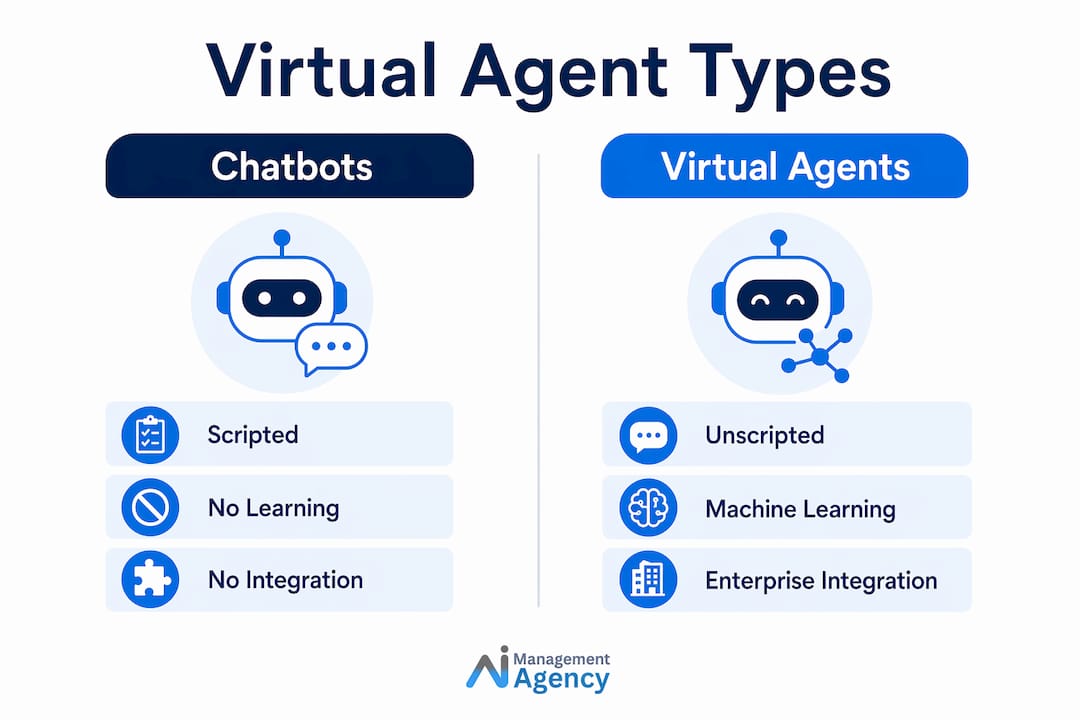
| Type | Interaction style | Learning ability | Enterprise integration | Typical use case |
|---|---|---|---|---|
| Basic chatbot | Scripted, rule-based | None | Minimal | FAQs, simple menus |
| Virtual assistant | Semi-dynamic | Limited | Moderate | Scheduling, reminders |
| Virtual agent | Dynamic, unscripted | Continuous | Deep | Customer service, automation |
| Autonomous agent | Proactive, self-directed | Advanced | Full | Complex workflows, outbound engagement |
Chatbots are scripted and limited to FAQ-style interactions without enterprise integration or learning capabilities. Virtual assistants, such as Apple Siri or Amazon Alexa in a consumer context, handle a broader range of tasks but are not designed for deep enterprise workflow automation. Virtual agents, by contrast, are purpose-built for business operations.
Autonomous agents represent the most advanced category. These systems initiate contact rather than waiting for a user to begin a conversation. Openreach’s deployment of NiCE Cognigy AI agents is a strong example: the agents reached out proactively to customers ahead of broadband installation appointments rather than sitting idle waiting for inbound queries. That proactive model is where the roles of virtual agents are expanding most rapidly in 2026.
When selecting a solution, focus on unscripted interaction capability and enterprise-level integration depth. These two factors determine whether a virtual agent delivers operational value or simply adds a conversational layer on top of existing processes.
What are the benefits of virtual agents for UK businesses?
The business case for virtual agents is grounded in measurable outcomes, not theoretical efficiency. UK enterprises that have deployed them at scale are reporting results that justify the investment clearly.
- 24/7 availability without additional headcount. A virtual agent handles enquiries at 2am on a Sunday with the same capability as during business hours. For UK businesses with customers across time zones or simply high out-of-hours demand, this removes a structural gap in service coverage.
- Significant reduction in routine workload. Virtual agents reduce up to 70% of routine enquiries without escalation to a human agent. That figure translates directly into reduced staffing pressure and faster resolution for the remaining complex cases.
- Faster resolution times. The same technology cuts resolution times by 40 to 60%, which has a direct impact on customer satisfaction scores and repeat contact rates.
- Scalability without proportional cost increase. A virtual agent handles ten simultaneous conversations as easily as one thousand. Human teams cannot scale that way without significant recruitment and training investment.
- Data and service intelligence. Every interaction generates structured data about customer intent, common failure points, and unmet needs. This data feeds continuous improvement in both the agent and the wider business.
The Openreach case is the most compelling UK example available. After deploying proactive AI agents across 15 million customer journeys, Openreach saw its Trustpilot score rise from 2.0 to 4.7. The agents used text, email, and voice to engage customers proactively before appointments, reducing inbound contact volume and improving appointment success rates simultaneously.
“Proactive virtual agents that initiate conversations provide greater operational value than reactive ones.” This is not a marginal difference. Openreach’s results demonstrate that the shift from reactive to proactive engagement is where the largest efficiency gains are found.
Pro Tip: Do not measure your virtual agent’s success solely on chat resolution rates. Track operational metrics such as appointment success rates, inbound contact volume reduction, and first-contact resolution. These figures reveal the true return on your investment.
For UK small and medium-sized businesses, the advantages for smaller enterprises are particularly compelling because the technology removes the need to hire additional staff to cover growth in customer demand.
What should UK businesses consider before deploying a virtual agent?
Deploying a virtual agent successfully requires more than selecting a platform and switching it on. Several practical considerations determine whether your deployment delivers results or falls short of expectations.
- Enterprise integration is non-negotiable. A virtual agent that cannot connect to your CRM, booking system, or ticketing platform will not automate tasks. It will only answer questions. Confirm API compatibility with your existing tools before committing to any platform.
- Proactive versus reactive models. Decide early whether your agent will wait for customers to initiate contact or whether it will reach out proactively. Proactive engagement consistently delivers higher operational impact, but it requires more careful design and data access.
- Data privacy and UK compliance. Any virtual agent handling personal data must comply with UK GDPR. Confirm where data is stored, how long it is retained, and whether the vendor holds appropriate certifications. This is a legal requirement, not an optional consideration.
- Human handover design. The transition from virtual agent to human agent must be smooth and context-preserving. A customer who has already explained their issue to an AI should never have to repeat themselves to a human. Poor handover design is one of the most common causes of customer frustration in AI deployments.
- Continuous training and improvement. Virtual agents improve with use, but only if someone is actively reviewing performance data and updating the agent’s knowledge base. Build an ongoing maintenance process into your deployment plan from day one.
- Measuring the right outcomes. Measuring only conversational KPIs underestimates operational benefits. Track appointment success rates, reduced contact volumes, and workflow completion rates alongside chat metrics.
For a practical overview of how UK businesses are applying these principles in 2026, the AI uses in SMEs guide covers deployment patterns across a range of sectors.
Key takeaways
Virtual agents deliver genuine operational value only when they combine conversational AI with deep enterprise integration and, ideally, proactive engagement capabilities.
| Point | Details |
|---|---|
| Definition clarity | A virtual agent is AI-powered software that automates tasks and integrates with enterprise systems, not just a chatbot. |
| How they work | Virtual agents process input, retrieve context, execute tasks via APIs, and escalate to humans when needed. |
| Proactive models win | Openreach’s proactive deployment across 15 million journeys raised its Trustpilot score from 2.0 to 4.7. |
| Measure operational metrics | Track appointment success and contact volume reduction, not just chat resolution rates. |
| Integration determines ROI | A virtual agent without enterprise system integration delivers a fraction of its potential value. |
Why most businesses are still thinking about this the wrong way
The single most persistent mistake I see when UK businesses evaluate virtual agent technology is treating it as a customer service upgrade rather than an operational infrastructure decision. They focus on the chat interface, compare conversation flows, and pick the product with the slickest demo. Then they wonder why the ROI never materialises.
The chat interface is the least interesting part of a virtual agent. What matters is what happens behind it. Can the agent read your live appointment calendar? Can it write back to your CRM after a call? Can it trigger a workflow in your fulfilment system without a human touching a keyboard? Those capabilities are what separate a technology that saves you money from one that simply looks impressive in a presentation.
The Openreach result, a Trustpilot score moving from 2.0 to 4.7 across 15 million customer journeys, was not achieved by building a better chatbot. It was achieved by deploying an agent that took action proactively, connected to real operational data, and reduced the need for customers to contact the business at all. That is the model worth replicating.
I also think the difference between AI agents and chatbots is still widely misunderstood in procurement processes, and that misunderstanding is costing businesses real money. If your current evaluation criteria do not include API integration depth and proactive engagement capability, you are not evaluating virtual agents. You are evaluating chatbots with better branding.
The businesses that will gain the most from this technology in 2026 are those that treat virtual agent deployment as a workflow redesign project, not a software purchase.
— Geoff
How Aimagency helps UK businesses deploy virtual agents that actually work
Aimagency specialises in building high-quality AI agents for UK businesses, from AI receptionists that answer calls 24/7 in a natural tone to agents that respond to FAQs and book qualified sales appointments directly into your calendar. Every solution is built around your existing systems and workflows, not a generic template dropped into your website.
If you are a UK business owner ready to move beyond basic automation, explore the AI agent advantages Aimagency delivers for small and medium-sized businesses, or review the best practices for 2026 to understand what a well-deployed virtual agent looks like in practice. Contact Aimagency to discuss a solution built specifically for your operation.
FAQ
What is a virtual agent in simple terms?
A virtual agent is AI-powered software that holds natural conversations with users, automates tasks such as booking appointments or updating records, and connects to your business systems to act on those conversations in real time.
How does a virtual agent differ from a chatbot?
Chatbots follow scripts and answer fixed questions. Virtual agents handle dynamic, unscripted interactions, integrate with enterprise systems, and execute tasks rather than simply providing information.
What are the main benefits of virtual agents for UK businesses?
Virtual agents operate 24/7, handle up to 70% of routine enquiries without human involvement, and cut resolution times by 40 to 60%, delivering measurable cost savings and improved customer satisfaction.
How do I create a virtual agent for my business?
Creating a virtual agent requires selecting a platform with strong API integration capability, connecting it to your existing CRM and booking systems, and designing both reactive and proactive conversation flows aligned with your operational goals.
Are virtual agents compliant with UK data protection law?
Any virtual agent processing personal data must comply with UK GDPR. Confirm data storage locations, retention policies, and vendor certifications before deployment to meet your legal obligations.
Recommended
- What is an AI agent? A guide for UK small businesses 2026 – AI Management Agency
- AI agents vs chatbots: What UK small businesses need to know – AI Management Agency
- AI agent advantages for small UK businesses – AI Management Agency
- Real benefits of 24/7 AI agents for small UK businesses – AI Management Agency