TL;DR:
- Call automation is a technology-driven approach that handles telephone communications without requiring human involvement, improving efficiency and customer experience. It uses AI voice agents, IVR systems, and no-code integrations to automate tasks like booking appointments and routing calls, saving time and reducing costs for UK businesses. Implementing automation gradually with continuous monitoring can optimize workflows while maintaining human oversight for complex interactions.
Call automation is one of those terms that gets thrown around a lot, yet many UK business owners still aren’t entirely sure what it means in practice. The assumption tends to be that it’s either a basic recorded message or something that requires an expensive IT overhaul. Neither is true. What is call automation, really? It’s a technology-driven approach to handling telephone communication, partially or fully, without requiring a human to pick up every call. Done well, it frees your team from repetitive tasks, keeps customers from waiting, and feeds data directly into your systems without anyone lifting a finger.
Table of Contents
- Key takeaways
- What is call automation and how does it work?
- The real benefits of call automation for UK businesses
- Call automation software: what UK businesses are actually using
- Best practices for deploying call automation effectively
- Challenges and limitations to be aware of
- My honest take on call automation for UK businesses
- See what Aimagency’s AI call automation can do for you
- FAQ
Key takeaways
| Point | Details |
|---|---|
| Call automation is accessible | Modern call automation tools work for businesses of all sizes, with no complex coding required. |
| AI voice agents outperform basic IVR | AI-powered agents handle calls naturally and can book appointments, answer FAQs, and route callers intelligently. |
| Integration is simpler than expected | No-code tools like Make.com connect call systems to your CRM quickly, saving hours of manual data entry each week. |
| Start small for best results | Beginning with one or two automated workflows, such as speed-to-lead calls, produces faster ROI than full deployment from day one. |
| Balance automation with human empathy | Automation handles volume; your team handles complexity. Getting this balance right protects customer satisfaction. |
What is call automation and how does it work?
At its core, call automation uses AI, telephony software, and pre-built logic to handle calls without requiring constant human intervention. Think of it as giving your phone system a brain. Rather than every incoming call landing on a receptionist’s desk, automation sorts, responds to, and routes calls based on rules you define.
The technology behind it typically includes several components working together:
- AI Voice Agents that speak in a natural, conversational tone and can answer questions, collect information, and book appointments
- Interactive Voice Response (IVR) systems that present callers with menu options and route them accordingly
- Auto-diallers that handle outbound calling for follow-ups, reminders, or lead outreach
- Webhooks that silently pass call data to your CRM the moment a call ends, no manual entry needed
- CRM integration that logs call summaries, transcripts, and caller details automatically
The distinction between partial and full automation matters here. Partial automation might mean your AI agent answers after hours, collects a caller’s details, and alerts your team in the morning. Full automation means the AI handles the entire interaction, books the appointment, and updates the CRM without any human involvement at all.
Call centre automation covers eight key functions including auto-dialling, speed-to-lead, IVR routing, quality assurance, compliance, and reporting. For a small UK business, you won’t necessarily need all eight. But even adopting two or three of these functions can transform how your phones work.
Pro Tip: If you’re worried about the tech side, don’t be. No-code webhook tools like Make.com let you connect your call system to a CRM using drag-and-drop interfaces. No developer required.
The real benefits of call automation for UK businesses
The advantages of call automation aren’t just about saving money, though that matters too. They’re about doing more with what you already have.
Here are the most tangible call automation benefits UK business owners report:
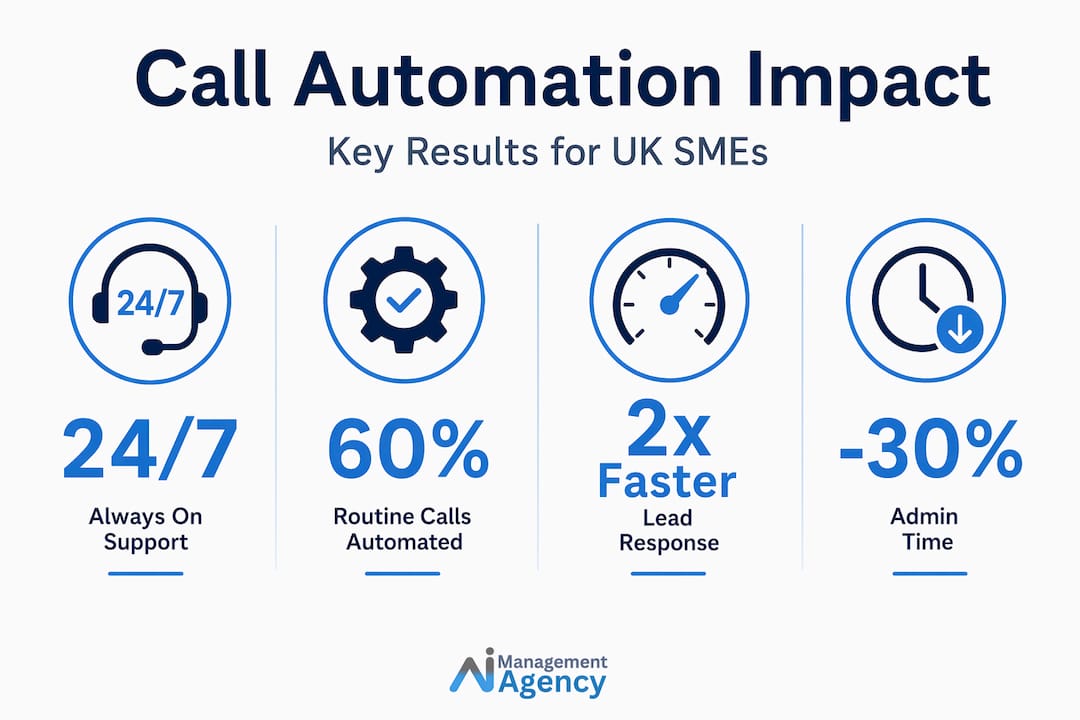
- Time recovered from admin. Automated call data capture via webhook integration can save businesses 2 to 4 hours weekly in manual CRM entry alone. That time goes back to your team.
- 24/7 call handling. An AI voice agent doesn’t take lunch breaks or annual leave. Callers who ring outside business hours get a real, helpful response rather than voicemail.
- Faster response to new leads. Speed-to-lead is critical. Automation can trigger an outbound call to a new enquiry within seconds of them submitting a form, before a competitor even reads their email.
- Lower cost per call handled. Strategic automation can reduce call centre operational costs by 25 to 35% while maintaining or improving customer satisfaction.
- Increased call capacity. You handle more calls without proportionally increasing headcount. Your existing team focuses on conversations that actually require human judgement.
- Better data quality. When call logs, transcripts, and outcomes feed directly into your CRM, the data is consistent and complete. No more missing notes or incomplete records.
The customer service impact is just as significant. Deflecting routine queries to AI agents removes unnecessary work from your team and cuts wait times for callers, which improves the overall experience. A customer who gets an immediate, accurate answer at 9pm is a customer who stays.
Call automation software: what UK businesses are actually using

The call automation solutions available to UK SMEs have matured considerably. You no longer need enterprise-level contracts to access professional tools.
| Tool type | Best for | Integration approach |
|---|---|---|
| AI Voice Agents | Inbound calls, FAQs, booking appointments | Webhook to CRM via Make.com |
| Traditional IVR | Simple call routing, menu options | Phone provider configuration |
| Auto-diallers | Outbound lead follow-up, reminders | Direct CRM integration |
| Automation platforms (Make.com) | Connecting call data to any CRM | No-code, drag-and-drop setup |
| Multi-channel tools | Calls, SMS, and email in one workflow | API or no-code connector |
AI voice agents are increasingly preferred over traditional IVR because they handle natural conversation rather than forcing callers through rigid menus. If someone says “I want to rearrange my appointment,” an AI agent understands. A traditional IVR system likely won’t.
For AI call handling, the typical workflow connects your phone number to an AI agent, which manages the conversation and, at the end of the call, fires a webhook to your CRM. Make.com sits in the middle, translating call data into CRM entries without you writing a single line of code.
Tracking and reporting features deserve attention too. Good call automation software tells you call volumes, resolution rates, how often callers were transferred to a human, and what questions came up most. That data helps you refine the system over time.
Pro Tip: When evaluating call automation software, ask specifically about CRM compatibility and whether the provider offers pre-built webhook templates. This dramatically reduces your setup time.
Best practices for deploying call automation effectively
Getting call automation right isn’t complicated, but it does require a clear approach. The businesses that struggle are almost always those that tried to automate everything at once.
A few principles worth following:
- Start with one automated workflow. Automating your speed-to-lead outbound calls or your out-of-hours inbound handling gives you a quick win and builds confidence. Starting with basic automation can boost contact rates from 10 to 12% up to 25 to 35% before you add anything more complex.
- Keep humans available for complex calls. Automation excels at volume and repetition. Complaints, nuanced queries, and emotionally charged conversations still need a real person. Design your system to hand over smoothly.
- Use real-time agent assist. Rather than replacing your team, AI can support them during live calls by surfacing relevant information. This combined approach of AI deflection and agent assist maximises efficiency while preserving service quality.
- Monitor and refine continuously. Listen back to a sample of calls monthly. Review satisfaction scores. Adjust your AI agent’s responses where callers are getting confused or frustrated.
- Know your compliance obligations. UK businesses must comply with GDPR when recording and storing call data. Make sure your call automation software provides clear consent mechanisms and data handling controls.
Pro Tip: Review your common AI tasks list before choosing what to automate first. The best starting point is always the call type your team finds most repetitive and least rewarding.
Challenges and limitations to be aware of
Call automation is genuinely powerful, but it isn’t without its complications. Being aware of these upfront prevents costly missteps.
- Poor workflow design frustrates callers. Over-automation or poor design risks alienating customers and lowering satisfaction scores. If your AI agent can’t handle a curve ball, callers will hang up.
- Data errors from incomplete integration. Without proper duplicate checks and correct data mapping, CRM records can become cluttered and inaccurate, which undermines the efficiency gains you were aiming for.
- AI has limits with complex queries. Current AI voice agents handle routine interactions very well. But highly technical, emotionally sensitive, or legally complex conversations are still better managed by a skilled human.
- Maintenance is ongoing. Automation workflows need regular reviews. Products change, processes evolve, and what worked well six months ago may need updating.
- Upfront setup requires thought. Even with no-code tools, the initial design of call flows, responses, and integrations takes time. Budget for a proper setup phase rather than expecting instant results.
- Human handover must be seamless. If the transition from AI agent to human feels abrupt or requires callers to repeat themselves, the experience suffers. Design handovers carefully.
The good news is that most of these challenges are manageable with proper planning and the right partner supporting your implementation.
My honest take on call automation for UK businesses
I’ve worked with dozens of UK small businesses helping them get automation into their phone operations, and the pattern is consistent. The businesses that see the best results are never the ones that go all-in immediately. They’re the ones that start with a single, high-value trigger, usually speed-to-lead or out-of-hours call handling, and build from there.
What I’ve learned is that the technology itself is rarely the obstacle. The real challenge is getting business owners to trust it enough to hand over even a fraction of their calls. Once they see the data coming in cleanly, the appointments being booked, and the team freed up to focus on real conversations, the appetite grows fast.
I’ve also seen the mistakes. Businesses that mapped their existing broken process directly into automation, then wondered why results were poor. Or those that built a technically correct workflow without ever testing how it sounded from the caller’s perspective. The human element matters, even in automated systems.
My honest advice: treat your first automated call flow as a pilot. Measure it. Refine it. Then expand. Call automation done thoughtfully doesn’t just cut costs. It genuinely improves the experience for your customers and your team.
— Geoff
See what Aimagency’s AI call automation can do for you
If this article has helped clarify what call automation can offer your business, the logical next step is seeing it in action.
Aimagency builds high-quality AI voice agents for UK businesses that answer calls 24/7, handle FAQs in a natural conversational tone, and book qualified sales appointments directly into your diary. Every solution connects to your existing CRM using no-code integrations, so there’s no complex IT project to manage. Whether you run a trade business, a professional services firm, or a growing SME, Aimagency has an AI call handling solution designed to fit. Explore AI call handling with Aimagency and request a demo to see the difference a well-built AI agent makes from day one.
FAQ
What is call automation in simple terms?
Call automation uses technology, including AI voice agents, IVR systems, and telephony software, to handle telephone calls without constant human involvement. It can answer calls, respond to common questions, route callers, and log data automatically.
How does call automation work for a small UK business?
A small business typically connects an AI voice agent to its phone number. The agent handles calls according to pre-set workflows, then passes data to the CRM via a webhook. Tools like Make.com make this setup possible without any coding knowledge.
What are the main advantages of call automation?
The main advantages of call automation include 24/7 call handling, faster lead response times, reduced admin work, lower cost per call, and improved data quality in your CRM. Research indicates that strategic automation can reduce operational costs by 25 to 35%.
Is call automation suitable for businesses without a call centre?
Yes. Call automation is not limited to call centres. Any UK business that receives regular inbound calls or needs to follow up with leads can benefit from even basic automation, such as an AI receptionist or automated appointment booking.
What is automated calling and is it the same as call automation?
What is automated calling refers specifically to outbound calls triggered by a system, such as appointment reminders or lead follow-ups. Call automation is a broader term that includes both inbound and outbound automated call handling across multiple workflows.
Recommended
- How to automate calls and boost customer satisfaction – AI Management Agency
- Call answering process guide for UK small businesses – AI Management Agency
- Step-by-step task automation guide for UK small businesses – AI Management Agency
- AI automation examples boosting UK small business efficiency – AI Management Agency