
Choosing the right AI automation for your small UK business can feel overwhelming when hundreds of tools promise to transform operations overnight. Many small business owners struggle to identify which solutions genuinely improve customer service and efficiency versus those that add complexity without clear returns. This article cuts through the noise by providing practical criteria for evaluation, showcasing proven AI automation examples with measurable results, and highlighting both the benefits and hidden risks you need to consider before implementation.
Table of Contents
- Key Criteria For Choosing AI Automation In Small UK Businesses
- AI Chatbots And Virtual Assistants Delivering Customer Service Excellence
- Workflow Automation Tools: Saving Time On Repetitive Tasks
- Real-World Results And Hidden Risks Of AI Automation
- Explore Expert AI Automation Support Tailored For UK Small Businesses
- Frequently Asked Questions About AI Automation Examples
Key takeaways
| Point | Details |
|---|---|
| AI chatbots handle routine queries | Automate 70-80% of customer questions, reducing support costs by 30-60% whilst improving response times |
| Workflow tools save significant time | Small teams report saving 15-40 hours weekly by automating repetitive tasks between apps |
| Start small with clear metrics | Successful implementations begin with one high-volume task, human oversight, and defined success measures |
| Hybrid models work best | Combining AI automation with human review delivers superior results and reduces costly errors |
Key criteria for choosing AI automation in small UK businesses
Before investing in any AI solution, you need a framework to separate genuine value from marketing hype. The most successful small business implementations share common characteristics that you can replicate.
Start by identifying one high-volume repetitive task that consumes disproportionate team time. This could be answering the same customer questions repeatedly, syncing data between systems, or generating routine reports. Focusing on a single pain point allows you to measure impact clearly and build confidence before expanding.
Train your chosen AI tool on relevant business data and establish human review processes from day one. 95% of generative AI pilots fail to scale due to poor data quality, absent goals, and unmonitored errors. You cannot simply switch on AI and walk away.
Measure success with specific metrics that matter to your operations:
- Escalation rate to human staff
- Customer satisfaction scores
- Time saved per week
- Cost reduction per transaction
- Error rates compared to manual processes
Hybrid human-AI models consistently outperform fully automated approaches for small teams. Your AI handles routine work whilst humans manage complex requests and edge cases. This balance maximises efficiency without sacrificing service quality or creating customer frustration.
Common pitfalls include over-automating too quickly, implementing poor governance structures, and underestimating data quality requirements. Many businesses also fail to update AI systems regularly with new information, causing performance degradation over time.
Pro Tip: Document every customer query your AI cannot handle properly during the first month, then use this feedback to refine responses and identify gaps in your knowledge base.
Explore broader applications of AI in SMEs to boost efficiency across different business functions beyond your initial automation target.
AI chatbots and virtual assistants delivering customer service excellence
AI chatbots represent the most accessible quick win for small UK businesses seeking immediate operational improvements. These tools handle customer queries around the clock without requiring additional staff, freeing your team to focus on complex requests that genuinely need human expertise.
The numbers tell a compelling story. AI chatbots automate 70-80% of routine queries, reducing support costs by 30-60% whilst simultaneously improving customer experience. Response times drop from hours to seconds, eliminating the frustration customers feel waiting for simple answers.
Real UK SME results demonstrate tangible returns:
- E-commerce retailers report 30-45% cost savings on customer support
- Service businesses see 20-40% improvements in customer satisfaction scores
- Professional services firms handle 3x more enquiries without increasing headcount
- Hospitality businesses manage booking queries 24/7 without night staff
Case studies across sectors consistently show these ranges, with higher savings correlating to businesses that previously relied heavily on phone or email support for routine questions.
Consider a typical scenario. Your business receives 50 customer queries daily, with 40 asking about opening hours, pricing, availability, or basic product information. A properly trained chatbot handles these 40 instantly, leaving your team to focus on the 10 complex requests requiring judgement, negotiation, or problem-solving skills.
“The chatbot pays for itself within two months just from the time we save on repetitive questions. Our team now focuses on building relationships with customers who need real help, not reading out our opening hours for the hundredth time.”
Implementation requires careful planning. You must train the chatbot on your specific business information, test thoroughly with real scenarios, and establish clear escalation paths to humans when needed. The chatbot should never pretend to know something it doesn’t or trap customers in frustrating loops.
Pro Tip: Review chatbot transcripts weekly during the first three months to identify common questions it struggles with, then enhance responses based on how your best team members would answer.
Discover how AI transforms small business customer service beyond just chatbots to create comprehensive support systems.
Workflow automation tools: saving time on repetitive tasks
Whilst chatbots handle external customer interactions, workflow automation tools transform internal operations by connecting your business applications and eliminating manual data transfer.
These platforms act as digital assistants that move information between systems automatically. When a customer fills in your contact form, the data flows directly into your CRM. When a sale completes, your invoicing system updates and your accounting software records the transaction. When inventory drops below threshold, purchasing receives an alert.

Workflow automation saves 15-40 hours weekly for small teams by eliminating repetitive data entry and reducing errors from manual transcription. One agency documented 40 hours saved per week just from automating their client reporting workflow using Zapier.
Common automation workflows for small businesses include:
- Syncing new leads from website forms directly to CRM with automatic assignment to sales team members
- Creating invoices automatically when project milestones complete in project management software
- Sending personalised follow-up emails based on customer behaviour triggers
- Generating weekly performance reports by pulling data from multiple sources
- Updating inventory levels across sales channels simultaneously
| Tool | Best For | Monthly Cost | Key Features |
|---|---|---|---|
| Zapier | Connecting 5000+ apps | £20-£50 | Easy setup, extensive integrations, multi-step workflows |
| Make | Complex workflows | £9-£29 | Visual builder, advanced logic, unlimited operations on higher tiers |
| Microsoft Power Automate | Microsoft 365 users | £12-£40 | Deep Office integration, AI Builder, desktop automation |
| IFTTT | Simple triggers | Free-£3 | Consumer-friendly, mobile focus, limited business apps |
Start by mapping your highest-frequency repetitive tasks. Which actions do you or your team perform multiple times daily that involve copying information from one system to another? These represent your best automation candidates.
Implementation typically takes 2-4 hours for simple workflows and 1-2 days for complex multi-step automations. Most platforms offer templates for common business scenarios, reducing setup time significantly.
Pro Tip: Begin with a single workflow that runs at least 10 times weekly to ensure you see meaningful time savings quickly, building momentum for additional automations.
Explore comprehensive AI automation solutions that integrate workflow tools with intelligent decision-making capabilities.
Real-world results and hidden risks of AI automation
The gap between AI automation success stories and failures often comes down to implementation approach and realistic expectations. Understanding both outcomes helps you avoid expensive mistakes.
Documented results from UK SMEs show impressive returns when automation is implemented thoughtfully. AI reduces 73-80% of manual work, saving hundreds of hours and thousands of pounds annually for businesses with tiny teams. A legal practice automated document review and saved 300 hours monthly. An accounting firm automated client onboarding and reduced processing time from 4 hours to 30 minutes per client.
However, the failure rate tells an equally important story. 95% of AI pilots fail due to hype-driven decisions, poor data quality, and absent success metrics. Businesses rush into automation without proper planning, then abandon projects when results disappoint.
| Benefit | Risk | Mitigation Strategy |
|---|---|---|
| 70-80% reduction in routine queries | AI provides incorrect information damaging reputation | Implement human review for first 100 interactions, maintain updated knowledge base |
| 15-40 hours saved weekly on tasks | Over-automation eliminates human touchpoints customers value | Identify which interactions benefit from human connection, automate only truly routine tasks |
| 30-60% lower support costs | Upfront investment and ongoing maintenance costs exceed savings | Calculate total cost of ownership including training, monitoring, and updates before committing |
| 24/7 availability without staff costs | System failures leave customers with no support option | Maintain fallback processes and clear escalation paths to human staff |
Best practices for successful rollout include:
- Define specific, measurable goals before selecting tools
- Pilot with a small subset of customers or tasks first
- Establish weekly review processes for AI performance
- Train AI systems on high-quality, current business data
- Create clear escalation protocols for edge cases
- Maintain human oversight indefinitely, not just during launch
- Update AI knowledge bases monthly with new information
- Measure customer satisfaction alongside efficiency metrics
The most successful implementations adopt hybrid models where AI handles volume whilst humans provide expertise and judgement. This approach delivers efficiency gains without sacrificing service quality or creating customer frustration.
Businesses that treat AI as a team member requiring ongoing training and supervision achieve sustainable results. Those expecting set-and-forget solutions inevitably face disappointment and wasted investment.
Learn from common AI implementation mistakes to avoid expensive failures and maximise your automation returns.
Explore expert AI automation support tailored for UK small businesses
Implementing AI automation effectively requires expertise that many small teams lack internally. AI Management Agency specialises in creating high-quality AI agents designed specifically for UK small businesses with teams up to 5 employees.
Our services include AI receptionists that speak naturally, answer calls 24/7, respond to frequently asked questions, and book qualified sales appointments automatically. We handle everything from initial concept through training, testing, and ongoing optimisation.
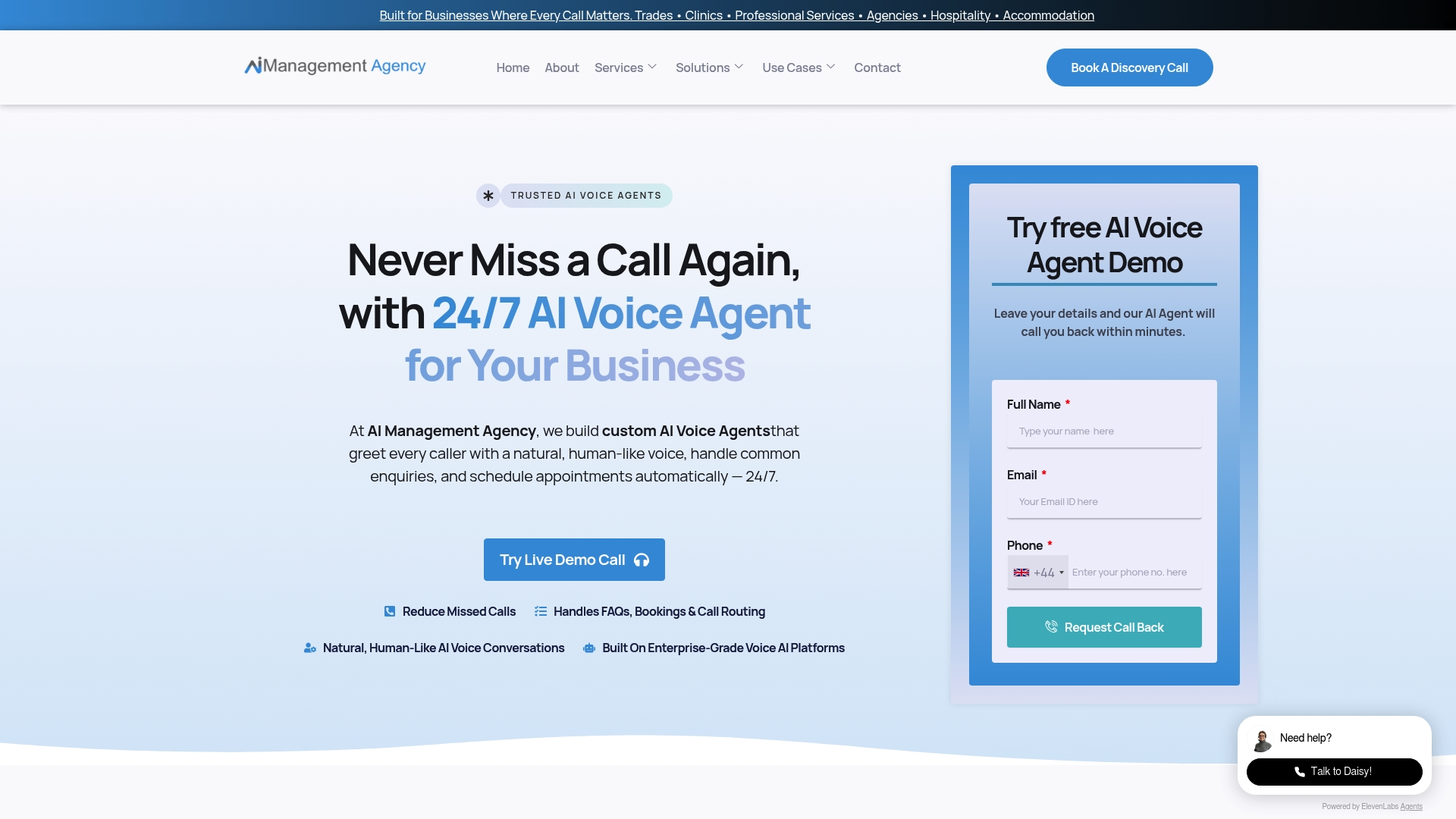
Whether you need guidance selecting the right automation approach or full implementation support, we provide tailored solutions that match your specific operational needs and budget constraints. Our team understands the unique challenges small UK businesses face and designs systems that deliver measurable returns without overwhelming your existing processes.
Explore our comprehensive AI agent guide for UK small businesses to understand implementation options, or discover our AI agent development services for custom solutions. Review our full range of AI automation solutions to identify which approach best fits your business goals.
Frequently asked questions about AI automation examples
What is the first AI automation task to try for a small team?
Start with automating responses to your most frequently asked customer questions through a chatbot or automated email system. This delivers quick wins with minimal risk whilst building confidence in AI capabilities. Choose a task that currently consumes 5-10 hours weekly and has clear success metrics you can measure easily.
How much can AI chatbots reduce customer support costs?
Properly implemented AI chatbots typically reduce customer support costs by 30-60% by automating 70-80% of routine queries. Actual savings depend on your current support volume, the complexity of typical questions, and how well you train the chatbot on your specific business information.
Are there risks in fully automating customer service?
Yes, fully automated customer service often damages satisfaction and reputation when customers cannot reach humans for complex issues. The hybrid approach works best, using AI for routine queries whilst ensuring easy escalation to human staff for problems requiring judgement, empathy, or creative solutions.
How do I measure success of AI automation?
Track specific metrics including time saved per week, cost per transaction, customer satisfaction scores, escalation rate to humans, and error rates compared to manual processes. Measure before and after implementation to quantify actual impact rather than relying on assumptions.
What budget is typical for AI tools suitable for small businesses?
Entry-level AI chatbots and workflow automation tools cost £20-£100 monthly for small business plans. Custom AI agent development ranges from £2,000-£10,000 depending on complexity and integration requirements. Calculate return on investment by comparing costs against time saved and efficiency gains to determine appropriate budget levels.
Recommended
- Uses of AI in SMEs: boost efficiency with smart tools 2026 – AI Management Agency
- Understand AI voice bots to boost your UK small business – AI Management Agency
- Train AI Agents: Cut Errors 30% in 12 Weeks for UK SMEs – AI Management Agency
- What is an AI agent? A guide for UK small businesses 2026 – AI Management Agency