TL;DR:
- Automated AI Voice Agents handle inbound calls instantly, increasing revenue by capturing missed opportunities and reducing costs. They operate 24/7, delivering natural, conversational interactions that improve customer experience and scalability without additional staffing. For small UK businesses, this technology transforms routine call management into a strategic advantage, boosting conversion rates and operational efficiency.
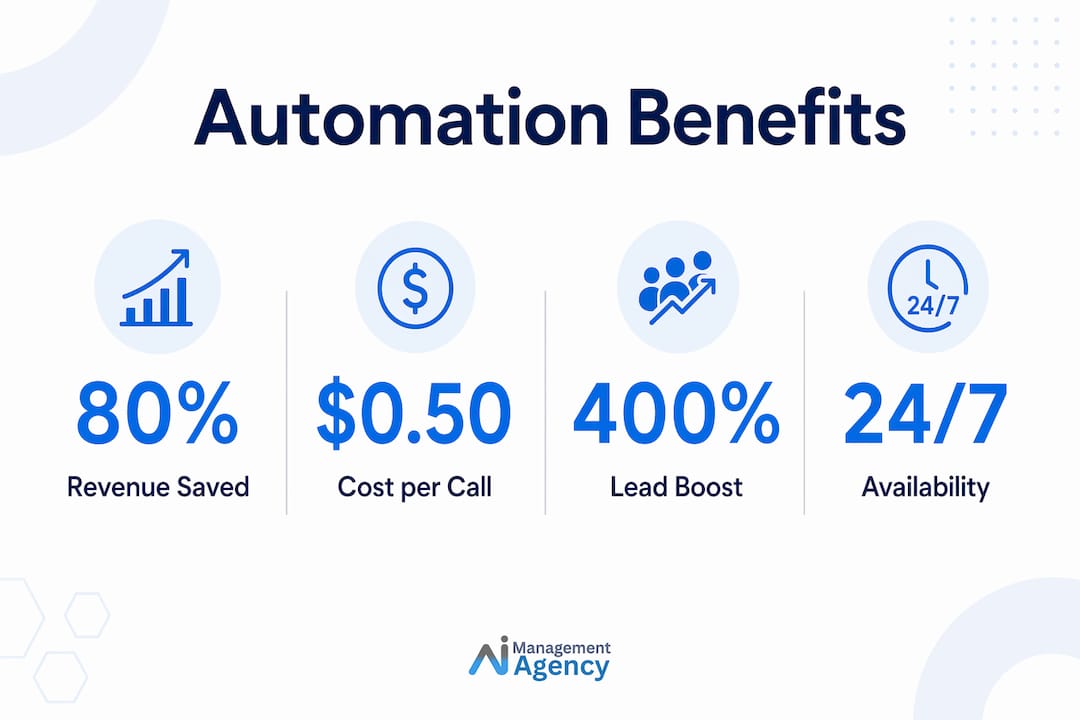
Automated call answering is defined as an AI-powered system that handles inbound business calls instantly, without hold times, queues, or missed opportunities. For small UK businesses, this technology functions as a virtual receptionist that operates around the clock, responds to frequently asked questions, and books qualified appointments directly into your calendar. The core reason to automate call answering is straightforward: around 80% of callers who reach voicemail do not leave a message, meaning every unanswered call is likely lost revenue. AI Voice Agents, the industry term for these systems, combine natural language processing with real-time workflow integration to turn your phone line into an active sales and service channel.
Why automate call answering: the core case
The business case for automating phone responses rests on one undeniable fact: callers do not wait. When a prospect rings your number and hears a voicemail or a long hold queue, they call your competitor instead. AI Voice Agents remove that risk entirely by answering on the first ring, every time, regardless of the hour or how many calls arrive simultaneously.
The technology behind this is natural language processing (NLP), which allows the system to understand spoken requests conversationally rather than forcing callers through rigid button-press menus. Unlike traditional Interactive Voice Response (IVR) systems, an AI Voice Agent listens, interprets intent, and responds in a natural tone. This distinction matters because conversational AI maintains a personal touch rather than frustrating callers with inflexible scripts.
For a small business owner managing a lean team, the importance of call automation becomes clear the moment you calculate how many calls go unanswered during a busy afternoon, a staff lunch break, or outside office hours. Each one of those calls represents a person who chose to contact you. Giving them an instant, intelligent response is not a luxury. It is a baseline expectation in 2026.

How does automated call answering work in practice?
An AI Voice Agent connects to your phone number and intercepts every inbound call before it reaches voicemail or a hold queue. The system processes the caller’s speech in real time, identifies their intent, and selects the appropriate response or action from a pre-configured knowledge base. The entire exchange feels like speaking to a knowledgeable member of staff.
Here is what a well-configured system can do autonomously:
- Answer on the first ring, 24 hours a day, seven days a week, with no degradation in quality during peak periods
- Respond to frequently asked questions such as opening hours, pricing, service areas, and appointment availability
- Book appointments instantly while the caller is still on the line, integrating with live calendars to confirm slots in real time
- Qualify leads by asking pre-set questions and logging responses directly into your CRM
- Route calls intelligently, passing complex or sensitive enquiries to the right human team member with full context already captured
- Handle multiple simultaneous calls without any caller experiencing a queue
The integration layer is what separates modern AI call answering from older automated systems. When the AI books an appointment, it writes directly to your calendar. When it qualifies a lead, it creates a CRM record. When it escalates a call, it passes the conversation history so your team member does not ask the caller to repeat themselves.
Pro Tip: Before configuring your AI Voice Agent, document your ten most common inbound call types. This list becomes the foundation of your system’s knowledge base and determines how quickly you see a return on your investment.
What are the main benefits of automating call answering for small businesses?
The advantages of automated answering extend well beyond simply picking up the phone. For small UK businesses, the benefits divide into four clear categories: revenue protection, cost reduction, availability, and consistency.
1. Revenue protection through zero missed calls
Every call answered is a potential sale retained. With 24/7 availability eliminating hold times and call abandonment, businesses capture leads that would otherwise disappear silently. This is particularly significant for trades, professional services, and hospitality businesses where a single booking can be worth hundreds of pounds.
2. Dramatic cost reduction
AI answering services cost roughly $0.30 to $0.50 per call compared to approximately $6 to $7.68 for human agents. That cost difference translates directly into lower overheads for small businesses that cannot justify a full-time receptionist but still need professional call handling.
3. Faster lead conversion
Speed of response is the single biggest driver of lead conversion. Engaging a new lead within the first 60 seconds boosts conversion rates by nearly 400%. An AI Voice Agent achieves this automatically, every time, without relying on a staff member being available at the right moment.
4. Consistent brand experience
Human receptionists have good days and bad days. An AI Voice Agent delivers the same tone, the same accuracy, and the same professionalism on every single call. For small businesses where brand perception is built one interaction at a time, that consistency is genuinely valuable.
5. Scalability without hiring
When call volumes spike, whether due to a marketing campaign, a seasonal rush, or a viral social media post, an AI system handles the increase without any additional cost or staffing. You do not need to hire temporary staff or ask your team to drop everything.
6. Staff freed for high-value work
Automation removes repetitive call burdens from staff, enabling them to focus on complex tasks and increasing job satisfaction. For a small team, redirecting even two hours per day away from routine call handling creates meaningful capacity for revenue-generating activity.
How does automated call answering compare with traditional methods?
Understanding the advantages of call automation requires a direct comparison with the alternatives most small businesses currently rely on.
| Method | Cost | Availability | Caller experience | Scalability |
|---|---|---|---|---|
| Voicemail | Very low | 24/7 passive | Poor. 80% of callers hang up | None |
| Traditional IVR | Low to medium | 24/7 | Frustrating. Rigid menus | Limited |
| Human receptionist | High | Business hours only | Excellent when available | Requires hiring |
| AI Voice Agent | Low per call | 24/7 active | Natural and conversational | Unlimited |
The table makes the trade-offs visible. Voicemail is cheap but loses most callers. A human receptionist delivers the best experience but only during paid hours and only for one call at a time. Traditional IVR covers availability but at the cost of caller satisfaction. An AI Voice Agent is the only option that combines low cost, full availability, natural interaction, and unlimited scale.
The critical distinction between IVR and AI Voice Agents is the quality of the conversation. IVR forces callers to navigate menus. AI Voice Agents listen and respond. For a caller with an urgent question or a time-sensitive booking, that difference determines whether they stay on the line or hang up.
Pro Tip: If you currently use a basic IVR, audit your call abandonment rate before and after switching to an AI Voice Agent. Most businesses see a measurable drop in abandoned calls within the first month, which is a direct indicator of improved call answering efficiency.
What should small businesses know before automating call answering?
Implementing an AI Voice Agent is straightforward, but a few practical considerations will determine how quickly you see results.
- Assess your call volume and query types. If your inbound calls are predominantly repetitive, such as appointment requests, pricing questions, or directions, automation will deliver immediate ROI. If most calls require complex judgement, focus the AI on triage and routing rather than full resolution.
- Confirm integration compatibility. Your AI system needs to connect with your calendar, CRM, and any helpdesk software you use. Check that your chosen provider supports these integrations before committing.
- Prioritise natural language capability. A system that sounds robotic or misunderstands callers will damage your brand. Test the system with real call scenarios before going live. The call answering process guide from Aimagency covers the key steps for UK small businesses in detail.
- Plan your escalation path. Complex or upset callers should be routed to human agents with full context and conversation history passed across. A clean handoff protects the customer relationship.
- Brief your team. Staff need to understand what the AI handles and what it escalates. Clear internal workflows prevent confusion and ensure callers receive a consistent experience from AI to human.
- Review call data regularly. Automated systems capture strategic insights into call volume patterns, caller topics, and sentiment trends. Use this data to refine your knowledge base and improve responses over time.
What measurable impact can automated call answering have?
The numbers behind call automation make a compelling case for any small business owner evaluating the decision.
| Metric | Impact |
|---|---|
| Lead conversion rate | Up to 400% increase when leads are engaged within 60 seconds |
| Cost per call | Reduced from approximately £6 to under £0.50 per call |
| Call abandonment | Eliminated during peak hours and outside business hours |
| Staff productivity | Significant increase as routine call handling is removed |
| First-contact resolution | Improved through intelligent routing and context retention |
“The businesses that win on the phone in 2026 are not the ones with the most staff. They are the ones that respond first, every time, without exception.”
The productivity gain deserves particular attention. When your team is not fielding routine calls, they are closing deals, delivering work, and building client relationships. For a small business where every hour counts, that reallocation of effort compounds quickly. An AI answering service for UK small firms does not replace your team. It protects their time for the work that actually grows the business.
Key takeaways
Automated call answering delivers measurable gains in revenue, cost efficiency, and customer satisfaction by replacing passive voicemail and rigid IVR with intelligent, always-on AI Voice Agents.
| Point | Details |
|---|---|
| Revenue protection | 80% of callers who reach voicemail do not leave a message, making every missed call a likely lost sale. |
| Cost efficiency | AI handles calls at a fraction of the cost of human agents, reducing overhead without reducing service quality. |
| Speed drives conversion | Responding within 60 seconds boosts lead conversion by nearly 400%, making instant answering a direct revenue driver. |
| Scalability without cost | AI systems handle unlimited simultaneous calls, removing the need to hire during volume spikes. |
| Data as a strategic asset | Call pattern and sentiment data captured automatically informs staffing, content, and operational decisions. |
Why I believe this is the most overlooked investment in small business right now
Working closely with small UK businesses, I see the same pattern repeatedly. Owners invest in websites, social media, and paid advertising to drive enquiries, and then lose a significant portion of those leads the moment the phone rings and nobody answers. It is a quiet, invisible leak in the sales funnel that rarely appears on any dashboard.
What surprises me most is the assumption that automated call answering is a large-business technology. The cost data tells a completely different story. At under £0.50 per call, an AI Voice Agent is accessible to a sole trader, a three-person trades firm, or a boutique professional services practice. The barrier is not cost. It is awareness.
The businesses I have seen adopt AI Voice Agents do not just save money. They change how they think about their phone line. It stops being a source of anxiety, the missed call you notice at 6pm, and becomes a reliable, productive channel. That shift in confidence has a real effect on how owners run their businesses.
My advice is to start with your highest-volume, most repetitive call type. Get that working well, measure the result, and expand from there. Automation is not an all-or-nothing decision. It is a series of small, measurable improvements that compound into a genuinely different operation. The businesses that treat this as a strategic investment rather than a cost-saving shortcut are the ones that build a lasting advantage.
— Geoff
How Aimagency helps UK small businesses automate call answering
Aimagency specialises in building AI Voice Agents that speak naturally, answer calls around the clock, and book qualified sales appointments directly into your calendar. Every agent is configured to your business, your tone, and your most common caller needs.
Whether you run a trades business, a professional services firm, or a client-facing operation of any kind, Aimagency builds a solution that fits your workflows and integrates with your existing systems. Explore the AI agent advantages available to small UK businesses, or review AI agent best practices to understand how to get the most from your investment. Contact Aimagency today for a personalised consultation.
FAQ
What is an AI Voice Agent and how does it differ from IVR?
An AI Voice Agent uses natural language processing to understand and respond to callers conversationally, without button-press menus. Traditional IVR forces callers through rigid options, which increases frustration and call abandonment.
How quickly can automated call answering improve lead conversion?
Engaging a new lead within the first 60 seconds boosts conversion rates by nearly 400%. An AI Voice Agent achieves this automatically on every call, regardless of the time of day.
Is automated call answering affordable for very small UK businesses?
AI answering services cost roughly $0.30 to $0.50 per call compared to $6 to $7.68 for human agents, making the technology accessible even for sole traders and micro-businesses.
What happens when a caller has a complex or sensitive query?
A well-configured AI Voice Agent routes complex or upset callers to a human team member, passing the full conversation context so the caller does not need to repeat themselves.
Can an AI Voice Agent book appointments directly?
Yes. AI call answering systems book appointments instantly while the caller is still on the phone, integrating with live calendars to confirm availability and send confirmations in real time.