TL;DR:
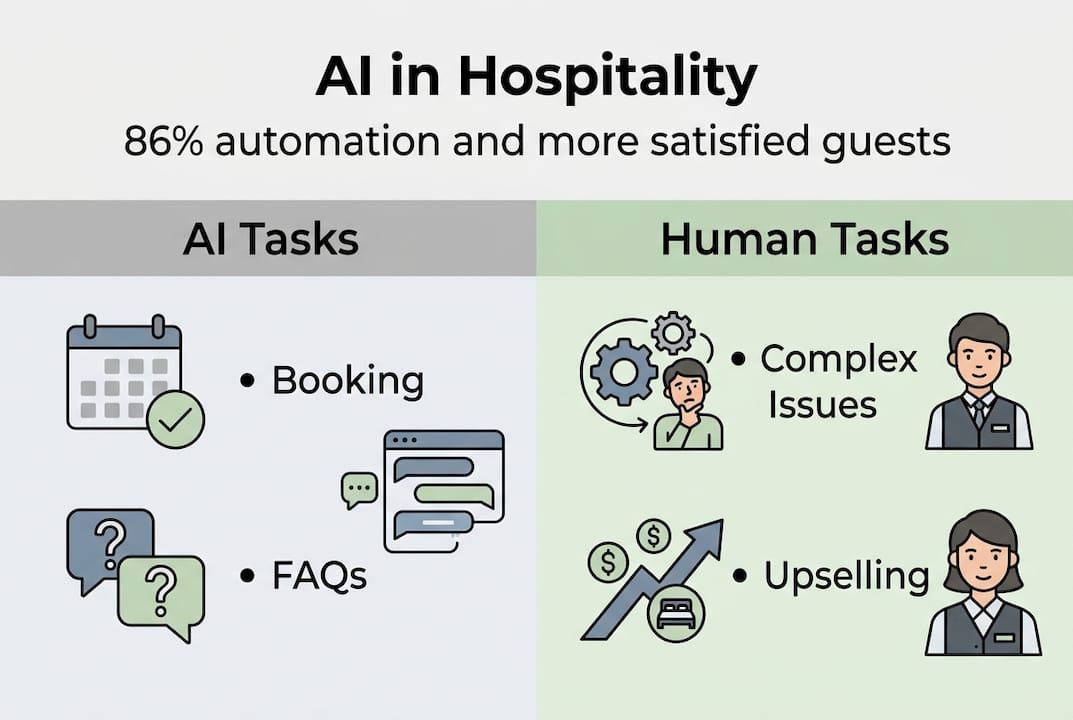
- Most UK small hospitality businesses successfully automate 86% of customer service with AI, improving satisfaction.
- Modern AI uses NLP, RAG, ML, and agentic architectures to understand, retrieve, and act autonomously.
- A hybrid AI-human approach with proper training and escalation procedures yields the best results.
Most small hospitality business owners assume that adding AI to their customer service means frustrated guests, robotic replies, and a flood of complaints. The reality is quite different. Leading UK small hotels and guest houses now have 86% of their customer service handled by AI while actually improving guest satisfaction. This guide cuts through the noise. You’ll learn what AI customer service really means, which applications deliver measurable results in UK hospitality, where the technology still falls short, and how to build a practical roadmap that works for your business without sacrificing the personal touch your guests expect.
Table of Contents
- What AI customer service really means
- How UK hospitality businesses use AI for customer service
- What works—and what doesn’t: Limitations and best practices
- How to get started: A practical roadmap for small UK hospitality businesses
- Why most small businesses miss out on AI gains (and how to get it right)
- Explore AI solutions tailored for your hospitality business
- Frequently asked questions
Key Takeaways
| Point | Details |
|---|---|
| Hybrid approach wins | Mixing AI with human support delivers higher satisfaction and operational efficiency than AI alone. |
| Automate routine tasks | AI is best for booking, check-in and common queries, freeing staff for more valuable interactions. |
| Plan for escalation | Always set up clear handover to human staff for complex or sensitive guest needs. |
| Revenue and speed boost | UK hospitality firms see up to 90% less admin, faster response and notably higher bookings from AI. |
What AI customer service really means
The term “AI customer service” gets thrown around loosely, and that causes confusion. Let’s be precise about what the technology actually involves.
Modern AI customer service draws on four core technologies. Customer service AI uses NLP, RAG, ML, and agentic architectures to understand intent, retrieve knowledge, improve over time, and take autonomous actions like order lookups or escalations. Each layer builds on the last.
- Natural Language Processing (NLP): Understands what a guest is actually asking, even when phrased in different ways.
- Machine Learning (ML): The system improves with every interaction, getting better at recognising patterns.
- Retrieval Augmented Generation (RAG): Pulls accurate, up-to-date information from your own knowledge base rather than guessing.
- Agentic AI: Takes real actions, such as checking availability, modifying a booking, or routing a query to a human agent.
The difference between a traditional scripted chatbot and a modern agentic AI is significant. Old-style bots follow rigid decision trees. If a guest asks something slightly outside the script, the bot fails. Agentic AI reasons through requests, retrieves relevant information, and acts accordingly.
| AI type | Best for | Limitations |
|---|---|---|
| Scripted chatbot | Simple FAQs | Breaks on unexpected queries |
| NLP assistant | Intent recognition | Cannot take actions |
| RAG-powered agent | Accurate knowledge retrieval | Needs quality data sources |
| Agentic AI | Bookings, escalations, complex workflows | Requires proper setup and monitoring |
The hospitality sector is moving fast. You can learn more about AI in call centres to understand how this technology is reshaping front-line communication across the industry.
Pro Tip: For hospitality specifically, prioritise agentic AI architectures. You need a system that can check booking availability, answer nuanced questions about your property, and escalate to a human when a guest is upset, all within a single conversation.
How UK hospitality businesses use AI for customer service
With the technology defined, let’s look at how hospitality businesses in the UK are seeing tangible results from adopting AI.
Guest messaging is the most immediate win. AI handles routine enquiries around the clock: room availability, check-in times, parking, local recommendations, and dietary requirements. Guests get instant responses at 2am without your team lifting a finger.
The numbers from UK case studies are striking. AI boosts UK hospitality with an 86% automation rate, 90% reduction in emails and calls, £2,000 more revenue per month, and 62% growth in booking value, all without losing guest satisfaction.
Here is how a typical AI-assisted guest interaction flows from start to finish:
- Guest sends an enquiry via website chat, WhatsApp, or phone.
- AI identifies intent using NLP, recognising it as a booking request.
- RAG retrieves availability from your property management system in real time.
- AI responds naturally, confirming options and presenting pricing.
- Guest confirms booking, which is logged automatically.
- AI sends confirmation and pre-arrival information without any staff involvement.
- Edge cases escalate to a human agent if the request is complex or the guest signals frustration.
You can explore real hospitality AI case studies to see how similar-sized UK businesses have implemented this workflow. For a broader view, the AI use cases in hotels resource covers everything from concierge automation to upselling. Practical AI guest messaging examples show exactly what these conversations look like in practice.
“We went from spending three hours a day on enquiries to almost none. The AI handles it all, and guests actually comment on how quick our responses are.” — UK boutique hotel owner
The revenue impact is often underestimated. When AI handles routine enquiries instantly, guests are more likely to complete a booking rather than abandon the process and look elsewhere.

What works—and what doesn’t: Limitations and best practices
The benefits are compelling, but to succeed you need to know where AI still struggles and how to avoid key pitfalls.
AI customer service can fail in predictable ways. AI fails on complex or nuanced issues, hallucinations from poor data, no clear escalation path, and industry-specific edge cases all require a hybrid human plus AI approach. A guest dealing with a bereavement, a complaint about a serious maintenance issue, or a highly specific accessibility requirement needs a human, not an algorithm.
Klarna’s experience is a cautionary tale for any business considering full automation. Klarna reversed AI layoffs after customer satisfaction dropped sharply on complex cases, ultimately rehiring human agents. Fifty percent of companies that attempted full AI rollouts have since brought humans back.
The winning model is hybrid: AI handles volume, humans handle complexity.
Learn more about AI answering services explained and how AI automation cost savings work in practice before committing to a full rollout.
Do’s for AI implementation in hospitality:
- Train your AI on accurate, property-specific data
- Integrate with your property management system from day one
- Set clear escalation triggers for complaints and complex requests
- Monitor conversations weekly in the early stages
- Gather guest feedback on AI interactions regularly
Don’ts:
- Do not deploy AI without a human fallback option
- Do not assume the AI will manage edge cases without guidance
- Do not neglect ongoing monitoring once the system is live
- Do not use generic, off-the-shelf bots without sector-specific tuning
Pro Tip: Always build in clear escalation paths. A guest who cannot reach a human when they genuinely need one will leave a negative review. That one review can cost you far more than the savings from automation.
How to get started: A practical roadmap for small UK hospitality businesses
To ensure your move to AI is a success, here is how leading small businesses in hospitality get started, from pilot to scale.
The most common mistake is trying to automate everything at once. Start narrow, prove value, then expand. Start with high-volume routine queries such as bookings and check-in, use RAG-trained agents integrated with your property management system, ensure smart escalation, and use a hybrid model to boost efficiency and revenue without satisfaction loss.
Step-by-step implementation roadmap:
- Audit your current enquiries. Identify the top ten questions guests ask repeatedly. These are your automation targets.
- Choose a pilot scope. Start with booking enquiries and FAQ handling only. Do not try to automate complaints management in phase one.
- Select an AI solution that integrates with your existing property management system and communication channels.
- Train the AI on your data. Upload your policies, room descriptions, pricing, and FAQs. Quality data produces quality responses.
- Set escalation rules. Define exactly when and how the AI hands off to a human agent, whether by keyword, sentiment, or request type.
- Run a 30-day pilot. Monitor every conversation. Note where the AI performs well and where it struggles.
- Refine and expand. Use pilot learnings to improve the AI’s knowledge base, then gradually extend automation to additional touchpoints.
Common pitfalls to avoid in the early stages:
- Skipping staff training on how to work alongside the AI system
- Failing to update the AI’s knowledge base when policies change
- Setting escalation thresholds too high, leaving frustrated guests stuck with the bot
- Choosing a solution without UK hospitality sector experience
You can draw on AI automation examples from similar UK businesses to benchmark your approach. For round-the-clock coverage, 24/7 AI customer service is achievable even for small independents. Understanding AI agent roles explained will help you scope your implementation correctly from the start.
Pro Tip: Use case studies from similarly sized UK hospitality firms as your benchmarks, not enterprise hotel chains. The challenges and budgets are completely different, and the solutions should reflect that.
Staff training is not optional. Your team needs to understand what the AI handles, when they will receive escalations, and how to pick up a conversation seamlessly when a guest is transferred. This is what separates a smooth guest experience from a frustrating one.
Why most small businesses miss out on AI gains (and how to get it right)
With a roadmap in hand, it is worth reflecting on what makes some hospitality businesses stand out with AI and why most competitors fall short.
The conventional wisdom says full automation is the goal. Get the AI to handle everything, reduce headcount, and watch costs fall. In practice, this approach backfires more often than it succeeds. The businesses seeing the strongest real AI results are not the ones who replaced their teams. They are the ones who used AI to free their teams to do what humans do best: build genuine rapport, resolve emotionally charged situations, and create memorable guest experiences.
The overlooked practice is sector-specific tuning. A generic AI will give generic answers. A hospitality-trained AI understands the nuance of a guest asking about accessibility, a late check-out during a busy weekend, or a complaint about noise. That specificity is what drives satisfaction scores up, not just automation rates.
The hard-won lesson: blending AI efficiency with human empathy is not a compromise. It is the strategy that wins.
Explore AI solutions tailored for your hospitality business
If you want to see how these principles work in real UK hospitality settings, explore these resources.
Our AI agents are built specifically for hospitality businesses like yours. They answer calls 24/7 in a natural tone, handle FAQs instantly, and book qualified appointments without your team needing to be available around the clock.
Browse AI agent hospitality results to see what is achievable for businesses your size. Explore the full AI for hospitality customer service resource to match solutions to your specific needs. Ready to take the first step? Visit AI-Driven Solutions for Small Businesses to find out how we can build an AI receptionist tailored to your property and your guests.
Frequently asked questions
What is agentic AI in customer service?
Agentic AI can learn, retrieve information, and perform actions like booking lookups or escalations, making it far more capable than traditional scripted bots. Customer service AI uses NLP, RAG, ML, and agentic architectures to operate autonomously across complex workflows.
How much can AI really reduce workload in UK hospitality?
UK case studies report 86% automation and 90% fewer emails or calls, plus notable revenue gains, with no satisfaction loss when using a hybrid AI plus human model.
What are the main risks of AI customer service?
AI can fail with complex cases, give incorrect answers due to poor data, and frustrate guests if there is no fast route to a human. AI fails four times more on nuanced issues, making escalation paths essential.
Should I replace my entire team with AI?
No. Leading research and sector evidence recommend hybrid human plus AI setups, which yield higher satisfaction and reliable escalation. Hybrid models deliver 40% higher CSAT and fifty percent of firms that attempted full rollouts have since rehired human agents.
Recommended
- Understanding AI Automation: Cut Costs by 25% in UK Hospitality – AI Management Agency
- Role of AI agents explained: 30% more bookings UK 2026 – AI Management Agency
- 6 Ways to Use AI in Customer Service List for Hotels – AI Management Agency
- AI answering services explained: UK hospitality guide 2026 – AI Management Agency
- Customer service best practices for CX leaders in 2026
- Case Study: The Workforce’s Opinion of Artificial Intelligence – Insights Report – Veridata Insights