TL;DR:
- AI-driven guest support reduces manual workload and improves response times for small hotels.
- Implementing AI tools can lead to higher guest satisfaction and significant time savings.
- Starting with one channel and ensuring integration with existing systems helps successful adoption.
Delayed responses cost UK hotels real business. In fact, 36% of guests abandon their booking process when they don’t get a timely reply. For small hotel owners, this is a serious problem, especially when you’re already stretched thin across reception, housekeeping, and operations. The good news? AI-driven guest support is no longer reserved for large chains with deep pockets. Today, even a boutique B&B in the Cotswolds can deploy intelligent tools that answer calls, respond to enquiries, and manage bookings around the clock. This guide explains what AI-driven guest support is, how it works, and exactly how you can start using it.
Table of Contents
- What is AI-driven guest support?
- Key features and types of AI guest support tools
- Real-world benefits for small UK hotels
- Barriers, practical steps, and tips for adoption
- Rethinking guest support: why the personal touch isn’t lost to AI
- Take your hotel’s guest support to the next level
- Frequently asked questions
Key Takeaways
| Point | Details |
|---|---|
| AI supports, not replaces, your staff | AI-driven guest support handles routine tasks, letting your team focus on personal service. |
| Accessible and affordable | Modern AI guest support tools suit small hotel budgets thanks to scalable solutions. |
| Efficiency boosts are rapid | Hotels typically see faster response times and happier guests within the first months. |
| Start simple, scale smart | Begin with one core AI tool, then expand after seeing positive results. |
What is AI-driven guest support?
AI-driven guest support uses artificial intelligence, including chatbots, voice agents, and automated workflows, to manage guest interactions without requiring constant human input. Think of it as a highly capable digital team member who never sleeps, never takes a lunch break, and always responds politely.
These tools handle a wide range of tasks:
- Check-in and check-out queries answered instantly, any time of day
- Room requests and service bookings processed without staff involvement
- Frequently asked questions about parking, breakfast times, local attractions
- Guest feedback collection triggered automatically after a stay
- Reservation confirmations and reminders sent without manual effort
One of the biggest misconceptions is that AI is only viable for large hotel chains. That simply isn’t true. Cloud-based AI tools are now scalable, affordable, and designed with smaller operators in mind. The role of AI in small business customer service has grown significantly, and the hospitality sector is catching up fast.
“AI doesn’t replace your hospitality. It protects it, by making sure no guest is ever left waiting for an answer.”
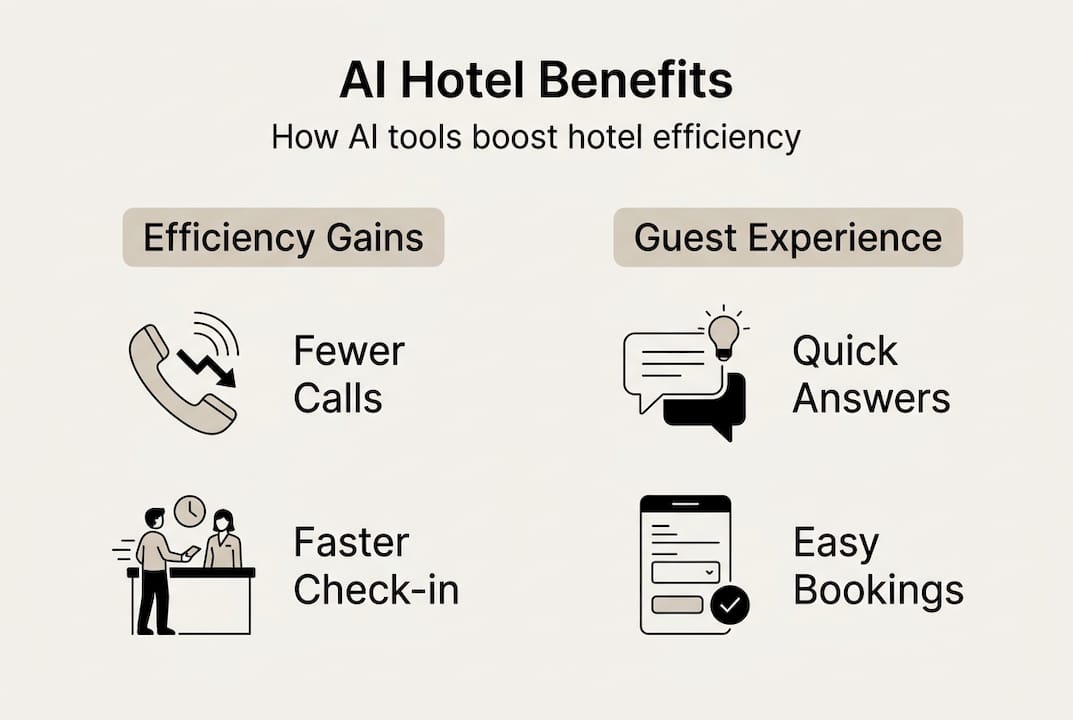
Perhaps the most compelling fact is that AI can handle up to 70% of guest queries without any human intervention. That’s a substantial reduction in the volume of calls and messages your team needs to manage manually. It means your staff can redirect their energy towards creating memorable in-person experiences rather than answering the same questions repeatedly.
Voice AI for hotels takes this further by enabling natural, conversational phone interactions. A guest calling at midnight to ask about early check-in gets a clear, friendly answer immediately, without waking anyone up. That’s the kind of reliability that builds loyalty.
AI-driven guest support also learns over time. The more interactions it handles, the better it becomes at recognising patterns, anticipating needs, and delivering relevant responses. It’s not a static tool. It evolves with your guests’ behaviour.
Key features and types of AI guest support tools
Now you understand the basic concept, let’s explore the features and types of AI guest support solutions available to small hotel owners.
The three primary categories are:
| Tool type | Best for | Key strength |
|---|---|---|
| Chatbot | Website and messaging enquiries | Instant text responses, 24/7 availability |
| Voice agent | Phone calls and reservations | Natural conversation, call handling |
| AI guest app | In-stay communication | Self-service requests, upselling |
Each serves a distinct purpose, and the most effective approach is to combine them. Here are the core features to look for when evaluating any AI for hotel customer service solution:
- Instant messaging across web, WhatsApp, and email channels
- Multilingual support to cater for international guests
- Self-service booking with real-time availability and confirmation
- Local information delivery covering restaurants, transport, and attractions
- Integration with your property management system (PMS) for seamless data flow
PMS integration is particularly important. When your AI tools connect directly to your booking and operations software, updates happen automatically. A guest changing their arrival time triggers an instant notification to housekeeping without anyone lifting a finger.
Research shows that AI voice agents boost satisfaction scores by up to 25%. That’s a measurable, meaningful improvement that directly influences reviews and repeat bookings.

Exploring AI automation solutions can also reveal opportunities beyond guest-facing tools, such as automating internal workflows, supplier communications, and reporting.
Pro Tip: Don’t try to implement every tool at once. Start with the channel your guests use most, whether that’s phone or web chat, and expand from there once you’re confident in the results.
Real-world benefits for small UK hotels
With the features in mind, it’s essential to see how these tools actually perform for businesses like yours.
The operational improvements are tangible and fast. Here’s a snapshot of what small hotels typically experience after adopting AI-driven guest support:
| Metric | Before AI | After AI |
|---|---|---|
| Missed calls per week | 15 to 20 | Under 3 |
| Admin hours per day | 4 to 6 hours | 1 to 2 hours |
| Guest satisfaction score | 7.2 / 10 | 8.9 / 10 |
| Upsell conversion rate | 4% | 11% |
These aren’t theoretical figures. A real-world example from our own work shows a boutique hotel reduced admin by 60% after implementing AI booking and email nurture workflows. That’s hours returned to the team every single day.
The benefits go beyond time savings:
- Fewer booking errors because AI systems verify details automatically
- Reduced missed calls as voice agents handle overflow during peak periods
- Higher upsell rates because AI can suggest room upgrades and dining packages at the right moment
- Improved online reviews driven by faster, more consistent guest communication
- Lower staff stress as repetitive admin tasks are removed from their workload
60% reduction in admin time. That’s what one boutique hotel achieved in its first quarter with AI booking and email automation.
For small hotels operating with lean teams, these gains are transformative. When your receptionist isn’t fielding the same five questions all morning, they’re free to greet arriving guests warmly, handle complex requests thoughtfully, and deliver the kind of personal service that earns five-star reviews.
The efficiency gains for SMEs using AI are well documented, and hospitality is one of the sectors seeing the strongest returns. The combination of 24/7 availability, instant responses, and intelligent automation creates a compounding effect on both guest satisfaction and profitability.
Barriers, practical steps, and tips for adoption
Benefits are promising, but how do you actually get started and avoid common mistakes?
The three most common barriers small hotel owners face are:
- Budget concerns: Worry that AI tools are too expensive for a small operation
- Lack of technical expertise: Uncertainty about how to set up and manage AI systems
- Staff resistance: Fear among team members that AI will replace their roles
All three are understandable, and all three are manageable. Up to 84% of small UK hotels are now considering digital transformation a top priority, which means the tools, support, and expertise available have never been better.
Here’s a practical step-by-step approach to getting started:
- Audit your current guest touchpoints. Identify where enquiries come in, where delays happen, and where staff time is most consumed.
- Choose one tool to start with. A voice agent or website chatbot is a low-risk entry point with fast, measurable results.
- Work with a specialist provider. Look for an agency that understands hospitality and offers onboarding support, not just software.
- Train your team. Position AI as a support tool, not a replacement. Show staff how it reduces their workload rather than threatening their roles.
- Measure and iterate. Track key metrics from week one: response times, missed calls, guest satisfaction scores, and booking conversion rates.
- Scale gradually. Once one tool is performing well, add complementary solutions to build a connected guest support system.
The guide to AI management is a useful resource for understanding how to structure this process, and the AI answering service guide offers specific advice for UK small businesses handling inbound calls.
“The biggest mistake is waiting for the perfect moment. Start small, learn fast, and build from real results.”
Pro Tip: Choose AI solutions that integrate with your existing PMS from day one. Retrofitting integrations later is costly and disruptive. Compatibility should be a non-negotiable requirement in your selection process.
Futureproofing matters too. Select scalable platforms that grow with your business, and pay attention to the data your AI tools generate. Guest behaviour patterns, peak enquiry times, and common questions are all insights that can inform your wider business strategy.
Rethinking guest support: why the personal touch isn’t lost to AI
Let’s address a concern we hear often: will AI erode the warm, personal hospitality that small British hotels are known for?
Our view is the opposite. AI actually creates more space for genuine human connection. When your team isn’t buried in repetitive admin and missed calls, they have the time and energy to focus on what truly matters: welcoming guests by name, remembering preferences, and going the extra mile.
Personalisation is also enhanced by AI, not diminished. Every interaction your AI tools handle generates data. Over time, you build a richer picture of each guest’s preferences, habits, and expectations. That intelligence feeds back into more thoughtful, tailored service.
The hotels that will thrive are those that use AI agent development to handle the functional, and reserve their human warmth for the meaningful. AI answers the call at 2am. Your team makes breakfast feel like a moment worth remembering. That combination is genuinely powerful.
Take your hotel’s guest support to the next level
If you’re ready to put these ideas into practice, the right partner makes all the difference. At AIM Agency, we specialise in building AI solutions designed specifically for the demands of small hospitality businesses.
Our AI receptionist for hotels answers calls 24/7 in a natural, conversational tone, handles FAQs, and books qualified appointments without any manual input. Combined with our AI call handling service, you get complete coverage across every inbound channel. Whether you’re starting from scratch or looking to upgrade existing tools, explore our full range of AI-driven hotel solutions and see how quickly your operation can transform.
Frequently asked questions
Can AI guest support replace my hotel’s front desk staff?
AI guest support automates routine enquiries but works best alongside staff, freeing them to focus on personalised guest service. AI-driven systems reduce manual workload while enhancing the overall guest experience rather than replacing the human element.
Is AI guest support expensive for small hotels?
Modern AI tools are scalable and increasingly affordable, making them accessible for small hotels with limited budgets. AI solutions suit all business sizes thanks to cloud-based delivery models that remove the need for costly infrastructure.
How quickly can a hotel see benefits from adopting AI guest support?
Many hotels see operational improvements and guest feedback gains within a few months of implementation. Boutique hotels reported 60% less admin within the first quarter of adopting AI booking and email automation.
What support do AI providers offer for onboarding and staff training?
Most reputable providers offer thorough onboarding, tutorials, and ongoing support to ensure a smooth transition for your team. Professional AI agencies provide both initial set-up guidance and follow-up training to build staff confidence quickly.
Recommended
- Enhance guest experience with AI in UK hotels 2026 – AI Management Agency
- Boost sales with AI: a 2026 guide for small UK hotels – AI Management Agency
- Examples of AI in guest communication for UK hotels 2026 – AI Management Agency
- 6 Ways to Use AI in Customer Service List for Hotels – AI Management Agency