TL;DR:
- Missed calls at hospitality businesses lead to lost bookings and customer frustration. Call automation with AI handles 30% more bookings, provides 24/7 support, and improves operational efficiency. Regular review and update of scripts ensure ongoing success, turning automation into a valuable long-term operational habit.
Every missed call at your hotel, restaurant, or bed and breakfast is a potential booking walking straight to your competitor. Research confirms that AI agents can handle 30% more bookings for UK hospitality businesses, yet thousands of small operators still rely on a single member of staff juggling the phone alongside a dozen other tasks. The result is unanswered calls, slow responses, and frustrated customers who simply move on. Call automation changes this entirely, giving you 24/7 coverage, consistent service, and more time to focus on what really matters: running a great hospitality business.
Table of Contents
- Understanding call automation for small businesses
- What you need to automate calls: Tools, requirements and setup essentials
- Step-by-step: How to automate calls in your business
- Common mistakes and troubleshooting tips
- What to expect: Measuring success and maximising impact
- What most guides miss about making call automation work for UK small businesses
- Ready to streamline your calls? Next steps with AI Management Agency
- Frequently asked questions
Key Takeaways
| Point | Details |
|---|---|
| Manual call handling risks | Relying on live staff for every call can lead to missed revenue and dissatisfied customers. |
| Simple prerequisites | Most UK businesses only need phone access, the right software, and basic team training to automate calls. |
| Major efficiency gains | Automation can boost bookings by 30% and cut admin by 60% for hospitality firms. |
| Continuous improvement | Regularly updating scripts and reviewing performance ensures your automation stays effective. |
| Accessible next steps | Specialist agencies help you automate calls quickly and deliver measurable results. |
Understanding call automation for small businesses
Call automation refers to technology that handles incoming and outgoing telephone interactions without requiring a human to pick up the phone manually. At its most advanced, this means an AI Voice Agent, a system that speaks naturally, recognises caller intent, answers questions, and takes action such as confirming a table booking or scheduling a guest check-in call.
For UK small businesses, particularly those in hospitality, the practical applications are immediate and significant. You can automate:
- Reservation and booking calls for restaurants, hotels, and event spaces
- Frequently asked questions such as opening hours, parking availability, menu options, and pricing
- Appointment scheduling for spa treatments, consultations, and group bookings
- Order handling for takeaway and delivery enquiries
- Out-of-hours call management to capture leads when your team is off the clock
The numbers speak for themselves. Focusing on improving customer calls through automation consistently produces measurable results for small operators in months, not years.
Manual answering vs. automated call handling
| Feature | Manual answering | Automated call handling |
|---|---|---|
| Response speed | Dependent on staff availability | Instant, every time |
| Out-of-hours support | Limited or unavailable | 24/7, including weekends |
| Accuracy of information | Variable by staff member | Consistent and standardised |
| Booking system integration | Manual entry required | Direct, real-time sync |
| Scalability during peak periods | Strained and unreliable | Handles volume spikes easily |
| Cost per call handled | High (staff time) | Low, once system is live |
Immediate wins small businesses report after automating calls
- No more missed calls during busy service times
- Guests receive accurate answers regardless of which “staff member” answers
- Bookings confirmed instantly, even at 11pm
- Reception staff freed up to focus on in-person guest experience
- Reduction in no-shows thanks to automated reminders built into call flows
The shift from manual to automated is not just about efficiency. It is about creating a consistently professional impression every time a customer contacts your business.
What you need to automate calls: Tools, requirements and setup essentials
With an understanding of the benefits, here’s exactly what you’ll need to set up automated calls in your business.
Getting started does not require a complete technology overhaul. Most UK small hospitality businesses already have the infrastructure needed. What matters is ensuring the right pieces are in place before you begin.
Essential requirements at a glance
| Requirement | Details |
|---|---|
| Stable broadband connection | Minimum 10 Mbps recommended for reliable VoIP-based systems |
| Compatible phone line | VoIP or cloud phone system (traditional landlines may need porting) |
| Cloud-based call software | AI call automation platform with natural language processing |
| Booking/calendar integration | API connection to your reservations or CRM system |
| Staff training time | Half a day to one day for core team orientation |
| GDPR-compliant data handling | Call data stored and processed in line with UK data protection law |
Using AI receptionists for restaurants and hotels means you can automate call answer and appointment setting without significant upfront hardware investment. The setup is predominantly cloud-based, which makes it fast to deploy and easy to adjust.
Top features to look for in call automation software
- Natural language processing (NLP): The system should understand varied phrasing, not just scripted commands
- Seamless booking integration: Direct sync with platforms like ResDiary, OpenTable, or your hotel’s PMS
- Customisable scripts: Ability to edit FAQs and responses as your business evolves
- Call recording and reporting: Data on call volume, resolution rates, and missed call patterns
- Escalation routing: Option for callers to reach a live team member when needed
- Multi-language support: Useful for businesses welcoming international guests
Pro Tip: Before going live, map your call automation to your existing automated hotel call answering and hotel appointment scheduling automation workflows. If your current booking system supports API connections, integration is typically straightforward and dramatically reduces manual data entry.
Staff buy-in is critical. Involve your front-of-house team early in the process. Explain that automation handles repetitive calls so they can invest more time in delivering exceptional guest experiences. When staff see automation as support rather than replacement, adoption is far smoother.
From a compliance standpoint, ensure your chosen platform processes call data in line with UK GDPR requirements. Callers should be informed they are interacting with an automated system, and any personal data collected must be stored securely. Most reputable UK providers handle this as standard.
Step-by-step: How to automate calls in your business
Once your essentials are in place, it is time to take the practical steps to turn on call automation for your business.
1. Assess your current call volume and call types
Start by reviewing your call logs for the past month. Identify your busiest hours, most common enquiries, and how many calls go unanswered. This baseline is essential for choosing the right system and configuring it correctly from day one.
2. Choose your call automation provider or software
Look for a provider with hospitality-specific experience and proven integrations. Evaluate their demo, check for UK-based support, and confirm GDPR compliance. Ask to see live examples of their AI Voice Agent in action before committing.
3. Integrate with your booking and CRM systems
Work with your provider to connect the automation platform directly to your reservations calendar or customer management system. Real-time integration means bookings are confirmed instantly without any manual entry. Explore AI appointment booking options to see how this works in practice.
4. Test your call flows and FAQ responses
Run through every scenario a caller might present. Test booking requests, cancellations, allergy questions, directions, and pricing queries. Identify gaps and refine your scripts before any customer hears them.
5. Train your team
Walk your staff through what the system does, what it cannot do, and how escalation to a live team member is triggered. Give them access to call reports so they can see how the system is performing.
6. Go live and monitor closely
Start with a soft launch, running automation alongside your existing process for the first week. Monitor call resolution rates daily, gather feedback from staff, and make small script adjustments as needed. A pilot approach reduces risk significantly.
Pro Tip: Record real customer questions from your busiest periods over two weeks before configuring your AI system. This ensures your FAQ library reflects the actual queries your callers ask, not just the ones you expect. Businesses that use real call data to build their initial scripts report significantly fewer escalation failures in the first month.
The results of getting this right are substantial. Automating calls and appointment booking with AI can cut admin by 60% and increase overall efficiency by over 40% in hotel settings. When you consider how many hours your team currently spends on repetitive enquiries, the return on investment becomes very clear very quickly.
Broader AI automation solutions can further extend the value of your initial call automation investment once you are comfortable with the core setup.
Common mistakes and troubleshooting tips
Even the best systems can experience hiccups. Here is how to avoid the most common errors and keep your automation delivering results.
Common mistakes to avoid
- Failing to update call scripts after menu changes, seasonal offers, or policy updates
- Not testing all call routing paths before going live, leaving some callers stuck in loops
- Neglecting staff training so escalated calls are not handled professionally at handoff
- Poor customer communication about the automated system, which can cause confusion and frustration
- Ignoring call reports after launch, missing early indicators of recurring issues
- Setting up automation and never revisiting it, treating it as a one-off task rather than an evolving asset
Warning: Missed calls are a leading cause of lost revenue for small businesses, but poorly configured automation can be just as damaging as no automation at all. If your system routes callers incorrectly or provides outdated information, you risk damaging the very trust you are trying to build. Always have a live escalation option available, and review your system monthly during the first quarter.
Troubleshooting tips when automation underperforms
- Calls not connecting correctly: Check your VoIP settings and confirm the correct number is routed to your automation platform
- AI misunderstanding caller intent: Review call transcripts and add missed phrases or synonyms to your FAQ triggers
- Bookings not syncing: Verify API credentials and re-authenticate your booking system integration
- High escalation rate: Indicates gaps in your FAQ coverage. Pull the most common escalation reasons and add them to your scripts
- Caller drop-offs at specific points: Listen to recordings of those moments to identify confusing prompts or slow system response times
Staying proactive about these checks is what separates businesses that thrive with automation from those that abandon it after a difficult first month. Review and adapt. That is the mindset that makes call automation a long-term asset. Incorporating AI sales automation principles into your broader approach can also sharpen how you handle outbound follow-ups alongside your inbound call workflows.
What to expect: Measuring success and maximising impact
To keep making the most of your investment, measure performance consistently and improve how you use your call automation tools over time.
Key performance indicators to track
| KPI | Before automation | Target after automation |
|---|---|---|
| Missed call rate | Baseline from call logs | Reduce by 80% or more |
| Bookings handled per week | Current manual total | Increase by up to 30% |
| Admin time spent on calls | Hours per week | Reduce by up to 60% |
| Customer satisfaction score | Pre-automation survey | Measurable improvement within 60 days |
| Call resolution rate | Estimated from staff feedback | 85%+ resolved without escalation |
| Out-of-hours bookings captured | Near zero (manual) | Significant new revenue stream |
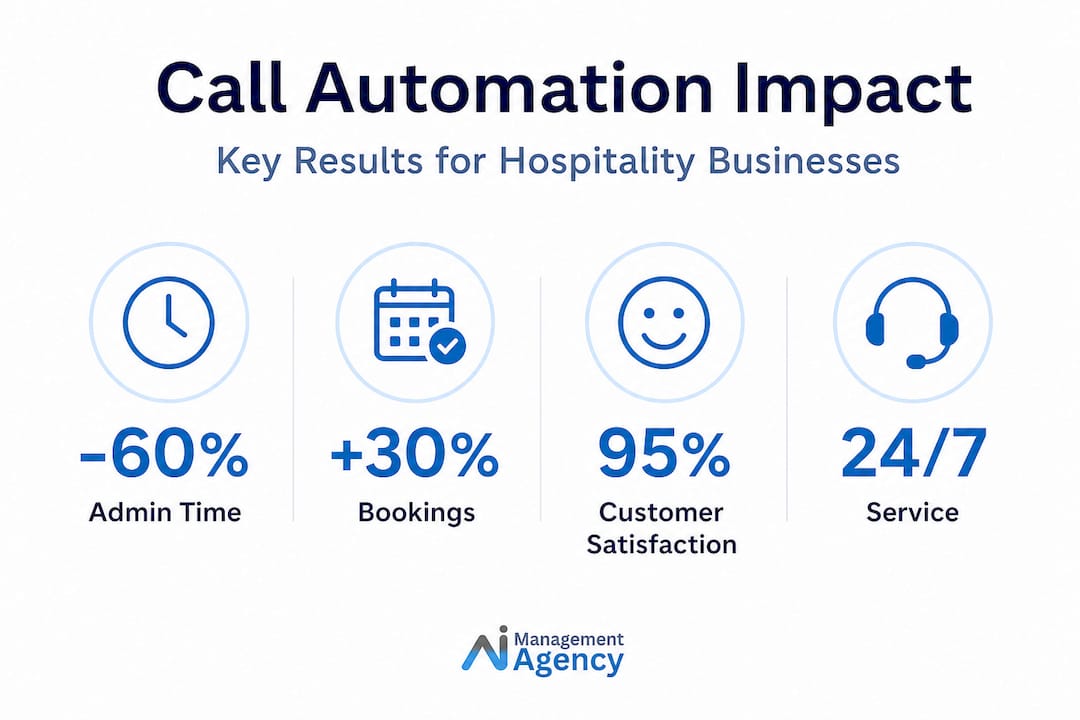
The data from UK hospitality businesses using AI automation is consistent: AI automation can increase bookings by up to 30% and reduce admin by 60%. For a small restaurant taking 200 calls per week, that could mean 60 additional confirmed bookings with a fraction of the staff effort currently required.
To gather customer feedback effectively, consider a brief post-call SMS survey. Keep it to one or two questions. “Was your query resolved today?” and “How would you rate your experience?” are enough to surface issues quickly and demonstrate to customers that you value their input.
Reviewing your automation settings quarterly is the minimum recommended practice. Seasonal menu changes, new services, updated pricing, and shifting guest expectations all require your call scripts to evolve. Think of your AI Voice Agent as a team member who needs regular briefings, not a machine you switch on once.
As confidence grows, consider extending automation to adjacent processes. Payment confirmation calls, pre-arrival reminders, post-stay follow-ups, and loyalty programme communications are all natural next steps. See how a structured approach transforms outcomes in this AI receptionist case study, which demonstrates the power of consistent, automated communication workflows.
What most guides miss about making call automation work for UK small businesses
Most guides give you the steps. Very few tell you the truth about what actually determines long-term success.
Here is the insight that separates businesses that genuinely transform their operations from those that feel disappointed six months in: automation is not a technology project. It is an operational habit.
The businesses that consistently win with call automation are not the ones with the most sophisticated setup. They are the ones that treat their AI Voice Agent as a living part of their team. They review call transcripts every few weeks. They add new FAQ responses after every busy period. They hold a brief quarterly meeting specifically to update call scripts based on what their customers have actually been asking about.
Contrast this with the ‘set-and-forget’ approach. A small hotel in a competitive UK city installs call automation, configures it based on assumptions about what guests ask, and leaves it running for six months without a single review. By month three, the system is quoting outdated room rates, referring to a restaurant that has changed its menu entirely, and failing to mention a new early check-in service. Guest satisfaction scores dip. Staff blame the technology. The system gets switched off.
That outcome was not the technology’s failure. It was a process failure.
The most important thing you can do after going live is to assign ownership. One person, or one small team, should be responsible for reviewing automation performance and keeping scripts current. This does not require technical expertise. It requires attention and a commitment to continuous improvement.
There is also a deeper point worth making. AI automation is most powerful when it reflects genuine hospitality values, warmth, accuracy, and helpfulness. Scripting your AI Voice Agent to sound natural, knowledgeable, and genuinely helpful requires the same care you would invest in training a new receptionist. Explore advanced AI automation approaches to understand how sophisticated, personalised AI interactions can be when built with this philosophy in mind.
Ready to streamline your calls? Next steps with AI Management Agency
If you are ready to stop missing bookings and give your customers a genuinely world-class experience around the clock, the next step is straightforward.
AI Management Agency specialises in building high-quality AI agents for UK small businesses, including hospitality operators who want to automate calls, handle bookings, and respond to customer enquiries 24/7 without adding headcount. Whether you run a restaurant and need an AI receptionist for restaurants, a hotel seeking full hotel call automation, or want to understand the full capability of a high-performing AI voice agent, there is a tailored solution ready to fit your business. Book a free consultation today to see exactly how automation can work in your operation.
Frequently asked questions
Can I automate calls without replacing my staff?
Yes. Automation tools handle routine and repetitive calls so your team can focus on high-value interactions and face-to-face guest service, with no reduction in headcount required.
How quickly can I set up call automation for my business?
Most UK small businesses can be fully operational within a few days once requirements are confirmed, integrations are tested, and the system is configured to their specific call types and FAQs.
Will call automation work with my existing booking system?
Most modern AI call solutions integrate with popular booking and calendar platforms used across UK hospitality, including hotel property management systems and restaurant reservation tools.
What results can I expect from automating calls in hospitality?
You can expect up to 30% more bookings and up to 60% reduction in admin time once your call automation is live and optimised, based on results seen across UK restaurant and hotel settings.
What happens if a caller needs to speak to a real person?
A well-configured AI Voice Agent includes clear escalation options, routing callers to a live team member when their query falls outside the automated system’s scope or when they simply prefer human assistance.
Recommended
- Automate call answering to streamline your hotel – AI Management Agency
- How to improve customer calls for small UK businesses – AI Management Agency
- Stop Wasting Time on Manual Outreach: Try These 7 AI Sales Automation Hacks – AI Management Agency
- Aimagency: AI-Driven Solutions for Sales & Marketing Growth in 2026